An orthodox stance in boxing is the standard fighting position where the left foot and left hand lead toward the opponent and the right side stays in the rear. That rear position loads the rotation behind your strongest punch, which is why the cross hits harder than anything else you own.
Around 90% of boxers fight this way, so when a coach says “get in your stance,” they almost always mean this one. Left-handed fighters can stand orthodox too, which is how Mike Tyson built his whole game. This guide covers what the stance is, how to build it, why coaches push it, and where beginners get it wrong.
Table of Contents
- What Is an Orthodox Stance in Boxing?
- How Is an Orthodox Boxing Stance Built?
- Feet, Weight, and Balance
- Why Do Boxers Stand Orthodox?
- Orthodox Stance vs. Southpaw Stance
- How the Orthodox Stance Connects to Punching and Defense
- How to Adopt an Orthodox Stance Safely
- Common Orthodox Stance Mistakes and How to Fix Them
- Frequently Asked Questions
- Conclusion
What Is an Orthodox Stance in Boxing?
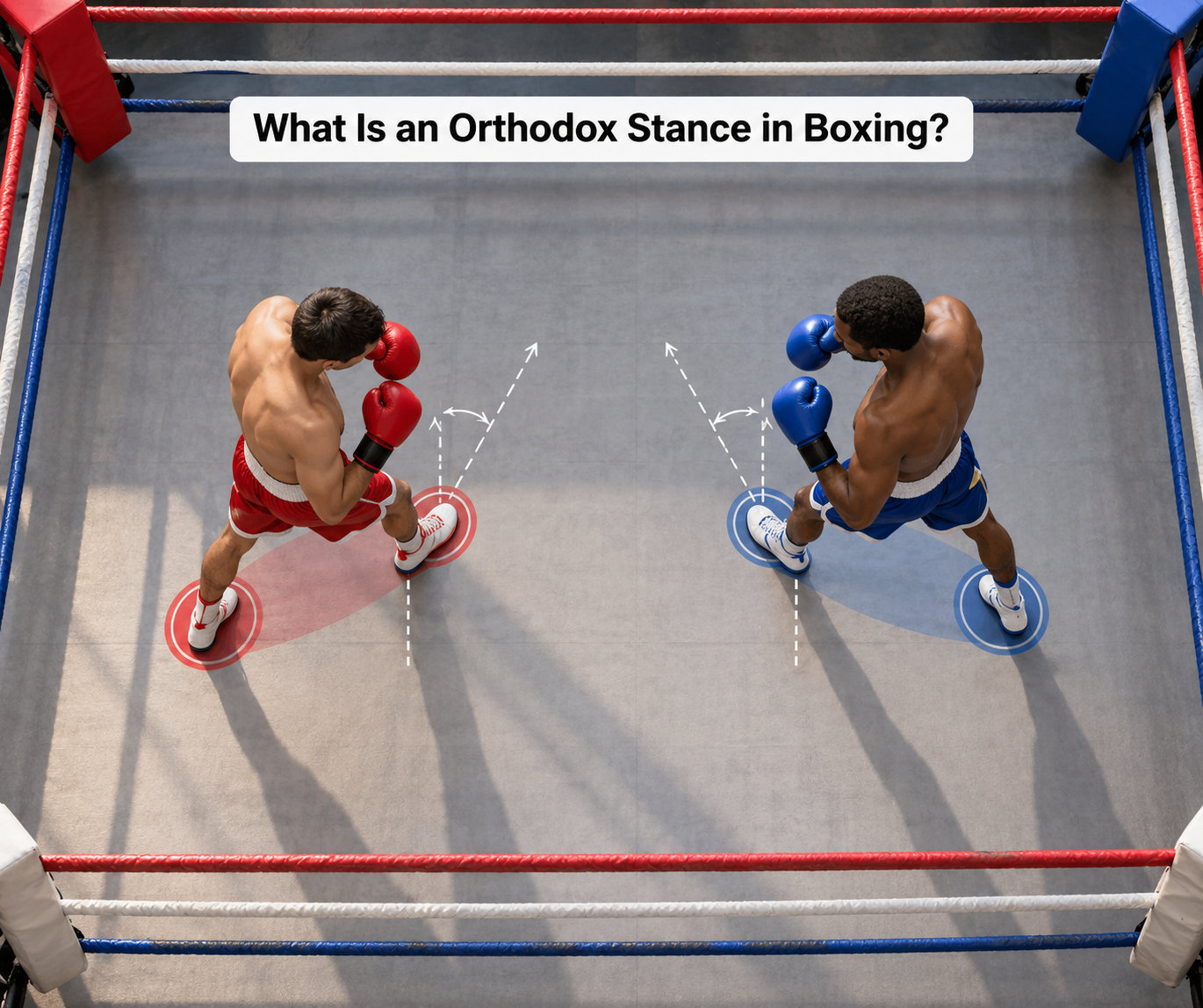
The word “orthodox” simply means the conventional version. In boxing it means the lead foot and lead hand are on the left, with the right side in the rear, whether or not right is your dominant hand.
Left-handed boxers who stand orthodox are common enough to have their own category. Tyson, Sonny Liston, Oscar De La Hoya and Miguel Cotto all fought orthodox despite being lefties, because the rear position suits their power hand in a way most left-handers never bothered to change.
One thing worth getting straight early: orthodox fighters are not automatically more likely to win. A study cited on the topic (Sorokowski and colleagues, published in Anthropological Review) found that fighters of either stance are more likely to beat an orthodox opponent than a southpaw one, but that an orthodox boxer does not carry a built-in win rate advantage. What orthodox buys you is familiarity, and familiarity is mostly about the other 90% of fighters already being used to fighting you.
How Is an Orthodox Boxing Stance Built?
Build it from the floor up. Feet first, then knees, then hands, and the rest of the guard follows from those three decisions.
Setting Your Feet
- Width. A little more than shoulder width, roughly 27 inches from heel to heel for most people. One coach’s rule of thumb: better a bit too wide than a bit too narrow, because narrow is the one that gets you pushed off balance.
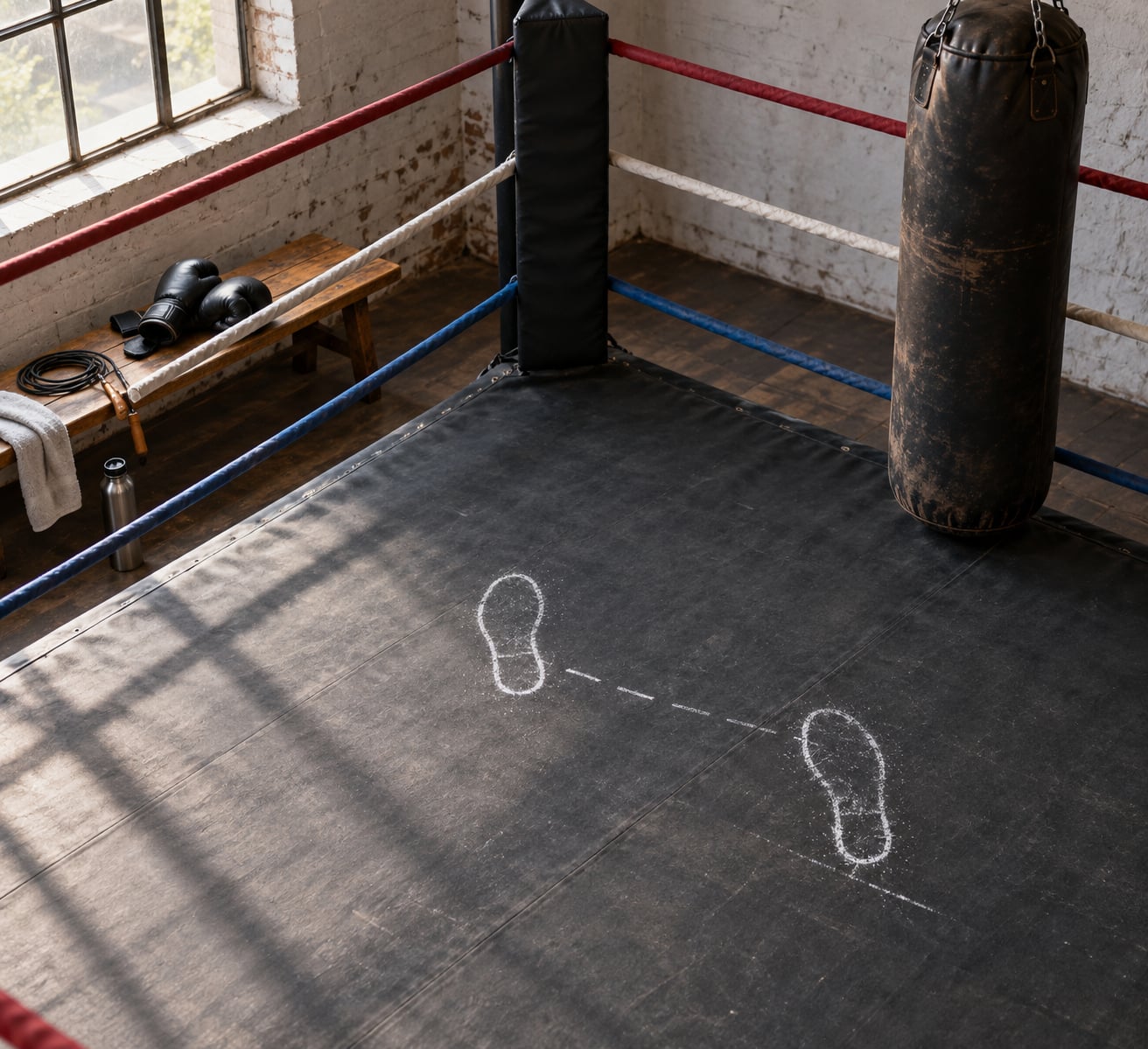
- Lead foot angle. Turn the left foot outward about 45 degrees. Picture your opponent at 12 o’clock on a clock face and put your lead foot anywhere from 1 to 2 o’clock. One o’clock is the minimum, 2 o’clock is the ideal.
- Rear foot angle. The right foot sits roughly between 4 and 5 o’clock, angled about 45 degrees in the opposite direction so your heels sit roughly on one diagonal line.
- Heels. Both heels stay slightly off the canvas, about 1 to 2 cm at the front and 3 to 4 cm at the back. Keeping them off the floor is what makes bouncing and circling possible.
- Knees. Bent and loose, like balancing on a skateboard rather than sitting into a squat. Deep tension in the knees kills your ability to move.
Setting Your Guard and Hands
Both fists sit at cheekbone level, elbows down and in, hands close enough that your forearms are roughly vertical. Your chin tucks behind the lead shoulder and stays below your hands rather than floating between them.
Many coaches ask for a 30 to 40 degree turn of the rear shoulder away from the opponent. That bladed angle keeps your chin out of line with a straight punch and puts your body behind the glove instead of behind your spine.
| Stance point | Where it goes |
|---|---|
| Feet | A little more than shoulder width, about 27 inches heel to heel |
| Lead foot | Left, turned out 45 degrees, at 1 to 2 o’clock |
| Rear foot | Right, at 4 to 5 o’clock, heel lifted more than the lead heel |
| Knees | Bent and springy, not locked |
| Hands | Both fists at cheekbone level, elbows tucked |
| Chin | Tucked behind the lead shoulder and below the hands |
| Rear shoulder | Turned out roughly 30 to 40 degrees |
| Weight | Evenly balanced, mostly on the balls of the feet |
Feet, Weight, and Balance
Balance in the orthodox stance lives on the balls of your feet. When you get tired and your heels drop, you turn into a slower, heavier boxer who gets walked backward and gives up angles.
The two legs do different jobs. The lead leg steers. It takes small steps, checks distance and pushes you out of range. The rear leg supplies power, and its job is to stay connected to your hips so a punch starts from the floor instead of the arm.
Weight sits around 50/50 rather than over the front foot. Plenty of beginners land their first few sparring sessions front-heavy because they are leaning toward what they want to hit, and a front-heavy boxer gets pushed off line with one jab.
A useful self-check: your nose should not go past the line of your front knee. If it does, you are bent over your lead leg. Coaches also draw a toe-to-heel line from the big toe of the rear foot through the heel of the lead foot, which tells you at a glance whether the feet sit on the same diagonal.
Why Do Boxers Stand Orthodox?
Four reasons come up constantly. First, the lead jab. Standing left foot forward puts your lead hand right next to your opponent’s lead shoulder, so the jab lands without travelling and it is the punch you use to set up everything else.
Second, power. Because your dominant hand sits in the rear, it has more time and more room to rotate into the cross. The rear foot pushes, the hip turns, the shoulder follows and the fist arrives already moving. That chain is why the cross is the biggest punch in the stance.
Third, combination options. From orthodox you can throw jab, cross, lead hook and lead uppercut in sequence without changing your base, and the straight punches stay on the same line as your feet.
Fourth, it is what everybody else does. Fighters spend thousands of hours sparring against orthodox boxers, so a stance that is strange to them is a stance that creates openings for you.
The convention also shows up outside the ring. Conor McGregor fights southpaw in MMA, which is where a lot of the “is McGregor southpaw” searching comes from, but orthodox is the default in boxing gyms almost everywhere.
Orthodox Stance vs. Southpaw Stance
Southpaw is the mirror image: left-handed boxers put the right foot and right hand forward. Beyond that flip, the difference shows up in angles. A southpaw’s rear left cross comes forward down your open side and lands behind your lead hand, which is why so many orthodox fighters need practice with that punch.
Neither stance wins on paper. What changes is the timing. In an orthodox versus southpaw matchup, the southpaw is often the more comfortable fighter because they are the rarer opponent, and the orthodox boxer usually has to adjust their usual lines.
| Detail | Orthodox | Southpaw |
|---|---|---|
| Lead foot | Left, at 1 to 2 o’clock | Right, at 1 to 2 o’clock |
| Lead hand | Left, for the jab | Right, for the jab |
| Power hand | Right, in the rear | Left, in the rear |
| Biggest punch | Rear right cross | Rear left cross |
| Opponent’s main risk | Southpaw rear cross down the open side | Orthodox rear cross down the open side |
| Share of boxers | About 90% | About 10% |
| Notable exponents | Ali, Mayweather, Sugar Ray Robinson, Tyson (left-handed) | Crawford, Lomachenko, Hagler, Usyk when he chooses it |
How the Orthodox Stance Connects to Punching and Defense
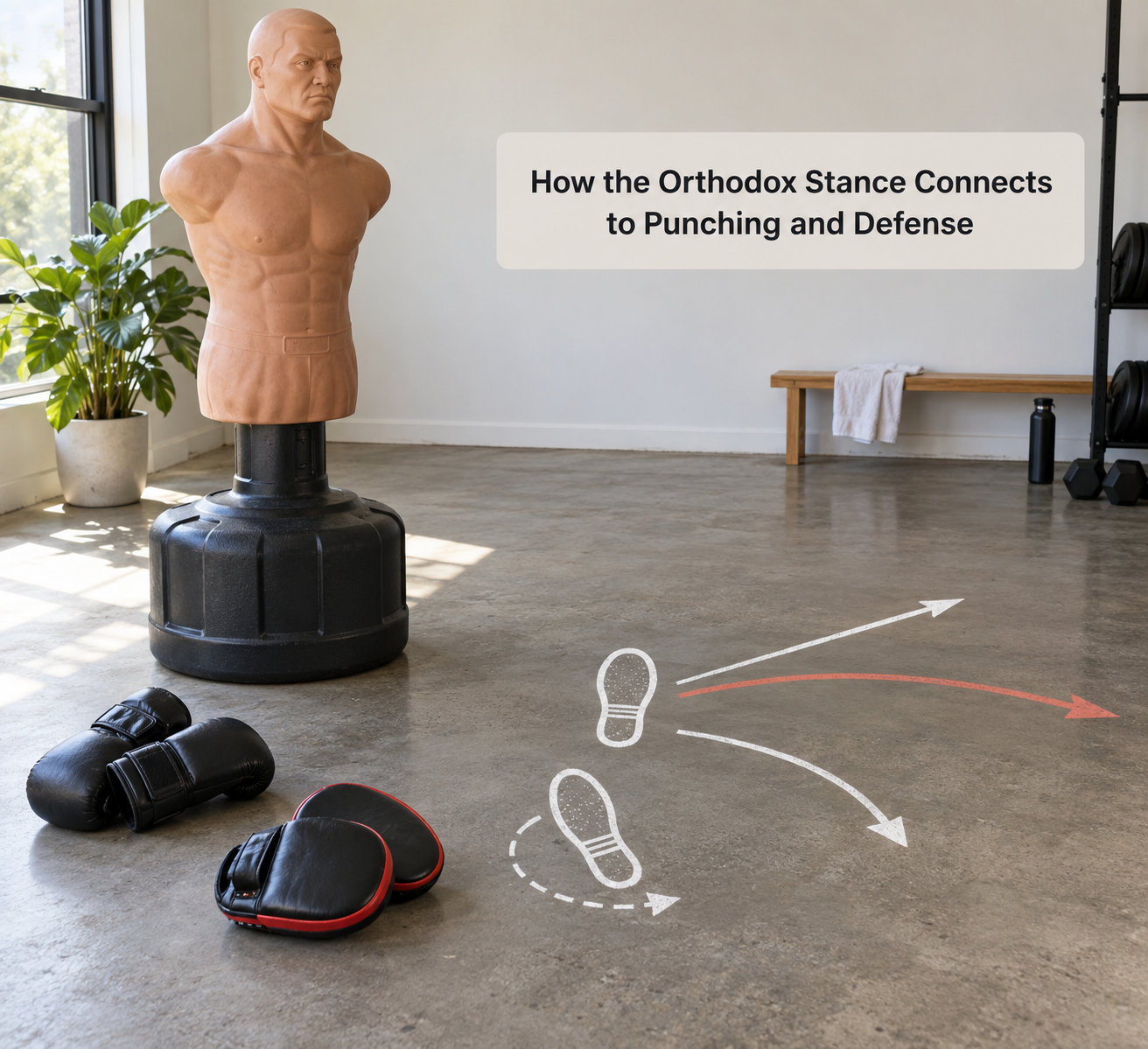
Every punch in the stance starts at the floor. In a jab-cross combination, the jab leaves from the lead shoulder and the rear hand fires as the rear foot pushes forward and the hips turn, usually 30 to 40 degrees for a straight cross and closer to 90 for a hook.
The lead hook works differently. Your lead foot pivots as the fist comes around, which is why the foot turn matters so much, and that same pivot is how you slip a straight punch or roll under one.
Defense runs on the same coordinates. Pushing off the rear leg moves you out of range, pushing off the lead leg angles you away, and pivoting the rear foot on your lead heel lets you spin out of range without crossing your feet.
The mistake that breaks all of it is crossing the legs while you move. If your feet swap sides, your stance is gone until you set it again, and that reset is where punches land.
How to Adopt an Orthodox Stance Safely
Take the first few weeks slowly. The stance is a skill, not a switch, and forcing it while fatigued is how people end up with sore knees and a bad habit.
- Warm up first. Ten minutes of movement, some shadow swings and light footwork. Skipping this is how a first session turns into a tweaked ankle.
- Shadowbox in place. Hold the stance and move without punching for a few minutes at a time. Bounce, circle, step in and out. Nothing fancy.
- Check with a mirror or your phone. Film ten seconds from the side and from the front. Most people find the lead foot is squarer than they thought, or the rear heel is flat.
- Rehearse the guard. Now add the hands at cheekbone level and work the jab-cross slowly, checking the nose-past-the-knee line as you go.
- Add pads or a bag. Only once the shape holds up for a full round. Speed comes later.
- Have a coach look at it. One glance from someone experienced beats a month of guessing, and beginner forums show how many people get stuck fixating on angles that do not matter much.
If you feel sharp pain, numbness or dizziness, stop and get it checked rather than pushing through. Boxing is a contact sport and this is general information about footwork and positioning, not individual training advice.
Common Orthodox Stance Mistakes and How to Fix Them
- Standing bolt upright. Fix: bend the knees, sit slightly back onto the heels, keep the chest up.
- Feet too close together. Fix: widen to a little more than shoulder width and check it once against a tape measure.
- Feet too wide. Fix: bring them in a few inches. Over-wide is better than narrow but it still slows you down.
- Lead foot turned too far inward. Fix: bring it back toward 1 or 2 o’clock. Pointing the toe at the opponent makes your lead hook and your forward movement both worse.
- Square shoulders. Fix: turn the rear shoulder out 30 to 40 degrees and keep the chin behind the lead shoulder.
- Dropped lead hand. Fix: bring the left fist back up to cheekbone level, elbows down.
- Rear elbow drifting away from the ribs. Fix: bring it in. A wide rear elbow opens the body to a straight punch and gives away the gap you want for the cross.
- Heels flat, knees locked. Fix: lift the heels and soften the knees. Loose knees, like skateboarding, not a quarter squat.
- Front-heavy weight. Fix: check the balance between your feet, then step forward with the lead leg instead of leaning onto it.
- Moving without the hips. Fix: power every punch from the floor and let the hips lead the shoulders.
Two of those deserve a caveat. Going squarer at close range is a deliberate choice for power, not a fault, and stance width genuinely changes across a round as you settle into your rhythm. Forum beginners often get told to stop trying to switch stances before they have mastered the standard guard, and that advice is sound.
Frequently Asked Questions
Does an orthodox stance always mean the left foot is forward?
Yes, in nearly every case. Orthodox means the left foot and left hand lead forward, with the right side in the rear. Left-handed boxers who stand orthodox, including Mike Tyson and Sonny Liston, do it deliberately so their power hand starts from the back. The handful of neutral or squared stances exist, but they are exceptions rather than the rule.
Is it better to fight orthodox or southpaw?
Neither is better in the abstract. About 90% of boxers fight orthodox, so an orthodox fighter is used to sparring against that stance, while a southpaw is used to facing the uncommon case. Research cited on the topic finds fighters of either stance are more likely to beat an orthodox opponent, but orthodox boxers do not carry an inherent win rate advantage. Pick the one you can make your own.
Can a boxer switch from orthodox to southpaw?
Yes, and several elite fighters have done it, including Terence Crawford, Vasiliy Lomachenko and Oleksandr Usyk. It takes months of dedicated work to make a new stance automatic, and most academies tell beginners to master one stance before touching the other. If you are new, learning what an orthodox stance in boxing feels like first is the better use of your time.
How wide should my feet be in an orthodox boxing stance?
A little more than shoulder width, which works out at roughly 27 inches from heel to heel for most adults. Wide is safer than narrow, because a narrow stance gets pushed off balance easily, but going far wider slows you down. Check it once, then stop measuring. Stance width also shifts a little across a round as you settle into your rhythm.
Why is the orthodox stance used in MMA as well as boxing?
Because it is the default across most striking disciplines, so coaches teach it once and it transfers. In MMA it also gives you a rear leg for kicking power and a stable base for wrestling entries and takedown defence. Conor McGregor fights southpaw, which is one reason questions about his stance show up so often in boxing searches.
Conclusion
An orthodox stance is a coordinated platform, not a fixed pose. Feet angled and knees loose give you balance, hands at cheekbone level give you a guard, and a bladed rear shoulder lets the hip and rear foot do the work your arm cannot.
Start by setting your feet roughly 27 inches apart, turning the lead foot out to about 45 degrees, and bouncing gently on the balls of both feet with your hands up. Shadowbox that for a week, get one pair of eyes from a coach on it, then add pads.