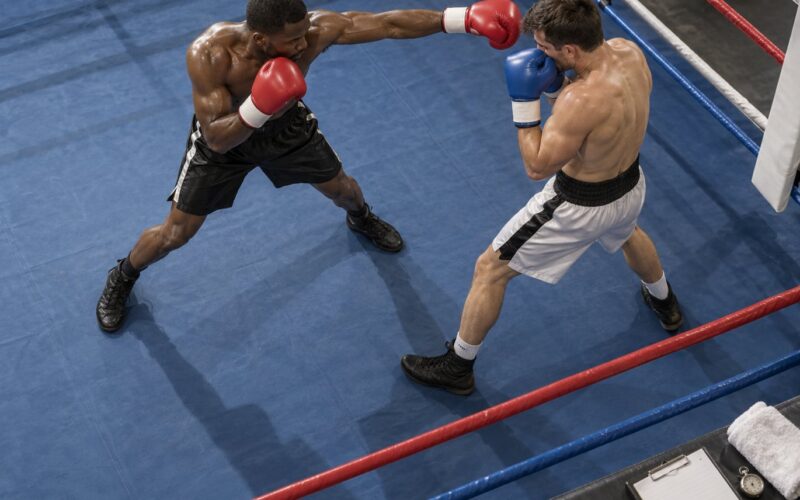
Searchers keep asking why boxers are counted out standing up, and the honest answer is that the count belongs to the referee, not to a clock. Reaching your feet satisfies the count; it does not clear you to fight on. Once a fighter is up, the referee decides whether he can intelligently defend himself, and that decision can end the bout on the spot.
That is the part that confuses people watching at home. A fighter takes a hooking shot, wobbles, gets counted to three or four while still on his feet, and then the action either continues or the referee waves his arms and the fight is over. Nothing about the picture looks like a knockout.
This guide walks through what the count actually measures, what a referee is looking at, and why the standing eight count and the mandatory eight count are two different things with two different histories.
Table of Contents
- What Does It Mean When a Boxer Is Counted Out Standing Up?
- Why Does a Referee Start Counting After a Knockdown?
- How Does the Standing Count Work in Professional Boxing?
- What Happens After a Standing Eight or Ten Count?
- Who Decides Whether a Boxer Is Safe to Continue?
- Why Do Standing Counts Sometimes Look Harsh or Strange?
- Do Boxing Rules and Standing Counts Vary by Organization?
- Frequently Asked Questions
- Conclusion
What Does It Mean When a Boxer Is Counted Out Standing Up?
A standing count is an informal assessment a referee gives to a hurt fighter who has never gone to the canvas. It is a number called out loud, usually one to ten, while the referee watches the fighter for signs that he can still compete safely.
Three different things get tangled together here, so keep them apart:
- The knockdown count runs after a fighter goes down. It is the formal ten count, and the one people mean when they say a boxer was counted out.
- The mandatory eight count runs when a fighter is down but rises before the count reaches ten. It exists so the referee can examine an unsteady fighter before action resumes.
- The standing eight count (also called a protection count) runs over a fighter who never went down. It is largely retired in professional boxing but still appears in amateur and some regional circuits.
So the answer to the headline question is simple. A fighter is counted out standing up because the referee is applying judgment, not because a rule says upright fighters get counted to a certain number. If the referee sees a fighter who cannot hold his guard, cannot answer a question, or is walking toward him instead of away, the count stops being a formality and becomes the last thing that happens.
Why Does a Referee Start Counting After a Knockdown?
The count is a safety procedure, not a punishment. Its whole purpose is to give a hurt fighter a window in which he can prove he is able to protect himself before the punching resumes.
There is a practical reason for the pause. A fighter who has just absorbed a heavy shot is not in a condition where the next punch lands any less hard simply because he is upright. The count buys a few seconds of observation and, if a ringside physician is present, time for a quick look.
That protection came about the hard way. Kim Duk-koo died in 1982 after being stopped in a professional bout in Las Vegas, and the attention that followed reshaped how protective counts were handled in the United States. Fans who argue online about whether refs are too quick or too slow are usually arguing about the rules written in the wake of that fight.
How Does the Standing Count Work in Professional Boxing?
It is not a fixed procedure with a script, but the pattern is predictable. The referee moves in close enough to see the fighter’s face, starts calling numbers, and watches. He usually tells the fighter to come to him, sometimes with his arms out, so he can judge whether the fighter is tracking him.
What the referee is looking for, in plain terms:
- Eyes and focus — can the fighter focus, follow a finger or a voice, and hold attention long enough to take instruction?
- Responsiveness — does he answer a question, or does he respond to a gesture only after a delay?
- Balance — does he sway, stumble, or need the ropes to stay upright?
- Hands — can he get his gloves back where they need to be, and will they stay there?
“Intelligently defend themselves” is the phrase in the rulebooks, and hands are the reason it is there. A fighter who rises at eight with his hands down has not satisfied the count in any meaningful sense, even if his legs are under him and he is answering questions correctly.
A count can be stopped at any point. A referee may begin counting, decide mid-count that the fighter is fine, and wave action back in. That flexibility is exactly what makes the procedure controversial.
How Many Counts Can a Boxer Receive While Standing?
There is no universal fixed number for a standing count in modern professional boxing. Some referees use five, some go further, and many begin the count knowing from the first second that it is a formality they will wave off.
The number people remember, ten, belongs to the knockdown count. That is the only count with a defined endpoint in professional boxing, and it comes with a mandatory eight count for a fighter who rises early. Standing counts have no hard ceiling precisely because they are discretionary, and referees are trained to use them as a prompt rather than a countdown.
What Happens After a Standing Eight or Ten Count?
The number that was called matters less than what happens next. There are a handful of realistic outcomes, and they get recorded very differently.
| Outcome | Who decides | How it is recorded |
|---|---|---|
| Fight resumes | Referee | Judged normally; the count affects nothing on the scorecards in professional boxing |
| Fighter’s corner retires the bout | Corner, during a break or at the stool | Retirement, often noted as a corner stoppage |
| Referee waves off in the ring | Referee | Technical knockout if the fighter was standing; knockout if the fighter was down and failed to beat the count |
| Stoppage after action resumed and the fighter was dropped again | Referee | Usually recorded as a knockout or technical knockout depending on how the fight ended |
| Bout declared a no contest | Referee and commission | No contest, typically where a rule violation, disqualification or bout failure stops the fight being scored |
That third row explains most of the confusion. When a fighter is standing and the referee stops the fight, the result goes down as a technical knockout, not a knockout. Fans who remember “he got up and still lost” are usually looking at a TKO and reading it as a KO.
Corners can also throw the towel. Once a fighter has beaten the count, the decision to continue is usually a conversation at the stool rather than a referee’s ruling, and plenty of corners end fights there. A corner that believes its fighter cannot continue will stop the fight regardless of what the count said.
Why Boxers Are Counted Out Standing Up Before Being Sent Back to Their Corner
They usually are not. This is the core misunderstanding behind the question. A fighter who is upright is not normally given a formal eight or ten count in professional boxing; the standing eight count is retired there.
What you are usually watching is the referee starting a count, seeing enough in the first few numbers to be concerned, and stopping the fight on the spot. The fighter never reaches a corner because he never goes back to one.
Where you do see a standing count used as a genuine safety measure, it is in amateur or regional boxing, and it often ends with the referee waving the fighter back to his corner so a trainer can look at him before the round restarts.
Who Decides Whether a Boxer Is Safe to Continue?

The referee, and nobody else, while the fight is in progress. The rulebook gives the referee final authority in the ring, including the authority to end a contest that the fighter, his corner, or the crowd disagrees with.
Other people have influence but not authority. The ringside physician can examine a fighter and can advise that a bout not continue, which carries enormous weight even though the formal call belongs to the referee. A corner can retire its own fighter at any point. The fighter himself can decide he is done, though that decision is usually made badly, which is a large part of why the count exists.
It is worth separating two different jobs that get blurred together. Officiating judgment asks whether a fighter can defend himself competently. Medical assessment asks whether a fighter has sustained a brain injury. A referee is not diagnosing anything, and no one watching the broadcast can see what a ringside doctor sees.
If you are ever weighing whether a stoppage was right, treat head-injury concerns seriously and take advice from a qualified medical professional rather than from a broadcast. A referee waving off a fighter who looks fine is a defensible outcome, not evidence of a mistake.
Why Do Standing Counts Sometimes Look Harsh or Strange?
Because the criteria are physical and hard to fake, which means they are easy to misread on a small screen.
A fighter drifting toward the ropes may not be hurt at all; he may be walking to a corner because he thinks the count is over. A referee who keeps counting there is applying the rule about fighters who cannot intelligently defend themselves, and fans at home see a man standing in front of a referee being counted for no obvious reason.
The other common mismatch is timing. Fighters get up at odd numbers because the count is not a stopwatch. Buster Douglas rose at what is widely reported as roughly 13.5 seconds against Mike Tyson in round eight in 1990, and the extra time looked to a lot of viewers like a gift. Referees simply do not count at a fixed cadence; they slow down when they are unsure and speed up when they are not.
On r/Boxing, the consensus has long been that the count belongs to the referee’s discretion rather than running from the moment the fighter hits the canvas. Ryan Garcia comes up repeatedly in those threads as the example people argue about, a fighter who came up before the count finished and then took more punishment than fans thought he should have.
Hand position is the other thing viewers underrate. A fighter whose gloves drift down mid-count has not defended himself, whatever his legs are doing, and referees notice that long before the crowd does.
Do Boxing Rules and Standing Counts Vary by Organization?
Yes, and the difference is worth knowing about. The Association of Boxing Commissions, the body that coordinates state athletic commissions in the United States, moved to eliminate the standing eight count in 1998. The WBC phased it out separately over the following years, and most state commissions and sanctioning bodies followed, which is why you almost never see one in a modern professional bout.
What remains consistent is the principle underneath it: a fighter who has been hurt and cannot demonstrate he can protect himself should not be expected to absorb more punches.
Amateur and Olympic-style boxing is a different rulebook. There, knockdowns accumulate against a fighter within a round or across a match, and a standing eight count counts toward that total in the jurisdictions that still use one. Rounds are scored on a ten-point must system, so a dominant knockdown round can score 10-8. None of that exists in professional boxing, where a knockdown is not a scoring category at all.
Rules can also shift at state level and by sanctioning body, so if you want the precise answer for a specific bout, the governing rulebook is worth more than any general article, including this one.
Frequently Asked Questions
Must a boxer stand up before the referee stops counting?
No. A referee can begin a count while a fighter is still on the canvas or already upright, and can stop it at any point regardless of the number reached. The count exists so the referee can judge whether the fighter can defend himself, so once that judgment is made the count has done its job. A fighter who is stopped while standing has usually been stopped during the first few numbers, not at ten.
Does a boxer automatically get an eight count while already standing?
Not in professional boxing. The standing eight count, sometimes called a protection count, was eliminated by the Association of Boxing Commissions in 1998 and phased out by most sanctioning bodies afterward. What you see instead is an informal count from the referee with no defined endpoint. The formal eight count you hear about is the mandatory eight, which runs after a knockdown when the fighter rises early.
Why does the referee count a boxer who is against the ropes?
Because a fighter backed into the ropes often cannot see incoming punches or cannot free himself, which the rulebooks treat as the inability to intelligently defend themselves. Referees will also start counting a fighter who has stopped moving his hands, is drifting toward a corner, or is not following instructions. The ropes case looks odd on television because the fighter is fully upright, but position and orientation matter as much as balance.
Can a boxer avoid being counted while standing?
There is nothing a fighter can do to guarantee it, since the count is a referee’s discretion rather than a punishment for anything the fighter controls. What reduces the odds is simply looking defensible: hands up and tracking, feet moving, following the referee’s voice, and answering questions. Fighters who look composed rarely get counted, and those who are drifting, unresponsive or staring usually do. Chasing the action is usually more effective than retreating.
Does a standing count mean a boxer has a concussion?
No, and no one watching a broadcast can tell you that. A count is an officiating judgment about whether a fighter can protect himself in the next few seconds. Diagnosing a concussion is a medical question that belongs to a ringside physician, and it often happens without any visible symptoms at all. Counted out does not mean concussed, and staying upright does not rule it out either. Take any head-injury concern to a doctor, not to a broadcast.
Conclusion
A standing count is a safety and officiating decision, not a fixed punishment with a number attached. Beating the ten count tells you a fighter reached his feet; it does not tell you he can protect himself, and it does not tell you anything about damage already absorbed.
Put simply, why boxers are counted out standing up has less to do with the number being called and more to do with what the referee saw in the first few seconds of it. Next time a fighter is stopped upright, watch the hands first, then the eyes, then the feet. Those are the checks the referee was making, and they explain far more than the number does.