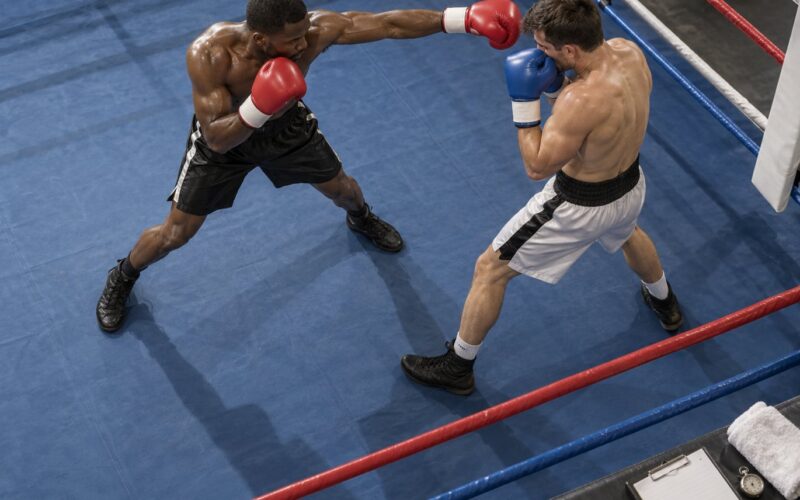
How referees decide to stop a fight comes down to one official’s judgement, backed by the ten count and the ringside physician. A referee must halt a bout when a fighter cannot defend himself, when he is outclassed or absorbing excessive punishment, when he fails to answer the bell, or when the doctor examines him and says he cannot continue. The referee can also stop a fight at any moment, in any round, on good judgment alone.
Last updated: October 2026
That answer hides a lot of subtlety. There is no rulebook clause that says a fighter must have glassy eyes before the count continues. What the manuals actually publish is a list of physical signals, and the referee’s job is to read them in real time, at close range, while a crowd counts with him.
Table of Contents
- How Referees Decide to Stop a Fight
- What Makes a Boxer Unsafe to Continue?
- Why Does a Knockdown Lead to a Count?
- What Happens During a Standing Eight Count?
- How Do Referees Spot a Knockout?
- Can a Referee Stop a Fight Because of a Cut?
- How Do Doctors Influence a Boxing Stoppage?
- What Are Technical Stoppages and No Contests?
- Can a Corner Throw the Towel?
- What Signals Do Referees Watch Beyond Knockdowns?
- Why Do Boxing Rules Allow Referee Discretion?
- Frequently Asked Questions
- Conclusion: What to Watch During a Boxing Stoppage
How Referees Decide to Stop a Fight
The short version: a referee stops a fight for one of a small number of reasons, and each one belongs to somebody specific.
- Knockout (KO) — the fighter is dropped and cannot answer the count of ten.
- Referee stoppage (TKO) — the fighter is still standing but cannot defend himself, is outclassed, or is taking punishment the referee will not allow to continue.
- Doctor stoppage — the ringside physician examines the fighter and advises the referee to stop.
- Corner stoppage — a trainer, manager or second waves the fight off, or a fighter retires at their corner.
- Failure to answer the bell — the fighter does not come out for the next round within the time allowed.
- Disqualification — fouls or rule violations that end the contest rather than a point deduction.
Only the referee can formally end a bout on the canvas. A doctor can examine and advise, and a corner can surrender a fighter, but the official announcement and the notation on the record come from the referee’s ruling.
What Makes a Boxer Unsafe to Continue?
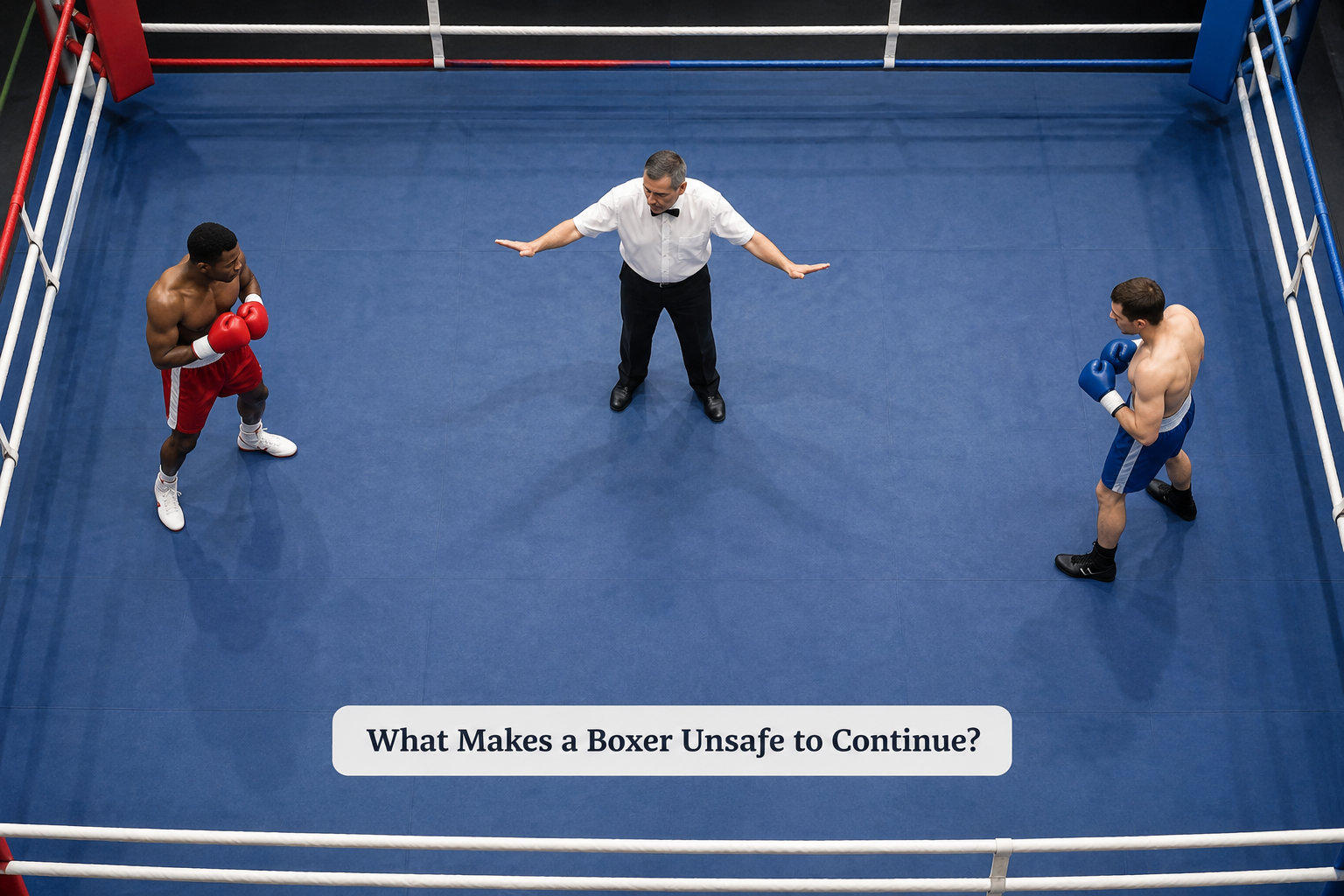
A fighter becomes unsafe when his body stops answering the damage it is taking. The rulebook wording used by most governing bodies is that a boxer must satisfy the referee he is in a position and condition to defend himself. In practice that means the referee is watching the same handful of things over and over.
The published tell-tale signs include strong fatigue that does not recover between exchanges, a change in skin colour, open-mouth heavy breathing, an unbalanced stance, a lack of muscle control, a dazed look, disorientation, nausea, claims of head or earache, changes in the pupils, and cuts or swellings that change how a fighter sees or moves.
Cumulative damage is the part casual viewers miss. A punch that would be harmless in round one can be the one that matters in round eight, because the neck muscles, the reflexes and the ability to protect the head have all been worn down. The referee is not looking for one catastrophic punch. He is watching a fighter slowly stop protecting himself.
Safety is the referee’s responsibility, and that responsibility is not shared. Promoters, commissions, corners and fighters all have an interest in how a bout unfolds, and the referee is the only person in the building whose job is to end the round if the answer is wrong.
Why Does a Knockdown Lead to a Count?
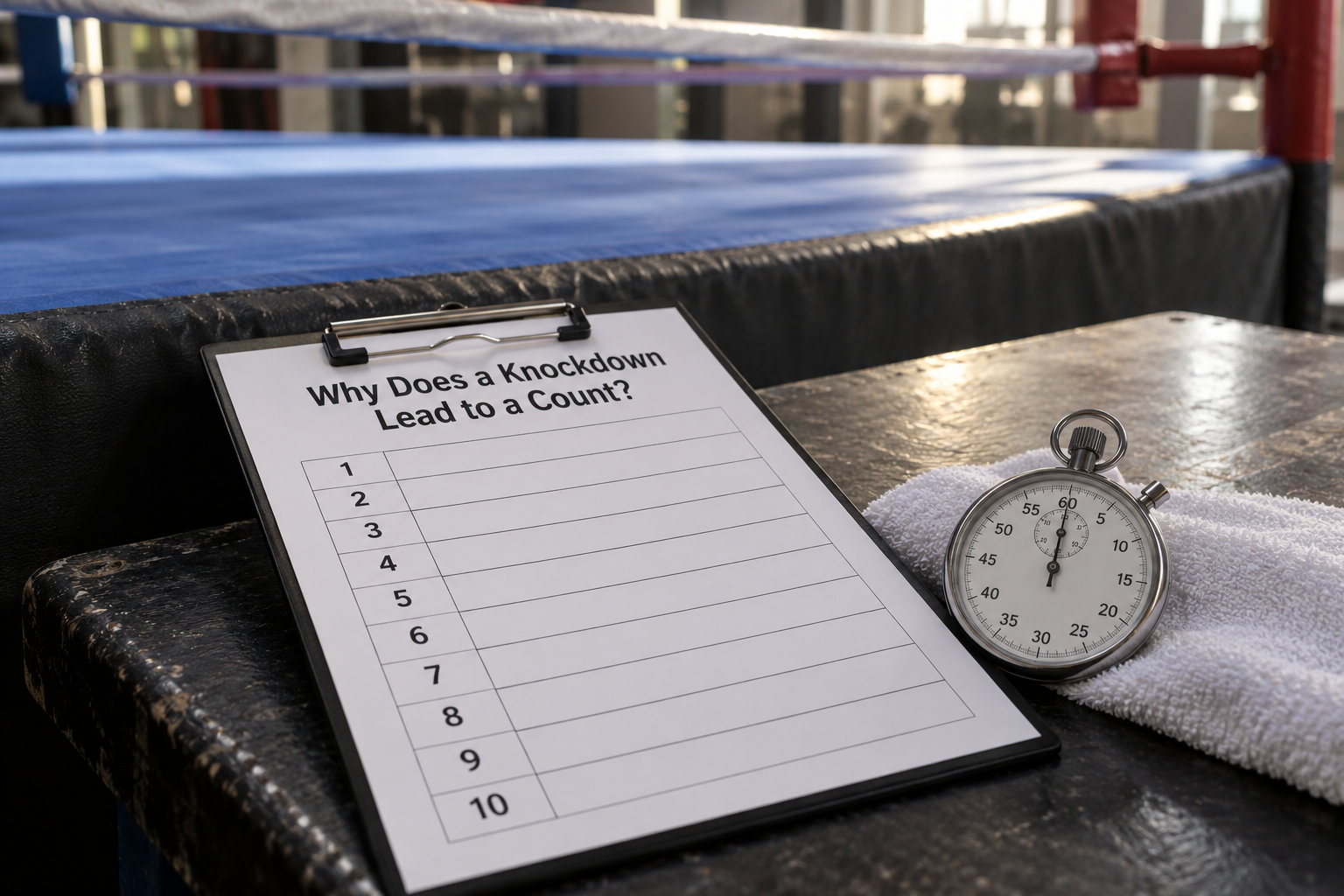
A knockdown is not the same thing as a stoppage. A knockdown starts a count; the count decides what happens next.
Under the unified professional rules, a fighter is down if any part of his body other than the soles of his feet touches the canvas. That includes a glove, a knee, a hand or a hip. A fighter who is thrown through the ropes and lands on the floor outside the ring has also been knocked down, as has one who is caught on the top rope and held there by his opponent’s weight rather than his own.
The count is started immediately, and the referee counts aloud or with a finger while circling. The count exists so a fighter cannot be counted while looking at the referee and hiding a state he is not in. The fighter has to show the referee, not the crowd, that he can rise and continue.
Some rulebooks also treat a fighter who drops to both knees and slides along the canvas as having been knocked down. That is why you see counts started when a knee hit first and it looked to half the building like nothing much happened.
The decision point sits at eight or nine. If a fighter is up by eight, he continues only if the referee believes he can defend himself. If the fighter rises at nine and looks like a man running on fumes, the count commonly goes to ten anyway.
What Happens During a Standing Eight Count?
A standing eight count is a mandatory, unprotected pause the referee gives after a knockdown or a hard head shot, even when the fighter never went down.
The referee waves the action off, sends the opponent to a neutral corner, and attends to the fighter himself rather than waiting for the doctor to walk in. He checks that the fighter is responding, that he is tracking the referee’s movement, that he can follow a simple instruction, and that his balance is intact. Then the referee counts.
What the fighter has to demonstrate is deliberately modest: look at the referee, answer a question, move on command, raise his guard when asked, and step toward the opponent. Nobody expects clarity from a concussed fighter. They expect responsiveness.
A standing eight count often ends with the fighter sent back to his corner rather than resumed, and a referee is entitled to finish the count at any point he does not like what he has seen. The eight count is the most common quiet stoppage in the sport, because the referee is not overruling anybody — he is simply refusing to let the fight continue.
How Do Referees Spot a Knockout?
The knockout is the least subjective outcome in boxing, which is exactly why it is the one everybody thinks they understand.
A fighter is counted out when he is dropped and does not show the referee that he can rise and continue. That is the whole test. If the fighter gets up before ten, keeps a guard up, and responds to the referee’s instruction, the count ends and the fight continues. The knockdown still goes on his record. The stoppage, if it happens, does not.
The bell cannot rescue a fighter. There is no point in the round where the count stops because time ran out, and most rulebooks make that explicit. A fighter saved by the bell in one sense is still a fighter who was counted out.
Referees are also required to count fast enough that a crowd cannot drag the count along with it, and slowly enough that a fighter who is genuinely recovering is not rushed into a decision. Getting that tempo right, out loud, in front of a building, is the hardest technical skill the job requires.
Can a Referee Stop a Fight Because of a Cut?
Yes. Bleeding and swelling are grounds for a stoppage on their own, and they are the most contested of all the referee’s calls.
The distinction that matters is not whether a cut has stopped bleeding. It is whether the fighter can see and defend himself with it. A gash above the eye that has clotted can be harmless; a swollen eye that has closed can end a fight on its own. A cut that has closed one eye shut and a cut that is still trickling are treated very differently by the doctor and by the referee’s own eye line.
The doctor is summoned, examines the fighter, and gives a recommendation. The referee then decides. Ringside rules vary: some commissions want the doctor to examine every cut before the action resumes, others let the referee resume with a fighter who is bleeding. A referee who resumes too quickly is answerable, and so is one who stops a fight over a nick.
This is the stoppage fans argue about most, because it can be called in either direction and because the visible evidence is so easy to argue with from the cheap seats.
How Do Doctors Influence a Boxing Stoppage?
The doctor examines; the referee decides whether the bout continues. The division matters, because the two officials are looking for different things.
The ringside physician is looking at damage: swelling, lacerations, eye function, breathing, alertness, the state of a suspected concussion. Their input carries enormous weight and in practice most commissions treat a doctor’s recommendation on a medical stoppage as decisive, with the referee recording the bout as stopped on medical grounds.
That weight is deliberate. It is not meant as a criticism of referees, who are not clinicians and are watching from a moving angle at close range. It reflects how much subjective reading of a hurt fighter goes wrong, and how often it goes wrong quietly.
The mechanics are worth knowing. When the referee wants an examination, he motions the doctor in and sends the opponent to a neutral corner. During a round the doctor is seconds away. Between rounds, the one-minute rest is when the detailed assessment happens, usually with the fighter sitting on a stool in his corner while the referee stands over the exchange. If a doctor is not ringside, most commissions require a stoppage to continue until a doctor arrives, or at least a formal assessment of anything more serious than a surface cut.
What Are Technical Stoppages and No Contests?
Technical stoppages end a bout for reasons that have nothing to do with a fighter being unable to continue.
- Accidental headbutt — usually produces a temporary stop, sometimes a standing eight count, occasionally a bout abandoned or ruled a technical decision.
- Low blow — an accidental one earns a recovery period, five minutes under most professional rulebooks, and the bout resumes. A deliberate one is a disqualification.
- Gloves or equipment trapped — the referee untangles and, if the problem repeats, issues a warning and then stops the bout.
- Injury requiring departure — a fighter who cannot continue for a reason the doctor cannot repair ends the contest on medical grounds.
- Rule violations — persistent fouls, refusal to comply, or leaving the ring can end a fight outright.
A no contest or technical decision records a bout that happened but produced no result. Terminology and consequence differ between governing bodies, and between professional and amateur codes, so the notation on a fighter’s record is the reliable version of what actually occurred.
Can a Corner Throw the Towel?
A corner can stop a fight at any point, and it often does so before the referee would.
The signal is a towel waved onto the canvas, or a trainer stepping up and waving the fighter’s arm, or the fighter sitting down and refusing to continue. No count is required and no ten count has to run. The result is recorded as a stoppage on the corner’s behalf rather than as a referee stoppage, which is a small technical detail that matters when you read a record.
This is where the blame argument usually lands. Ask a crowd why a hurt fighter kept taking punches and you will often be told two different things in the same breath: the referee was too slow, and the corner should have thrown the towel. The corner has information the referee does not — the fighter’s history, how he responds to being hurt, what his face looked like in the gym that week — and it is the corner’s job to act on it.
Veterans of the sport tend to defend referees more readily than casual viewers do, and they tend to reserve real praise for the ones who step in early. Fans watching live plead for the stoppage from their seats, which tells you how much of this decision feels shared when it is not.
What Signals Do Referees Watch Beyond Knockdowns?
Most stoppages never involve a knockdown at all, which surprises people who think of the ten count as the main event.
How referees decide to stop a fight: the practical checklist
- Hands dropping, or a guard held lower round after round.
- Legs going soft, feet crossing, or a fighter being unable to stay in a small circle.
- Delayed reactions — a punch landing late, or a fighter responding a beat after the bell.
- Eyes that track the opponent late, or attention drifting to the crowd and the lights.
- Failure to protect the head when a punch is thrown, which is the single clearest signal on the list.
- Answering the referee’s questions slowly, or not understanding the instruction at all.
- Breathing through an open mouth at rest, with colour draining from the skin.
- A fighter who cannot follow a simple instruction to step in and fight after the count.
Any one of those can be survivable. Several together, in the referee’s judgement, are not, and the test is never the knockdown count. It is the answer to one question: is this fighter able and able soon to defend himself?
Why Do Boxing Rules Allow Referee Discretion?
Because the situations that end fights are physical, immediate and unmeasurable. No rulebook can write a threshold for concussion or write the exact moment a fighter stops being able to take a punch, so the rules delegate that judgement to a trained official and hold them responsible for the outcome.
The manuals say this plainly. When asked when it is acceptable to stop a bout, the WBA referee manual answers that only good judgment and ring experience can settle it. Naming judgment as the deciding factor is not a gap in the rules. It is the design.
Discretion cuts both ways, and honest coverage should say so. A referee who stops a fight a round too early can end a championship, cost a fighter a title shot, and take away a career that a single disputed count would have preserved. That prospect sits on the other side of the same decision, and plenty of referees have been second-guessed for it.
Late stoppages also happen for reasons that are not about skill. A crowded building pushes a referee toward caution. An unfamiliar venue works against him. A fighter who keeps throwing punches with his hands low is generating noise that reads as defiance from a bad angle. And there is a subtler pressure in a sport where a promoted fighter who gets stopped costs somebody money, which is the part of the accusation nobody can prove and everybody believes.
The research side of the argument is harder to dismiss. A published review looking at good and bad medical stoppages in boxing asked physician raters to assess 60 professional bouts and found that in a substantial share they believed the fight should have been stopped earlier than it was. Whatever the causes, the outcome is not evenly distributed across the sport.
Regional rulebooks also differ in ways that change the mechanics. The WBA applies a three-knockdowns-in-one-round standard at the referee’s discretion, and a number of US state commissions run similar rules. Doctor requirements differ by commission, and so do the recovery periods allowed after a low blow. The professional codes and the amateur code under World Boxing diverge further, where the referee works in an inverted position and judges still score rounds.
Frequently Asked Questions
When should a boxing referee stop a fight?
A referee should stop a fight the moment a fighter can no longer defend himself, is being outclassed while taking excessive punishment, is unfit to continue after an examination, or has been counted out. A downed fighter must show the referee he can rise and continue before the count ends. A standing eight count is the same judgement applied to a fighter who never went down.
What is the rule for the 10 count in boxing?
After a knockdown the referee counts aloud at a controlled pace while the fighter recovers. Reaching eight or nine is the decision point: the fighter continues only if the referee believes he can defend himself. Otherwise the count runs to ten and the bout is stopped as a knockout. The bell cannot save a fighter, and the count cannot be paused or shortened by anyone in the arena.
Does a referee stoppage count as a knockdown?
No. A knockdown is the fall itself and is recorded separately from the result. A fight stopped by the referee while the fighter is still standing is recorded as a stoppage, not a knockout, and the knockdown only appears on the record if one actually happened during the bout. That distinction is why two bouts ending the same way can show very different statistics on a fighter’s page.
Can a boxing referee stop a fight between rounds?
Yes, and it is one of the more valuable decisions a referee makes. During the one-minute rest the referee examines a fighter and consults the ringside doctor, who can advise that the bout should not resume. The opponent is sent to a neutral corner while the assessment happens. A stoppage here avoids sending a hurt fighter back out, which is the clearest form of the late stoppage fans complain about.
Is taking a knee a knockdown in boxing?
Under the unified professional rules, a fighter is considered down when any part of his body other than the soles of his feet touches the canvas, so a knee counts. Some rulebooks go further and treat a fighter who drops to both knees and slides along the canvas as knocked down even if nothing else landed. That is why counts sometimes start when a knee hit first and the fall looked harmless.
Is taking the 80/20 rule used in professional boxing?
The 80/20 threshold belongs to the amateur code, not professional boxing. It sets punch-volume conditions for winning and stopping a bout under World Boxing rules. In the professional ring a stoppage comes from the ten count, the referee’s discretion or the ringside doctor, and anything else goes to the judges on the scorecard at the end of the scheduled rounds.
Conclusion: What to Watch During a Boxing Stoppage
The decision process is simpler than the argument around it. Watch the fighter’s responsiveness, balance, awareness and defensive movement, then watch the doctor’s assessment rather than the knockdown. If a fighter is up, tracking the referee and following instructions, he continues. If he is on his feet but not defending himself, the stoppage is the referee’s call and often the correct one.