Punching power is a whole-body skill, not an arm skill. You push off the floor, the force travels up through your legs and hips, the hips and torso rotate to whip the shoulders through, and the arm fires as the last link in a chain. If you know how to improve punching power, you can build it with a stable stance, deliberate leg and hip work, speed practice and a sensible strength programme — no special equipment required. Most people need 12 to 16 focused weeks to feel a real change.
I coach recreational boxers who lift in the gym and still feel like their punches do nothing. The pattern is almost always the same: the arms are doing 90 percent of the work and the rest of the body is standing there. Once they start moving the floor, something changes within a month. The interesting part is that the first improvements come from technique, and the later ones come from strength — in that order.
Table of Contents
What You Need to Improve Punching Power
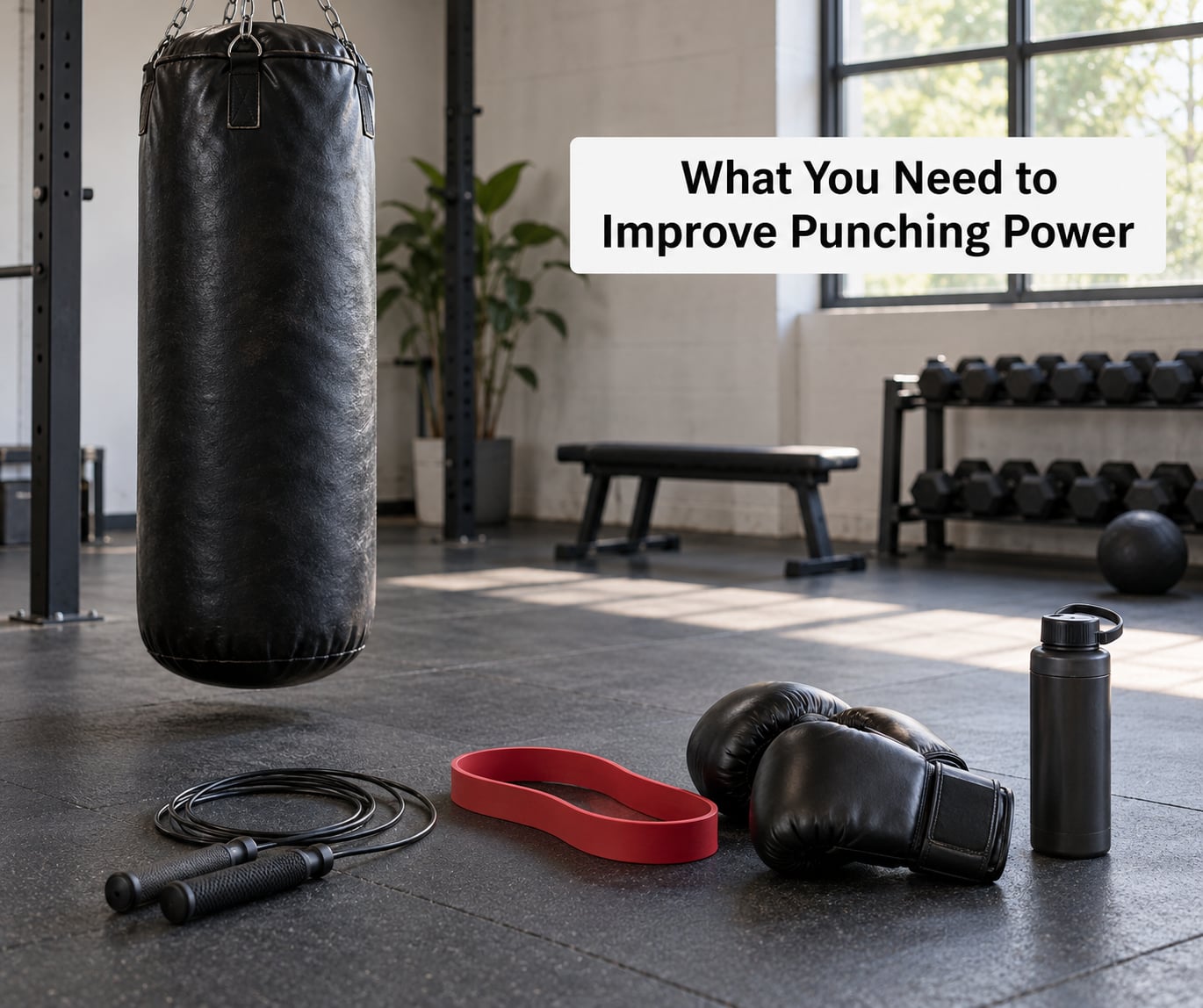
You need very little to start. Boxing gloves you can comfortably make a fist in, a clear patch of floor or wall to work against, and somewhere to hang a heavy bag if your gym has one. Resistance bands and a medicine ball help, but they are optional for the first month.
What genuinely helps is access to feedback. A coach watching three of your rounds, or a phone propped up recording a side-on view of your combinations, will find more faults in two sessions than a month of guessing. If you are training at a gym, ask whether the coaching time is included in your membership before booking anything extra.
One more thing worth sorting early: hand wraps and knuckle conditioning. Progressing your volume before your hands are used to it is the fastest route to sore knuckles and wrist ache, and sore joints change how you punch whether you want them to or not.
Beginners should also know when to get supervision. If you have any existing shoulder, wrist or lower-back pain, or you are returning to training after a long break, have a qualified coach or a physiotherapist look at your movement before you add load or plyometrics.
How to Improve Punching Power: Step-by-Step
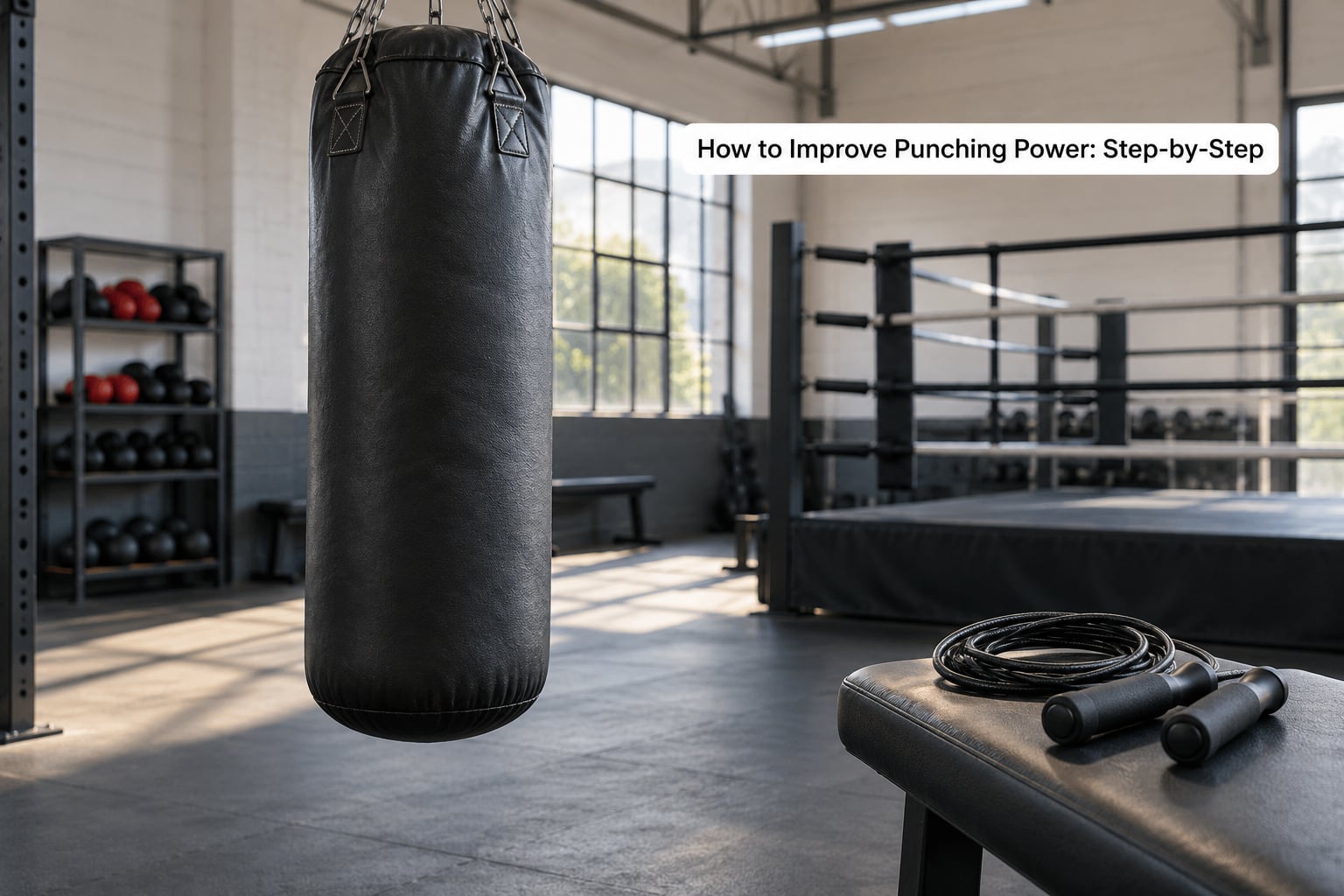
Here is the order I would follow. Each stage takes a few weeks, and moving on before the previous stage holds up is the most common reason people plateau. Work through them in sequence rather than doing them all in the same week.
Build a Stable Punching Foundation
A powerful punch starts from a stance you can load. Feet roughly shoulder-width apart, lead foot slightly forward, weight distributed roughly 55 to 60 percent on the back foot at rest, knees soft, chin tucked behind the front shoulder.
From there, the mechanics that matter most for the straight punch are elbow-to-knuckles alignment, a fist landing flat in line with the forearm, and the rear hand returning to the chin as the lead hand extends. For a hook, the elbow stays down and in front of the body, the wrist stays neutral, and the power comes from rotating the hip and torso before the arm uncoils.
How do you know the foundation is solid? Your combinations should look the same at full effort as they do at half speed, and someone filming you should not be able to see your shoulder rise before the punch lands. If they can, you are starting the punch with the wrong muscles.
A useful test: throw the same three-punch combination on a bag for a full round at moderate effort. Then repeat it shadowboxing in the mirror. If the mirror version looks slower and tighter, the bag was doing the work for you.
Develop Leg Drive and Ground Force
This is where most of the force in a punch is actually born. When you push the floor away, the ground pushes back with an equal and opposite force, and that reaction force is what ends up travelling up your body and out through the fist.
Two beginner-friendly drills build it. The squat-to-push: sit into a squat, drive up, step forward and throw a straight punch at the bag as you reach the top. The step-back: from an orthodox stance, push off the floor and explode backward, landing light on the balls of your feet with the rear heel turning through rather than dragging.
Do these on their own before you add them to combinations, and keep the volume low. Two sets of 6 to 8 reps each, three times a week, is plenty to start. Aim for quality rather than fatigue — once your legs are burning, your technique gets worse, not better.
Two things to avoid. Do not lock your knees or snap them straight at the top of a jump, and do not chase heavier loads before your footwork is consistent. Wrist and ankle pain in this stage almost always traces back to pushing off with a stiff, locked joint.
Rotate the Hips and Maintain Technique
Hip rotation is the link that turns body weight into a punch rather than an arm swing. The sequence should read from the floor upward: pressure through the rear foot, the rear hip drives forward, the torso rotates, the shoulder follows, and only then does the arm extend. If the shoulder starts first, the rest of the chain has nothing to transfer.
Progress it like this. Start on a heavy bag with slow, single hooks and check the video each week. Then move to the double-end bag, where you cannot cheat the timing, and finally to focus mitts with a partner, where someone is watching your feet and your guard in real time.
The technique check is simple: at the end of each round, ask whether your rear shoulder ended up in front of your chin. If it did, you were reaching. If your punches felt hardest when you were leaning back, the power is coming from the wrong place.
Film check worth doing once a week: record 30 seconds of you shadowboxing from the side, then from behind. Side view shows the lean and the arm path; the back view shows whether the hips actually turned. Most people are surprised by one of the two angles.
Improve Speed Without Sacrificing Accuracy
Speed multiplies force. The same muscle output delivered twice as fast is far harder to absorb, and a punch that lands while your opponent is still deciding what to do has already won half the exchange.
Train speed in three places. Shadowboxing builds the pattern and the timing without resistance, so your body learns the movement at the speed you will actually use. Speed bag intervals of 30 seconds on, 30 seconds off, three to five rounds, sharpen coordination and rhythm. Light-power bag sessions keep the accuracy honest — hit hard enough to feel it, but stay at about 70 percent of what you could do.
The stop rule matters more than the volume. End speed work the moment your form changes: guard drops, elbow flares, shots start landing late. The last 20 percent of a speed round is where technique erodes, and it is not worth trading.
You can also add a simple timing test. Throw a fixed three-punch combination ten times, record it, and compare the video against last month. Hand speed is one of the easier things to see improving on camera, and it is one of the strongest predictors of how hard a punch feels to the person receiving it.
Add Safe Strength and Conditioning Work
Strength is the raw material, and it is the last stage for a reason. Once your technique holds, heavier training gives you more force to transfer. Start lighter than you think you need, and progress slowly — this is where technique tends to break down.
- Squats and hinges: 3 to 4 sets of 4 to 6 reps, 2 to 3 minutes rest. Squats for leg drive, deadlifts or trap-bar deadlifts for total-body force.
- Carries and lunges: 3 sets of 30 to 40 metres. These build single-leg strength and hip stability, both of which show up in a long exchange.
- Push and pull: push-ups, press-ups, pull-ups and rows, 3 sets of 6 to 10 reps. Press-ups and pull-ups matter because they harden the arms and upper back against a heavy bag.
- Core and rotation: planks, side planks and rotational work, 3 sets held 30 to 45 seconds, or 10 to 15 reps per side. Your midsection is the transmission between the legs and the arm.
- Explosive work: clap push-ups, jump squats, box jumps and medicine ball slams, 3 to 4 sets of 5 to 8 reps, fully recovered. Explosive work belongs at the end of a session while you are still fresh.
- Conditioning: 8 to 12 rounds of 2 minutes hard, 2 minutes easy on a heavy bag or bike. Do this after the power work, never instead of it.
Balance matters here. Arms that get much stronger than the rest of the body tend to rush the punch, which is exactly the pattern that flattens a once-fast puncher. If your boxing sessions suddenly feel slower, the weights grew faster than your technique.
| Drill | Main target | Sets and reps | Rest | Weekly frequency |
|---|---|---|---|---|
| Shadowboxing | Speed and accuracy | 4 rounds of 3 minutes | 1 minute | 3 to 4 times |
| Speed bag intervals | Hand speed and rhythm | 3 to 5 rounds of 30 seconds | 30 seconds | 2 to 3 times |
| Heavy bag rounds | Technique under fatigue | 6 rounds of 3 minutes | 1 minute | 2 to 3 times |
| Squat or hinge lifts | Leg drive and total-body strength | 3 to 4 sets of 4 to 6 reps | 2 to 3 minutes | 2 times |
| Clap push-ups or medicine ball slams | Explosive power | 3 to 4 sets of 5 to 8 reps | 90 seconds | 1 to 2 times |
| Carries and lunges | Single-leg strength and stability | 3 sets of 30 to 40 metres | 90 seconds | 1 to 2 times |
| Interval conditioning | Work capacity | 8 to 12 rounds of 2 minutes | 2 minutes | 1 to 2 times |
A simple week: technique and shadowboxing on Monday, lower-body strength on Tuesday, explosive work plus intervals on Wednesday, mitts and speed bag on Thursday, full-body strength on Friday, sparring or a long easy bag session on Saturday, and a full day off on Sunday. Three hours of boxing a week with two strength sessions is plenty to make progress; more is not better if the technique is still deteriorating.
Recovery matters as much as the work. Most of the adaptation that makes a punch feel heavy happens between sessions, so treat sleep, food and rest days as part of the programme rather than time stolen from it. If you are training four sessions and progressing every session, something is missing.
Common Mistakes That Kill Punching Power
Punching with the arms. If your shoulders and elbows are visibly tensing before contact, you are arming the punch. Correct it by slowing down, dropping to about half speed, and throwing single hooks while a coach or a recording watches for the hips turning first.
Leaning back on impact. Weight moving away from the target means the force left your body before it arrived. Keep your weight over the front leg as the punch lands and learn to finish without falling off balance.
Dropping the guard. Power work is tempting to do bare-handed and at full intensity. Wrap your hands, wear gloves, and treat speed and accuracy sessions as technique sessions rather than fight rounds.
Skipping the legs. Lifters sometimes add upper-body work and hope it transfers. Build the base — squats, hinges, carries — because the legs are where the force starts.
Chasing heavy loads too early. The classic mistake from the gym, and the one most likely to set your boxing back. Heaviest work goes last, in small sets, and only once technique survives a normal session.
Training to exhaustion. Power training is high-intensity by definition and low-volume by design. Two or three quality efforts beat a long session of poor ones every time.
Raising volume too fast. Your body needs a few weeks to adapt to a new stimulus. Add one thing at a time, and if your knees, wrists or lower back start complaining, cut the volume before cutting the technique work.
The final tip: film every third session from the same two angles. Your perception of your own power drifts quickly, and a fixed camera angle is the cheapest measurement tool you will ever own. If the footage shows the hips turning earlier, the guard staying up and the rear shoulder landing in front of the chin, the work is going in the right direction even on a week when the bag felt heavy.
Frequently Asked Questions
How often should I train punching power?
Two to four focused sessions a week is the useful range. Keep at least one full rest day between heavy strength sessions, and treat speed and technique work as daily if you have the time. Progress should be slow: raise one variable at a time, whether that is load, volume or round length.
Can resistance bands help me punch harder?
Light bands are useful for learning to resist a little on extension, and for rotation work in the gym. Heavy bands or weighted gloves are a different matter: they slow the punch, block the natural hip rotation and can strain the wrist and shoulder. Use them sparingly and never on the days you are chasing speed.
Is bodyweight training enough to increase punching power?
Bodyweight work is a solid foundation, especially push-ups, pull-ups, lunges, single-leg squats and plyometrics. It will take you a long way, especially as a beginner, but a room with a barbell, a pair of dumbbells and a medicine ball will let you progress further. Add load only once your technique is solid.
When is my technique ready for power work?
When your combinations look identical at half speed and full effort, and your guard, stance and balance do not change when the intensity goes up. If you drop your hands, lean back or reach for the bag, you are not ready to add load. A coach watching one session is the fastest way to know for certain.
How do I know my punching power is improving?
Use three simple measures: record 30 seconds of shadowboxing from a fixed side angle every fortnight, count how many clean power combinations you can throw in a round without form breaking, and ask a training partner or coach whether your shots feel heavier. Progress here is gradual, so track it over months rather than days.
Conclusion: Start With the Floor, Not the Arms
If you only do one thing, spend the next four weeks on a stable stance, clean straight punches and hooks, and deliberate leg drive — squat-to-push and step-backs, a handful of rounds, filmed once a week. Nothing else in this guide matters as much as getting those three right, because every stage after it depends on them.
Once the mechanics hold, add speed work in short intervals, then build strength slowly with squats, hinges, carries and explosive movements, and let the pattern repeat for three or four months. Be consistent, sleep properly, and progress one variable at a time. That is genuinely how to improve punching power, and it is available to anyone willing to do the boring repetitions first.