Boxing changes your body in four broad ways: it builds cardiovascular fitness through hard interval work, develops strength and muscular endurance across the shoulders, arms, back, core and legs, reshapes body composition when your eating matches the training, and sharpens coordination, posture and mood. Most of what you feel in the first few weeks is fatigue and soreness, not change. Real adaptations take months of consistent sessions.
That distinction matters when you are trying to work out how boxing changes your body, because plenty of people quit in week two believing nothing is happening. Something is, but it is happening underneath the soreness.
Table of Contents
- What Changes When You Start Boxing?
- How Boxing Builds Strength and Muscle
- Does Boxing Help You Lose Weight?
- What Boxing Does to Your Heart, Lungs, and Endurance
- How Boxing Affects Your Bones, Joints, and Mobility
- Changes to Your Skin, Hair, and Appearance
- How Boxing Changes Your Mood and Mental Health
- Fatigue, Recovery, and What Happens After a Hard Session
- The Timeline of Common Boxing Adaptations
- How to Train Boxing Without Overloading Your Body
- When Should Boxers See a Doctor?
- Frequently Asked Questions
- Start Slowly and Let Training Adapt Your Body
What Changes When You Start Boxing?
The short version is that boxing is a full-body skill sport with the conditioning demands of repeated intervals. Every round mixes punching, footwork and defence, so almost nothing sits still.
Here is what tends to move, what causes it, and what it feels like from the inside.
| Main change | What drives it | How it may feel |
|---|---|---|
| Cardiovascular fitness | Repeated rounds with short recoveries | Breathing hard early, then recovering faster each session |
| Upper-body strength and endurance | Punching volume plus the isometric hold of the guard | Heavy arms at the end of a session, less tired after a few weeks |
| Core and rotational power | Hip and shoulder rotation through every combination | A firmer midsection, better balance under fatigue |
| Leg conditioning | Bouncing, sliding and repeated stance changes | Soreness in calves and quads rather than arms |
| Coordination and reaction speed | Reading a moving target and responding | Fewer mistimed punches, sharper foot placement |
| Posture and habit | Repeated stance and schedule demands | Shoulders sitting back, easier to train consistently |
| Body composition | Energy spent combined with how you eat | Waist narrowing gradually, weight moving slowly or not at all |
Short-term fatigue and long-term adaptation are different animals. Fatigue arrives within an hour and clears overnight. Adaptation builds across weeks and only shows up when you compare the same effort across time.
How Boxing Builds Strength and Muscle
A cross comes off the rear hip, through the core and into the fist. Repeated hundreds of times a session, that pattern develops rotational strength, which is functional strength rather than isolated muscle.
The shoulder, chest, upper back and arms do most of the visible work. Holding your hands up is an isometric contraction that keeps working the whole time you are on your toes, and most beginners underestimate how much that costs by the fourth round.
Footwork and the legs are the quiet engine. Bouncing for three minutes straight builds calf, quad and hip endurance that carries every other round after it.
Now the honest part. A pump is not growth. New muscle tissue forms when training is hard enough, repeated often enough, and supported by enough food. Boxing alone gives you the stimulus and the volume, but it is not a complete hypertrophy programme.
People on boxing forums ask this constantly: does all that cardio burn off the muscle you are trying to build? Sometimes, yes, if you train hard and eat too little. The fix is not to drop the boxing. It is to eat enough protein, keep a modest calorie deficit rather than a crash, and add two or three resistance sessions a week if size is a goal.
Muscular endurance, by contrast, comes fast. Holding your shape for three rounds when you could barely manage one is a real adaptation you will notice within weeks.
How Boxing Changes Your Body Through Conditioning
Conditioning is where most people notice the biggest shift. Rounds create an interval pattern of near-maximal effort and brief recovery, repeated for an hour or more.
That pattern raises your capacity to work hard and recover, improves aerobic efficiency over the session, and builds tolerance for discomfort that most people do not have on day one.
Hand and eye coordination improve too, simply because you are repeatedly aiming at something that moves back. On the bag that is a target; with a partner it becomes a reaction drill.
Does Boxing Help You Lose Weight?
Boxing burns a lot of energy per hour, but the honest answer is that it decides your weight far less than most people hope. A hard session can out-work an hour of steady-state cardio, yet the scale still responds mainly to what you eat.
Body recomposition is the more interesting outcome. Newer trainees often lose fat and gain some muscle at the same time, which shows up as a tighter waist, a firmer look, and a weight that barely moved.
Hydration matters more than beginners expect. Boxing is a hot, sweaty activity and people routinely mistake fluid loss for fat loss. Weigh yourself the next morning if you like, but expect that number to bounce back.
Talk to a registered dietitian about how much to eat if weight is your goal. They can work out a sensible deficit with you, which is far more useful than anything a generic article can hand you.
What Boxing Does to Your Heart, Lungs, and Endurance
Boxing repeatedly pushes your heart rate high and lets it come partway down, over and over. Done regularly, that is one of the most effective ways to raise general aerobic capacity.
Here is the part beginners find confusing: you keep gasping even after months. Fitness improves how much you can recover, not how comfortable hard work feels. The gap between rounds usually narrows long before the breathing during a round does.
Resting heart rate often drifts down and everyday activity gets easier, which is often the first change non-boxers notice around them.
How Boxing Affects Your Bones, Joints, and Mobility
Impact work gives bone a reason to stay dense, which is one reason combat sports are used in weight-bearing exercise research. Punching and bouncing load the bones of the hands, feet, legs and arms.
Load is only helpful when it is graduated. Coming in with no technique and immediately throwing hard shots concentrates stress in the wrist, elbow and shoulder rather than distributing it through the body.
Joints take the other side of that bargain. Repetitive rotation, awkward wrist angles and heavy rounds leave elbow and shoulder tissue grumbling for a while. Mobility work, sensible load management and a rest day between hard sessions keep most of it quiet.
Boxing is not universally safe or unsafe. It is a high-demand activity that rewards good technique and punishes impatience, which is why coaching matters more here than in almost any other fitness class.
Changes to Your Skin, Hair, and Appearance
Two things surprise almost everyone. The first is the sweat, which is far heavier than in most workouts and settles into your clothes and wraps.
The second is your face. Facial skin, hair and the general look of your head change more than your legs do, mostly because contact and heat happen up there constantly. Hair gets friction damage at the hairline where gloves and headgear sit, skin gets raised bumps, and chafing shows up anywhere sweat collects.
Simple habits handle most of it. Wash and dry your face after every session, clean your wraps and gloves on a schedule, change clothes right after training, and keep your hair tidy rather than wet under headgear for an hour.
Persistent itching, swelling, spreading redness or a rash that does not settle are not things to work through. Stop training and ask a doctor or pharmacist about it. Likewise, never share gloves or headgear, and do not train through a skin infection you suspect you have.
How Boxing Changes Your Mood and Mental Health
Most people come for the workout and stay for the head. A fixed session, a clear skill to learn and people who expect you to turn up combine into a routine that takes pressure off.
Boxing also gives you somewhere to put frustration without causing damage. People regularly report feeling calmer, more confident and far more tolerant of discomfort they used to avoid.
There is an honest other side. Intense training on top of an already full life can create anxiety, pressure to keep improving, or outright burnout. Weeks of poor sleep between hard sessions will undo more than you trained for.
If low mood, panic or hopelessness persists, or if you feel unsafe with yourself, talk to a doctor or a mental health professional. Boxing is a useful tool, not a treatment.
Fatigue, Recovery, and What Happens After a Hard Session
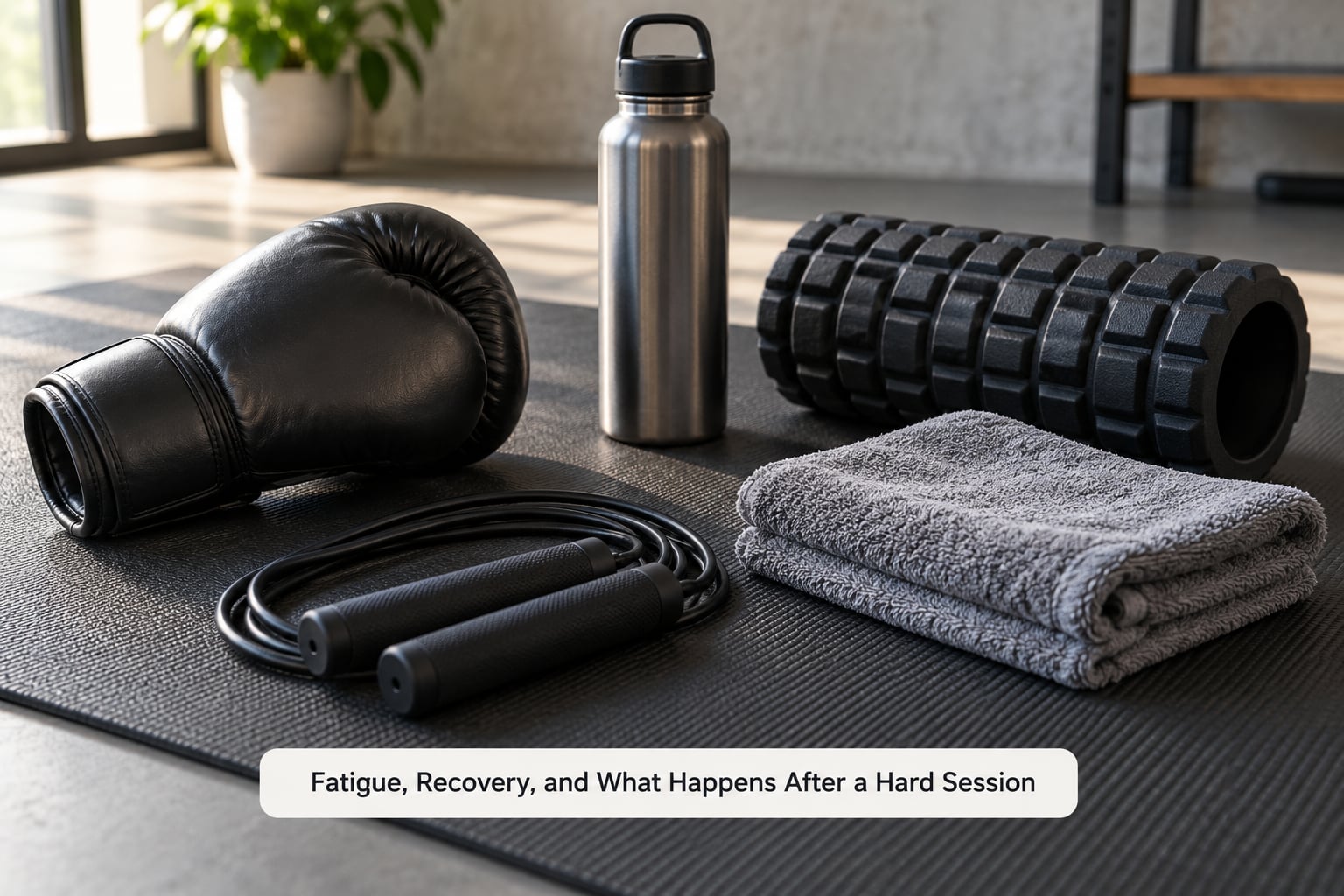
Normal recovery looks boring: sore calves and quads for two or three days, tiredness in the first two rounds, and a slightly lighter feeling by the time you reach the bag again.
Soreness tells you something new was asked of you. It stops telling you anything useful once you are used to the training, which is usually somewhere between four and eight weeks in.
Sleep does more for your progress than any supplement. Food refills what you spent, water replaces what you sweated out, and a rest day lets tissue repair instead of tearing down again. Most sore, stalled beginners are simply training too many consecutive days.
Stop and seek medical advice for chest pain, fainting, severe breathing difficulty, symptoms following a head strike such as confusion, worsening headache, vomiting, vision changes or drowsiness, joint pain that keeps worsening, or weakness you cannot explain. Do not train through any of those to see if they pass.
The Timeline of Common Boxing Adaptations
Nobody can promise you a schedule. Training age, nutrition, sleep and starting fitness all move these dates around, so treat the bands below as typical rather than guaranteed.
| Timeframe | What most beginners notice |
|---|---|
| First few sessions | Heavy breathing early, arms feeling full, sore legs and upper back, poor coordination, appetite up |
| Weeks 2 to 4 | Stamina in the early rounds improves, combinations feel smoother, basic footwork becomes automatic, soreness drops |
| Weeks 5 to 8 | Posture and core hold improve, recovery between rounds speeds up, weight or measurements start shifting if diet matches |
| Months 3 to 6 | Endurance in full-length rounds, genuine strength gains, calmer under pressure, sharper reaction, sleep often improves |
| Beyond 6 months | Technique compounds, muscular endurance is real, confidence carries outside the gym, body composition stabilises at your new habits |
What twelve weeks will not do is change your bone structure, give you a professional fighter’s build, or replace resistance training if size is your goal. Strength and fat loss move on their own clock, usually slower than people expect.
How to Train Boxing Without Overloading Your Body
Start with round counts you can finish with decent form. Three two-minute rounds with a minute rest is a real session. Nobody is impressed by someone who gasses out on round one and spends the rest of the week recovering.
Warm up properly, then spend real time on technique before you spend it on power. Hips, feet and breathing come first, and the punch gets sharper when they do.
Progress one variable at a time: a round here, a minute of rest there. Adding rounds, harder drills and more intensity in the same week is the most common way new boxers pick up an injury.
Book rest days as part of the plan, not as a reward for surviving it. Two hard sessions with a day between is far more productive than five in a row.
Get a qualified coach for the early months. Technique errors are cheap to fix in week one and expensive to fix in year three.
If you have a medical condition, an old injury, are pregnant or return after a long break, check with a doctor before starting hard training. It is a short conversation and it changes the plan, not the ambition.
When Should Boxers See a Doctor?
Some things in boxing are uncomfortable and normal. Others are signals to stop training and get checked the same day or the next.
- Chest pain, fainting, or a racing heart that does not settle after rest
- Breathing that stays difficult well after the session
- Confusion, a worsening headache, vomiting, vision changes or unusual drowsiness after a head strike
- Joint or bone pain that is sharp, worsening, or limiting what you can do
- Numbness, tingling or loss of strength in an arm or hand
- Swelling, redness or a rash that spreads or does not heal
- Pain that keeps returning for no clear reason
None of that can be diagnosed from an article, and this one is not trying to. Its only job is to tell you when self-assessment is not the right tool.
Frequently Asked Questions
Does boxing build muscle or burn it away?
Boxing builds both, but not equally. It gives you strong shoulders, back, arms, legs and a hard core, and most newcomers gain some muscle early on. High training volume can strip lean mass if you also under-eat, so keeping protein intake steady and cutting calories gently protects it. Adding two resistance sessions a week helps if size is your goal.
Is 30 minutes of boxing a day enough to see results?
Yes, for conditioning and coordination, and often for weight if your eating is sensible. Thirty focused minutes three or four times a week will move your fitness noticeably within a month or two. It will not build a large muscle mass or teach you much technique on its own. Think of it as the floor, not the ceiling, and add strength work if you want to change your shape as well as your fitness.
How long does it take to get a boxing physique?
Expect months, not weeks. Cardio fitness shows up in the first few weeks, visible body changes usually appear between weeks five and eight, and meaningful strength gains take three to six months of consistent training. Diet decides how much fat moves. Boxers who train several times a week and eat well can build a genuinely athletic build, but it is a slower route to size than dedicated resistance work.
Why are my legs sore after boxing instead of my arms?
Because your legs do the least visible and most constant work. Bouncing, sliding and pushing off the back foot runs for every second of every round, while punches come in bursts. Most beginners feel calves, quads and upper back for two or three days and are surprised their arms are fine. The soreness settles within about a week of consistent sessions.
Does boxing change the way your face looks?
It often does. Facial flushing during hard rounds, raised bumps from sweat and heat, chafing, and hair friction at the hairline are all common. Look after your skin by washing and drying your face after training, cleaning wraps and gloves regularly, and changing clothes straight away. Persistent itching, swelling or a spreading rash deserves a doctor’s opinion rather than another session.
What age is too late to start boxing?
There is no single age where it becomes too late, and adults in their thirties, forties and beyond train regularly. What changes is recovery: tendons and connective tissue adapt more slowly than muscle, and joints need more careful load management. Start with shorter rounds, get good coaching, and let technique do the work before load does. Check with a doctor first if you have any medical condition or injury history.
Start Slowly and Let Training Adapt Your Body
Here is how boxing changes your body, in the order you should expect it: cardiovascular capacity first, then technique and coordination, then muscular endurance and posture, then body composition if your eating matches, then skill and confidence over months.
The first thing to do is small. Book a beginner class, ask for a coach, and commit to a round count you can finish well. Protect the rest days and eat enough that you are not recovering from every session on empty.
Give it three months of consistent work before you judge it. Your body is already changing underneath the soreness, and the version of you who shows up in month six gets there by training sensibly in month one.