Olympic boxing scoring works on the 10-point-must system. Five ringside judges score every round on their own card, the boxer who wins a round is always given 10 points, and the other boxer gets 9 or fewer. Add the rounds together across all five cards and the higher total wins the bout.
That is the whole idea, and it explains a lot that confuses new fans. A boxer can win an Olympic bout without landing a single knockdown. A boxer can lose four rounds and still finish on 36 points, because points are not subtracted from a fixed pool. And the number you see on the broadcast scoreboard after four rounds, something like 40-36, is a sum of twenty separate round scores rather than a punch count.
Bouts at the Paris 2024 Games ran four rounds of three minutes, for men and women alike, and almost every medal was settled by a scorecard rather than a stoppage. This guide walks through the system from the first bell to the final announcement, including how to read the live scoreboard, why 10-8 rounds appear, and what happens when scorecards disagree.
Table of Contents
- What Is Olympic Boxing Scoring?
- How Olympic Boxing Scoring Works at the Paris 2024 Olympics
- What Do the Five Judges Score?
- How Are 10-9 and 10-8 Rounds Awarded?
- What Happens After Four Rounds?
- How Do Knockdowns Affect Olympic Boxing Scoring?
- What Is a Point Deduction?
- How Does Olympic Boxing Decide a Winner in a Tie?
- What Does a Replay Review Change?
- A Round-by-Round Example of Olympic Boxing Scoring
- How Is Olympic Boxing Scoring Different From Professional Boxing?
- Frequently Asked Questions
- Conclusion: Start With the Ten-Point Round
What Is Olympic Boxing Scoring?
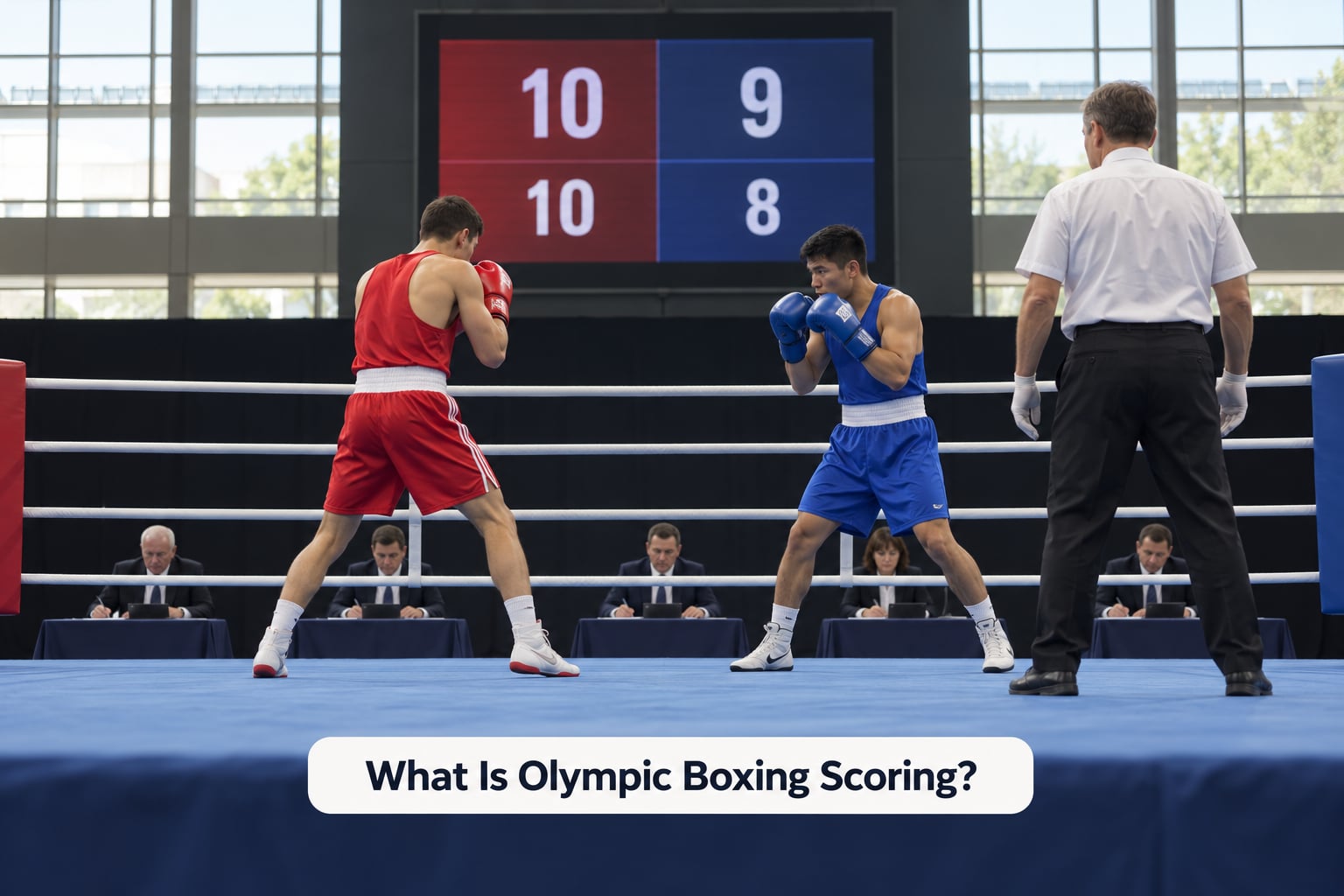
Olympic boxing uses the 10-point-must system. Five judges score each round separately, awarding 10 points to the boxer who won that round and between 6 and 9 points to the boxer who lost it. The scores for every round and every judge are added up at the end, and the boxer with the higher total wins by decision.
The word “must” is the important part. A judge cannot write 9-10 for a round and decide it was too close to call. Someone has to win the round, and that person’s card starts at 10. The only variable is how far the loser finishes behind, which is how judges communicate that a round was dominant rather than competitive.
Each judge writes on a paper card at ringside. At the end of every round the bell sounds, the fighters go to their corners, and each judge has 15 seconds to pick up a pen and record two numbers before the next round begins. That 15-second rule is small but it stops judges from deliberating in front of the crowd and it keeps the corners from hovering over the tables.
Once the fourth round ends, the referee brings the five cards to the ring, totals them, and the supervisor checks the arithmetic. The decision is announced there and then, and the scores are also posted on the arena boards and published in the official results.
How Olympic Boxing Scoring Works at the Paris 2024 Olympics
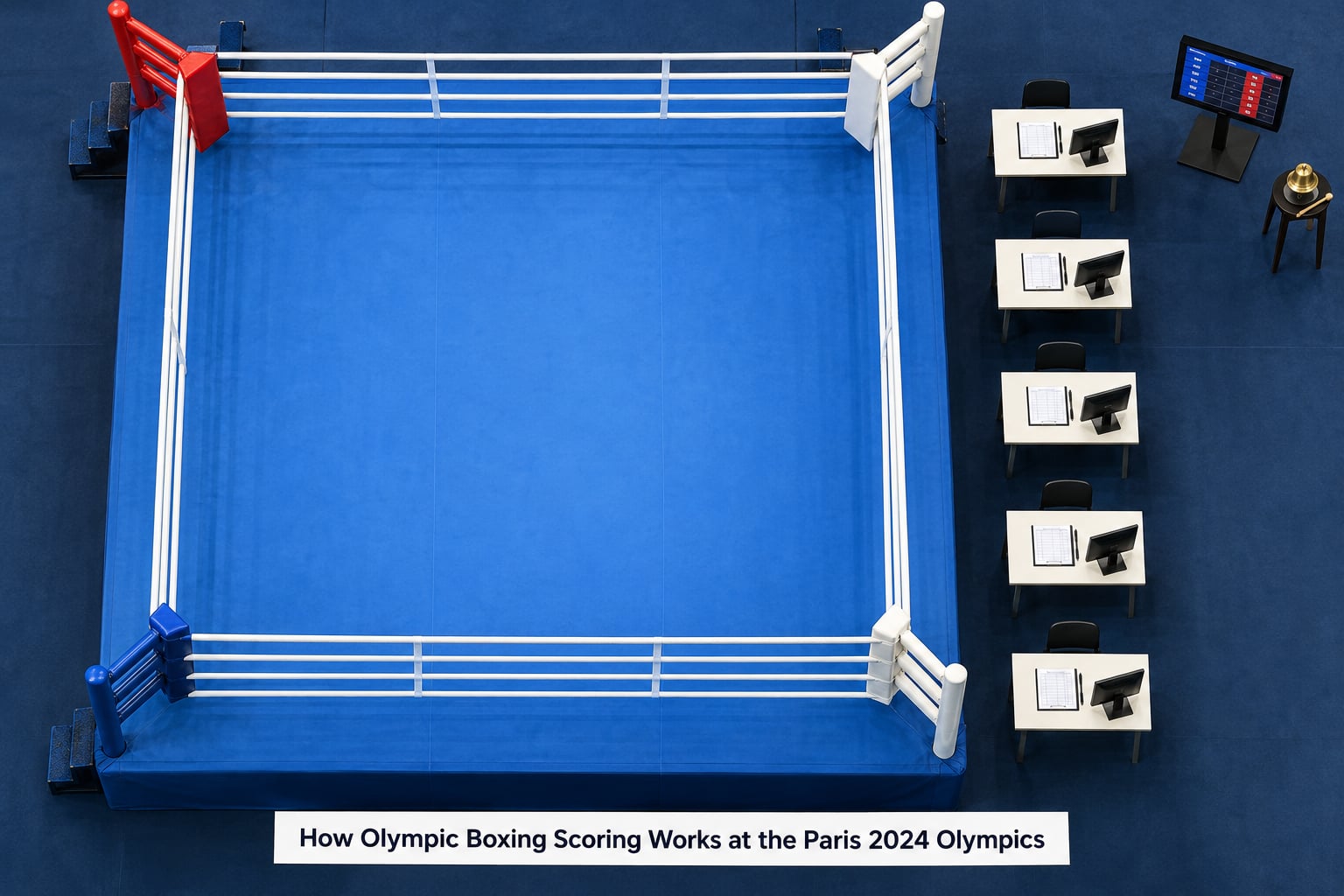
At Paris 2024, every Olympic bout was scored the same way regardless of weight category or gender: four rounds, three minutes each, five judges, one referee and one referee supervisor sitting with the judges. There is no separate scoring format for the medal rounds or for the finals.
That produces twenty individual round scores in a full bout, ten for each boxer. If all five judges agree on the same winner, the result is a unanimous decision. If most but not all agree, it is a majority decision. If they are split, it is a split decision, which is the outcome casual fans tend to find most baffling.
The tournament itself is a single-elimination bracket. There is no bronze medal bout, so both losing semi-finalists take bronze, and the final decides gold and silver on the cards unless someone is stopped early.
What Do the Five Judges Score?
Judges do not count punches. There is no punch counter in the ring and no tally of how many shots landed, which is why a boxer throwing a huge volume of light punches can still lose a round. Instead, each judge applies four criteria in a fixed order, and the IBA competition rules describe them clearly.
- Blows landed on the target areas. Both the head and the body count. Clean contact through the guard or on the gloves does not, and neither do swings that miss entirely.
- Domination of the bout. Who was controlling the distance, forcing the action and dictating the pace of the round rather than reacting to it.
- Technique and tactical superiority. Whether the work was accurate and disciplined, and whether the boxer used a recognisable game plan instead of flailing.
- Competitiveness. Judges reward a fighter who makes the round competitive, and they penalise a boxer who goes on the defensive and stalls.
The order matters in close rounds. Judges are instructed to treat a close competitive round as a 10-9 regardless of small differences in punch count, which is one reason many Olympic fights finish on identical cards even when the action looked untidy.
Power itself is not a criterion. A heavy punch that lands clean counts the same as a fast one that lands clean, and a boxer who swings hard but misses constantly is not rewarded. That is the single biggest difference fans notice between the two codes, and it comes straight out of how Olympic boxers are coached to fill space and throw volume.
How Are 10-9 and 10-8 Rounds Awarded?
Once a judge decides who won the round, the losing boxer’s score communicates the margin. These are the notations you will see on a card, on the arena boards and on the broadcast graphic.
| Round score | What the judge is saying |
|---|---|
| 10-9 | A competitive round. The winner was marginally better, not obviously. |
| 10-8 | Clear domination. Typically one knockdown, or sustained pressure with the loser landing almost nothing. |
| 10-7 | A near shutout round. A knockdown combined with heavy unanswered work, or a round where the loser was badly hurt. |
| 10-6 | Rare. Reserved for extreme one-sided rounds, including a knockdown that was not recovered from. |
| 9-9 | A drawn round. It only appears when a point deduction cancels out the advantage one boxer had, so neither fighter is marked down. |
The most common score in Olympic boxing is 10-9, and it is not a small thing. Two judges writing 10-9 for the same boxer in the same round have described a real advantage, they just do not think it was a big one.
A 10-8 does not automatically follow every knockdown. Judges are told to consider the knockdown together with the rest of the round, so a fighter who is caught by a clean shot, sits up and immediately resumes winning the exchange may still only get 10-9. What consistently produces 10-8 is a knockdown followed by sustained control.
What Happens After Four Rounds?
The referee collects the five cards, the referee supervisor verifies them, and the totals are added. The boxer with the higher aggregate wins, and the type of decision tells you how close it was.
- Unanimous decision: all five judges picked the same winner.
- Majority decision: three judges or more picked the same winner.
- Split decision: the judges did not agree, so the majority winner takes it. A split decision is not a draw.
Totals are usually announced as points for each boxer, such as 40-37 or 40-36, and they always add up to 80 in a four-round bout that went the distance. That 80 is the single most useful trick for reading Olympic results: 40-40 would mean a dead heat across all five cards, and 40-37 means the winner took four rounds from every judge.
A 40-36 looks bigger than it is. Two judges saw four close rounds, one saw a 10-8 somewhere in there, and nobody saw anything close to a shutout. Meanwhile a 39-38 can represent a genuinely tight fight decided by one round on three cards.
How Do Knockdowns Affect Olympic Boxing Scoring?
In Olympic boxing a knockdown is recorded when a boxer touches the canvas with any part of their body other than their feet. Going down on one knee, sitting down, or falling backwards onto the ropes all count. There is no concept of a knockdown being waved off, so a fighter who simply sits down after a miss still gives up the round.
After a knockdown the referee takes a standing count of up to eight. If the boxer cannot continue safely, the contest is stopped. If the boxer rises, the referee brings the action back with a short count, and the judge who gave the knockdown will normally score the round 10-8.
Repeated knockdowns change the arithmetic. Two knockdowns in a round will almost always push that judge to 10-8, and a third can push it to 10-7 or worse. A stopped bout, whether by knockout or by a referee decision after a count, is not decided by the cards at all; it goes into the record as a stoppage.
What Is a Point Deduction?
A point deduction is a penalty the referee applies for a foul during a round. The referee announces the foul and the deduction in front of the audience, and it is recorded on the scorecard, where it can change the outcome of that round or even the whole bout.
The fouls that show up most often in Olympic bouts include low blows, holding and leaning on the opponent, striking an opponent who is on the break, refusing to break, elbowing, repeated infringement of the rules, and headgear coming off during a contest.
The severity depends on the foul and whether the referee judges it intentional. An unintentional low blow that stops a fighter can cost the offender a point, while repeated or deliberate infringements carry heavier deductions, and a boxer who refuses to continue a contest after a count can be disqualified with their opponent awarded the win.
Deductions are why a round can be scored 9-9 or 10-9 even without a knockdown. They are announced loudly, which is why the arena often reacts before the crowd understands what the referee just did.
How Does Olympic Boxing Decide a Winner in a Tie?
Level scorecards are rare with five judges, because three judges choosing the same winner in four rounds takes most of the randomness out of it. When the totals do finish level, the officials apply a countback procedure rather than simply calling it a draw.
Countback compares the cards directly. The boxer who was awarded more winning rounds takes the contest; if that is level, the boxer with more 10-9 rounds takes it. In practice the split settles there, and a genuine draw is treated as an outcome the tournament tries to avoid entirely.
Knockouts and stoppages are settled before any of this. A bout stopped on the cards or by a count is decided at the moment it ended, and the scorecards are recorded as a formality or discarded, depending on the stage of the tournament. No countback is ever applied to a knockout.
What Does a Replay Review Change?
Replay exists to correct mechanical errors, not to re-litigate judging. Officials can review video to check that the scorecards match what happened on the canvas, that arithmetic was right, that a deduction was applied to the correct boxer, or that a bout was mis-recorded.
That distinction matters. If a judge gave a 10-8 when the video shows no knockdown, that is a disagreement about evaluation rather than a clerical error, and the result is normally left alone. If a deduction was entered against the wrong boxer, the card can be corrected, and the outcome of a close round can change with it.
Reviews can be requested by the referee supervisor, by officials and, within limits, by the competing nations. A bout can be held at the arena while a review is completed, though medal ceremonies are not routinely delayed for a dispute over one round’s score.
A Round-by-Round Example of Olympic Boxing Scoring
Here is a full four-round Olympic bout between two fictional boxers, scored by five judges. Red wins every round, but the margin varies from judge to judge, which is exactly what a real scorecard looks like.
| Judge | Round 1 | Round 2 | Round 3 | Round 4 | Total |
|---|---|---|---|---|---|
| 1 | 10-9 | 10-9 | 10-8 | 10-9 | 40-35 |
| 2 | 10-9 | 10-9 | 10-8 | 10-9 | 40-35 |
| 3 | 10-9 | 10-8 | 10-9 | 10-9 | 40-35 |
| 4 | 10-9 | 10-9 | 10-9 | 10-9 | 40-36 |
| 5 | 10-9 | 10-8 | 10-8 | 10-9 | 40-34 |
| Overall | Red | Red | Red | Red | Unanimous decision, 40-35 on three cards |
Round 3 is the interesting one. Judge 1 and Judge 2 saw a knockdown and wrote 10-8, Judge 3 watched a close round and wrote 10-9, and Judge 5 saw enough damage to make it a second 10-8. Same round, three different reads.
Now change one entry. If Judge 3 had scored round 4 to Blue, that card becomes 39-37 for Red and 38-38 for Blue, and the result flips to a split decision. Nothing about the fight changed; one number on one card did it.
Judges also work with a running sense of the whole contest rather than each round in isolation, which is why a judge who has seen four rounds of one-way action can afford to score the fifth 10-9. It is still a 10-point-must round, but it carries far less weight when the totals are already decided.
How Is Olympic Boxing Scoring Different From Professional Boxing?
Professional boxing also uses a 10-point-must card, so the two systems look similar on paper. In practice almost everything that matters has been changed, mostly to reduce the influence of a single judge and reward clean work rather than damage.
| Element | Olympic boxing | Professional boxing |
|---|---|---|
| Rounds | Four rounds of three minutes | Usually twelve rounds of three minutes, with title fights at ten or fewer |
| Judges | Five, sitting together | Three at ringside for most fights |
| What a score means | Number of clean blows on the head and body is the first criterion | Effect and damage carry far more weight than volume of punches |
| A knockdown | Usually produces a 10-8 round and a standing count | A clean knockdown usually produces a 10-8 and can end the fight outright |
| Point deductions | Commonly applied and announced by the referee | Less frequent and more heavily policed |
| Headgear | Compulsory in every contest | Not used, outside of unusual circumstances |
| Eligibility | Open to professionals since 2016, but world titles are not at stake | Champions risk their belts and licences by entering |
Five judges instead of three is the most reliable way to describe the difference. More cards means a single bad round from one official is less likely to decide the fight, which is exactly why the shift was made after a run of disputed decisions in the amateur system.
Frequently Asked Questions
What does 116 to 112 mean in boxing?
That score came from the old punch-count era, when judges literally counted the blows that landed. Under the 10-point-must system it no longer appears. The modern equivalent is a four-round Olympic total such as 40-37, which adds to 80 because five judges score ten rounds. Older scorecards with numbers like 116 to 112 come from twelve-round contests scored on a different basis entirely.
How does 10/8 scoring work?
A 10-8 means the judge scored that round 10 for the winner and 8 for the loser, a margin of two points instead of the usual one. It normally follows a knockdown, a sustained knockdown plus control, or a round in which the loser landed almost nothing clean. It is written as 10-8 on the card and simply adds to the totals at the end.
Can Olympic boxing bouts end in a draw?
Level scorecards are very unlikely with five judges, and the rules provide a countback procedure for the rare case: the boxer who won more rounds takes the contest, and if that is level, the boxer with more 10-9 rounds does. In practice a knockout or stoppage also settles matters outright, since no countback is applied to a bout that ended early.
Is taking a knee a knockdown in boxing?
Yes. In Olympic boxing a knockdown is recorded when any part of a boxer’s body other than the feet touches the canvas, so going down on one knee, sitting down or falling through the ropes all count. There is no provision for a knockdown to be waved off, which is one of the reasons amateur boxers are taught to stay on their feet.
What do 1, 2, 3, 4, 5, 6 mean in boxing?
Those numbers come from the old system where judges counted punches landed, so a boxer could be credited with six punches in a round. Under 10-point-must, judges never award fewer than 6 points to a boxer who lost a round. Seeing 10-6 on a card therefore tells you a judge considered the round close to a shutout, which is rare at Olympic level.
Why was boxing removed from the 2028 Olympics?
Boxing has not been removed from the Los Angeles 2028 programme, but its place there has been unsettled for years. The International Olympic Committee suspended its recognition of the sport’s governing body in 2023, and the two organisations have been in dispute since, including over who sets the competition rules that judges use. That fight is about governance, not about the scoring system.
Conclusion: Start With the Ten-Point Round
Strip away the ceremony and Olympic boxing scoring is simple. Someone wins each round, that boxer is given 10, and the judge uses the loser’s mark to say how one-sided it was. Five judges, four rounds, twenty scores, and the higher total takes the bout.
Once that clicks, the confusing parts sort themselves out. A 40-36 is four close rounds, not a rout. A 10-8 is a knockdown or a round of total control. A split decision is a normal result rather than a scandal, and a foul you heard the referee announce has already been written onto someone’s card.
Follow the round numbers rather than the total during the fight itself. By the time the final tally appears, the work has already been done, and the answer to who won was written down 15 seconds after each bell.