Your first boxing class is a coached, non-contact session built around the fundamentals: your stance, basic footwork, and the jab and cross, taught through shadowboxing, bags and pads before any contact work is introduced. You will sweat, forget half of what you were told, and go home sore in places you did not know existed. That is a normal first session, not a sign you are bad at it.
The honest version is that beginners rarely nail anything on day one. What you will get is a working vocabulary, a coach who corrects one or two things, and a clear sense of whether you want to come back. Everything else takes weeks.
Table of Contents
- What to Expect at Your First Boxing Class
- How to Prepare Before Your First Boxing Class
- What to Wear and Bring
- What Happens During Your First Boxing Class
- Which Skills Will You Learn First?
- How Hard Is a First Boxing Class?
- Do You Need to Be Fit Before Starting Boxing?
- Is Your First Boxing Class Safe?
- What to Do After Your First Boxing Class
- Frequently Asked Questions
- What Should You Do First?
What to Expect at Your First Boxing Class
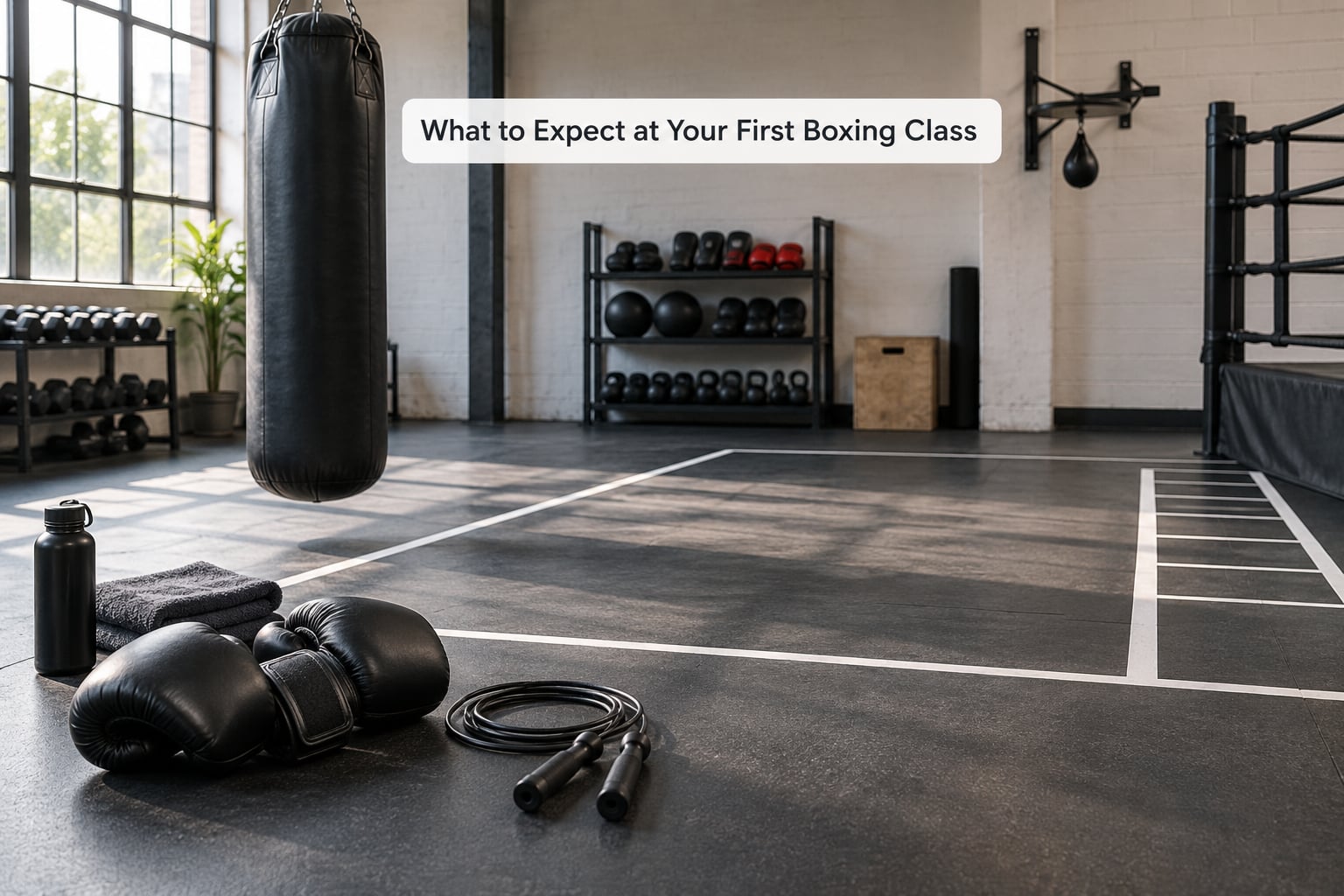
In the first hour you are mostly being introduced to the sport’s movement patterns rather than tested on them. Expect a group warm-up, a short technical breakdown, then drills where you repeat the same movement until it stops feeling strange.
The room will be louder and busier than you expect. Bags thumping, jump ropes on concrete, timers beeping, someone else grunting through burpees. Nobody is watching you the way you think they are.
That impression is the single biggest reason people put off starting, and it is worth naming directly. Posters on r/amateur_boxing asking what their first class will be like mostly get the same answer back: just be cool and you will have a great time, everybody in the room was terrible once, and hard work is what makes you stand out to a coach. Nobody in a beginner class is measuring you against the person on the bag next to you.
Everyone works at their own pace. The person shadowboxing next to you may have been coming for a year, and the coach will still break the technique down for the newest person in the room without hesitation.
You will make mistakes that feel obvious in hindsight. Hands drop when you get tired. Feet cross over. You reach with the jab instead of stepping. All of it is normal for a first class.
Most beginners finish a first session able to explain what a guard is and roughly how to throw a jab. That is a successful first class.
How to Prepare Before Your First Boxing Class
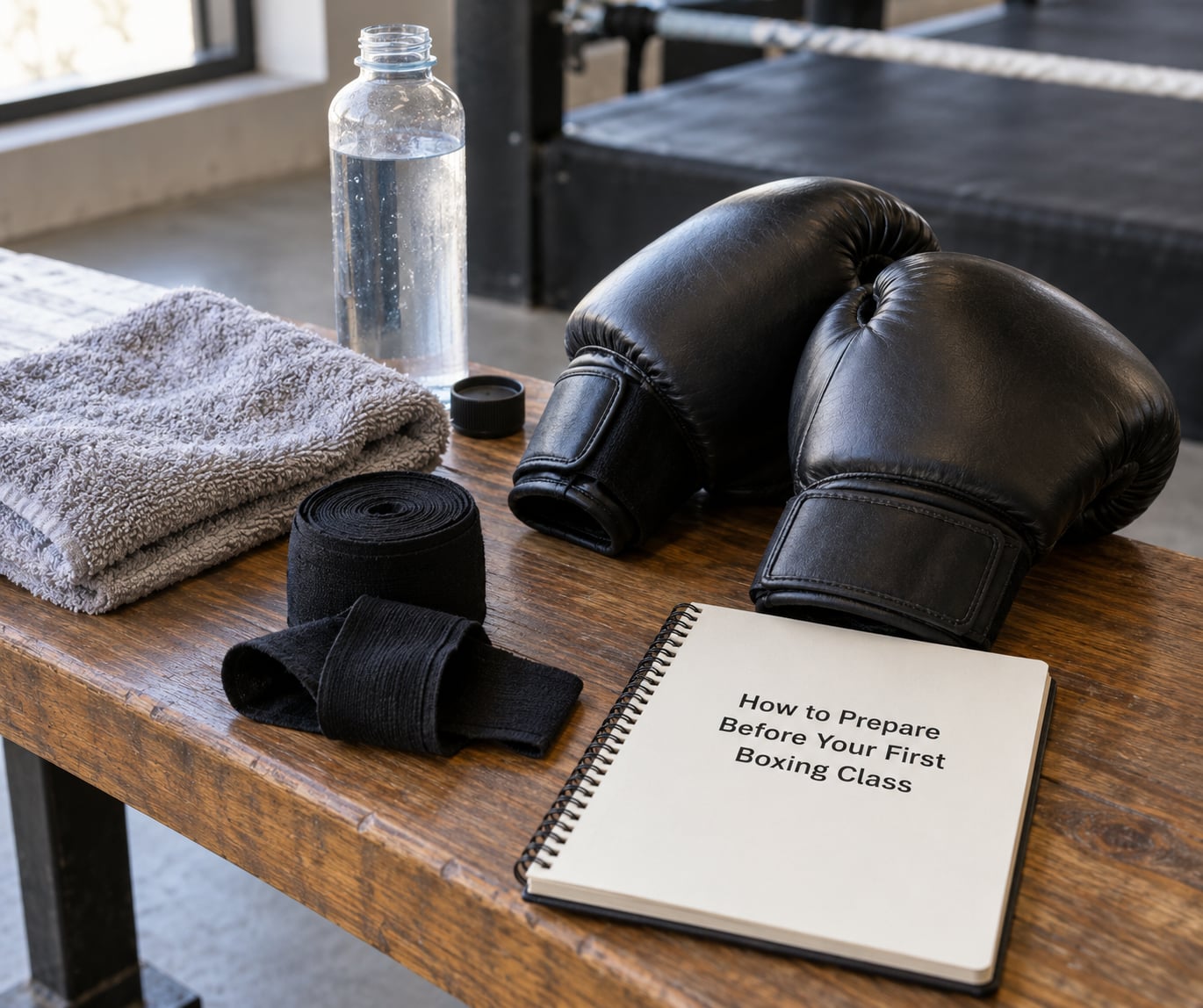
A couple of hours of sensible preparation makes the session noticeably easier. Eat a normal meal two to three hours beforehand rather than arriving empty or after a heavy meal.
Drink water through the afternoon and bring a bottle you can actually get open one-handed. Hydration matters more in a beginner class than most people expect, because the warm-up is long and the room is warm.
Skip the hard session the day before. If you have planned a leg workout or a long run, move it. You will be using your legs and shoulders hard enough without pre-fatiguing them.
Arrive 15 to 30 minutes early. That window covers sign-in or waivers, changing, loaner gloves and wraps. Arriving at the start of class often means the coach has already started without you.
Tell the coach about anything relevant before you begin: old injuries, a bad shoulder, a wrist issue, pregnancy, medication, or anything your doctor has told you to avoid. It takes ten seconds and it changes how you get coached.
Start at moderate effort. Training to failure in the first ten minutes means you spend the rest of the class with bad form and no memory. Coaches would much rather see controlled work early and more later.
What to Wear and Bring
You need very little for a first boxing class, and most gyms have the expensive parts on hand. Bring yourself, comfortable clothes and water, and check the gym’s website or front-desk list before you go.
Clothing and shoes
- Moisture-wicking athletic clothing you can move in. Shorts or leggings plus a plain top works.
- Flat, lightweight athletic sneakers with good lateral support. Court shoes or running shoes, not boots.
- No zippers, buttons, metal studs or loose jewelry. Anything that catches a glove or scrapes the bag becomes someone else’s problem.
- A change of clothes and a towel for afterwards.
What most gyms provide, and what you bring
| Item | Usually provided | Notes |
|---|---|---|
| Boxing gloves | Yes, as loaners | Sizes vary, and shared gloves get wiped down but not tailored to you. |
| Hand wraps | Often sold on site | Ask for a beginner pair; you need about 4.5 meters for standard wrapping. |
| Water bottle | No | Bring a large one. There is usually a refill point. |
| Clothing and shoes | No | Bring your own trainers. Coming in work shoes is a common first mistake. |
| Towel | No | Bring one, plus a change of clothes. |
| Mouthguard | Sometimes | Not needed for a non-contact class; useful once sparring starts. |
You do not need to buy your own gloves before your first class. Waiting until you know you will keep going saves money and saves you from owning a pair sized wrong for your eventual hand wrapping habit.
What Happens During Your First Boxing Class
A typical beginner class runs 45 to 60 minutes and follows the same arc every time: arrive and wrap, warm up, learn technique, apply it on bags or pads, finish with conditioning, then cool down. The exact order varies by gym and by coach, and a good coach will cut parts to protect safe movement rather than push through fatigue.
Minute by minute: what to expect at your first boxing class
- Arrival and sign-in (15 to 30 minutes before class). Waivers, membership forms, a locker key, maybe a photo for the wall. Some gyms do this online beforehand.
- Wrapping your hands (5 to 10 minutes). A coach or an experienced member shows you the loop-over-thumb, across the palm, around the knuckles method. Expect to do it clumsily the first time.
- Group warm-up (8 to 12 minutes). Jumping jacks, skipping or rope work, dynamic stretches, arm circles, shadowboxing at low intensity. This is where you find out how your body is doing today.
- Stance, guard and footwork (5 to 10 minutes). The orthodox stance, hands up, weight on the balls of the feet, moving laterally and pivoting. Repetition without speed.
- Punch technique (10 to 15 minutes). The jab and cross broken down, then the left hook and uppercut introduced. The coach demos, the class mirrors, then you do it alone.
- Bag or pad work (10 to 15 minutes). Working rounds with rest between them. This is where you put the new movement into practice and where technique gets corrected again.
- Conditioning finish (5 to 10 minutes). Burpees, squats, push-ups, core work, or skipping intervals. Often the part beginners underestimate.
- Cool-down (5 minutes). Stretching, breathing, and the coach telling you what to focus on next session.
Rounds in a beginner class are short. One minute of work with a minute or two of rest is a real round, and short rounds exist because they let you learn with fresh attention rather than grinding through fatigue. Boxing’s governing bodies use three-minute rounds for competition, which is a completely different demand.
Which Skills Will You Learn First?
The first session introduces a small set of movements and repeats them. Each one has a plain meaning, which helps when a coach uses the technical term.
- Orthodox stance. Feet shoulder-width apart, left foot and lead hand forward, weight balanced and slightly on the balls of the feet.
- Guard position. Hands up near the chin, elbows in, protecting the jaw and ribs. Dropping the hands is the single most common beginner habit.
- Footwork. Slipping left and right, moving in and out of range, and pivoting on the back foot after a punch.
- Jab. The lead straight punch thrown from the shoulder, used to measure distance and set up everything else.
- Cross. The rear straight punch, usually thrown with a hip and shoulder rotation. It carries the power, not the jab.
- Left hook. A lead-side curved punch. This is the one that feels most unnatural for most beginners, and it usually takes a couple of weeks to stop feeling wrong.
- Uppercut. A compact vertical punch that travels upward under the opponent’s guard. Often introduced but not drilled much in a first class.
- Shadowboxing. Punching the air with correct form. No bag, no partner, all the technique.
- Bag work and mitt work. Punching a heavy bag for power and rhythm, or focus mitts with a coach for timing and accuracy.
None of that is sparring. Sparring means another person deliberately throwing punches at your head with permission for you to return them, and it comes much later, after a coach has decided you can protect yourself and control your output.
How Hard Is a First Boxing Class?
Harder than most people expect, but the difficulty is mostly unfamiliar coordination rather than raw fitness. Your cardiovascular system will be fine; your nervous system will be doing something new for sixty minutes.
Rope work and shadowboxing are harder than punching a bag. Bag work is heavy, but it lets you set your own rhythm. The technical rounds ask more of your attention than your lungs, and the conditioning finish is what usually has people winded on the floor afterwards.
Symptoms of a normal hard class: sweat, a racing heart, shaking legs, breath you cannot control for the first few minutes, and a general sense of having done more work than you thought.
What to do about it: breathe through your nose when you can, drop your power to about 70% for the first technique round, and take the rest intervals the coach offers. Sitting out one round is fine. Nobody will remember it.
The first class tests whether you can learn a movement while tired, which is a different problem from whether you can run for 30 minutes.
Do You Need to Be Fit Before Starting Boxing?
No. Nobody starts fit, and beginner classes are built for people with no fitness base at all. Fitness helps, but it is not a qualification.
Classes are scaled more than beginners expect. Jumps can be done without a jump rope. Burpees can become step-backs. Long combinations become two punches at a time. A coach watching a mixed-ability class is usually choosing what to simplify.
Age is not a barrier either. It is a live question on these search pages, and the answer from people who coach beginners is consistent: nobody in a beginner class cares how old you are. Say your age only if it affects what you should be doing, and otherwise leave it at the door.
Choosing a class that matches your current level matters more than being ready. Look for a class labelled beginner, fundamentals, novice or Level 1, and avoid open gym sessions on your first visit. If you are returning to exercise after a long break or managing a health condition, tell your doctor first.
Women-only classes exist and are a good first step if the mixed room is part of what is holding you back. Nothing about the sport changes, but the room does feel different.
Is Your First Boxing Class Safe?
Yes, when the gym runs beginner classes properly, and the safety comes from a few unglamorous things: supervision, progressive load, matched equipment, hand wrapping, hydration, and honest communication.
Every beginner class at a legitimate gym is non-contact. Nobody is being used as a punchbag, and nobody is hitting you. USA Boxing, England Boxing and the BBBofC all treat sparring as a supervised step that comes after technique, conditioning and pad work, not as something a first-timer is dropped into.
Hand wrapping matters more than beginners expect. Wraps support the wrist and knuckles and spread impact across the hand. Poorly wrapped hands are a common source of knuckle pain in exactly the people who should avoid it.
Stop and speak to the coach if you feel sharp pain, dizziness, unusual breathlessness, or anything in a joint that changes the way you are moving. Pain is information. Ignoring it is not toughness, and no coach worth training with will mind you saying so.
For your own health questions, a doctor or physiotherapist is the right person, not a boxing coach. Coaches are excellent on movement and training, not on diagnosing anything.
What to Do After Your First Boxing Class
The first session does not end when the timer stops. What you do over the next 48 hours decides how you feel about coming back.
Rewrap your hands and take the tape off rather than leaving wraps wound tight overnight. Most people leave them on because they forget, and that is a good way to irritate your own hands.
Drink more water than you think you need over the next few hours, eat normally, and get a proper night’s sleep. Your body is repairing unfamiliar work, and sleep is when most of that happens.
Expect delayed-onset soreness in your shoulders, calves and the tops of your feet, usually showing up 12 to 36 hours later and easing over a few days. Unaccustomed exercise causes this; it is not a sign of damage.
Sharp pain, swelling, pain that lands in a joint rather than the muscles, or discomfort still getting worse after three or four days is not normal soreness. Stop training through it and speak to a healthcare professional.
Write down one thing the coach corrected. Bring it to the next class. That single note is worth more than the whole first session, because it is the thing you will actually fix.
Frequently Asked Questions
Do I need any boxing experience before my first class?
No. Beginner classes assume zero experience, and coaches teach from the stance up. Every movement gets demonstrated before the class tries it, and intensity is scaled to whoever is in the room. Fitness helps you feel better in class, but it is not a requirement and nobody in a beginner session is judging your conditioning.
What should I bring to my first boxing class?
Comfortable athletic clothing, lightweight trainers with good lateral support, a large water bottle, a towel and a change of clothes. Leave zippers, jewelry and watches at home. Most gyms supply loaner gloves and sell hand wraps on site, so you do not need to buy anything before your first session.
How long does a beginner boxing class usually last?
Most run 45 to 60 minutes, and arrive 15 to 30 minutes early for sign-in, waivers and wrapping. The session itself is roughly 10 minutes of warm-up, 25 to 30 minutes of technique and drills, 10 minutes of conditioning and 5 minutes of cool-down. Ask the gym before you go if you want to be certain of their timing.
Will I have to spar during my first class?
No. A legitimate beginner class is non-contact, and most run entirely without anyone throwing a punch at you. Sparring is a separate step that comes after technique, conditioning and pad work, and only when a coach decides you can protect yourself. You can also ask directly before you sign up and get a straight answer.
Is beginner boxing cardio harder than running?
In some ways, yes. Boxing keeps you at a high heart rate for a full hour with no long recovery, and it asks for coordination while you are out of breath. The rope work and shadowboxing are usually the hardest part for new people. If running feels easy but your first class wipes you out, that is normal, not a fitness failure.
How sore should I be after my first class?
Moderate soreness in your shoulders, calves and the tops of your feet is common, usually appearing 12 to 36 hours later and settling within a few days. It happens because the movements are new to your body. Sharp pain, swelling, or discomfort that worsens after several days is not normal soreness, so stop and speak to a healthcare professional.
What Should You Do First?
Book a beginner or fundamentals class, check what your gym provides, and bring trainers, comfortable clothes and a water bottle. Arrive 15 to 30 minutes early, tell the coach about any injuries, and do the first half hour at about 70% effort.
Then judge yourself on whether you enjoyed it, not on whether you were good at it. Nobody who trains now was competent in their first class. What you expect at your first boxing class is a foundation, and everything else gets built on it one Tuesday evening at a time.