To read a boxing scorecard, match each round to the number a judge wrote next to it, work down that judge’s column, and add it up. A boxing scorecard is the round-by-round record each of the three ringside judges keeps during a fight, giving 10 points to the fighter who won the round and 9 or fewer to the fighter who lost it.
That single rule is the whole system behind a result like 116-112. Once you can see how the boxes are filled in, a card stops being a puzzle and becomes a record of exactly which rounds decided the fight.
It takes about five minutes to follow a full card while a fight is on, and most broadcasts put a running tally on screen every round or two. One caveat before you start: those tallies are provisional until the announcer in the ring reads out the official decision.
Table of Contents
What You Need
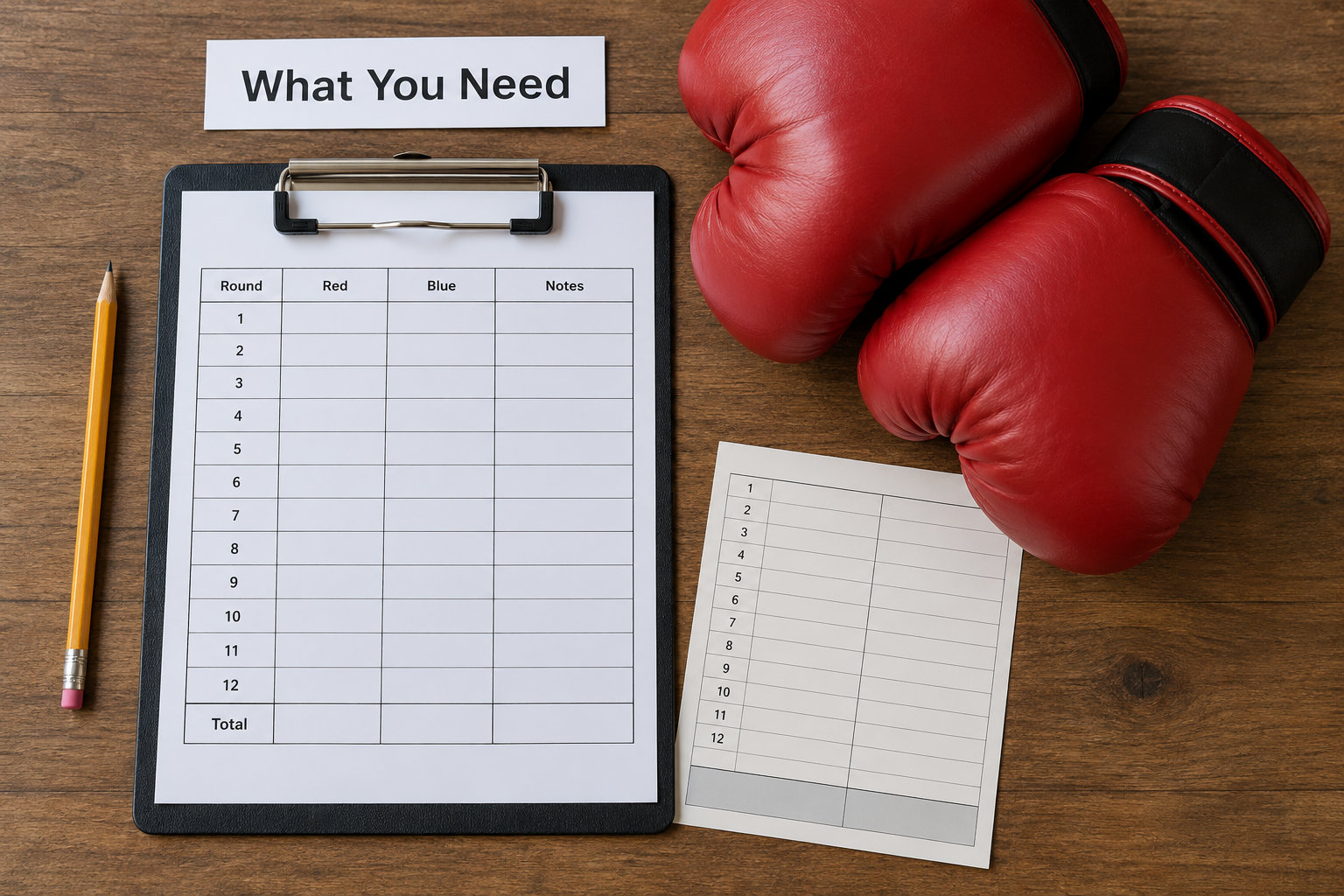
You need four things before a card makes sense: how many rounds are in the bout, the three judges’ names, the scoring rules, and somewhere to write. There is no punch counter and no hidden formula.
- The round count. Most title fights run 12 rounds of two minutes, plenty of championship and elimination bouts run 10, and lower-weight or early-round fights run 8.
- The judges’ names. Broadcasts put them on screen before the opening bell, one per column, and they change commission to commission.
- The 10-Point Must rules. Ten to the round winner, nine to the other fighter, with extra points subtracted for a knockdown or one-sided action.
- A pen and a quiet ten minutes. Fans who score along usually keep a card for the whole fight rather than catching up afterwards.
What you do not get is the judges’ reasoning. A card records only the numbers, so every argument about a close fight starts by disputing what a judge wrote in a box.
How to Read a Boxing Scorecard: Step-by-Step
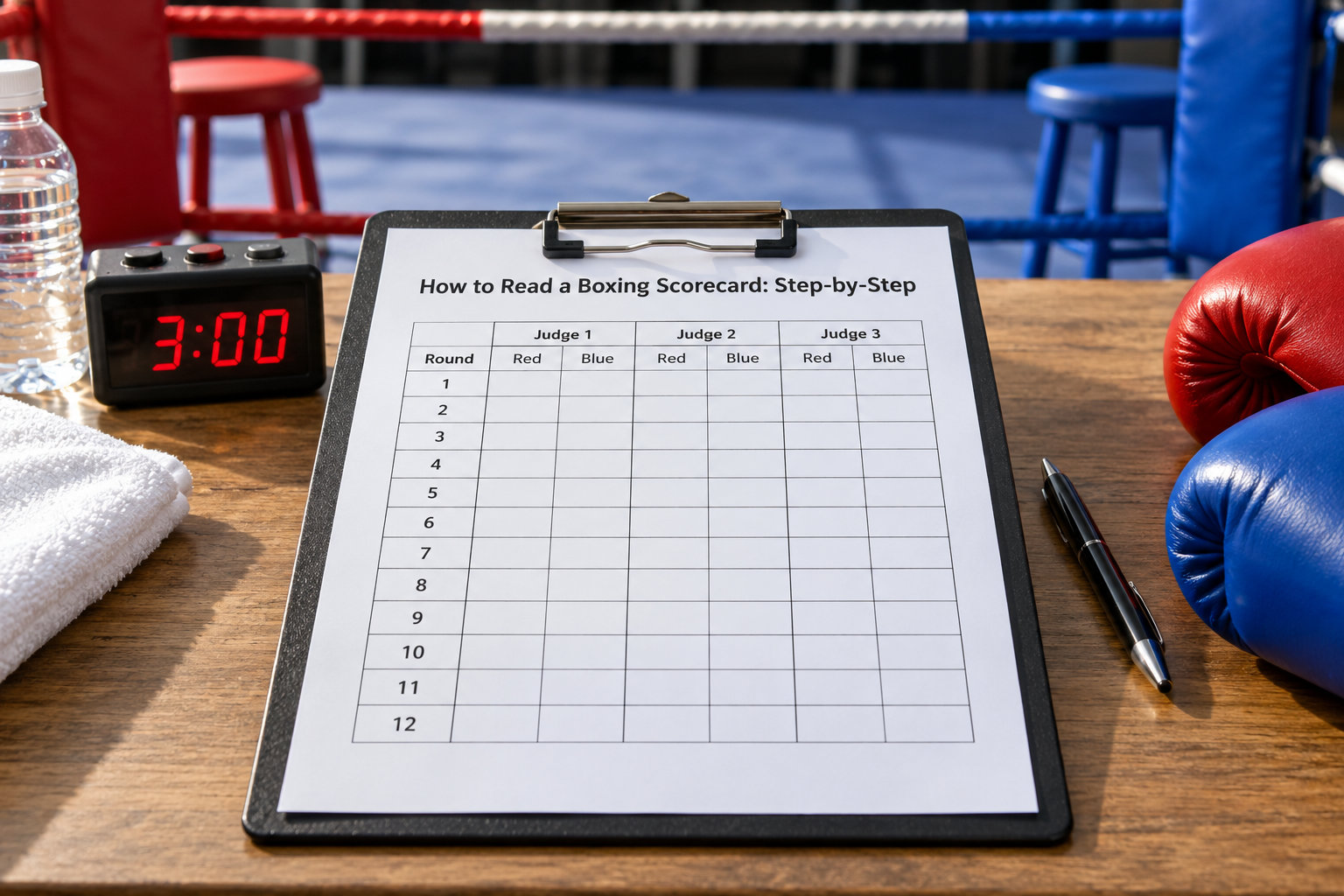
Reading a boxing scorecard takes five steps: find the round number and the judge’s column, remember that every round starts at 10 points, weigh each round on clean punching, defense and control, account for any knockdown, then add each column to a total. Here is each step in full.
1. Find the judges’ columns and round numbers
A card is a grid. Round numbers run across the top, one box per round, and the judges’ names sit above or below in three separate columns. Each judge scores independently, so the three columns are three different opinions of the same twelve minutes, not three versions of the same opinion.
Broadcast graphics usually start at round one on the left and read right, which is how a judge would hand-fill a paper card too. If you join a fight late, count the boxes across the top rather than trusting the round counter on screen, because broadcasters often trim a round early.
2. Understand the 10-point must
The 10-Point Must System means the winner of a round is awarded 10 points and the loser 9, no exceptions, and judges write the 10 first and subtract from there. That default matters: if a judge cannot decide a round clearly enough to take more than a point off, the card says 10-9.
| Score | What it means | When a judge writes it |
|---|---|---|
| 10-9 | A clear round for one fighter | The default. Any round one fighter won without dominating it. |
| 10-8 | A knockdown or a dominant round | A fighter was dropped, or controlled the action almost without answer. |
| 10-7 | A lopsided round | Two knockdowns in one round, or sustained one-way pressure. |
| 10-6 | Almost no contest | Rare. Three knockdowns, or a round so one-sided the judge treats it as negligible. |
| 10-10 | An even round | Very little landed, or clean punches traded evenly with nobody hurt. |
A 10-8 does not mean a knockout happened. The rules tell judges to award it when one fighter has dominated the action of the round, and most knockdowns produce one anyway.
3. Score each round for clean punching, defense and control
Judges are required to weigh four things, in a fixed order of importance. Knowing the order stops you from rewarding the wrong fighter.
- Clean punching. Shots that land cleanly without the receiver holding on, leaning away, or the punch landing on the glove.
- Effective aggression. Pressing the action, not just being busy. Punching into a block and coming straight back out of range scores less than a shot that forces a defensive move.
- Ring generalship. Controlling where the fight happens, dictating the distance and pace, pushing an opponent onto the ropes or the ropes-cutter.
- Defense. Slipping, blocking and making an opponent miss. Defense only counts when it works; slipping punches and getting hit anyway is not a strong round.
Landed punches matter, but they are evidence rather than the score itself. The old CompuBox punch-counting figures were dropped as a scoring basis years ago for exactly that reason, and the “80/20 rule” the internet repeats, meaning a fighter should lose a point when he lands four punches to one, is not a rule in any commission’s book.
4. Account for knockdowns and competitive rounds
When a fighter goes down, a judge does not simply tick 10-8 and move on. The questions asked are how hard the shot was, whether it was clean, whether the hurt fighter recovered before the bell, and whether the round was already lost. A late knockdown of a fighter who was already winning usually stays a 10-9.
The referee’s opinion of a knockdown matters too, since a fighter who trips, catches a shot on the glove, or goes down off balance can have the count waved off. But the referee cannot go back and change a round a judge has already written down.
5. Add the round totals and check the official decision
Add one judge’s column and you get that judge’s total. A twelve-round card of 116-112 is 116 for one fighter and 112 for the other, and the 120-point maximum only exists on paper, since it would need every round to be 10-8 or better. A four-point gap like that is built from eleven 10-9 rounds for the winner, one 10-8 the other way, and no round scored above 10-9 for anybody.
Then look at the three totals together. That combination is what the announcer reads out as the decision, and the ringside announcement, not your screen, is the official result.
| Decision | What it takes | Typical announcement |
|---|---|---|
| Unanimous decision | All three judges picked the same fighter | “unanimous decision, 116-112, 116-112, 116-112” |
| Majority decision | Two of three judges, with one judge favoring the other fighter | “majority decision, 115-113, 115-114, 112-116” |
| Split decision | Two of three, and the third judge goes the other way | “split decision, 114-114, 115-113, 112-116” |
| Draw | Every judge wrote the same score for both fighters | “a draw, 114-114, 114-114, 114-114” |
A majority and a split decision sound identical and are not. A majority decision means the dissenting judge scored the fight a draw, so two judges agree on a winner and the third says nobody won.
Common Mistakes
- Treating landed punches as the whole score. Fix: score the round by what it forced, not what it counted. Two heavy shots that block a counter do not beat twenty jabs that do nothing.
- Assuming a knockdown wins the fight. Fix: one knockdown changes one round, usually to 10-8. Two more rounds after it, and the totals decide the fight.
- Thinking three judges means three systems. Fix: all three use the same rules and score independently. A wide card usually means three honest opinions, not three different rulebooks.
- Treating the on-screen tally as final. Fix: wait for the announcer. A running total can move until the sheets are signed.
- Ignoring fouls and deductions. Fix: low blows, headbutts, holding and hitting after the bell can cost a fighter a point, and a deduction is not always written where a fan can see it.
Two habits help more than any tip. First, write your card round by round instead of deciding the fight at the end, because a fan who only picks a winner at the final bell is really voting for a fighter rather than scoring rounds. Second, keep the round your favorite fighter lost; watching a decision is where the argument usually lives.
It is also normal to score a fight differently than the judges did. Fan cards usually land within one to three rounds of the official one, and a fifth-round gap is rare enough to be worth investigating, usually by rewinding the round you scored wrong.
Frequently Asked Questions
How is boxing scored on a 10-point scale?
Every round starts with 10 points for the fighter who won it and 9 for the fighter who lost it, under the 10-Point Must System. Judges write the 10 first, then subtract, so the default for any round without a knockdown or dominant action is 10-9. Points are added across all rounds for each judge, and the fighter with the higher total on the majority of the three cards wins.
How does 10-8 scoring work?
A 10-8 is written when a fighter is knocked down or dominates the round. Judges are told to award it when one fighter has clearly controlled the action, and a knockdown from a clean shot almost always produces one. Two knockdowns in a round can become a 10-7, and a fighter who goes down late in a round they were already winning may still only receive a 10-9.
What does 116 to 112 mean in boxing?
Those are the two fighters’ final totals from a 12-round bout, and the gap is only four points, so the fight was close. Reading the card tells you where those points came from. If one judge scored 116-112, another 115-113 and a third 115-114, it was a unanimous decision. If the third card went the other way, it was a split decision instead.
Can you get a 10-8 in boxing without a knockdown?
Yes. A knockdown is the usual trigger, but not the only one. Judges are instructed to award a 10-8 whenever one fighter has dominated the action of a round, and some commissions require it in that situation. The difference on the card is the same single point, so a fighter who controlled six minutes of a round can pick up the extra point without anyone touching the canvas.
Can a boxing round be scored 10-10?
Yes, a judge may write 10-10 for an even round, and it is rare rather than forbidden. It usually happens when almost nothing lands, or when both fighters traded cleanly and neither was in control. A 10-10 is a normal entry on an official card, and plenty of fans who score fights themselves allow it when a round was genuinely even, which many online scorecard tools do too.
Why is boxing no longer 15 rounds?
Fifteen-round bouts disappeared because of the damage they did to fighters, and the risk came from cumulative punishment rather than any single round. The last 15-round world title fight in the United States was in 1987, and 12 rounds has been the standard championship length ever since. Most title fights now run 10 or 12 rounds, and lower-weight and early-round bouts run 8.
Conclusion
The first thing to do with a boxing scorecard is find the round number and the judge’s column, then treat every round as 10 points until something makes you subtract. Weigh each round on clean punching, defense, ring control and how badly a knockdown hurt the fighter, write the number in the box, and keep going.
When the bell ends, add each column separately. Three totals in the same direction is a unanimous decision, two is a majority or split depending on what the third card said, and identical totals on all three mean a draw. Getting there takes one fight of practice, and after that you will read results the way you read any other sport.