Boxers build strength without losing speed by training for rate of force development, not tonnage. Heavy base work on squats, hinges, presses and pulls builds the engine; fast strength-speed work, band resistance and medicine-ball throws keep the punch quick. Most fighters need two or three lifting sessions a week, with upper-body volume kept deliberately low.
The old gym saying is that weights make you slow and bulky, and plenty of clubs still repeat it. The saying is not entirely wrong, but it describes one narrow way of training: slow, grinding, high-rep work dominated by arms and chest, performed without any fast work at all. Strip that out and the argument collapses. A punch is over in roughly 60 milliseconds, so what matters is how quickly you can produce force, not how much weight you can move for ten seconds.
Below is the way how boxers train strength without getting slow in practice: a progression you can slot around three or four boxing sessions, a load table you can copy, and the honest list of mistakes that do slow fighters down. This is general training information, not medical advice. If you have an existing shoulder, wrist, elbow or lower-back injury, or you are making weight under a coach’s supervision, talk to a doctor or a qualified strength coach before adding load.
Table of Contents
What You Need for Boxing Strength Training
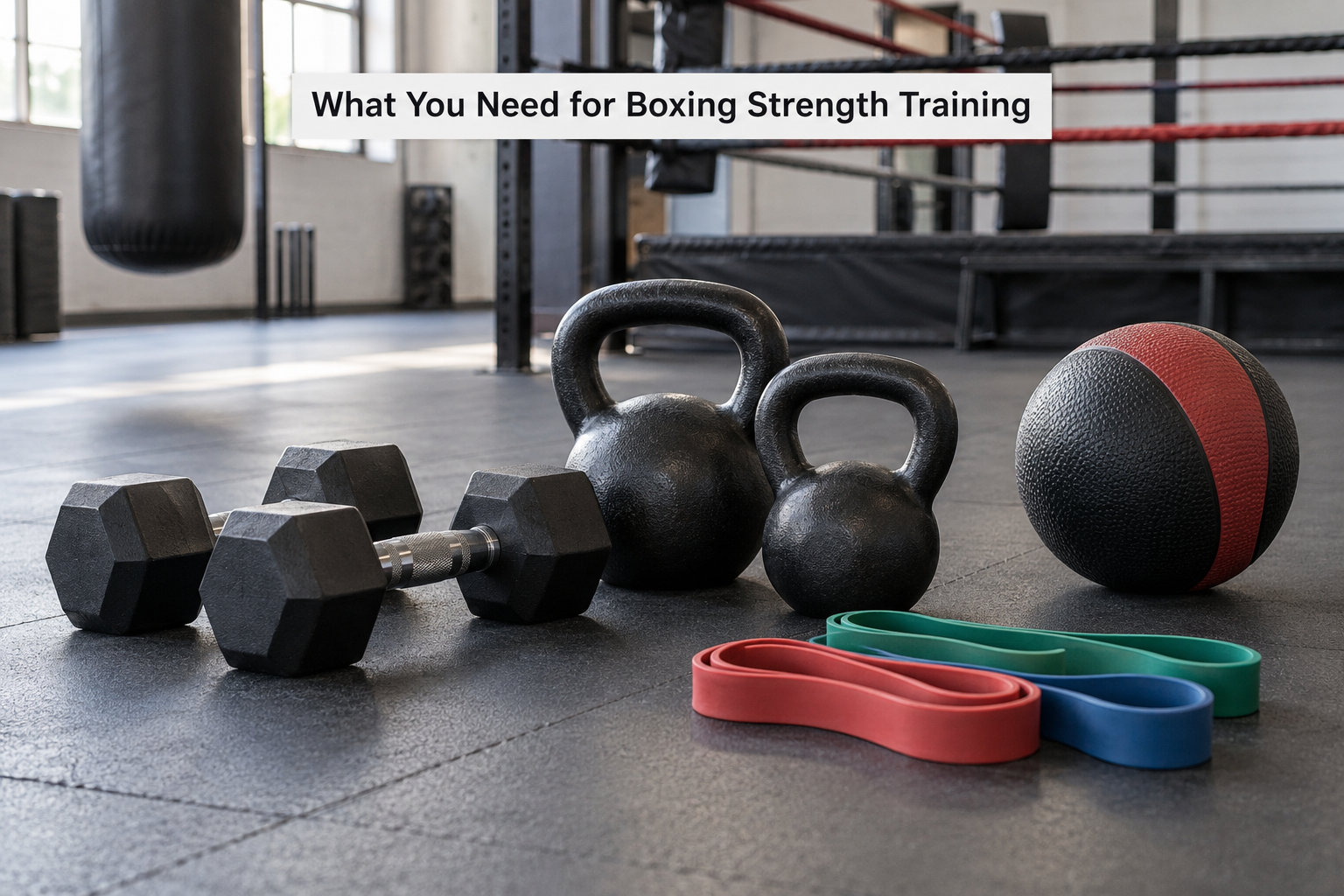
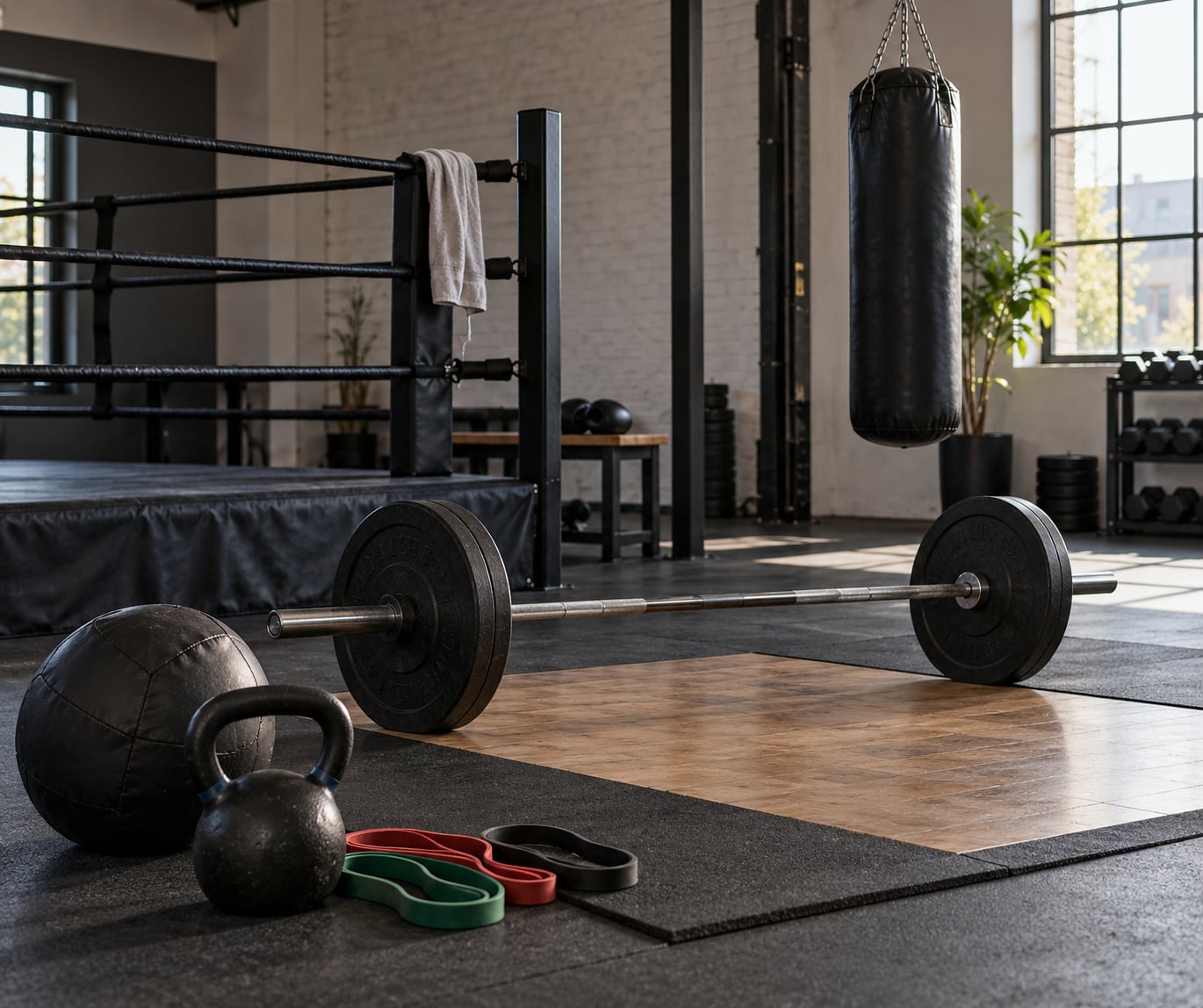
You need very little to start, and the list matters less than how you use it. Four things cover almost everything a boxer does: a barbell or dumbbell setup, a kettlebell, a medicine ball, and bands. A rack, a stable platform and enough clear floor space to swing a bar without hitting someone are the only real requirements.
Free weights come first because they let you load progressively and measure the result. Kettlebells handle swings, goblet work and carries. The medicine ball covers the rotational throw, which is the closest gym approximation to a punch. Bands matter more than most amateurs expect, since they add resistance exactly where the force is highest, at the top of the movement.
Then there is the boring part that decides whether any of it works: food and sleep. Amateurs running a boxing volume of five to eight hours a week are often in a calorie deficit, and you cannot add strength in a deficit. Before adding another lift to the week, get protein and total intake stable, and treat sleep as a training variable rather than a bonus.
A simple weekly schedule matters more than the perfect exercise choice. If you box three or four days, put lifting on the days furthest from hard sparring, and never lift heavy legs the day before a hard sparring session.
Step-by-Step: How Boxers Train Strength Without Getting Slow
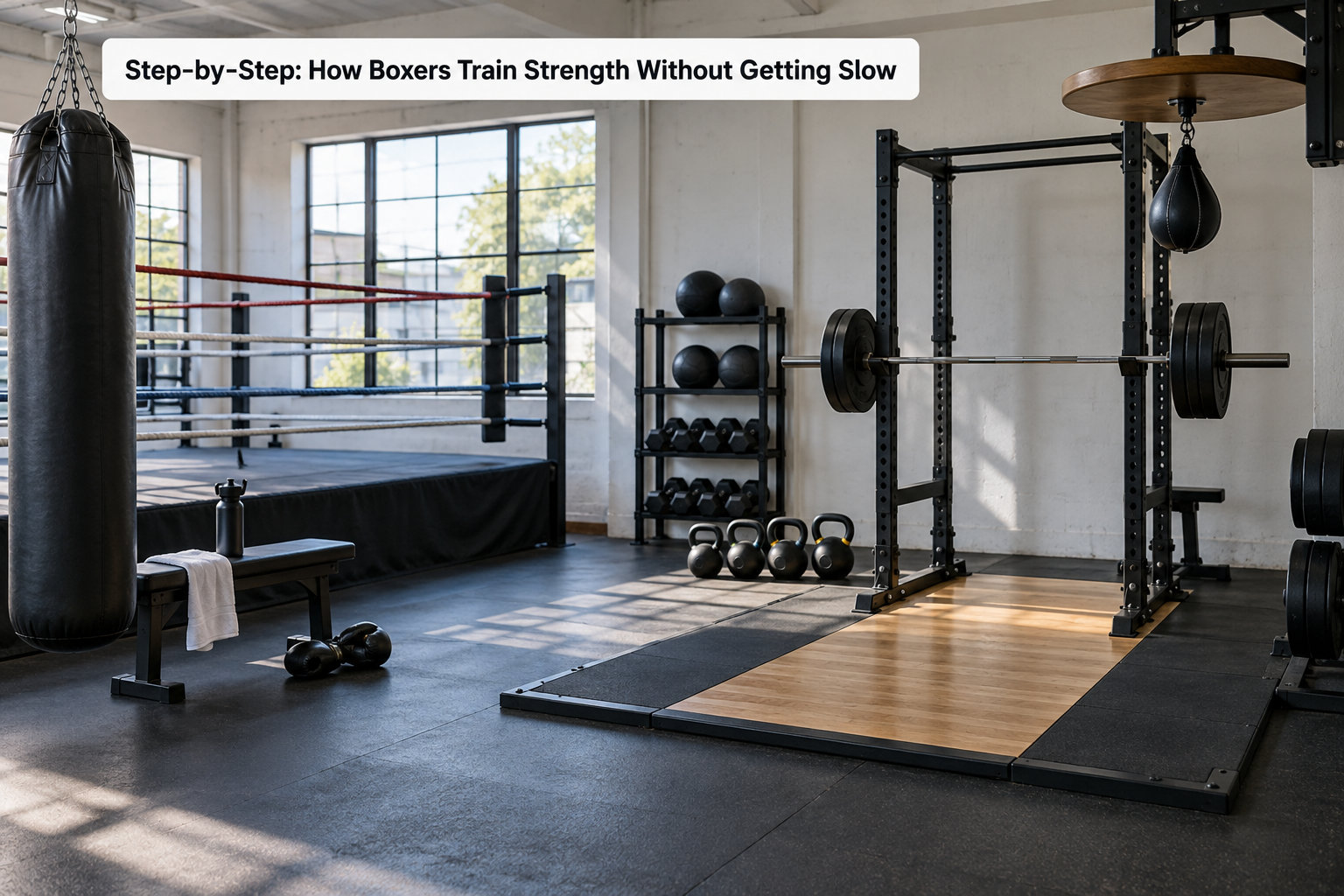
The plan below runs in order, and each step assumes the one before it is in place. Skipping the baseline is the most common reason fighters stall: they add load, feel heavy in the ring, and blame lifting instead of a bad week of sleep or a sparring clash they had not accounted for.
Start With Movement Quality and a Baseline
Learn the main lifts before you chase numbers. A boxer who cannot control a bottom squat position, cannot hinge without rounding the spine, and cannot finish a rep with a stable ribcage will get injured or stalled long before getting strong. Spend the first two or three weeks with light loads, two or three sets per exercise, and a coach or training partner watching the rep rather than counting plates.
Record a baseline for boxing, not just for lifting. Time a fixed three-minute combination on the heavy bag, count how many clean power shots you land in a round, and note how you feel on the roadwork the next morning. Write down your squat and deadlift loads too, even if they are embarrassing. That number is the one you will compare against in eight weeks.
Two or three sets per exercise, two to four reps, and a stop with two reps left in reserve is the right starting dose. Anything more and you are training endurance in a lift that is supposed to build strength.
Prioritize the Big Strength Movements
Five patterns cover almost all of a boxer’s needs: squat, hinge, press, pull and carry. The legs generate the force, the posterior chain transmits it, the press and pull keep the shoulders durable, and carries build trunk stiffness without adding bulk. Everything else is optional detail.
Most of the work belongs in a middle band rather than at either extreme. The table below is a workable prescription for a fighter with three or four boxing days a week.
| Movement | Start with | Main lift | Sets x reps | Load | Purpose |
|---|---|---|---|---|---|
| Squat | Goblet squat, box squat | Back squat or trap-bar deadlift | 3 x 3-5 | 70-85% of 1RM | Base leg strength, force production |
| Hinge | Romanian deadlift with dumbbells | Trap-bar or conventional deadlift | 3 x 3-5 | 70-85% of 1RM | Posterior chain, hip extension |
| Press | Push press, landmine press | DB push press, DB bench | 3 x 4-6 | 70-80% of 1RM | Upper-body power, shoulder health |
| Pull | Band row, inverted row | Neutral-grip pull-up or chest-supported row | 3 x 5-8 | 60-75% of 1RM | Back strength, scapular control |
| Carry | Bodyweight or dumbbell suitcase carry | Farmer carry | 3 x 20-30 m | Challenging but not maximal | Trunk stiffness, grip, posture |
| Core | Dead bug, side plank | Pallof press, anti-rotation press | 3 x 8-12 per side | Moderate | Rotation control under punching load |
Read that as a range, not a prescription. A beginner starts at the bottom of the band with three reps left in reserve and works up. An experienced fighter with a good base can sit at the upper end. The mistake is not the load, it is grinding: if the last rep of a set takes more than a couple of seconds, the set is too heavy for that day.
Keep the volume small. Three to five working sets per movement, two lifts per session, twice a week is a full program for most amateurs. Anything more starts to compete with boxing for recovery rather than helping it.
Keep Power High With Fast but Controlled Work
This is the part that separates boxing strength training from ordinary strength training, and it is where the myth gets tested. The force-velocity curve says a muscle produces more force the longer it has to contract, so heavy slow lifting trains the slow end of the curve. A punch uses the fast end. You can train both, but if the fast end is never trained, it does not improve much on its own.
The strength-speed band sits at roughly 70 to 85 percent of your one-rep max, and that is where most of your strength work should live anyway. Above 85 percent you are training maximal strength, which is useful but small in return for the recovery it costs. Below about 50 percent you are training speed, which is worth keeping in the programme for jump work and short sprints.
Use loads you can move fast: a push press instead of a strict press, a trap-bar jump instead of a static trap-bar deadlift, a loaded jump instead of a slow landing. Medicine-ball throws, kettlebell swings and broad jumps do the same job with less skill demand, which makes them ideal for the boxer who has never opened a gym.
Accommodating resistance is the clever trick here. Add a band to a jump or a lift and the weight grows through the range, so the hardest part of the movement is also the heaviest part. Boxing Science has written at length on this, and coaches such as Caleb Handley use it with fighters. Chains do something similar at the bottom of the lift.
A good power dose is short. Three to five sets of three to five explosive reps, full recovery between sets, once or twice a week. Anything more and you are accumulating fatigue instead of power.
Build Stability Without Bulky Extra Work
Trunk strength in boxing is anti-rotation, not repeated sit-ups. A punch transfers force from the ground through the hips into the fist, and the trunk has to resist twisting out of the line rather than create the rotation itself. Anti-rotation presses, Pallof presses and loaded carries train exactly that, using very little mass.
Single-leg work does more than build balance. Split-stance presses, step-ups and controlled single-leg squats address the same pattern as the boxing stance, where you are rarely on two feet. They also expose the difference between sides, and most fighters find one leg noticeably weaker the first time they test it.
Shoulder work gets overlooked. Rows, pull-ups and band face pulls keep the scapula moving, which matters more over a season of punching than any single heavy press will ever give you. Add a small amount of mobility alongside, and stop at the first sign of pain in the joint rather than trying to work through it.
Ten to fifteen minutes of this work is plenty. It is support, not the main event.
Manage Volume, Sparring, and Recovery
Your week is not a blank page. A fighter with three hard sparring days has almost no room for extra fatigue, and a fighter in the final week of a weigh-in has less still. In those weeks, cut sets rather than cutting effort: keep the bar speed, halve the sets, and drop the accessories entirely.
Boxers in a fight camp should deload in the second half of the camp. Heavy work belongs early, when there is time to recover, and tapers to lower volume and higher quality as the fight approaches. Amateur fighters in a weight cut need the same logic applied to food, since a large deficit erodes the muscle you spent months building.
Two signals tell you recovery has run out. The first is speed: if your bag work feels heavy and your power shots arrive late, cut volume now rather than next week. The second is soreness that lasts more than about 48 hours after a session, which usually means the total load across boxing and lifting is too high.
Most forum discussion on this topic lands on the same conclusion: the lifting is rarely the problem on its own. Cardio volume, poor sleep and a sparring clash usually account for a sudden drop in punch speed, and athletes frequently blame the barbell because it is the newest variable in the week.
How to Measure Progress Without Killing Speed
Track three things, and you will know whether the plan is working: bar speed, jump height, and punch output. Load the bar and film a rep from the side. If a weight that moved fast in week one now crawls upward, your strength has improved whether the gym record says so or not. Most good programs judge a rep by how fast it travels, not by whether it moved at all.
Jump height catches the fast end. A countermovement jump tested weekly, or every two weeks, is a cheap and honest measure of power. A linear position transducer, which is a device mounted to a rack that measures bar displacement over time, is the accurate version of the same idea and is now standard in professional setups.
Boxing benchmarks close the loop. Time a fixed combination on the bag, count clean power shots landed in a three-minute round, and re-test monthly. If the bar is moving faster and the shots are landing harder, you are getting stronger without getting slower. If the bar is moving faster and the bag work is getting worse, something outside the gym is going on.
Ignore body weight as your main metric while you are training strength, because you are deliberately trying not to change it. A scale that moves up two kilos while the jump improves is usually muscle, and a scale that drops while the bar speeds up is usually a deficit you need to fix.
Common Mistakes That Make Boxers Slower
Most of these are avoidable, and each one is a small change to a plan that is otherwise fine.
Grinding every rep of a maximal set. Reps that take three seconds to complete train slow-twitch recruitment, not punch speed. Drop the load so the bar keeps moving.
Arm and chest volume that dwarfs everything else. Large deltoids and forearms add mass to the end of the chain and can make a punch heavy. Press, pull and carry instead, and keep direct arm work to a minimum.
Training every set to failure. Boxing Science and most strength coaches agree that failure is unnecessary outside the last set of the last exercise. Stopping with reps in reserve costs you almost nothing and saves recovery.
Lifting heavy legs the day before hard sparring. Soreness from squats will show up in your rounds. Move lifting earlier in the week, or move it after the spar, not before.
Skipping deceleration and landing work. Jumping and hopping without absorbing quietly leaves the athlete stiff and injury-prone. Land soft and quiet every rep.
Running the same heavy block straight through camp. Without a deload, a fighter arrives at fight week fatigued rather than fresh, and often blames the strength block for a bad performance.
One more worth naming, because it is the most common piece of misinformation still circulating: the claim that heavyweights never lifted. The best-known case is Mike Tyson, whose early career is often held up as proof that weightlifting does not build punching power. Tyson’s own preparation combined heavy bag work, dense plyometrics and serious roadwork rather than a barbell, and coaches who worked with him have described that as a genuine plan with clear trade-offs, not an accident that worked out. Amateur coaches who say “never lift” are repeating a myth they have never examined.
Frequently Asked Questions
Did Mike Tyson not lift weights?
Tyson did not do barbell programmes in the way a modern strength block works. His preparation leaned heavily on heavy bag work, dense plyometrics and long roadwork sessions, which built power without adding upper-body mass. That is a real approach with real trade-offs, not proof that lifting makes a punch slow. Modern S and C coaches use lifting to protect a fighter against injury and to keep the legs fresh once the volume is managed.
Will heavy lifting make my punches slow?
Only certain kinds of lifting do that, and it is a small part of the picture. Slow grinding work at very heavy loads, high-rep arm and chest training, and lifting to failure with no fast work are what add unwanted mass and deaden a punch. Train most sets between 70 and 85 percent of your max with intent to move fast, keep press and pull volume modest, and add medicine-ball and jump work twice a week.
How many times a week should a boxer lift weights?
Two sessions a week suits most fighters who box three or four days, and three is plenty for an amateur who recovers well. Keep each session to two main lifts plus one or two accessories, and place them as far as possible from hard sparring. If your bag work feels heavy two days after a session, the frequency is too high for your current recovery.
Can I get stronger in boxing without getting bulky?
Yes, and the shape of the programme matters more than anything you eat. Low-volume lifting, high food quality and adequate protein build strength with very little mass. The parts that add mass are high-volume arm and chest work, unlimited calories and training to failure. A boxer moving six to eight hours a week is often in a deficit, which is why progress stalls and why stabilising food comes before adding sessions.
How much protein do I need, and does a weight cut kill my strength?
Protein supports the strength work, and athletes generally benefit from the higher end of the usual range, around 1.6 to 2.2 grams per kilogram of bodyweight per day. A weight cut does cost some lean tissue unless protein and food volume are managed well, which is why coaches cut from a full camp rather than at the end. General nutrition guidance varies with your situation, so get individual advice from a registered dietitian.
What strength training works for a boxer with no gym?
Bands, a suspension trainer, a long resistance band and a sandbag cover the main patterns. Squat patterns, rows, presses, split-stance work and anti-rotation presses all adapt well, and bands add resistance hardest at the top of the movement. Medicine-ball throws substitute for most plyometrics. What you cannot easily replicate at home is measured progressive loading, so keep a written log and raise resistance in small steps.
Conclusion: Start With the First Two Sessions
Pick two or three movements, learn them properly, and use loads you can move fast. Add a short block of medicine-ball and jump work twice a week, keep press and pull volume modest, and record your bar speed and bag output before you add anything else. That is the whole method for how boxers train strength without getting slow: get stronger in a way you can still throw, and let next 2026‘s numbers tell you what to change.