
A boxing record is written by a commission official and a contracted record keeper, not by the boxer, the promoter or the broadcaster. A state or national commission supervises the bout, its officials record the result on an official sheet, and that result is transmitted to a database such as BoxRec, which files it against both fighters. Everything else you see in a profile sits on top of that line of results.
New fans usually get stuck on the same two things: the order of the numbers, and the difference between a record, a ranking and a title. This guide walks through how a boxing record is written, step by step, with examples you can follow line by line. Updated for 2026.
Table of Contents
- What Does a Boxing Record Show?
- How a Boxing Record Is Written in a Boxer’s Profile
- What Do W, L and D Mean?
- How Are Knockouts and Technical Decisions Recorded?
- Why Does a Boxing Record Include a Round and Time?
- What Other Details Can Appear in a Boxer’s Record?
- Frequently Asked Questions
- Is a boxing record the same as a boxer’s fight record?
- Why do some boxing records appear longer than W-L-D totals?
- What does it mean when a knockout time is written as 1:12?
- Are no-contest results included in a professional boxing record?
- Why might two websites display slightly different records for the same boxer?
- Conclusion
What Does a Boxing Record Show?
A boxing record shows the outcome of every sanctioned professional bout a fighter was paid to contest: wins, losses and draws, usually written as three numbers separated by hyphens. It is a summary of fights that a boxing commission licensed and supervised.
That last clause does most of the work. A record is not a biography of everything a person did in a ring. It is a ledger of officially sanctioned results, which is why a bout can exist on video and still not appear on a record, and why a bout on a record can carry notes you did not expect.
Three other things often get called a boxing record, and none of them are:
- A ranking is a committee’s opinion about who should be next, not a count of anything.
- A rating is a number computed from opposition quality, usually shown in stars or points.
- A title is a belt, and a belt is granted by a sanctioning body rather than earned by the result itself.
How a Boxing Record Is Written in a Boxer’s Profile
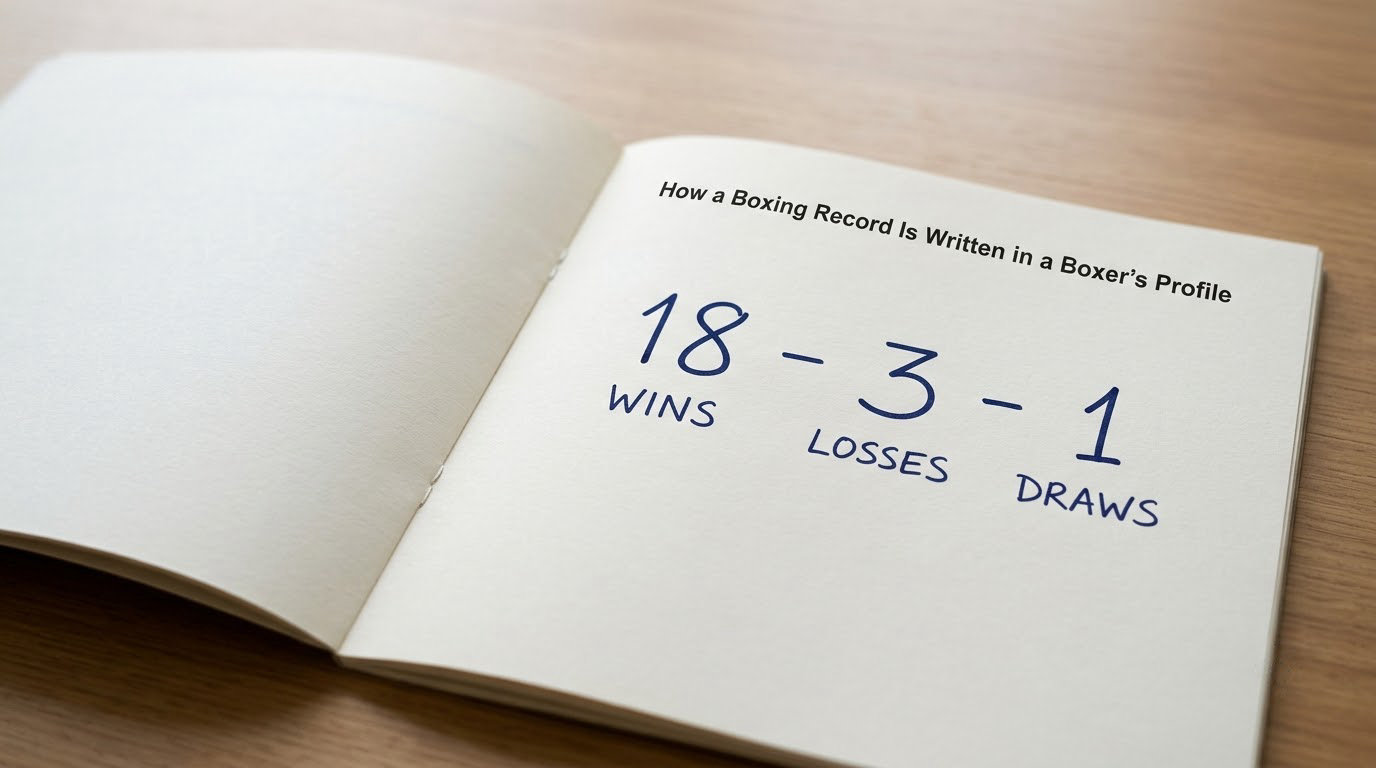
Read a record line from left to right, and the first number is wins, the second is losses, the third is draws. A profile reading 18-3-1 has eighteen wins, three losses and one draw, for twenty-two professional bouts in total.
Here is how the same fighter appears at two levels of detail:
Concise version: 18-3-1, with 11 knockouts, 4 wins by decision, 2 losses by knockout.
Detailed version: a row for each bout, giving the date, the opponent, the venue, the weight, the round and the result — for example, a fourth-round technical knockout against an opponent listed at 154 pounds.
The concise line is what you see in a headline or a broadcast graphic. The detailed list is what you see when you open a fighter’s bout page, and it is where the notation rules actually apply.
Why two records sometimes look different
Different publishers keep their own databases, and each one decides how much detail to display. One might collapse a bout into the totals, another might list it as a separate line. Neither is necessarily wrong; they are different views of the same underlying results.
What Do W, L and D Mean?
W means win, L means loss and D means draw, and those three letters account for every officially recorded professional result except one: the no contest.
Some example lines and what they say:
- 10-0-0 — ten wins, no losses, no draws. An undefeated professional record.
- 18-3-1 — eighteen wins, three losses, one draw.
- 0-1 — a single loss, the record of a fighter whose debut went the other way.
- 24-2-2 — twenty-four wins, two losses, two draws.
A draw appears once in each boxer’s own record, so it costs both men a result on the line without changing either man’s win or loss total. Two fighters who draw twice can both finish with a record showing two draws, and neither draw is counted twice within a single record.
What a no contest does to the line
A no contest means a bout happened but the commission declined to sanction the result — a glove or equipment failure, a foul before the opening bell, or a supervisor stopping the contest for another regulatory reason. It is marked NC and it does not count as a win, a loss or a draw in the W-L-D totals.
How Are Knockouts and Technical Decisions Recorded?
Every win falls into one of two families: the fight stopped, or it went the distance and was scored. How it stopped changes the wording, and so does how the judges scored it.
Fight stopped:
- KO — knockout. The fighter was counted out or could not continue.
- TKO — technical knockout. The fight was stopped without a count, commonly after repeated low blows, a cut, or a corner stoppage.
- Corner stoppage — the fighter’s own trainer ended it between rounds. Recorded as a TKO with the round and time.
- DQ — disqualification, usually for a foul.
Fight scored:
- UD — unanimous decision. All three judges scored it the same way.
- MD — majority decision. Two judges went one way and one went the other, so the fighter with two judges wins.
- SD — split decision. The judges split two to one in favour of the winner.
- Draw — recorded as a draw when the majority of judges scored it even.
Judges score each round separately, with 10 must for the fighter they scored it to, and one round can be 9 or 8. A 10-8 must applies to a round that one fighter dominated so completely that the other is deducted a point for it, and a single 10-8 must is enough on its own to turn what would have been a draw into a decision.
You will sometimes see MD or SD written as majority or split rather than by abbreviation, and you will see KO and TKO used loosely in conversation. On a record the difference matters, because a knockout carries more weight than a decision in most ratings systems.
Why Does a Boxing Record Include a Round and Time?
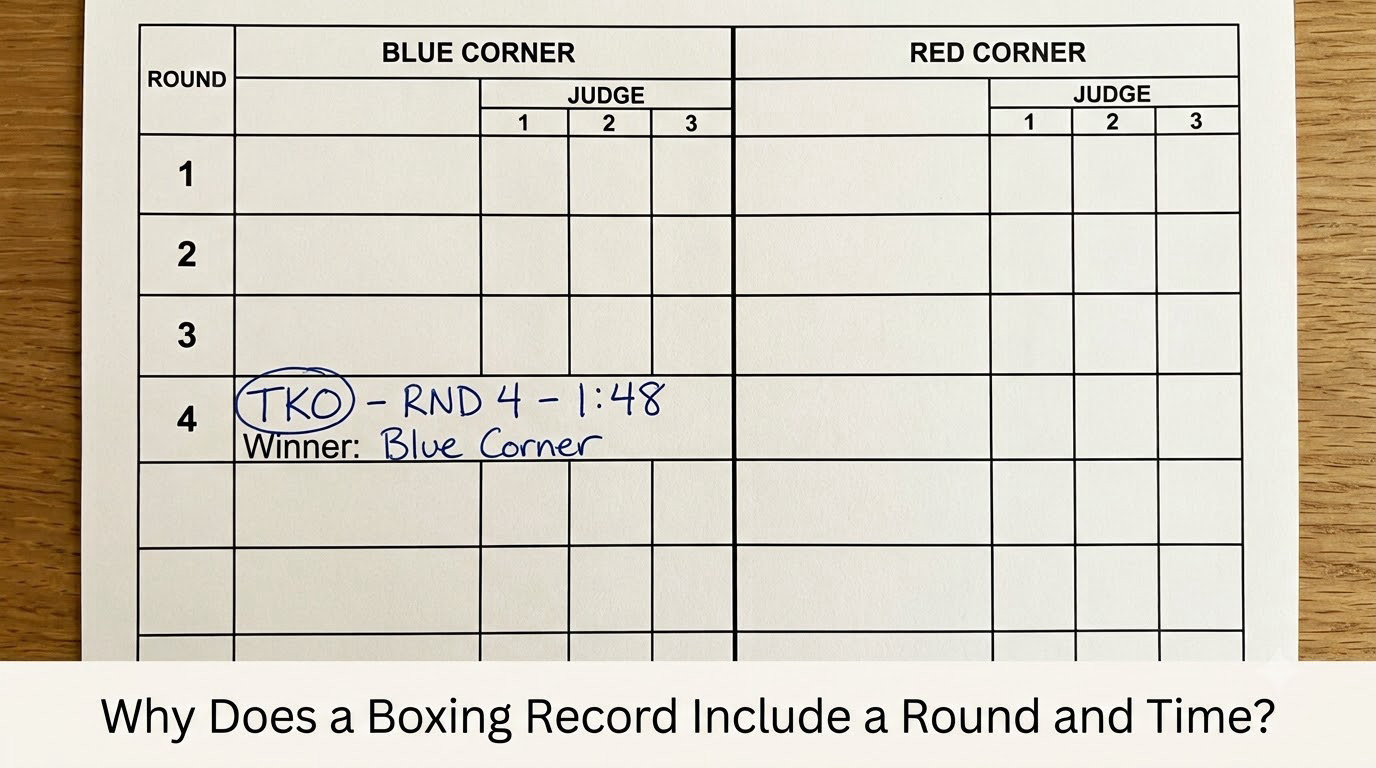
The round and time tell you when a fight ended, which is why they appear beside almost every stoppage on a bout line. A reading of KO4 means the knockout happened in round four; TKO3 means a technical knockout in round three; UD12 means the fight went twelve rounds to a decision.
When a time is included, it is the time inside that round. A stoppage written as 1:12 means one minute and twelve seconds into the round named before it, not into the fight overall. So KO4 at 1:12 means the fourth round, one minute and twelve seconds in.
Why the formatting drifts between sources
One database may show 1:12 and another 12, and a third may round the time to the nearest five seconds. Rounds also vary by title: a championship bout is scheduled for twelve, while a main event on a regular card may be scheduled for ten or eight. Both are correct for their own bout.
What Other Details Can Appear in a Boxer’s Record?
Most profile pages add optional details around the core numbers. These are useful, but they are not part of the record itself and they are formatted differently from source to source.
- Division and career weight — the weight class a fighter has usually contested.
- Height and reach — physical measurements, usually in inches, often written as 5 foot 11 inch and 71 inch.
- Stance — orthodox, southpaw or switch.
- Nickname — a promotional label, not an official title.
- Career title — a line such as former world champion or two-time champion.
- Age, dates and total fights — debut date, most recent bout, and a bout count that should match your own tally from the record line.
Here is the useful test. The W-L-D line, the per-bout results and the round-and-time notation are the record. Divisions, nicknames, reach and stance are descriptive metadata. A disagreement between two sources about a fighter’s stance is trivia; a disagreement about a win is not.
Frequently Asked Questions
Is a boxing record the same as a boxer’s fight record?
Yes. A boxing record and a boxer’s fight record are the same thing, and the fight record is the more accurate phrase. It means the wins, losses and draws from officially sanctioned professional bouts, written as W-L-D. What it is not is a ranking, a rating or a list of belts held, because none of those count bouts.
Why do some boxing records appear longer than W-L-D totals?
Because detailed records list every bout on its own line, with the date, opponent, venue, weight, round and result. The W-L-D totals are just the summary of those lines. If a page shows 18-3-1 but twenty-two separate bouts underneath, the two are describing the same twenty-two fights in different formats.
What does it mean when a knockout time is written as 1:12?
It means the fight stopped one minute and twelve seconds into the round named just before it. In a reading of KO4 1:12, round four began, and twelve seconds past one minute into that round the fight was stopped. It is not a cumulative time from the start of the bout.
Are no-contest results included in a professional boxing record?
A no contest does not count as a win, a loss or a draw, so it leaves the W-L-D totals untouched. It is usually marked NC and listed on the bout page. A bout can end in a no contest when a commission declines to sanction the result, for example after a foul before the opening bell or an equipment failure.
Why might two websites display slightly different records for the same boxer?
Most often the difference is which bouts each database counts, since some record unsanctioned or exhibition bouts that others omit. Formatting differences in how times and round notations are shown also cause mismatches. To settle it, look for the bout both sources share and check the date, opponent and result rather than comparing the totals alone.
Conclusion
The easiest way to learn how a boxing record is written is to start with the totals, then read how each win was recorded, and only then look at titles, nicknames and ratings. That order keeps a belt or a star rating from standing in for a result that may not be there.
Try it on one example. Take a profile reading 18-3-1 with 11 knockouts, and count the bout lines until you reach eighteen wins. You will learn more in two minutes of counting than from an hour of argument about who the best fighter was.