Pound-for-pound greatness comes down to one question: if every fighter on the list were the exact same size, who would win? Answer it well and you are already ahead of most published rankings, because the honest answer is never a single skill. It is a stack of abilities, habits and results that all have to point in the same direction.
I have gone back to the same debate too many times to count, and the arguments rarely move. One fan says ring IQ decides it, another says punching power, a third says the résumé. They are all describing part of the same eight hallmarks, and the useful part of this guide is the framework: what each trait measures, how you can actually see it on fight film, and how much weight honest analysts give it.
What follows is an explainer, not a ranking page. I am not going to hand you a numbered list of names and call it settled, because a list with no stated criteria is just an opinion in a nicer font.
Table of Contents
- What does pound for pound greatness mean in boxing?
- The eight hallmarks of what makes a fighter pound for pound great
- How can you evaluate pound for pound greatness?
- Who are the strongest all-time pound for pound candidates?
- Why do division size, era, and competition affect rankings?
- How can you make your own pound for pound ranking?
- Frequently Asked Questions
- Who is the greatest pound for pound boxer of all time?
- Should a fighter’s size and physical advantages count against a pound for pound ranking?
- Is beating more champions better than dominating one strong division?
- Should boxing pound for pound rankings compare different eras?
- What separates the best pound for pound boxer from the best counterpuncher?
- How much should knockout ability factor into a pound for pound ranking?
- Conclusion
What does pound for pound greatness mean in boxing?
Pound-for-pound is a comparison that ignores the one advantage a fighter cannot train. If you set every fighter at identical size, which one would win? That is the whole exercise.
It matters because size dominates outcomes in a way skill cannot fully offset. A fighter moving up in weight is facing someone with more mass, more reach and more punch resistance on every exchange, so beating a champion one or two divisions above you is a far stronger statement than beating everyone at your own.
Here is the distinction most people miss. An official world champion is decided by a sanctioning body inside one weight class, with defined titleholders and a division full of specific rivals. A pound-for-pound ranking is nobody’s job. Publications such as The Ring, ESPN and the UFC publish their own orderings, and the criteria behind each one differ.
Those lists are also unfalsifiable by design, which is worth saying plainly. You cannot book the fight, so any argument can be indefinitely postponed.
The phrase is generally traced to Sugar Ray Robinson’s era, when writers were trying to answer exactly this question across the weight classes of the 1940s and 1950s. The intent has not changed: greatness relative to size, not greatness inside a division.
The eight hallmarks of what makes a fighter pound for pound great
Eight traits carry most of the weight. Here is what each one measures and where you can see it.
| Trait | What it measures | How to watch for it | Example |
|---|---|---|---|
| Technical skill | Whether the fighter can do the basic things better than anyone else on the card | Footwork, head movement, jab control, punch selection | Bernard Hopkins |
| Ring IQ | Reading a round and adjusting before the round reads you | Does he change anything after losing the first two rounds? | Bernard Hopkins |
| Adaptability | Working against styles that were not part of the game plan | Plan A, B and C all working against a southpaw or a pressure fighter | Sugar Ray Leonard |
| Defense | Taking a punch without giving one back | Ratio of punches landed to thrown, slips and rolls at the right moment | Floyd Mayweather Jr |
| Power and accuracy | Whether clean shots end the argument | How often a landed shot visibly changes the fighter’s stance | Naoya Inoue |
| Durability | Staying sharp after being hurt | Performance in the rounds after the hardest shot of the fight | Muhammad Ali |
| Achievement | What was actually won, and against whom | Weight classes cleared, titles taken, quality of the opposition beaten | Sugar Ray Robinson |
| Longevity | Being great across a long window rather than one peak | Championship years, wins after a loss, reinvention later in a career | Bernard Hopkins |
Technical skill separates the great from the merely talented
Watch the feet before you watch the hands. Distance control, head movement off the line and a jab that keeps an opponent honest are harder to acquire than power, and they show up in every round rather than only when a punch lands.
Punch selection is the part casual viewers miss. A fighter who throws 50 punches and forces his opponent into 12 of them is doing something different from a fighter who throws 50 and forces 30, even if the totals look similar on a stats sheet.
Ring IQ is the trait analysts weight most heavily
Ring IQ is the ability to notice what an opponent is doing early, adjust before it costs you, and get better as the fight goes on. It is not a romantic quality; it is observable. Look for the round where a fighter’s plan visibly changes, usually after a knockdown or a bad round on the cards.
Bernard Hopkins is the example most often used here. His record against opponents who were expected to beat him, and his ability to win fights he was losing on paper, are the standard evidence.
Adaptability shows up when a fighter meets a different style
Every great run eventually ends when someone arrives with a style that does not suit them. Sugar Ray Leonard’s ability to shift against opponents who came to fight at a different range is the classic illustration of adaptability as a ranking asset rather than a nice-to-have.
The test is simple. Did the fighter win with his original plan, or did he build a new one mid-fight and win with that?
Defense, durability and power are how greatness survives contact
Defense is what makes a fighter difficult to solve, and durability is what lets him keep solving opponents after being hit hard. Both matter more in a pound-for-pound comparison than a knockout percentage does, because the claim is about being able to beat anyone, not about ending fights quickly.
Power still counts. When a clean shot visibly changes an opponent’s stance, or ends a fight outright, that is real evidence about a fighter’s ceiling.
How can you evaluate pound for pound greatness?
Use a fixed process rather than a memory of highlight reels. Reputation is the least reliable input, because it is the most repeated.
- Ignore the résumé first. Titles and highlight reels tell you what happened, not how well it was done.
- Score each fighter on the eight traits above, using the same standard for both.
- Weight the traits before you score, so the answer is not decided in advance.
- Adjust for era and opposition quality, and say what you adjusted and why.
- Only then look at the record, as a check on the pattern rather than the pattern itself.
What Makes a Fighter Pound for Pound Great?
In short, exceptional ability combined with ring intelligence, adaptability across styles, reliability under pressure and achievements against elite opposition in more than one weight class. Missing any one of those usually leaves a fighter outstanding inside a division rather than great across them.
How important is technical skill and shot selection?
Technical skill is the floor rather than the ceiling. Nearly every champion can box well enough to win rounds, so it rarely separates the top of a list. What separates them is where the skill is applied: accuracy, timing, and the discipline to throw the right punch rather than the exciting one.
A pure puncher with poor shot selection can win a lot of fights and still sit below a fighter who controls the distance and picks his moments. That is a defensible ranking, not a stylistic preference.
Why do ring intelligence and adaptability matter?
Because the pound-for-pound claim is a claim about unfamiliar opponents. A fighter who wins with one plan has demonstrated one thing; a fighter who wins with three plans has demonstrated a trait that transfers to any opponent a ranking might put in front of him.
It is also the attribute most damaged by highlight-clipped analysis. A fighter who looks brilliant in short clips has not shown you what he does when the plan breaks down.
How should achievements and opposition be weighed?
Achievements matter, but only as a summary of traits already observed. Beating an elite opponent at a heavier weight is worth more than the same result at your own weight, and that is the single biggest lever on a résumé.
There is a fair counter-argument here. A fighter who never moved up a weight has left the question untested, so the claim is a hypothesis rather than a result. The other side matters too, since a dominant champion who never got the opportunity to move up should not be punished for it.
The way major publications handle this is worth understanding before you argue about their lists. Points systems are common: voters rank a field, first place is worth the most points, and the total decides the order. What differs between outlets is which criteria they tell voters to weight, and how recently the list was updated.
Who are the strongest all-time pound for pound candidates?
Any list of names is a verdict, so here are case studies instead. Each one shows how the same framework produces a different argument depending on which trait you weight most.
Sugar Ray Robinson
Robinson is the historical anchor because the phrase itself comes from his era. The case for him rests on achievement and talent at a time when the talent pool at the top was thinner than it is now. The case against him is a short, dated career and a limited body of championship work.
Muhammad Ali
Ali is the durability and adaptability case. His chin, movement and ability to win after being dropped make him the standard when someone argues that toughness belongs at the center of a pound-for-pound list. Critics point to the length of time he was out of the ring and the level of opposition in his later years.
Bernard Hopkins
Hopkins is the counterpunching technician and the longevity argument in one fighter. Defense, ring IQ, wins after losses and a long window at the top put him near the top on every trait except raw punching volume. That is why he appears in almost every serious list.
Manny Pacquiao and Floyd Mayweather Jr
These two usually get compared on two attributes: speed against a higher-weight opposition, and defensive efficiency. Pacquiao’s case is the weight-class bypass, having won titles well above the division where he began. Mayweather’s case is that almost nothing landed. Which wins depends entirely on whether you weight durability or accuracy.
Roy Jones Jr and the modern era
Roy Jones Jr is the instructive case for why peak and longevity get argued. His four-division run in the 1990s is unmatched in ambition, and the losses that followed raise the question of how much weight a single peak carries. Modern candidates such as Naoya Inoue, Terence Crawford and Shakur Stevenson are argued about on the same axis: recent dominance against how far they have yet been tested.
Notice what changed once you score the traits instead of arguing about names. The debate stops being about which fighter fans prefer and becomes about which trait deserves the most weight, which is a question you can actually settle, or at least argue honestly.
Why do division size, era, and competition affect rankings?
Cross-era comparison is the least defensible part of any pound-for-pound list, and the reasons are structural rather than sentimental.
- Division depth. Some weight classes at some moments had a crowded, elite field and some had thin ones. Winning a title in a deep division means more than winning the same title elsewhere.
- Rule changes. Weight limits, rehydration policy and officiating emphasis on clinch work and fouls have shifted over time, and they change how a fighter’s style is valued.
- Career length. Fighters miss prime years for reasons that have nothing to do with ability, including military service, prison, family and promotion politics. A short career and a career interrupted are not the same résumé.
- Recovery between rounds. Changes to corner work, nutrition and scheduling altered how much damage carries over late in a fight, which flatters or penalizes certain styles.
- Records understate everything. A knockout-heavy résumé from an era with thinner matchmaking looks more impressive than the same fighter’s actual opposition.
Reach and body composition sit under the same problem. A fighter with unusual reach or a lower body fat percentage has an edge that does not appear anywhere in a punch statistic, which is one reason some fighters who look unremarkable on paper keep winning.
The honest response is not to refuse the comparison. It is to state the adjustment you are making, in writing, before you vote.
Which brings us to the objection that the whole concept is worthless. A version of this argument shows up in comment sections constantly: pound-for-pound is just an opinion dressed up as a measurement, and no one can actually test it. Fans tend to split on it, valuing the argument as argument while criticising the term as undefined.
Both things are true at once. The comparison cannot be tested in the ring, and it can still be argued well. The answer to a subjectively ranked debate is not silence, it is a stated method.
How can you make your own pound for pound ranking?
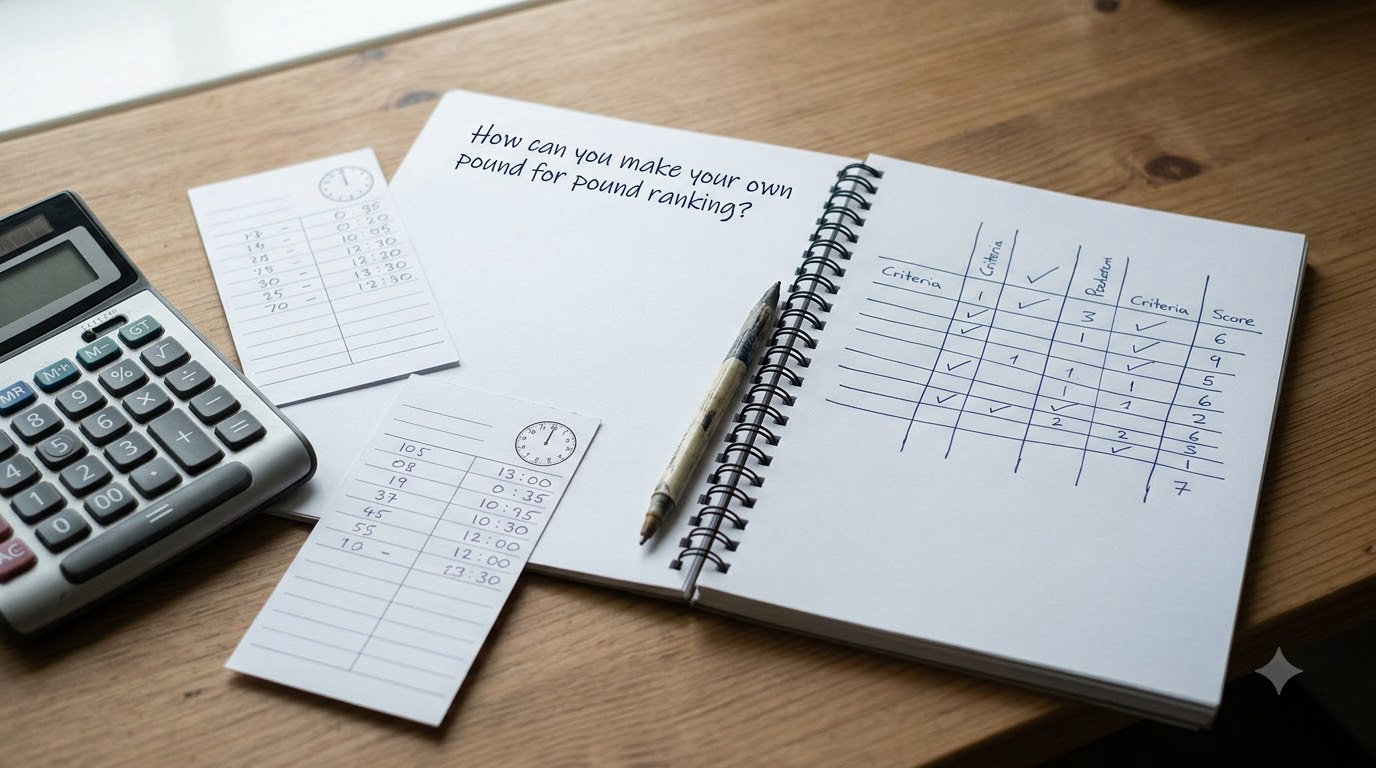
Set the weights before you look at any names, then score everyone on the same scale. Suggested weights:
| Criterion | Weight | How to score it (0 to 10) |
|---|---|---|
| Ability and technique | 20% | Footwork, defense, accuracy, control of distance |
| Tactical control and ring IQ | 20% | Adjusting plans round by round |
| Adaptability | 15% | Success against different styles |
| Achievement | 15% | Divisions cleared, titles taken |
| Quality of elite opposition | 15% | Who the wins were actually against |
| Durability and longevity | 10% | Performance after being hurt, years at the top |
| Power and effectiveness | 5% | How decisively clean shots finish opponents |
Multiply each score by its weight and total them. Do the same for the second fighter before you read either résumé, because a résumé read first will anchor the whole exercise.
Here is how the worked example changes an argument. Suppose two fighters both score well, but one earns 8 on tactical control and 7 on power while the other earns 6 on tactical control and 9 on power. The gap is two points in favour of the first fighter on the heaviest-weighted trait. The power fighter is a better puncher. That is not the same claim as being better pound for pound, and the rubric is what tells you which one you are actually making.
Then apply your era adjustment, in writing, and note that this is the step most people skip. Say what you changed and why. A reader can disagree with your adjustment; what they cannot do is ignore it.
Two rules keep the exercise honest. Score fights you watch, not fights on a highlight reel, and update the list with a visible date, because stale pound-for-pound lists are worse than none.
Frequently Asked Questions
Who is the greatest pound for pound boxer of all time?
There is no settled answer, and Sugar Ray Robinson, Muhammad Ali, Bernard Hopkins, Floyd Mayweather Jr and Manny Pacquiao are the names that appear on most lists. The reason they recur is not name recognition. Each one tops the traits that matter most for a different voter, which is why a stated method matters more than a name.
Should a fighter’s size and physical advantages count against a pound for pound ranking?
Extra size is supposed to be factored out, so it should not count against a fighter directly. What should count is unusual reach or a body composition advantage that persists after weight is equalized, because those features are not erased by the comparison. Fighters built on reach alone also tend to fall off harder with age, and a ranking that ignores that is overweighting the peak.
Is beating more champions better than dominating one strong division?
For pound-for-pound purposes, beating more champions at higher weights is the stronger claim, because it proves the ability transferred upward. Dominating one stacked division is still a huge achievement, and analysts weight it heavily when the opposition was genuinely elite. The distinction only matters when the two results are otherwise close, and then the fighter who moved up usually wins the tie.
Should boxing pound for pound rankings compare different eras?
Usually yes, since the question is which fighter was best relative to size, and that has no natural time limit. The comparison is distorted by era, so a careful ranking states its adjustments in writing rather than pretending they are unnecessary. If a ranking offers no era adjustment at all, treat its confident ordering as partly an argument about era instead of about ability.
What separates the best pound for pound boxer from the best counterpuncher?
A counterpuncher wins by making opponents miss, which depends heavily on reacting, and that is a narrower way to win than controlling the fight. The best pound-for-pound candidate has to force the issue as well as punish it, and to do it against styles that are nothing like the one they built a career on. Best counterpuncher is a style ranking, not a greatness ranking.
How much should knockout ability factor into a pound for pound ranking?
Less than most fans expect, because the claim is about beating anyone, not about ending fights quickly. A knockout percentage is also the statistic most distorted by era, matchmaking and opponent quality, and it says nothing about what happened after a fighter got hit. Power is best used as evidence of a ceiling, weighted lightly, alongside defense and durability.
Conclusion
What makes a fighter pound for pound great is a stack, not a single trait: technical skill, ring IQ, adaptability, defense, power, durability, achievement and longevity, weighted so the heaviest items are the ones that travel to an unfamiliar opponent. Start your own ranking by separating raw ability from the size and difficulty of the division each fighter competed in, set your weights before you look at any names, and write down your era adjustments where someone can argue with them.