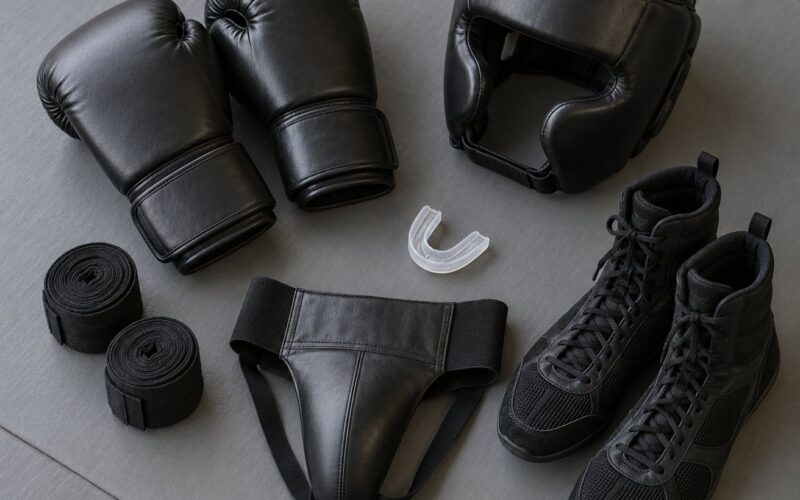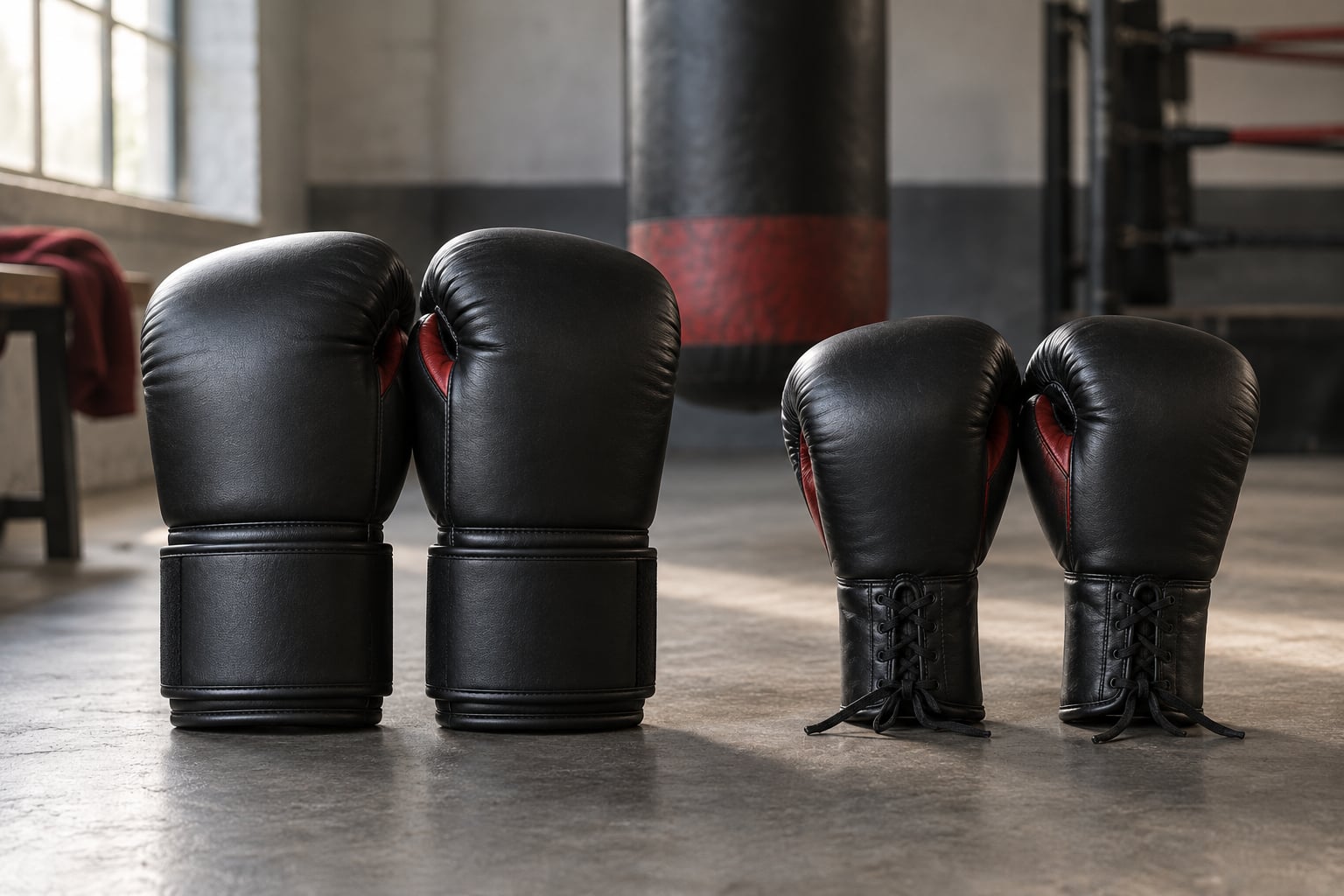
Training gloves are built for repetitive bag, pad and technique work, with firmer padding, longer wrist support and a shape that survives thousands of impacts. Fight gloves are built for a sanctioned bout, with softer shock-absorbing padding, a lighter hand feel and less wrist bulk so the referee can inspect them. Most serious boxers own both.
That is the difference between training gloves and fight gloves in one line: what each pair is absorbing. One is taking punishment from a leather bag, the other is taking punishment from a human head, and each glove is engineered for that one job.
One honest warning first. Training gloves is not a standardized category the way competition gloves are. On most gym floors the label gets used for bag gloves that have been renamed to sound friendlier, which is why two people can buy training gloves, spar a week later and end up with a scraped cheek. Ask your coach what the pair in front of you is actually built for.
Table of Contents
- Difference Between Training Gloves and Fight Gloves at a Glance
- What Are Training Gloves?
- What Are Fight Gloves?
- How Do Padding and Protection Differ?
- What Is the Difference in Glove Weight and Size?
- Which Glove Is Better for Bag Work, Sparring, and Fights?
- How Do You Choose Between Training Gloves and Fight Gloves?
- Frequently Asked Questions
- Conclusion
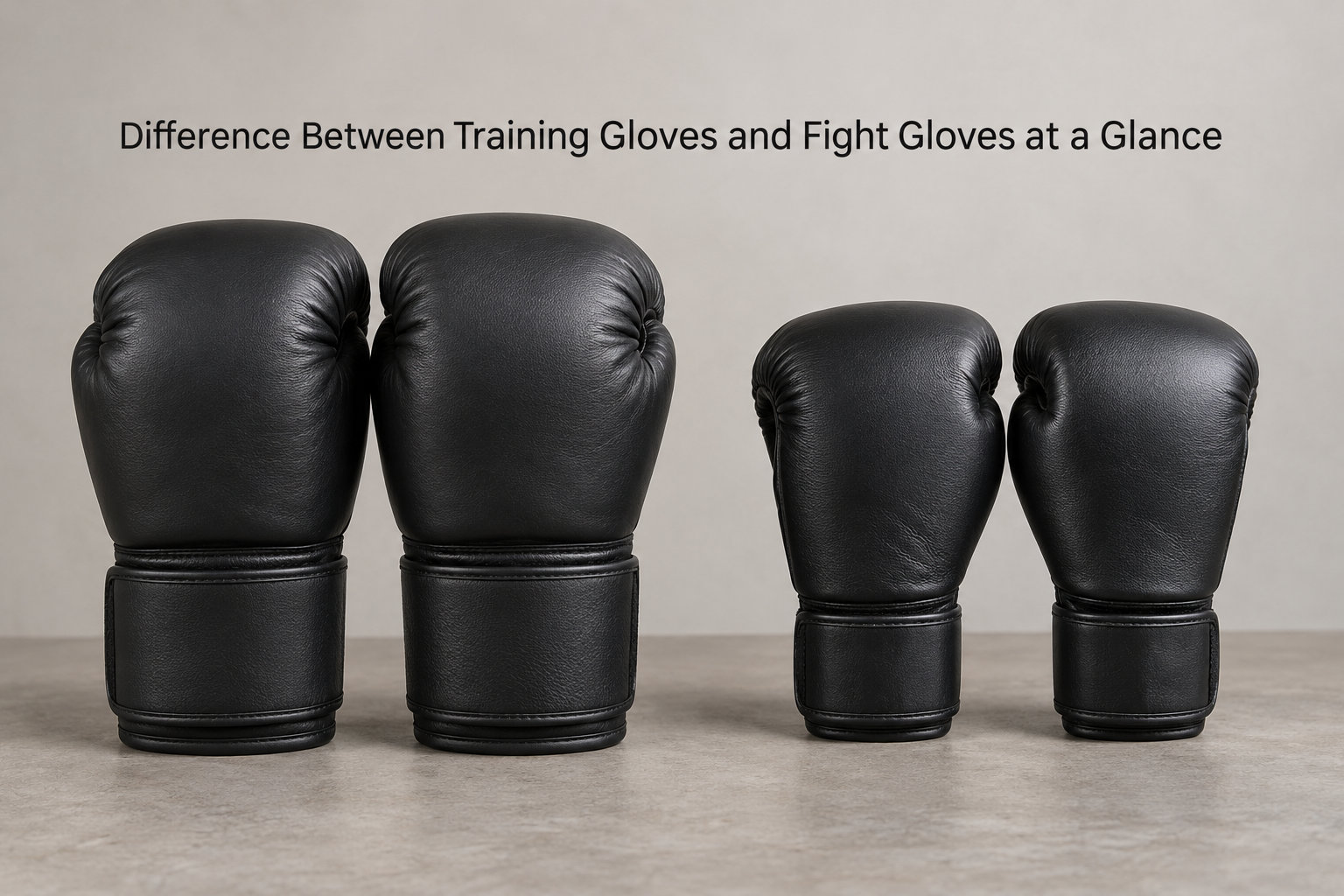
Difference Between Training Gloves and Fight Gloves at a Glance
| Criterion | Training gloves | Fight gloves |
|---|---|---|
| Primary job | Heavy bag, pad work, technique and speed drills | A sanctioned bout under a commission or governing body |
| Padding | Firm, dense foam that resists flattening | Soft, compressible foam that spreads impact |
| Typical weight | 12 oz to 18 oz for adult boxing gloves, plus 4 oz to 8 oz bag mitts | 10 oz to 16 oz set by the division and the rules of the event |
| Sizing method | Often hand fit, small through extra large, for bag mitts | Ounces plus hand circumference |
| Wrist support | Long cuff, often with a rigid splint built in | Short cuff, minimal or no rigid support |
| Closure | Hook and loop wrist strap, sometimes a full lace-up | Full lace-up with a short strap, or a long wrap |
| Surface | Flat and smooth, fine against a bag | Smooth, rounded, deliberately free of hard seams |
| Best for | Most of your training week | Bout day and the final sparring phase before it |
| Worst use | Hitting a training partner | Punishing a heavy bag every session |
| Typical lifespan | Long, if you rotate pairs | Short, because padding crushes fast |
The honest verdict is simple. Training gloves are generally heavier and more padded, built to take abuse and hand you honest feedback on every shot. Fight gloves are lighter, thinner and shaped so a referee can approve them and a punch can land with realistic feedback.
What Are Training Gloves?
Training gloves cover a wide family. At the bottom sit bag mitts, the slim 4 oz to 8 oz gloves designed for a heavy bag and pad work, where your knuckles are hitting a surface that gives a little. Above them sit general training or day gloves, usually 12 oz to 16 oz, thick enough for pads and light contact.
What they share is construction aimed at repetition. Firm foam resists compression, so a thousandth bag round feels much like the first one. A longer cuff and a rigid wrist splint keep the small hand bones stacked when the punch lands badly or at an angle.
Community consensus over on r/fightgear and r/amateur_boxing matches what the construction says. Buy one pair for the bag, keep a separate pair for sparring, and treat bag work as something that consumes a glove rather than something a glove enjoys.
Here is the part that gets missed: not every training glove is safe or legal for partner work. A bag glove has almost no shock-absorbing layer over the knuckles and a surface that roughens once the leather has been hit hard for months. Both of those punish the person in front of you, not you.
What Are Fight Gloves?
Fight gloves, usually called competition gloves, exist for one afternoon. They are made to satisfy a rulebook: a specified glove weight for the division, a shape a referee can approve, and padding thin enough that striking feels the way it will feel on fight night. Amateur bouts typically run 10 oz in the lightest divisions, 12 oz through the middle, 14 oz in the heavier ones and 16 oz at heavyweight, though the sanctioning body sets the final call.
Construction usually means laced leather, a compact cuff and a small amount of foam. That is not a flaw, it is the brief. Thick, soft padding feels safe in the gym and gives you the wrong idea about what lands on a jaw. Real fight gloves also wear out quickly, because padding that compresses is padding that has done its job.
Two details catch newcomers. First, gloves at a sanctioned event generally have to be approved by the body running it, and that requirement decides your choices far more than any brand preference. Second, cheap competition gloves often feel thin and unsupported next to sparring gloves, which is why fighters with a bout booked usually buy them once, keep them in a bag and put them on for the last few weeks of training.
How Do Padding and Protection Differ?
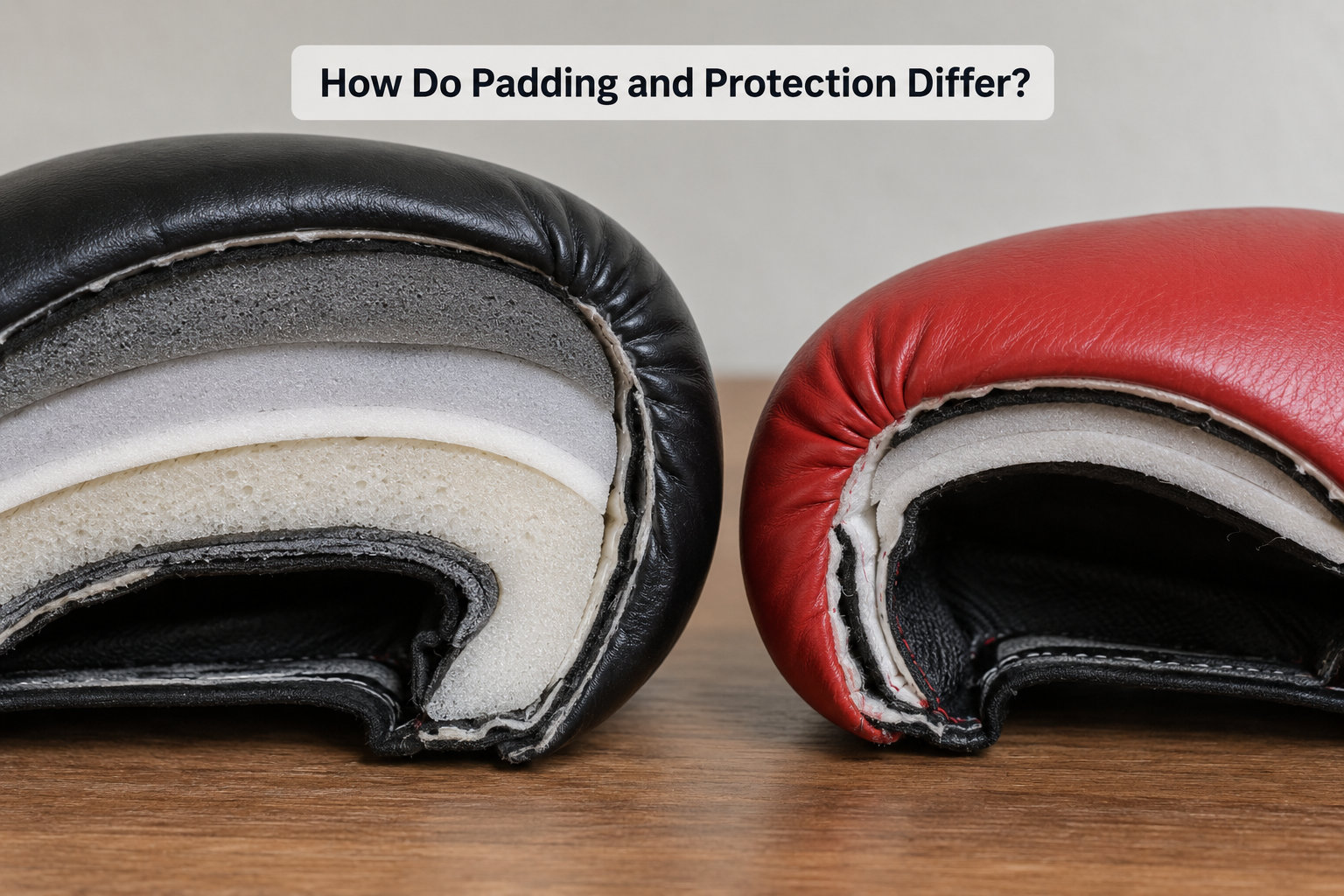
Padding is the whole argument, so it is worth being precise. Modern foam comes in several flavours. Multi-layered foam stacks softer sheets over a firm core. Triple-density foam combines three densities in one block so the surface softens on impact while the base stays firm. Infused foam is a gel-like layer that spreads force across a wider area. Horsehair and foam hybrids pack a thin layer of horsehair with foam for a firmer, more traditional feel.
Training gloves use the firm end of that range on purpose. Padding that resists compression protects your knuckles and gives you feedback, and a hard-ish surface teaches you to land shots properly because the bag punishes a bad punch immediately.
Fight gloves use the soft end. Softer padding absorbs more of the impact and keeps a training partner or an opponent safer, but too much of it dulls the sensation of a landed shot. That trade-off is why heavy bag and pad work in competition gloves makes no sense. You get a light, fast glove that gives the bag nothing back and offers your hand almost no protection across a long session.
Padding also compresses unevenly with age. Once a bag glove has flattened and the surface has scuffed up, it is not a sparring glove any more. Have a look at where your coach stands before you put a new pair on for partner work, and take their read on it over any product page.
What Is the Difference in Glove Weight and Size?
Bag mitts are usually sized by hand, small through extra large, because they are a tool for a specific fist. Boxing gloves and competition gloves are sold by ounces, and that number describes the padding weight more than the total weight in your hand.
| Weight | Typical use | Notes |
|---|---|---|
| 4 oz to 8 oz | Bag mitts and youth bag work | Almost no protection, heavy bag only |
| 10 oz | Lightweight competition bouts | Fast, minimal padding, referee approved |
| 12 oz | Most amateur divisions and general training | The most common choice in gyms |
| 14 oz | Heavier amateur divisions and sparring | Good balance of speed and hand protection |
| 16 oz | Heavyweight competition and bag work | Slower hand speed, more knuckle coverage |
| 18 oz | Sparring with heavier partners | Maximum padding, rarely used in competition |
Three things matter more than the number on the label. Fit around the fist and thumb, measured with your hand wraps already on, because that is how you will actually wear them. Palm ventilation, so sweat does not turn a long session into a grip problem. And closure, where a hook and loop strap is quick for bag rounds and a full lace-up gives you a tighter, more stable fist for competition.
A larger-looking glove is not automatically better. Some big-feeling gloves are mostly cuff, and a glove that does not close properly around your thumb will annoy you long before it protects you.
Which Glove Is Better for Bag Work, Sparring, and Fights?
The difference between training gloves and fight gloves, use by use
- Heavy bag work: training gloves every time. Bag mitts for speed-focused rounds, 12 oz to 16 oz day gloves for power and conditioning rounds. Reserve fight gloves for the weigh-in photo and nothing else.
- Pad work and focus mitts: training gloves. Pads are easier on your hands than a bag, so the firmer padding is wasted protection here, and the harder surface is what gives your coach something to correct.
- Speed bag and technique drills: lighter training gloves or mitts. Less mass on the hand means your technique shows instead of your arm.
- Beginner fitness classes: a solid 12 oz to 14 oz training pair. Learn to punch on a bag with wraps and proper boxing gloves rather than bare-knuckle or MMA open-finger gloves, since you are building wrist and hand habits that last.
- Sparring: sparring gloves rated for the intensity and rules of that session. Anything sold only as a bag glove is the wrong tool, and a worn bag glove is worse than the wrong one.
- Competition: fight gloves that meet the event requirements, switched into during the final sparring phase rather than from week one.
How Do You Choose Between Training Gloves and Fight Gloves?
Work through these in order and the choice makes itself.
- Start with the activity, not the label. Bag, pads, sparring and competition are four different jobs. Decide which one covers most of your week and buy for that.
- Match the contact level. Anything touching another person needs more shock absorption than anything touching a bag.
- Check required weight and size. For competition, the rules of the event decide first and everything else second.
- Try them with wraps on. Make a fist and shake it. If the glove rotates, pinches at the thumb or floats loose at the wrist, the size is wrong.
- Look at ventilation and closure. Ventilated palm, reinforced seams and a wrist strap that stays put during a long session.
- Ask who will approve them. Your coach for sparring, your commission or event organizer for competition.
One warning worth repeating: do not buy fight gloves because they look sleek or because they are advertised as lightweight. A glove that feels fast in a showroom will feel fast and unprotected after twenty minutes on a heavy bag, and it may not be accepted on fight night either.
On cost, the arithmetic favours owning two or three pairs and rotating them. One pair used for both bag work and sparring gets replaced more often than two pairs used separately, because the bag work destroys the padding the sparring needs. Two pairs also keep their shape longer, since each gets rested between sessions. If your gym already sells bags and mitts, buy them there and spend your own money on the sparring pair.
When a bout is booked, keep the training gloves for bag work and switch into fight gloves for sparring in the final few weeks, so your hands meet the real glove shape before the bell does. Wear them in for a few short sessions first, since new gloves feel strange until the leather gives.
Frequently Asked Questions
Can you use training gloves for sparring?
Only if they were built for it. Sparring needs soft, shock-absorbing padding and a surface smooth enough not to abrade a partner’s face. Bag gloves and general day gloves are made for surfaces, not people, and once the padding compresses and the leather scuffs they get worse. Buy a dedicated sparring pair, and let your coach confirm the gloves are rated for the intensity of your session.
What weight fight gloves do I need for competition?
It is decided by your division and the sanctioning body, not by preference. Amateur bouts commonly run 10 oz in the lightest classes, 12 oz through the middle, 14 oz in heavier divisions and 16 oz at heavyweight. Check the event rules and the approval requirements before you buy, because gloves that are not approved may not be allowed in the ring at all.
Why do fight gloves feel less protective than training gloves?
They are built thinner on purpose. Competition padding has to be soft enough to spread impact, but every layer of foam that absorbs force also dulls the sensation of a landed punch. Training gloves trade that realism for knuckle protection and wrist support, which matters over hundreds of bag rounds. Neither is better. They are answering different questions about what will be hitting what.
Do heavier boxing gloves build stronger hands?
No reliable evidence supports that. Heavier gloves add knuckle padding and can slow your hand speed, which some coaches like for power work, but they do not make your bones or your punch harder. If anything, training in competition-weight gloves teaches you to punch with less protection than you will have in a real exchange. Ask your coach whether your goal calls for speed, power or technique.
Are competition gloves good for everyday training?
Rarely. Competition padding crushes quickly under repetitive bag work, and the light, low-cuff design gives your wrist little support across a long session. Plenty of fighters keep fight gloves in a bag and use them only in the final sparring phase before a bout. For day-to-day work, a training pair that resists compression will outlast them several times over.
Conclusion
Buy properly padded training gloves for the work that fills your week, and buy them in a weight that suits your size and your bag work. Anything touching a training partner needs a glove built for contact, and a worn bag glove is the one option nobody should be hitting anyone with.
When a bout is on the calendar, check the event requirements before buying fight gloves, then switch into them for your final sparring phase rather than from day one. Two or three pairs, rotated, will serve you better and cost less over a year than one pair doing every job.