To find a good boxing gym, shortlist two or three clubs near you, check the head coach’s background and class size, then take a trial class at each one before you pay anything. The gym matters more than the price tag, because boxing is learned by one coach correcting one person at a time.
Most beginners pick a gym off a map pin or an Instagram photo. That is backwards. The room only matters once you’re inside it, sweating, trying to get your hands up, and finding out whether anyone is actually watching you.
This guide walks through seven checks in the order that saves you the most time and money, roughly two evenings of research and a couple of trial classes. You can run the whole process from your phone and a notebook.
Table of Contents
- What You Need
- Step-by-Step: How to Find a Good Boxing Gym
- Step 1: Define Your Training Goals
- Step 2: Check the Coach and Class Structure
- Step 3: Visit During a Real Class
- Step 4: Look for Safety and Cleanliness
- Step 5: Compare Memberships and Hidden Costs
- Step 6: Try the Gym Before Committing
- Step 7: Choose the Best Fit for Your Goals
- How to Find a Good Boxing Gym: The 10-Point Scorecard
- Common Mistakes to Avoid
- Frequently Asked Questions
- Conclusion
What You Need
Before you start calling gyms, write down five things. Everything after this gets easier once you have them.
- Your actual goal. Get in shape, learn technique, compete in amateur bouts, cross-train for another sport, or lose weight. These pull you toward different gyms.
- Your realistic schedule. Two mornings a week, three evenings, weekends only. A gym with one class at 6pm may be useless to you no matter how good it is.
- Your monthly ceiling. Pick the number you can sustain for six months, not the number that sounds impressive.
- Your five questions for the coach. Write them down before the call so you don’t get talked into something.
- Trial class terms. Ask whether the first session is free, discounted, or included in a mandatory first month. If you have to sign up front to try, that is information too.
Also note what’s near the gym and what time you can realistically get there. Members in gym-shopping threads consistently say the same thing: a great gym twenty minutes away loses to a decent gym five minutes away once work gets busy.
Step-by-Step: How to Find a Good Boxing Gym
Step 1: Define Your Training Goals
A gym that fits someone chasing their first amateur bout will frustrate someone who just wants a hard hour three times a week, and the reverse is just as true.
For fitness and stress relief, you want clear class times, a schedule you can keep, and a room that doesn’t punish you for being new. For technical development, you want a coach who corrects stance and footwork rather than yelling combinations at a bag. For competition prep, the gym should be affiliated with USA Boxing or your local commission, run sanctioned shows, and have fighters on the roster with actual amateur records.
The test: name the specific thing you want in twelve weeks. Weight loss, learning a jab-cross without telegraphing it, or passing your first fitness test. If you cannot name it, you cannot tell whether the gym delivered.
Step 2: Check the Coach and Class Structure
The coach is the gym. Everything else is rented space and hanging bags.
Ask how long the head coach has coached, where they trained, and whether they held an amateur record or competed professionally. USA Boxing keeps a public member directory, so if the gym claims to be a registered club you can look it up rather than take their word for it. Many coaches also hold certification through organizations like USA Boxing or the Amateur Boxing Federation, which is a floor, not a ceiling.
Then ask about class structure. Good gyms split beginners from advanced groups and keep sparring separate from technique work. Members in amateur boxing forums repeatedly single out coaches who personally correct a new member’s guard and stance as the reason they stayed for years.
Two questions worth asking by name: what is your typical class size, and what is the coach-to-member ratio in a beginner session? Anything past roughly fifteen beginners and correction gets thin. If the front desk answers vaguely, that is your answer.
Step 3: Visit During a Real Class
Tours are useless. Ask to watch a beginner class during its normal scheduled slot, not the one they tidy up for visitors.
Watch five specific things: whether the coach talks to more than one person, whether beginners are paired with each other or left standing while advanced members spar, whether the coach corrects form without yelling, whether bag work is deliberate or just fast random combinations, and how the room handles a new person standing in the doorway. The last one matters most and is the one people forget to look for.
That last check is not paranoia. A gym with a cliquish culture and a coach who works only with the competitive roster shows up in beginner threads over and over as the reason people quit in month two.
Talk to two current members during or after class. Ask them how long they have trained there and how the coach treats people who are not going to compete. Those two answers carry more weight than any website.
Step 4: Look for Safety and Cleanliness
A boxing gym is a room full of hard, heavy, swinging things. Judge it like one.
Look at the ring padding and canvas for torn seams or bare patches. Check that heavy bags hang off rated chains and swivels, that bag surfaces are not cracking and splitting, and that the floor around the bags is clear. Count the bags against the class size, because a room with eight bags and twenty people is doing bag rounds in groups.
Then check the less glamorous parts. Changing rooms with a door that locks, showers, clean towels, drinking water, decent ventilation, and somewhere for gloves to dry. A gym with a foul locker room is a gym that will eventually give someone an infection.
Ask directly about safety: who carries a first-aid kit, whether the gym requires hand wraps checked before bag work, how headgear and mouthguards are handled, and what happens if someone is concussed. Then ask the question most beginners skip entirely, which is how sparring is handled and who has to consent to it. A gym with a clear written sparring policy is telling you something good about how it runs.
Step 5: Compare Memberships and Hidden Costs
Compare total monthly cost, not the headline number. A low advertised rate with a registration fee, a mandatory kit package, and a twelve-month contract is the expensive option.
Work out these four things for each gym you are considering:
- Monthly fee and what tier it buys: a fixed number of classes, unlimited classes, or a mix.
- Registration and annual fees, charged once but spread over a year they still count.
- Equipment charges, especially forced glove, wrap, and uniform purchases you cannot use elsewhere.
- Contract terms: length, notice period, freezing options, and what happens if you move away.
Also price the extras that quietly drain a budget: guest passes, late cancellations, open gym time, private sessions, and sparring sessions billed separately. A membership that looks reasonable gets expensive fast if you pay for every add-on.
Look for a no-contract option or a month-to-month tier. Plenty of good gyms offer one, and its existence usually says they expect to keep you because the training is worth it.
Step 6: Try the Gym Before Committing
Take a real class, wearing normal training clothes, at the time you would actually attend. A free introductory session offered only on Saturdays morning is not the same as the class you’ll be in on a Wednesday night.
Afterwards, ask yourself four questions. Did I learn something I could repeat at home? Did the coach notice me without me asking? Did I know what to do the whole hour? And would I be annoyed if I had to do this again in three days? That last one is a better predictor of whether you’ll stick with it than any facility tour.
Ask the front desk the practical follow-ups too: what should the first month look like, when will a coach move me up, and what is the plan for someone who wants to compete eventually. A gym with an answer for that has a pathway. A gym that shrugs has a revolving door.
Step 7: Choose the Best Fit for Your Goals
Put your two or three trials side by side and score them on the same seven points: coach quality, beginner class size, safety and cleanliness, sparring policy, schedule fit, total monthly cost, and how the room made you feel as a newcomer.
Weight coaching quality and beginner class size above everything else, then schedule fit. Cost matters, but only after those three, because a cheap gym with a distracted coach and twenty-person classes will cost you months of bad technique. You cannot unlearn a habit the coach let you build.
How to Find a Good Boxing Gym: The 10-Point Scorecard
Print this and use it during each visit so you’re comparing the same things at every gym.
- Coach corrects beginners by name and by hand.
- Beginner class size small enough for individual correction.
- Beginners separated from advanced and sparring groups.
- Written sparring policy, and sparring is never pushed on new members.
- Clear path from your first month toward your goal.
- Bags, ring, and floor padding in good repair.
- Clean changing rooms, showers, and ventilation.
- Schedule that matches your week, including one you’re likely to keep.
- Transparent membership terms with no forced equipment package.
- Current members who would recommend the coach to a friend.
Common Mistakes to Avoid
Choosing on price alone. The cheapest gym in town is cheap for a reason, and beginners who shop on fee end up paying it back in bad habits. Compare what the fee buys, including coaching time, before you compare the number.
Confusing a hard workout with good coaching. Sweating hard is not the same as learning. Bag work that is random fast-called combinations feels brutal and teaches nothing about technique, which fighters on martial arts forums call one of the bigger red flags in a boxing gym. Slow, deliberate drills with corrections are the better session.
Ignoring the room’s culture. Watch how a new person is greeted. If nobody acknowledges the beginner standing in the doorway, nobody will correct their stance in month three either.
Never asking about sparring. Ask how it’s handled, who must consent, and what happens to members who say no. Get the answer before you join, not during your first month.
Committing before a real session. Signing a contract off a tour and a price sheet is how people end up locked into a gym they visited once. Trial at least two gyms, and use the trial as an evaluation rather than a demo.
One more that’s easy to miss: don’t let a gym’s trophies, records, or photos of the owner do the work. Memorabilia is fun, but it isn’t a substitute for watching a coach teach. Beginners who compared gyms on equipment lists rather than class behavior are the ones who quit fastest.
Frequently Asked Questions
Do boxing gyms make beginners spar?
A good gym never makes anyone spar. Sparring sits in separate, optional sessions and only starts once a coach judges you ready, which for most people takes months of consistent training. Ask about the written sparring policy before you join, and treat any pressure to hit a live partner in your first weeks as a serious warning sign about how the gym runs.
What should I wear and bring to my first boxing class?
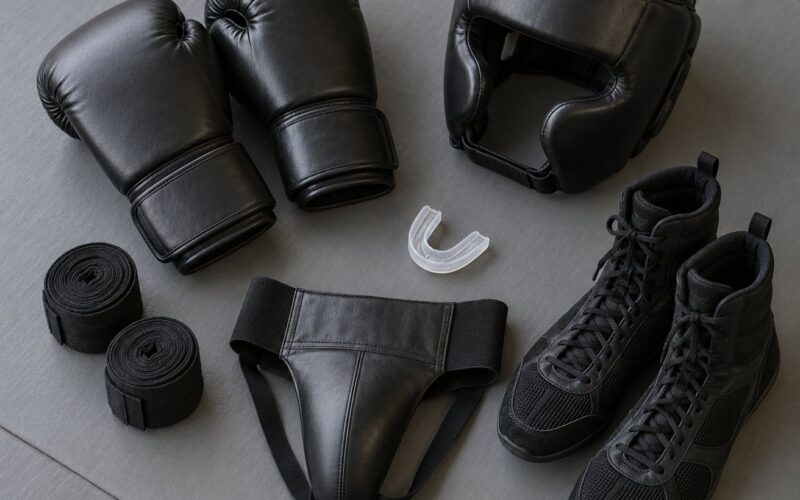
Wear clothes you can move in and will sweat through, plus trainers with a flat, grippy sole. Bring water, a small towel, and a hair tie if you have long hair. Most gyms have loaner gloves and wraps for new members, but confirm before you go so you are not standing barefoot on the side watching.
How do I know if a beginner class is actually any good?
Watch the coach, not the class. A good beginner session spends real time on stance, guard, and footwork, keeps the group small enough that the coach circulates, and pairs newcomers together instead of dropping them into advanced work. If the coach shouts long combination sets and nobody’s form improves in ten minutes, the class is cardio, not instruction.
Do I need my own boxing gloves and hand wraps?
Not for the first class. Most beginner-friendly gyms lend out gloves and wraps, and buying a full kit before you know your size or your coach’s preferred style is wasted money. Ask what the gym provides and what they recommend. If you do buy gloves early, a well-fitting pair of training gloves plus hand wraps covers every class short of sparring.
How often should I train to see progress as a beginner?
Two or three sessions a week is the sweet spot. Boxing skills consolidate between sessions, so training twice as often usually means a worse session each time rather than twice the progress. Consistency over months beats intensity in any single week. One good session with a coach who corrects you is worth more than three solo workouts.
Is it too late to start boxing as an adult?
No. Adults start boxing regularly, and most gyms have at least a few members who came to it in their thirties or later. What matters is picking a gym with a genuine beginner track and a coach who works with novices rather than a squad of competitors. Build up conditioning and technique slowly, and give it three consistent months before judging it.
Conclusion
Finding a good boxing gym comes down to three things you can verify yourself: a coach who personally teaches beginners, a class small enough for that coaching to land, and a room where new people are expected rather than tolerated.
Start tonight. Search boxing gyms in your area and check the USA Boxing club directory, then note the beginner class schedule and total monthly cost for each one. Book a trial at the most promising option this week, take notes with the 10-point scorecard, and decide after two real classes. That process takes a couple of evenings and saves you from paying for a membership you quietly cancel in month two.