
What a boxing manager does is run the business side of a fighter’s career. They negotiate fight contracts, pick opponents, find sponsors, handle the paperwork and the money, and take care of everything outside the gym so the fighter can concentrate on training.
The confusion is understandable, because boxing borrows its language from the film industry, where the same word meant something else for decades. A promoter puts on the show. A trainer teaches the fighter. A manager is the one who looks after everything the fighter owns.
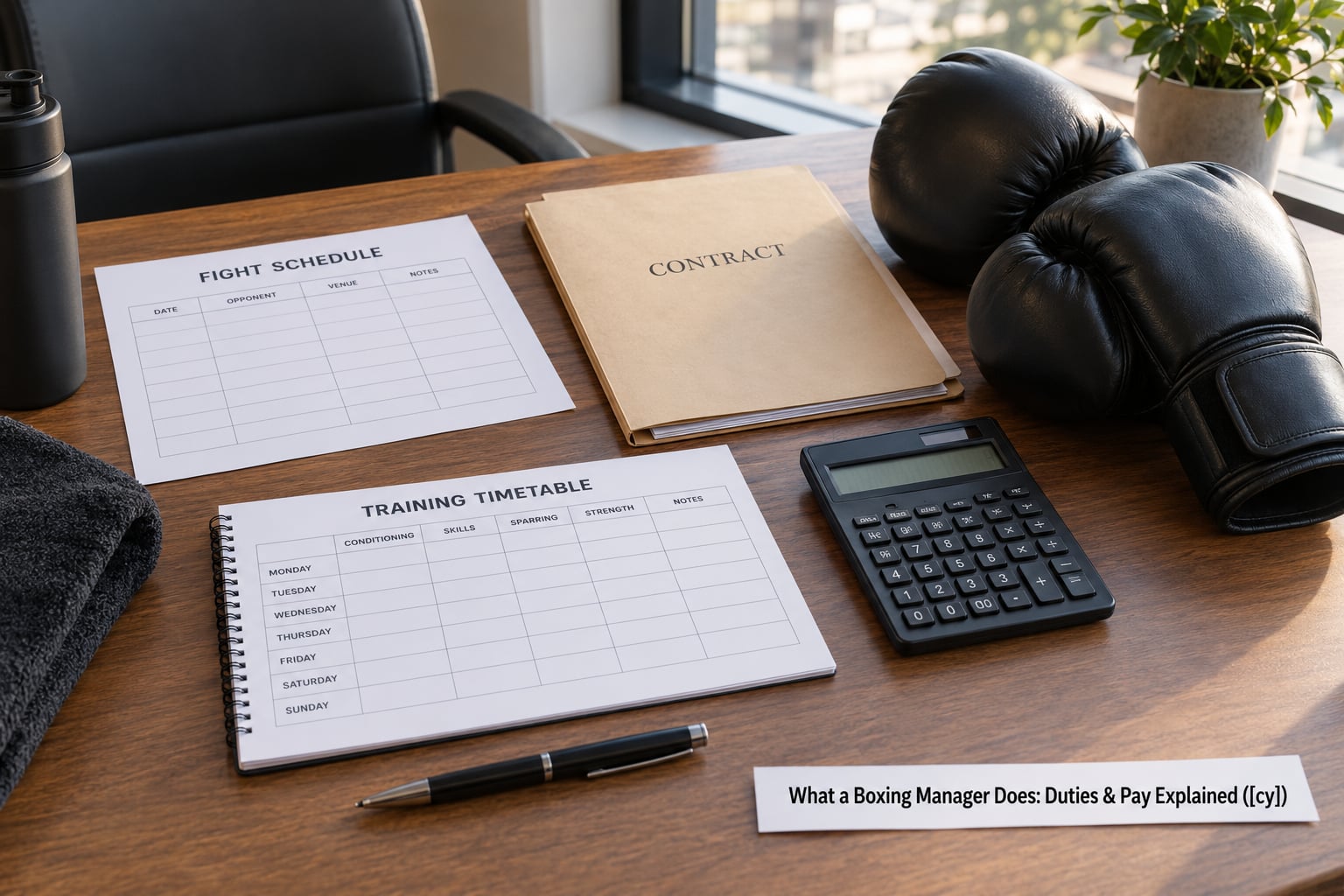
Table of Contents
- What Does a Boxing Manager Do?
- How Does a Boxing Manager Support a Fighter’s Career?
- What Are the Main Duties of a Boxing Manager?
- What Does a Boxing Manager Do on Fight Week?
- How Is a Boxing Manager Different from a Promoter, Trainer, or Agent?
- How Is a Boxing Manager Paid?
- How Long Can a Management Contract Last?
- What Skills Does a Boxing Manager Need?
- How Do You Become a Boxing Manager?
- What Should a Boxer Look for in a Manager?
- Frequently Asked Questions
- What to Do First
What Does a Boxing Manager Do?
Put simply, a boxing manager is the fighter’s representative in every business deal outside the ring. That covers four areas: protecting the fighter’s interests, creating commercial opportunities, running the operational side of a fight camp, and planning the arc of a career that usually lasts somewhere between eight and twenty fights.
A manager negotiates and reviews the boxer-manager agreement, pushes for fair fight terms, and handles commission paperwork with promoters. They look for sponsorship and endorsement money, since a fighter’s purse is only part of the income picture. They coordinate the gym, the trainer, the promoter and the commission so everyone is working from the same dates. And they advise the fighter on what the money means: taxes, savings, a retirement pot that gets started long before the last fight.
That last part is where a good manager earns the commission. A fighter who wins a title at 24 can still end up broke at 35, and a fighter with no manager can end up broke at 27.
How Does a Boxing Manager Support a Fighter’s Career?
The way a manager helps changes completely depending on where the fighter sits in the career. Here is how the job looks at each stage.
Turning pro
A new pro usually has a trainer, a small record and no idea what a fight contract should contain. The manager reviews the first contract before it is signed, sets up licensing and insurance, and negotiates a first opponent who suits the fighter’s style rather than one that fills a promoter’s card.
Building a record
Over the first two years, the manager protects the fighter from fights that are bad on paper. Too much travel, too little notice, a step down in opposition, a date that collides with another commitment. A manager who books eight fights in a year and gets to four is doing the job. A manager who books twelve for quick money is burning the fighter’s prime.
Title contention
Once a ranking or a belt is within reach, the manager’s phone gets busier. Ranking eliminators, mandatory challengers, sanctioning body fees, rematch clauses, broadcast appearances. This is where relationships with promoters and matchmakers decide whether a fighter gets the shot, and where a manager’s record matters.
Late career and retirement
The final stage is the one fighters think about last. A good manager raises the subject years in advance, lines up coaching work, gym ownership or a promotion role, and makes sure the fighter has health cover and something to live on after the gloves come off for good.
What Are the Main Duties of a Boxing Manager?
Day to day, the job covers eight recurring pieces of work.
- Career strategy. Deciding how many fights to take per year, which divisions to work in, and what the one-year and three-year goals look like. This is the decision everything else hangs from.
- Opponent selection. Putting together a shortlist with the trainer, then taking it to the promoter. Managers push back on fights that make no sense commercially or physically.
- Contract and promotion discussions. Reading the fight contract, the option clauses and the rematch terms, then negotiating. On bigger cards, that includes matching terms on a support bout for the fighter.
- Scheduling and bout paperwork. Filing with the state commission, confirming the opponent holds a valid licence, tracking medicals and suspensions, and keeping deadlines that are not negotiable.
- Sponsorship and endorsements. Pitching the fighter to brands, gym partnerships and appearance deals, and handling the paperwork and the follow-up so a deal actually gets delivered.
- Finances. Tracking what was earned, what was deducted, and what arrives when. Managers often sit down with an accountant or financial planner, because a boxer is usually a self-employed athlete with an irregular, lumpy income.
- Media preparation. Writing talking points for press conferences, briefing the fighter on reporters, and managing a social media presence that a promoter or sponsor may have a stake in.
- Fighter advocacy. When something goes wrong, the manager is the one who pushes back. Late payment, a cut that was not agreed, a trainer being sidelined without explanation. This is the part of the job nobody sees unless it goes wrong.
What Does a Boxing Manager Do on Fight Week?
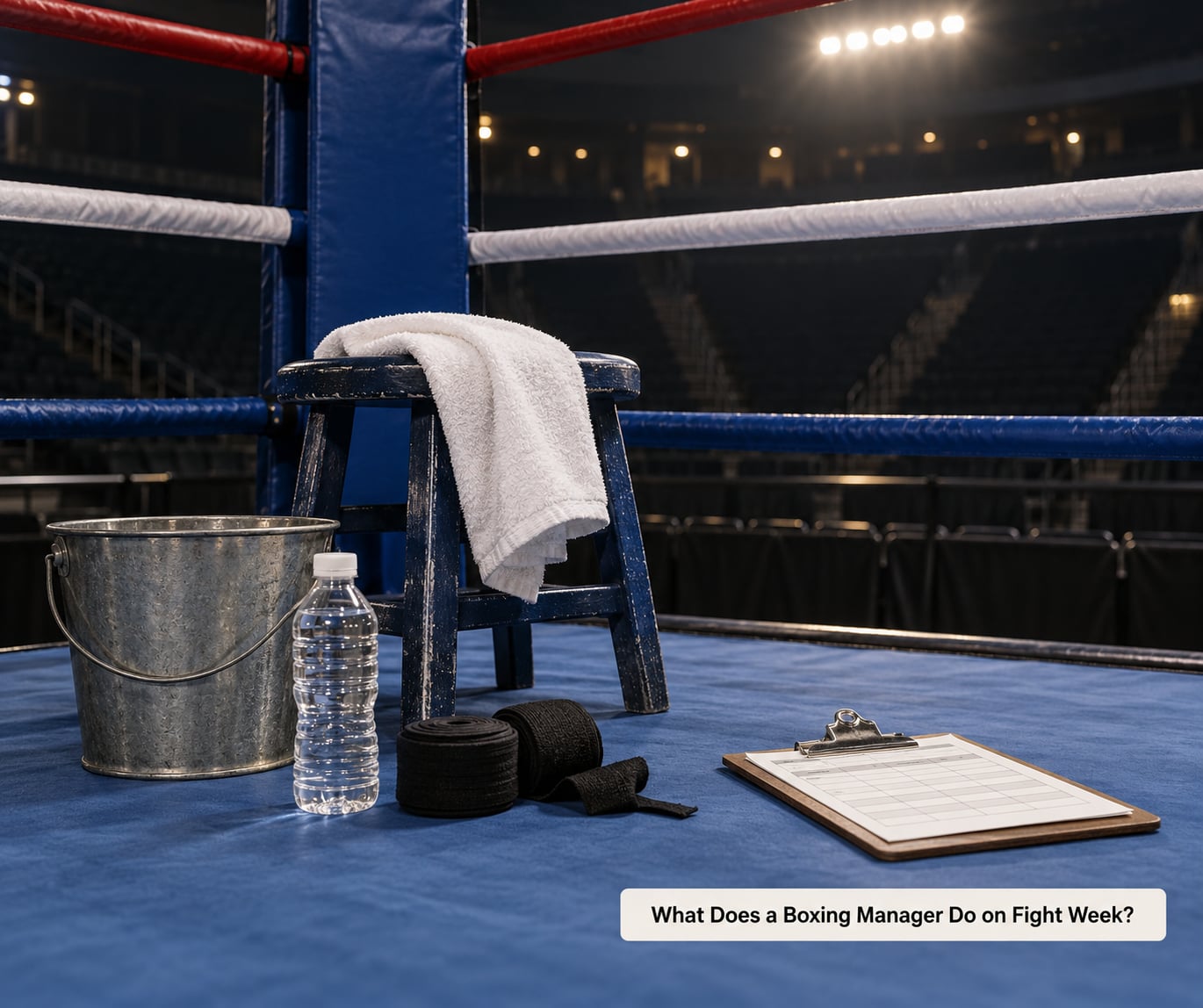
Fight week is the part of the schedule everyone can see and almost nobody understands. For a manager it is a logistics sprint that runs alongside a training camp.
In the final week before the bout, the manager confirms travel, flights, hotels and the ground transport for the team. He checks that the bout contract has been countersigned by both parties and that the commission has the bout on its calendar, because a missing signature is the classic reason a fight gets delayed on the night.
On fight night the manager attends the weigh-in, watches it happen rather than delegating it, and speaks to commission officials if a number is wrong. In the arena he sits ringside or in the corner area as the rules allow, holds the corner bag, and keeps the fighter’s attention on the plan. He also handles the media obligations that come with the card, so the fighter does not have to think about interviews while managing a swollen eye.
Afterwards, he processes the result and, within days, opens the next conversation. Win or lose, there is usually a rematch clause, a medical hold or a ranking update to deal with, and the manager is already talking to promoters about what comes next.
How Is a Boxing Manager Different from a Promoter, Trainer, or Agent?
These roles get mixed up constantly, including inside the sport. The promoter produces the event and owns the broadcast, the venue and the ticket income. The trainer teaches boxing. The manager works for the fighter. The agent is a specific sub-role that many managers perform themselves.
| Role | Who they work for | Main responsibility | Where the money comes from | Licensing |
|---|---|---|---|---|
| Manager | The fighter | Contracts, opponents, sponsors, career planning, day-to-day operations | A percentage of the fighter’s earnings under a boxer-manager agreement | Licensed as a manager by state athletic commissions |
| Promoter | The event and investors | Putting on the show: venue, broadcast, ticketing, undercard, budgets | Gate receipts, broadcast and streaming deals, sponsorship of the event | Licensed as a promoter, separate from manager licensing |
| Trainer | The fighter, typically on a weekly fee | Teaching the skill, camps, corners, strength and conditioning | Flat or per-session training fees, sometimes a percentage | No manager’s licence, but corner credentials are required |
| Manager’s agent | The manager | Finding and negotiating fights on the manager’s behalf | A share of the manager’s own commission | Typically registered as the manager, with the agent named in the agreement |
The cleanest test is who is on the other side of the table. If the person across the table wants the fighter to sign something, they might be a manager. If they want the fighter to fight on a date on their card, they are a promoter. If they are the fighter’s own employee holding a separate agent agreement, they are an agent.
Conflict of interest is the part that trips people up. A promoter can absolutely also serve as a manager, and plenty do in smaller promotions. The problem is not the dual role itself; it is that the promoter, who is buying a fighter’s services, is also the person supposed to be protecting the fighter’s interests in the deal. Fighters in that situation are advised to get an independent lawyer to review the paperwork.
How Is a Boxing Manager Paid?
Almost always with a percentage of what the fighter earns, though the structure varies more than most people assume. The figures below are the ranges that come up repeatedly in boxing forums and industry conversations, not fixed rates.
Flat percentage commission. The commonest arrangement is a share of everything the fighter receives, typically around 10 to 15 percent. Forum discussion about managers often cites 10 to 20 percent, and complaints usually start above that line, because at the top end the manager is taking a fifth of the income for what may be a few fights a year.
Higher percentage with services included. Some managers charge more when they are covering everything, including marketing, a publicist, a nutritionist and paid travel. The trade is simple: a bigger cut in exchange for a manager who does more than negotiate.
Retainer plus smaller percentage. A monthly retainer, sometimes described as an availability fee, paired with a lower commission. This suits a manager who is handling a career all year rather than only around fight nights.
Negotiation fee. A flat, one-off fee per deal worked, rather than a percentage. Rare, and usually paired with something else.
Success-based payments. A bonus or an override if the fighter wins a belt, lands a specific sponsorship, or extends a deal. This is the arrangement that most rewards a manager doing real work, and it is the one worth asking for.
How Long Can a Management Contract Last?
Boxer-manager agreements are usually fixed-term, and many states cap how long a manager can be tied to a fighter. California is commonly cited at five years and Nevada at four. Other states have their own limits and their own licensing rules, so the real answer is always: check your state athletic commission before signing anything.
What matters more than the length is what is in it. Fighters should look hard at the option clauses, which can extend the agreement automatically, and at the termination terms, which decide whether a fighter can leave a manager who has stopped delivering. Anyone considering signing should have a sports lawyer read it first. It is a small cost next to a multi-year commitment.
What Skills Does a Boxing Manager Need?
Being around boxing is not enough. The work is mostly negotiation, administration and judgement, and the skill set looks like this.
- Contract reading. The ability to parse a bout agreement, an option clause and a rematch clause, and to explain them in plain language to someone who is tired and emotional.
- Negotiation. Not being liked. Getting the purse, the notice period, the opponent, the support bout and the rematch terms a fighter actually asked for.
- Bookkeeping and financial basics. Reading a statement, chasing a late payment, understanding an escrow and deductions list.
- Commission and regulatory knowledge. Which rules apply where, what the deadlines are, what a sanctioning body requires.
- Relationship building. Promoters, matchmakers, trainers, sponsors, journalists and commission officials all matter, and none of them are won over once.
- Discretion. A manager hears things at 3am after a tough loss. Some of it belongs in a newspaper and most of it does not.
- Availability. Fight week and contract season mean being reachable when other people are not.
How Do You Become a Boxing Manager?
The path runs through the state commissions, and there is no shortcut around it.
- Live in the sport first. Work a gym, corner as a second, or spend time at a promotion’s shows. You need to know how the rooms work before you are allowed to negotiate in them.
- Pick the state. Licensing is state-by-state, so start with your commission. Find the manager or representative application on its website and read what the state requires in bond, insurance and experience.
- Get licensed. Applications usually need proof of liability insurance, a background check, and sometimes an examination. Some states also limit contract duration, which shapes what you can offer a client.
- Learn the contracts. Read real bout agreements, manager agreements and commission rules until you can spot a bad clause from across the room.
- Find a mentor already doing the job. Most working managers will talk to someone serious. Ask how they got their first fighter, not what their commission rate is.
- Start with one or two fighters. Managing one fighter well is a full-time job. Most managers only ever handle a handful.
- Keep a paper trail. Every conversation, offer and agreement in writing. It protects the fighter and it protects you.
What Should a Boxer Look for in a Manager?
Ask these questions before you sign anything, and treat the answers as carefully as the contract itself.
- Are you licensed, and in which states?
- Who are your current and former fighters, and will you give me references?
- What is your commission, what does it apply to, and what happens to it when I stop fighting?
- What were my last four fights and who else wanted them?
- Do you have your own lawyers, or do you use mine?
- Do you have any financial interest in any promotion, gym or sponsor I might work with?
- How quickly do you respond to a message, and when did you last book a fight?
Red flags are easier to spot than people expect. A manager who discourages a lawyer, who is vague about the commission, or who cannot name a single fight they have made since the fighter signed are giving you clear answers.
Two more worth watching for. First, a manager who books showcase fights one after another for quick money, which is what fighters describe on forums as being treated like a cash cow. Second, a promoter pushing a fighter toward a particular manager, which is common and rarely wrong in the fighter’s favour. Fighters are usually advised to choose independently, away from the promoter.
Frequently Asked Questions
Do boxing managers need a license?
Yes in most states. Managers are licensed by the state athletic commission where the fighter is licensed, and the licence is specific to that state. Applications typically require liability insurance, a background check and sometimes an exam. Some states also cap how long a management contract can run, which is why a manager who works across state lines usually holds more than one licence.
What percentage does a boxing manager usually take?
Around 10 to 15 percent is the range most often described as fair, with 10 to 20 percent appearing repeatedly in boxing forum discussions. Higher rates usually come with more services bundled in. What matters as much as the rate is what it applies to: every purse, endorsement and signing bonus, or only fight income. Get that defined in writing.
Does a boxing manager arrange the fighter’s fights?
In practice, usually yes, and that is the point of the job. The manager and trainer agree on a shortlist of opponents, then negotiate dates and terms with one or more promoters. No manager controls who says yes. A promoter books the event and decides what fits the card, so a good manager is the one who knows which promoters will move for which fighter.
Can a promoter also be a boxer’s manager?
It happens, especially in smaller promotions, and it is not automatically a problem. The concern is the conflict: the promoter buying the fighter’s services is also the person meant to protect the fighter’s interests in that deal. Fighters in this position are advised to have the paperwork reviewed by a lawyer who does not work for the promotion.
What is the difference between a boxing manager and an agent?
A manager handles the whole business relationship: contracts, sponsors, money, media and career planning. An agent is a narrower role that finds and negotiates fights for the manager, and the agent is normally named in the manager’s own agreement with the fighter. Many managers are their own agent, which is why the two titles often get used interchangeably.
Should a boxer have a manager before turning professional?
Getting someone early is usually an advantage, because the first contract is the one that sets the tone. A manager can review the terms before they are signed, help with licensing and insurance, and avoid a bad first deal that shapes the next three years. It does not have to be a long-term commitment at that stage, and it is worth having the first agreement read by a lawyer.
What to Do First
If you are a fighter without a manager, the first step is not shopping for a commission percentage. It is writing down the last three contracts you have seen, if you have any, and asking a sports lawyer what you do not understand in them. Then ask two or three managers in your area for a conversation, and compare what they offer beyond the percentage: fights booked, sponsors landed, references they will give.
The details of licensing, contract length and commission rates vary by state and change over time, so confirm the current rules with your state athletic commission before signing anything.