Short answer first: how boxers manage weight between camps is mostly restoration. They put back what the cut took away — fluid, glycogen and some lean mass — then settle into a stable walk-around weight that becomes the baseline for the next camp. The number on the scale is only part of it. Recovery, appetite and the training load between fights decide whether the next camp starts healthy or already behind.
The weeks after a bout are the least discussed part of the whole cycle. Fans see the weigh-in, the robes, the eight rounds, then silence for a few months. That silence is where most of the actual work happens.
Table of Contents
- How Boxers Manage Weight Between Camps
- What Is a Boxer’s Baseline Weight?
- What Happens During the Weeks After a Fight?
- How Do Boxers Lose Weight Safely and Gradually?
- How Much Weight Should a Boxer Lose for a Fight?
- What Does a Boxer’s Weight-Making Week Look Like?
- How Is Weight Loss Monitored?
- What Happens After a Boxer Makes Weight?
- Which Problems Come From Cutting Weight Too Fast?
- Frequently Asked Questions
- Conclusion
How Boxers Manage Weight Between Camps
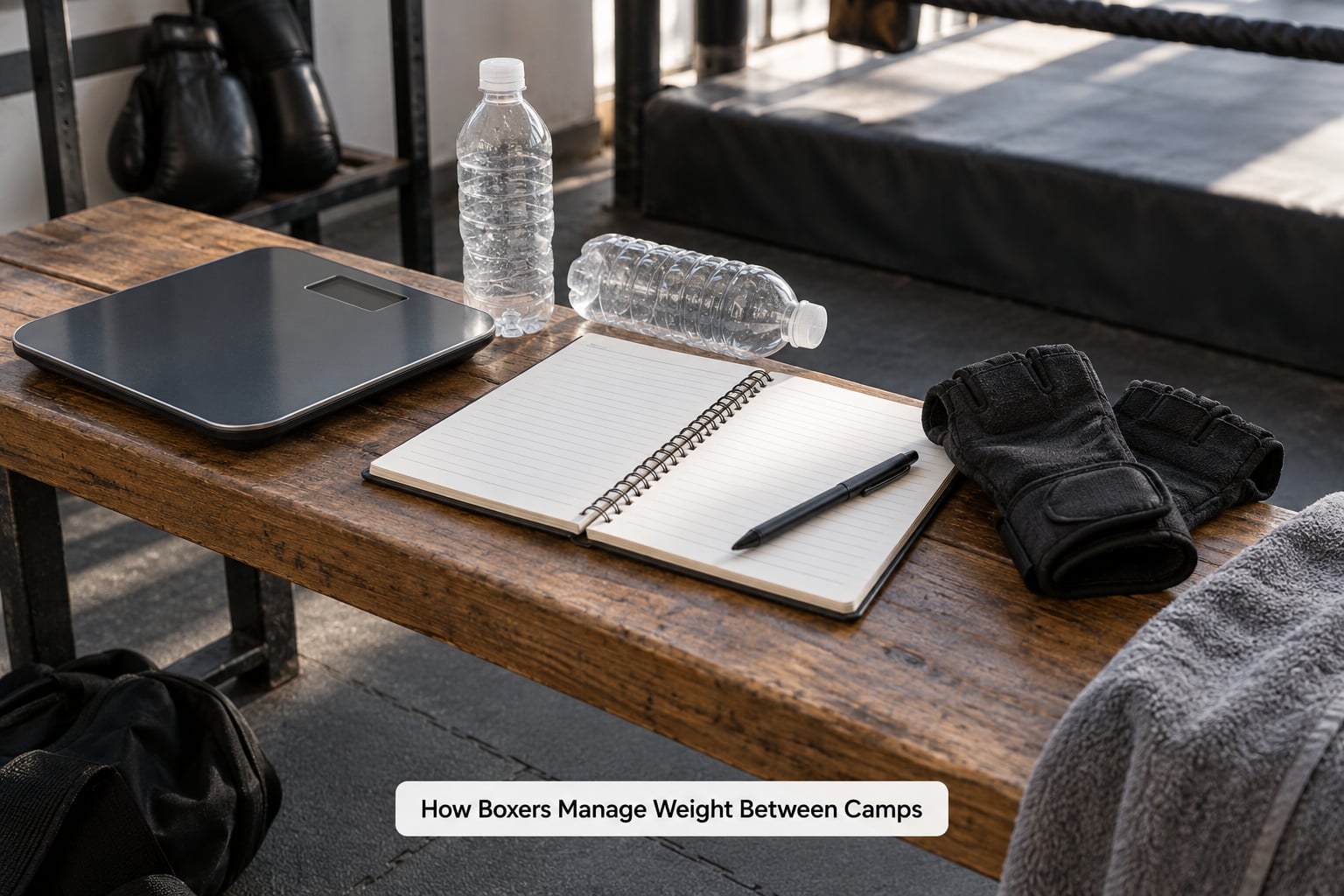
The process starts the moment a fight ends, not the moment the next camp is announced. The first job is restoration: fluids, carbohydrates, protein and sleep. Only after that comes the formal weight-making period that most people picture when they think about a boxer’s weight.
Those two phases are easy to confuse. Recovery is about repairing what the cut and the rounds removed. Weight-making is a planned, timed reduction that ends at the weigh-in. Run the second one straight after the first and the fighter arrives at the next camp depleted twice over.
In practice the off-camp block is longer than most people assume. A busy professional might have ten to sixteen weeks between bouts, and a large part of that window is spent doing almost nothing about weight at all.
What Is a Boxer’s Baseline Weight?
A baseline weight is the healthy weight a boxer can hold while training normally, sleeping properly and eating enough to recover from hard sessions. It is not the championship limit. It is the number the cut starts from.
How Boxers Manage Weight Between Camps Using a Baseline
The baseline is built from repeated observation, not one reading. Fighters weigh in on the same scale, at the same time of day, in similar conditions, and the seven-day trend matters far more than any single morning. A number that looks like a three-pound loss can be a salty meal, a long run in the heat or a long night of bad sleep.
Once the trend is stable, the baseline becomes the reference for two decisions: how much weight the next cut has to remove, and how much time it will realistically take.
Several things shift a fighter’s baseline over a career. Division expectations change as a boxer matures, age slows recovery, and body composition matters more than raw scale weight — muscle on the frame makes a weight easier to hold. Long-term injuries push it around too.
A senior competitor walking around near 147 lb, for example, is working with a very different margin than a twenty-year-old at the same weight. Anyone rebuilding after a serious injury usually needs a higher baseline than they did before it.
What Happens During the Weeks After a Fight?
The first phase of between-camp management is recovery, and for most fighters it lasts two to six weeks depending on how hard the cut was. Rehydration comes first, often guided by a plan the nutritionist wrote before the fight rather than improvised afterwards.
Glycogen stores get refilled with carbohydrate, and protein intake goes up to protect muscle. Sleep is treated as training, because that is what it is for tissue repair. Medical clearance usually arrives before hard training restarts.
Movement returns gradually. Light roadwork and easy shadow work before anything resembling a session, with sparring held back until a doctor and a coach agree the fighter can take it. Fighters who skip this step are the ones who pick up a shoulder problem in the second month.
Appetite is worth watching. Coming out of a cut leaves many boxers genuinely hungry for several weeks, and that is a good signal, not a flaw. It settles as the fighter returns to normal intake.
How Do Boxers Lose Weight Safely and Gradually?
The methods used in professional boxing are less dramatic than the internet suggests. A cut that was planned well is mostly food, done slowly, with training adjusted rather than removed.
- Modest calorie reduction. A controlled deficit removes fat at a pace the body can tolerate. Sports-science coverage of combat-sport cuts commonly uses about 0.7% of body mass per week as a ceiling for preserving lean tissue, which is a useful anchor for how patient a real plan has to be.
- Lower-carbohydrate approaches. Reducing carbs early in the week drops glycogen, and glycogen carries water with it. That accounts for several pounds quickly, and those pounds come back as soon as eating returns.
- Higher protein intake. Ranges around 2.0 to 2.4 grams per kilogram of body mass are commonly used during a descent to support muscle retention.
- Fluid and sodium management. Fluid restriction and sodium reduction change what the scale reports, not what the body contains. This is the tool of the last few days, never the foundation of a cut.
- Training changes. Cardio volume rises, hard sparring drops, and heavy strength work is kept at low volume so output stays familiar.
Extreme dehydration, sauna suits and punishing extra sessions are not shortcuts around planning. They are ways of borrowing performance from the next month and paying it back with interest.
How Much Weight Should a Boxer Lose for a Fight?
Most of the total change is decided long before fight week, and the number is individual. The division a fighter competes in sets the limit; the baseline sets the gap.
| Weight class | Typical walk-around range | Weight limit | Typical total change |
|---|---|---|---|
| Strawweight | 120-128 lb | 115.5 lb | 5-12 lb |
| Featherweight | 128-134 lb | 126 lb | 4-10 lb |
| Lightweight | 136-142 lb | 135 lb | 3-8 lb |
| Welterweight | 143-150 lb | 147 lb | 3-7 lb |
| Middleweight | 155-163 lb | 156 lb | 4-10 lb |
| Light heavyweight | 172-180 lb | 175 lb | 4-9 lb |
| Heavyweight | 188-200 lb | over 200 lb | Varies widely |
These ranges are illustrative rather than a prescription. A fighter who already sits at the limit with a healthy baseline may need to lose almost nothing, which is a position many experienced professionals work toward over a career.
No one should attempt a large cut without a qualified coach and a registered dietitian or sports-medicine professional. The number that works for a 25-year-old middleweight will not work for a 38-year-old at the same weight, and the difference is not stubbornness.
What Does a Boxer’s Weight-Making Week Look Like?
A well-run final week is boring and repetitive, which is exactly why it works. The sequence below describes the pattern, not a prescription — every element is set individually.
- Day one to four. Baseline weigh-in and review, normal training with sparring reduced, calories trimmed slightly, carbohydrate lowered, sodium kept steady so the week stays predictable.
- Day five. Weight and hunger check. If the trend is off by more than the plan allows, the fight date moves or the cut moves. It does not get solved by starving on day six.
- Day six. Fluid and carbohydrate management begin in earnest, with rest and lighter sessions replacing hard work.
- Day seven, weigh-in morning. Official weigh-in, then rehydration begins immediately with measured fluid and electrolytes rather than free drinking.
- After the weigh-in. Small, easily digested meals introduced gradually, then a normal fight-night intake.
- After the bout. Refuelling and rehydration take priority for several days, with the fighter eating rather than dieting.
What gets checked across that week: urine colour and frequency, resting heart rate, sleep quality, digestion, mood, and how sparring feels. Any of those going the wrong way ends the cut early.
How Is Weight Loss Monitored?
How boxers manage weight between camps comes down to measurement discipline, because the scale lies more often than fighters would like. The same time, same scale, same conditions, and a seven-day trend — single readings are noise.
Body composition estimates, whether from calipers, a handheld device or a scan, add context but carry real margins of error. Treat them as a trend line, not a verdict.
Performance is usually the most honest marker. Output on the pads, sparring quality and resting heart rate tend to move before the scale does, in both directions. Food records kept honestly add more than any device bought late in a cut.
Warning signs — dizziness, confusion, repeated vomiting, fainting, a racing heart at rest, or a fighter who cannot stop training — mean stopping and calling a doctor. Those are not things to train through, and no article, including this one, replaces medical advice.
What Happens After a Boxer Makes Weight?
Boxers put on so much weight after weighing in because most of what they lost was fluid and glycogen, not fat. A middleweight commonly regains around 20 lb between the weigh-in and fight night, and that weight returns in roughly 24 hours when fluid and carbohydrate are restored.
Rehydration is a measured protocol, not a chugging contest. Drink volumes, electrolytes and timing are set in advance, and a promoter’s rehydration clause in the bout contract can legally cap how much a fighter may put back on, which exists to protect both competitors.
What comes back is not the same tissue that left. Glycogen returns with its water, some lean mass does not return at all, and a fighter who feels soft after rehydrating is usually reacting to that difference.
One more wrinkle: many promotions now hold a ceremonial weigh-in earlier in fight week and the official one 24 hours out. Fighters know this and time eating and fluid intake accordingly rather than arriving at the ropes still half empty.
Which Problems Come From Cutting Weight Too Fast?
Severe restriction, heavy dehydration and pushed training stack up on each other. The usual consequences are a decline in punch output and endurance, poor sleep, slower wound healing, a persistent feeling of running on empty, and a higher injury risk that shows up weeks later.
Community discussion around cutting has long raised concerns about brain health, and the reasoning is straightforward: rapid weight loss involves losing fluid alongside tissue, and fighters take the ring with depleted reserves. That is a reason for medical oversight, not something to argue about online.
Signs a cut has gone too far include a resting heart rate that stays elevated, repeated weight-class changes without time to adjust, deliberate attempts to make an impossible cut on purpose, and senior competitors pushing harder than their recovery allows.
Anyone dealing with these signs should talk to a doctor or a registered dietitian, not to a forum thread. General information only, and it is not a substitute for an individual assessment.
Frequently Asked Questions
How quickly should a boxer cut weight for a fight?
Most camps aim for a gradual reduction rather than a crash, and sports-science work on combat athletes commonly uses about 0.7% of body mass per week as a ceiling that protects lean tissue. Anything faster relies on fluid and glycogen rather than fat, and it comes back. The final days add a smaller fluid-and-sodium adjustment on top of a food plan that was built weeks earlier.
Why does a boxer weigh more after making weight?
Because most of the weight lost before a weigh-in is fluid, glycogen and its attached water, not body fat. A middleweight typically regains around 20 lb within about 24 hours of rehydrating and refuelling. That is why fighters are measured hours before they fight, and why promoter contracts often include a rehydration clause.
Do boxers have to dehydrate to make weight?
Sometimes, for the last few pounds, and it is the least desirable part of the process. Dehydration changes what the scale reports without removing tissue, and it degrades output, endurance and concentration in the ring. A planned cut should use food and training adjustments for most of the total change, with fluid and sodium manipulation reserved for the final day under professional supervision.
What should a boxer eat after making weight?
Small, easily digested meals with carbohydrate and a modest amount of protein, introduced gradually over the hours after the weigh-in rather than one large feast. Sodium and fluid intake are measured and scheduled. By fight night the goal is normal intake, and for several days afterwards the priority is refuelling and rehydrating, not dieting back down.
Who should supervise a boxer’s weight cut?
A qualified coach working alongside a registered dietitian or sports-medicine professional who has access to the fighter’s medical history. Between camps matters just as much: the rebuilding block after a fight determines the baseline the next cut starts from. Anyone with an existing medical condition, or competing in a masters division, should be assessed before planning any weight change.
Conclusion
How boxers manage weight between camps follows a sequence: recover from the fight, reestablish a stable baseline weight, reduce gradually with training adjusted rather than abandoned, monitor it with trends instead of single readings, and restore what was taken away once the weigh-in is done.
If you want one thing to take from this, start with the baseline. Know the healthy weight, watch it over weeks rather than days, and let a qualified coach and dietitian build any fight plan around it. Everything else is detail.