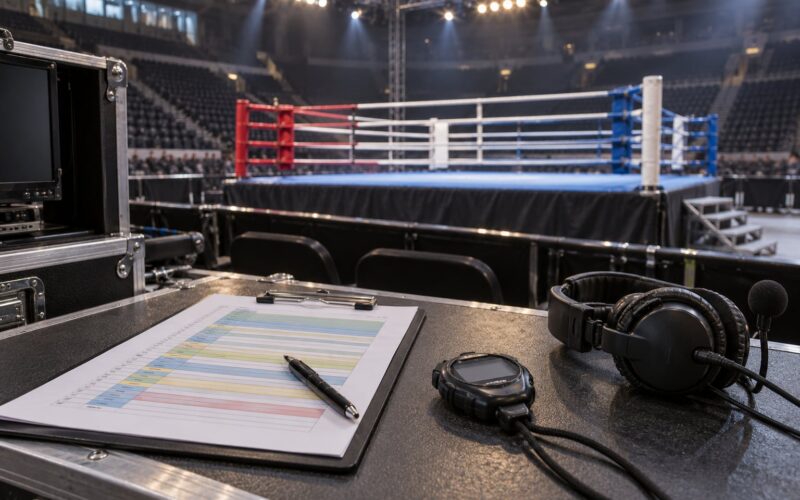
A chief support bout is the most important fight on a boxing card below the main event and the co-main — the marquee undercard bout, usually featuring a ranked contender or a title eliminator, that sits near the end of the running order immediately before the headliner.
The phrase is boxing’s way of saying one undercard fight matters more than the others. It describes billing and placement, not a weight class, not a championship, and not a guarantee of anything about the fighters involved.
If you are new to the sport, a few words do a lot of work in fight coverage. A bout is simply a fight. A fight card, or just a card, is the full schedule for one night. The main event is the last fight, the one the headline is built around. The undercard is everything listed beneath it, and the main card is the portion of the undercard a broadcaster chooses to televise or stream.
Getting those four straight makes the rest of a card obvious, including where a chief support bout fits.
Table of Contents
- What a Chief Support Bout Is
- Chief Support Bout Meaning and Card Position
- Chief Support Bout vs Main Event vs Undercard Bout
- Why Promotions Use a Chief Support Bout
- How to Read a Boxing Card’s Fight Order
- What a Chief Support Bout Is on a Typical Card
- Does a Chief Support Bout Have to Be a Title Fight?
- Frequently Asked Questions
- Is a chief support bout always right before the main event?
- Do promoters use chief support bout for every boxing card?
- Is a chief support bout more important than every other preliminary fight?
- Can a chief support bout be a title eliminator?
- Does a fighter become a champion by winning a chief support bout?
- Where should I find the official fight order for a boxing card?
- Conclusion: Start with the Main Event
What a Chief Support Bout Is
A chief support bout is a selected fight on a boxing card, usually placed immediately before the main event, given a higher billing than the rest of the undercard because of who is fighting or what is at stake. It is a promotional billing rather than an official division, and no sanctioning body awards it.
In practice the fighters involved are usually a ranked contender working up toward a title, an unbeaten prospect, or a fighter in a title eliminator. The matchup is expected to be competitive enough that a promoter will not want a fan arriving late, missing it, and settling in for the headliner to a quiet room.
Search for “chief support bout” and you will find the phrase used constantly by fight promoters, broadcasters and reporters, and almost never explained. It comes up in preview copy the same way “undercard” does, which is probably why so many readers take it at face value.
Chief Support Bout Meaning and Card Position
Break the term into parts and it becomes obvious. “Bout” means fight. “Support” means it supports the main event — it is on the same card and it helps fill and build the night. “Chief” means it is the top-ranked of those supporting fights, the first among equals in the undercard.
The important thing to notice is that the phrase describes the other fighter’s billing on the card, not the fighter’s own status. If your fighter is in the chief support bout, it means the opposition is considered the most notable name among the non-headline bouts. It is not a compliment to the opposition and not a demotion for your fighter.
How the position varies
There is no rulebook version of this. On a nine-fight pay-per-view, the chief support bout may be the seventh or eighth fight and get a prime-time slot. On a six-fight hall show in Britain, the same phrase can be applied to the second fight of the night, because the label scales with the card rather than travelling with the fight.
Promotions also disagree about how many positions sit below the co-main. Some build a stack of five or six support bouts beneath it. Others run a single chief support, one supporting bout and then straight to the headliner. That is why the term is descriptive rather than structural.
Chief Support Bout vs Main Event vs Undercard Bout
This is the confusion almost every beginner hits. A chief support bout is an undercard bout — it is not a separate division of the sport. What differs is billing, expected competitiveness and where it sits on the broadcast.
| Element | Main event | Co-main event | Chief support bout | Standard undercard bout |
|---|---|---|---|---|
| Where it sits | Last fight of the night | Immediately before the main event | One or two fights before the co-main, or directly before it on shorter cards | Anywhere from second fight to the walkout bout |
| Typical stakes | World, WBC, WBA or IBF title, or the biggest available matchup | Ranked contender, eliminator or a name with title implications | Eliminator, ranked challenger or a high-upside prospect | Developmental, regional or a record-building opportunity |
| Broadcast tier | Full main event broadcast | Streamed on the main feed in most cases | Streamed, occasionally on the secondary feed | Often not streamed at all |
| Career context | Champion or top contender status | A serious step toward the top | A step up, or a place to rebuild after a loss | Getting fights and accumulating rounds |
Read that table as a ranking of importance, not a ranking of quality. A chief support bout can be the most competitive fight on a quiet card, and a main event can be a mismatch that nobody wants to watch past round four. The billing reflects what the promoter is selling, not what the fans should enjoy.
Why Promotions Use a Chief Support Bout
There are two reasons, and they sit side by side.
The first is commercial. A card needs a second act. Without a strong chief support bout, you have a run of developmental fights and then a headliner, and the middle of the night is where casual viewers drop off. A promoter’s job is to build toward the fight they sold tickets for, and that means putting something worth staying for just ahead of it.
The second is matchmaking. Promoters cannot build a headline around an opponent who has not been tested, and they cannot hand a rising fighter a main event before the promotion has something credible to offer in return. The chief support slot is the working compromise: real stakes, a real audience, and a result that moves a career forward either way.
It also protects a fighter. A prospect coming off a loss often gets a chief support bout with a name they can beat. That is not a demotion, it is a comeback route, and plenty of champions have taken it.
How to Read a Boxing Card’s Fight Order
Find the running order before the card rather than after. Promotions publish it on the event page, broadcasters print it at the top of a preview, and sportsbooks update it once the weigh-in is done.
- Count the fights. A typical professional card runs six to twelve bouts, and the main event is always the last one listed.
- Find the broadcast splits. The first one or two bouts are usually non-streamed preliminaries that nobody has seen. The streamed portion starts further down.
- Look for the co-main event. If the card names one, it sits directly beneath the main event.
- Look for the phrase “chief support”. If the copy uses it, that fight is the one the promotion is selling as the best of the rest.
- Identify the walkout bout. The last fight before the headliner, sometimes called a curtain-raiser or special attraction, though some promoters use those words loosely.
- Check the time estimate. Rounds, ringwalks and between-fight intervals add up fast, and a chief support bout often starts two hours or more after the doors open.
Who hands out the label? In practice, the promoter and the broadcaster together, because billing and airtime follow the same conversation. A sanctioning body has no say, though a title eliminator gives a promoter a strong reason to call a bout the chief support.
Terms you will meet in the same coverage
- Support bout — the same idea, slightly less precise.
- Co-feature — the US equivalent, sometimes used for either the co-main or the chief support.
- Special attraction — a billing that says the matchup is attractive, not that it sits in a particular slot.
- Curtain-raiser — normally the opening or closing fight, used inconsistently.
- Floated bout — a fight held in reserve in case an earlier bout ends quickly and the card needs filling.
What a Chief Support Bout Is on a Typical Card
Take a six-fight card and work through it. Bout one is a regional debut fight for a debutant, not streamed. Bout two is a six-round fight between two unbeaten prospects. Bout three is a former title challenger against a ranked newcomer. Bout four, the chief support bout, is a title eliminator between two ranked fighters, broadcast live and given a longer pre-fight presentation. Bout five is a twelve-round bout that is the co-main event. Bout six, the main event, is a world title fight.
Notice what changed between bout four and bout three: nothing about the ranking of the fighters changed, only the slot. A chief support bout is that slot, and its meaning comes from the position and the promotion’s billing rather than from anything written in a boxing rulebook.
Real usage backs this up. Matchroom Boxing called a WBA world super-bantamweight eliminator between Murodjon Akhmadaliev and Kevin Gonzalez the chief support bout on its Arizona card in 2024. A thread on r/Boxing described Nick Ball’s WBA featherweight title defence against Sam Goodman in Riyadh as the chief support bout. DAZN used the phrase for Demsey McKean against Patrick Korte on the Paro-Brock Jarvis bill, and Racing Post called Yarde-Arthur the chief support on the Eubank Jr versus Benn card.
Does a Chief Support Bout Have to Be a Title Fight?
No. Plenty of chief support bouts are non-title fights, and a champion has regularly headlined one.
A promoter might use the billing for a title eliminator, where the winner earns a mandatory shot, or for an outright world title fight on a card that already has one. It works just as well for two ranked fighters with no titles involved, or for a young unbeaten prospect matched against an established name, which is often the most dangerous kind of fight to walk into.
Conversely, a world title fight can be buried lower on a card if the promoter has another attraction it wants to sell. Position and status are related, but they are not the same thing.
Frequently Asked Questions
Is a chief support bout always right before the main event?
Usually, but not always. On a card with a co-main event, the chief support bout normally sits one or two fights below it. On a shorter card with no co-main, it is usually the fight directly before the headliner. The phrase describes billing rather than a fixed slot, so check the promoter’s published running order instead of assuming a position.
Do promoters use chief support bout for every boxing card?
Larger promotional cards use it, because there are enough bouts for a billing to be worth assigning. Small regional shows often skip the label entirely and just list fight numbers, or apply the phrase to whichever bout they consider the best one that night. The term scales with the size of the card.
Is a chief support bout more important than every other preliminary fight?
In billing terms, yes — it is ranked first among the non-headline bouts on that card, so it will get the most prominent treatment, commentary and airtime of anything below the co-main. That is a statement about placement, not about how close or exciting a particular fight will be. A supporting bout can still out-fight the chief support on the night.
Can a chief support bout be a title eliminator?
It very often is. An eliminator gives the promotion a reason to market a fight as important, because the winner earns a mandatory title shot, and promoters tend to attach their biggest non-headline billing to a bout with a clear consequence attached to it. A chief support slot can also be an outright title fight, a ranked non-title matchup or a prospect’s introduction at a higher level.
Does a fighter become a champion by winning a chief support bout?
Only if the bout itself was for a title. The billing carries no championship status of its own. Winning a chief support bout usually means something less literal and more useful: a ranking, a mandatory shot at a title, a broadcast date, or a name that makes the next offer harder to refuse.
Where should I find the official fight order for a boxing card?
On the promoter’s event page first, since that is the version the broadcaster works from. Broadcasters publish their own running order with broadcast splits in the days before the event, and sportsbooks update bout order after the weigh-in, when non-streamed preliminaries sometimes change. Print previews from established outlets usually list the full order with the chief support labelled.
Conclusion: Start with the Main Event
A chief support bout is the best-billed fight under the main event and the co-main. It signals that a promotion wants you watching, not that anything official has been decided about either fighter. Start from the main event and read backwards down the card, and the running order makes sense on its own.
One last thing worth doing: check the promoter’s running order on the day of the event, because bout order shifts after weigh-ins and a chief support bout is identified through placement and billing rather than any universal rule.