How fight start times are decided comes down to two parties: the promoter, who owns the event, and the broadcaster or streaming service that bought the rights to air it. They agree a date and a main-event slot months in advance, and everything else on the card is built backwards from that slot.
The rest of the night follows from that one number. Venue doors, undercard running times, ring announcer breaks and broadcast analysis segments are all arranged so the headline fighter walks to the ring at the agreed hour, give or take the ten minutes that reality tends to add.
If you have ever set an alarm for a fight and found yourself still waiting an hour later, the reason is almost never a mistake. It is a system designed to protect a commercial window, working exactly as intended.
Table of Contents
- How Fight Start Times Are Decided
- Why the Undercard Affects the Headline Fight
- Why Broadcasters Want Fights to Start on Time
- How Venue and Television Schedules Are Coordinated
- What Can Cause a Fight to Start Late
- How Time Zones and Start-Time Listings Work
- How to Find the Most Accurate Start Time
- Frequently Asked Questions
How Fight Start Times Are Decided
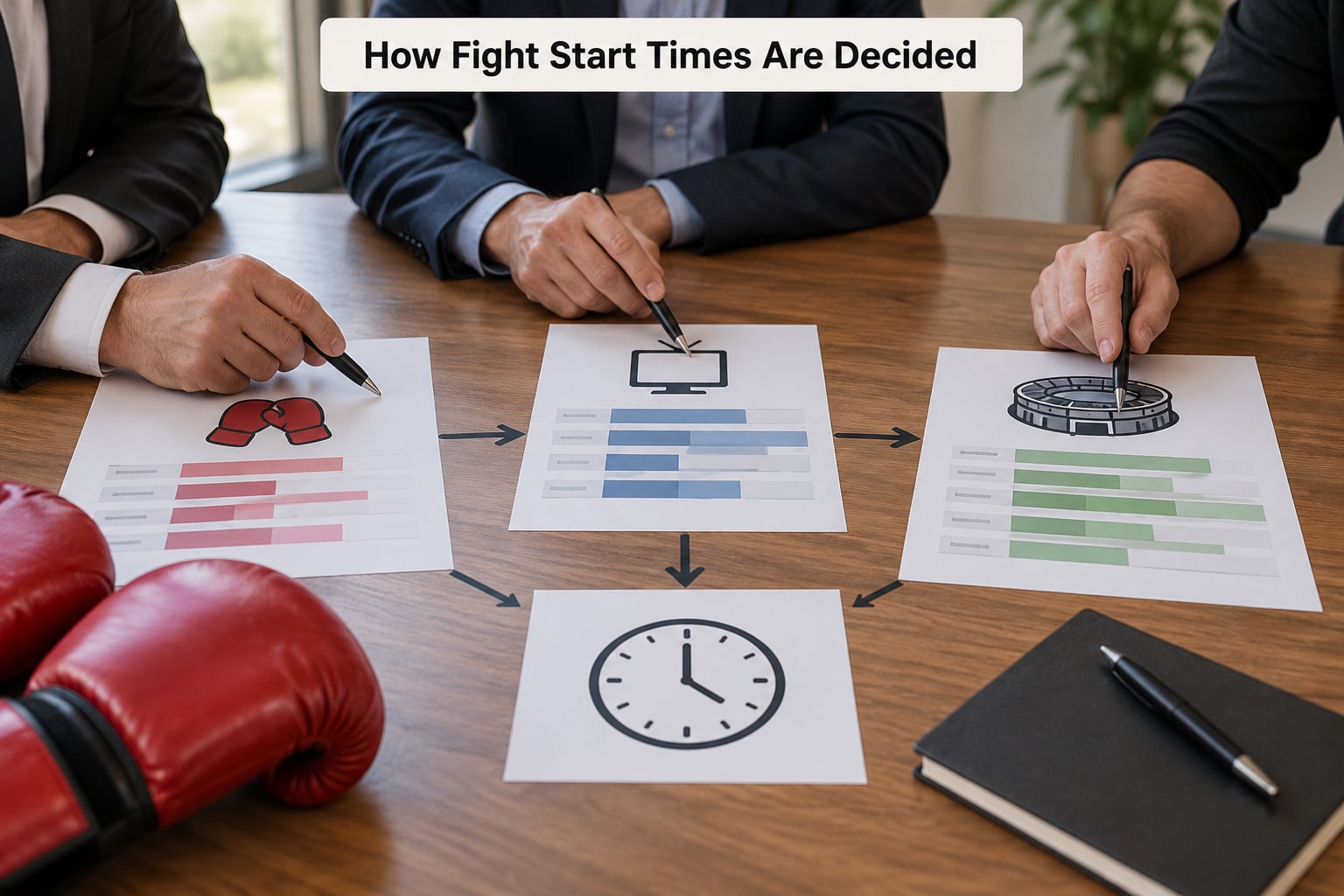
The decision runs as a chain, and each link constrains the next. Camps agree a window, the promoter books a venue for that window, the rights are sold, the buyer picks the hour, the paperwork is ratified and a running order is published.
- Both camps agree a date range. The fighters and their teams block out a period that suits training camps, injuries and weight cuts. Nothing else happens until a window of a few dates exists.
- The promoter books the venue. Arena availability, other events in the building and the cost of holding the space all narrow the window down to one night.
- The promoter sells the broadcast rights. A network or streaming platform bids for the card, usually as part of a wider deal rather than a single event.
- The broadcaster chooses the slot. This is where the actual start time is fixed, because the hour that maximises buys, subscribers or advertising inventory is worth the most.
- The commission and sanctioning body sign off. A state athletic commission licenses the event and the sanctioning body approves the paperwork, but neither normally sets the hour.
- The promoter publishes a running order. Card start, main card and a target ring-walk time go out as advance listings.
Who Makes the Final Call on the Start Time?
The promoter is the contracting party and the broadcaster is the paying customer, so in practice the two of them negotiate the slot together. A promoter will not put on a date that the right platform will not carry, and a broadcaster will not accept a time that buries the card in a dead zone.
| Party | What it actually controls |
|---|---|
| Promoter | The date, the venue, the card, the running order and the advertised target times |
| Broadcaster or streamer | The start hour inside that date, chosen for its own market and schedule |
| State athletic commission | Licensing the event and sanctioning the bouts, including officials and paperwork |
| Sanctioning body | The championship belt and its rules, not the evening schedule |
| Venue | Doors, capacity, security, house rules and holding the building for the required hours |
| Fighter camps | The agreed date window, and increasingly their preference for a start hour that suits camp routine |
Regulars on the BoxingScene forum put it more bluntly than any promoter would: the first undercards start at 7pm Eastern with the main event at 11pm Eastern, as per the contract. That is the correct answer, and it is worth reading carefully. The contract, signed by both camps and filed with the commission, is where the time actually lives.
How the Main Event Slot Is Chosen
Three different numbers get published for one night, and mixing them up is the most common source of confusion. The card start time is when the first bout of the preliminary card begins. The broadcast start time is when coverage begins, often hours later. The main-event ring walk is the hour people actually care about.
The ring walk is the moment the headliner walks out, and the first bell usually follows within a couple of minutes. Promoters aim the ring walk at a specific hour because that is the number that matters commercially: the audience arrives, buys and stays for the headliner.
Where that hour lands depends on which market the buyer wants. United States cards are built around the Eastern Coast audience, so a late Saturday evening slot Eastern is common even when it means midnight or later for viewers on the West Coast. Fights staged in Europe follow the buying power of the local market instead, which is why the same style of event can land at completely different hours in different countries.
Why the Undercard Affects the Headline Fight
Every fight on the card is a timer for the fight after it. Promoters know roughly how long a scheduled bout will run, and they build the undercard so the running total lands the headliner near its target.
A twelve-round distance fight that goes the distance can occupy close to an hour including the corner interval and ring ceremony. Two quick fights that end early do the opposite. A worked example shows how easily the arithmetic shifts:
| Moment | US Eastern | US Pacific | UK |
|---|---|---|---|
| Venue doors | 5:30pm | 2:30pm | 10:30pm |
| First preliminary bout | 6:30pm | 3:30pm | 11:30pm |
| Broadcast coverage begins | 8:00pm | 5:00pm | 1:00am |
| Main card begins | 9:00pm | 6:00pm | 2:00am |
| Main event ring walk target | 11:00pm | 8:00pm | 4:00am |
| Expected final bell | 11:45pm | 8:45pm | 4:45am |
Now add twenty minutes because one preliminary goes the full distance instead of ending in the third round, and every subsequent bout shifts. That is why main events drift later rather than earlier, and why fans describe a card as running behind.
Two other pressures complicate the count. Changing rooms hold a queue of fighters waiting to be ready, so an overrunning bout can stall the next one while the incoming fighter is still in the back. And a fighter who has waited an hour past his planned ring walk may have less appetite for a long fight, which changes the expected length again.
Why Broadcasters Want Fights to Start on Time
A broadcaster is selling a slot in someone else’s evening. Programming is built in advance around the start time, and the amount of advertising or subscription value attached to that hour depends on the schedule holding.
Several practical pressures shape the decision:
- Audience concentration. A headliner that walks to the ring while the target audience is awake and at home is worth more than the same fight at an hour most of them are asleep.
- Schedule collisions. A Saturday night boxing slot competes directly with other sport. Fights that clash with the biggest football window of the weekend lose viewers by the million.
- Commercial inventory. Break times are sold before the event. A card that starts an hour late disrupts every slot planned behind it.
- Contractual commitments. Talent, on-site analysts and studio segments are all booked against the same published hour.
- Territory splits. Rights sold by region mean the agreed hour must suit the market that pays most, which is rarely the market with the most convenient evening.
Streaming has changed the shape of this but not the logic. When a platform carries a card as part of a subscription rather than a pay-per-view, the goal shifts from a single night’s buys to keeping subscribers and stopping cancellations. Either way, someone still wants the headliner in a predictable hour.
How Venue and Television Schedules Are Coordinated
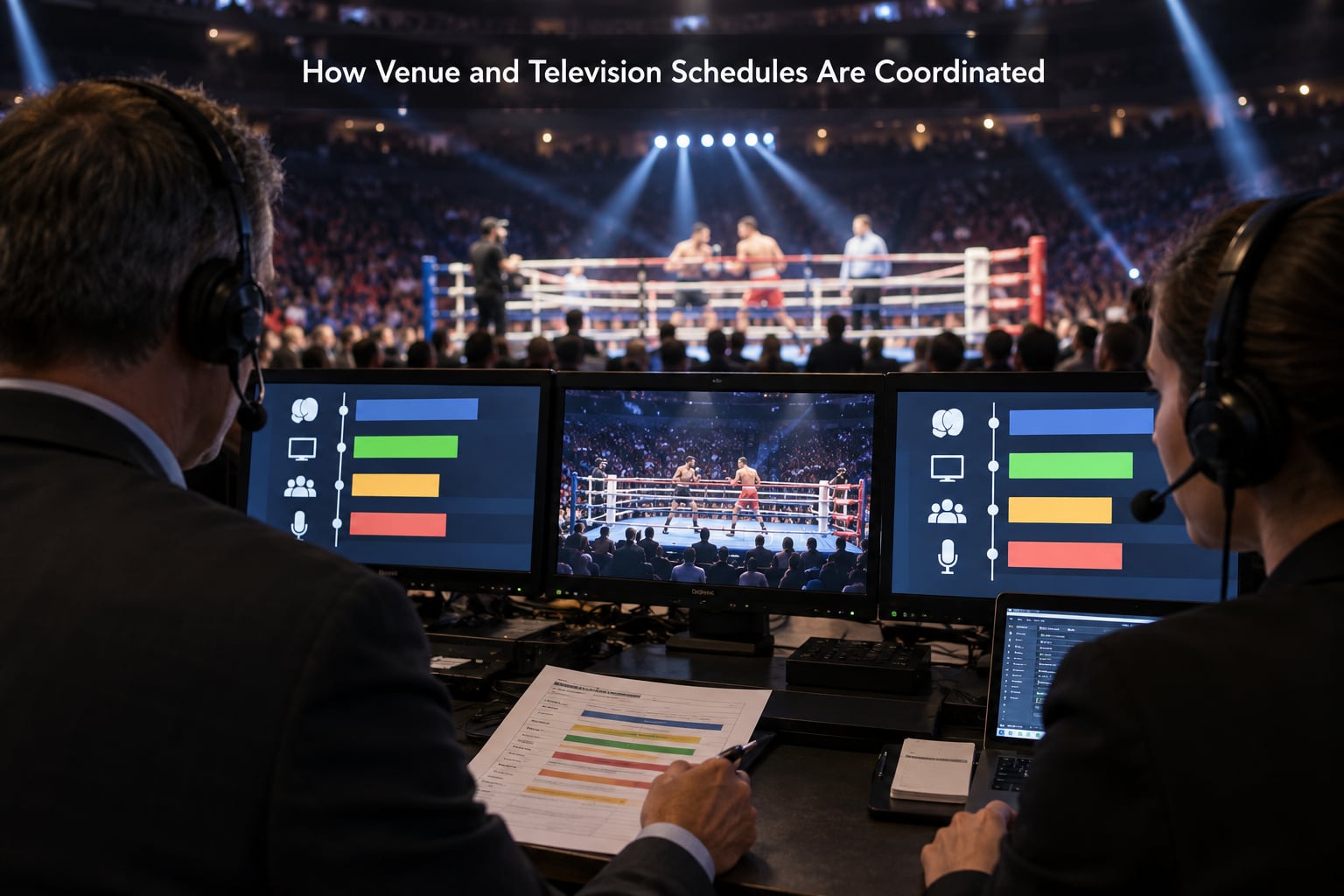
The published schedule is the output of a shared document that the promoter, the venue, the production crew and the broadcast team all work from. It sets out every bout with a planned duration, a notional start and end time, and the ceremonies that sit between them.
On fight night that document becomes a live conversation. The broadcast producer calls the running order against a clock, the ring announcer gets a warning before each introduction, and the production team inserts analysis or promotional video when the card runs ahead of schedule.
That last part matters more than most fans realise. When preliminaries finish quickly, the gap is filled rather than skipped. A BoxingScene thread put it plainly: the vast majority of the time main events hold their estimated start, give or take ten minutes, and very rarely start early. Nobody wants to explain to a paying audience that the card finished early.
What Can Cause a Fight to Start Late
Some delays are ordinary and nobody minds. Others are real problems, and the difference is usually visible.
- A long introduction. Corner speeches, anthem, a special presentation or a dignitary in the ring can add several minutes to one bout.
- Equipment trouble. A loose glove, a malfunctioning mouthpiece or a scorecard issue means a pause the timekeeper cannot skip.
- A bout that goes longer than expected. This is the big one. A fight planned for six rounds can take forty minutes instead of twenty.
- Late crowd entry. Large cards sometimes hold the start while ticketed guests are still finding seats, particularly at venues where the upper bowl fills late.
- Ceremonial requirements. Title presentations, commemorations and belt inscriptions all happen in the ring and cannot be moved.
- A technical stoppage. A ring collapse, a cut that needs treatment or a doctor asking for a pause pushes everything back.
If a fighter is injured, fails a medical or withdraws, the schedule changes structurally rather than by a few minutes. Standby bouts on the same card are promoted into the vacant slot, or the card is shortened and the remaining bouts are pulled forward. Either way the advertised target is abandoned rather than defended.
How Time Zones and Start-Time Listings Work
A listed start time is nearly always given in the venue’s local zone, and platforms convert it for you. The confusion comes from what the conversion actually represents, not from the arithmetic.
The offset between US Eastern and the UK changes twice a year, because the two countries switch to and from summer time on different dates. In winter, Eastern is five hours ahead of the UK; for a few weeks each spring and autumn it is four. A listing that worked last March can be an hour wrong this March.
Labels also differ between platforms. Some listings show the broadcast start, some the main card, some an approximate window rather than a single time. Where a listing names a ring-walk estimate, that is the number to plan around, because it points at the fight itself rather than at the first preliminary.
There is also the venue country to consider. A card in Manchester, Las Vegas or Tokyo does not follow United States prime-time logic, and its published hour can look strange when read against a United States card on the same weekend.
How to Find the Most Accurate Start Time
Work down this list and stop at the first source that gives you a specific main-event ring-walk time.
- The event page from the promoter or broadcaster. These normally list the broadcast start and an approximate ring walk.
- The platform’s own listing. Check which time zone the platform displays by default, then set it to yours.
- The venue’s social accounts on the day. Venues post door times and, frequently, a heads-up when the card is behind.
- Fighter and camp updates. Camps often post their own timings on the night, and they are usually working from the same run of show.
- Live tracking once the card begins. This is the only genuinely accurate option, because it reflects the running order rather than the plan.
My own rule is to work backwards from the ring walk rather than forwards from the advertised card start. If the listing says the card begins at 8pm Eastern and the ring walk is quoted at 11pm, that gap of three hours is the information that matters, not the 8pm.
Frequently Asked Questions
Are boxing start times guaranteed?
No. An advertised time is a target agreed months ahead in the bout contract, and the promoter manages the card around it. Most main events land within about ten minutes of the quoted ring-walk time, but an overrunning undercard, a long introduction or an equipment issue can push it back. Once the preliminaries are underway, the live running order is more reliable than any advance listing.
Why is the main event later than the advertised start time?
Because the advertised start usually refers to the first bout of the card or to the start of broadcast coverage, not to the headliner. Promoters build the undercard to fill the hours before the target ring walk, so a card beginning at 8pm often does not reach its main event until 11pm or later. Always look for a separately quoted ring-walk time.
Does the undercard determine when the title fight begins?
More or less. Each bout acts as a timer for the one after it, and promoters plan the running order so the totals land near the target. Two quick stoppages or a fight that goes the full distance will shift everything that follows. The undercard sets the pace, but the ring announcer and producer still control when the headliner is introduced.
Should I convert a boxing start time to my local time zone?
Yes, and be careful with daylight saving. United States Eastern is five hours ahead of the UK in winter and four during the shorter periods when one country has switched and the other has not. Check which time zone the listing is quoted in before converting, and remember that ring-walk times are often approximate by fifteen minutes or more.
Can a boxing event start early?
Very rarely. Early finishes in the preliminaries create a gap rather than an earlier main event, and the gap is filled with extra analysis, interviews or promotional video. Boxers and promoters understand that finishing ahead of schedule looks careless to the paying audience, so the headliner tends to be held back until close to the target ring-walk time.
How late can the main event start after its scheduled time?
A modest overrun of fifteen to thirty minutes is common on long cards, and forum regulars generally expect the main event to land within about ten minutes of its quoted time. Bigger delays of an hour or more usually trace to a withdrawn fighter, a shortened card or a serious disruption in the ring. In those cases the schedule changes rather than slips.
Treat the advertised main-event time as a target rather than a promise, and plan around the ring-walk figure rather than the card start. Check the event listing on the day, set your reminder in your own time zone, and expect the headliner within about ten minutes of the published hour.