Boxing uses walkout songs because the sport has almost no other ceremony. There are no team intros, no national anthem at the walkout and no mascots on the apron, so a single track, a robe and a fighter’s walk to the ring carry all the ritual, mood and pageantry. The music primes the fighter, lifts the building, projects an image and gives the crowd a shared moment right before the first bell.
Table of Contents
- Why Boxing Uses Walkout Songs
- How Walkout Music Became a Boxing Tradition
- How Fighters Choose Music for a Walkout
- Does Walkout Music Affect a Boxer’s Performance?
- How Walkout Songs Build a Fighter’s Brand
- Why Some Boxers Use Songs, Themes, or Soundtracks
- How Walkout Music Helps Create Crowd Energy
- Frequently Asked Questions
- Conclusion
Why Boxing Uses Walkout Songs
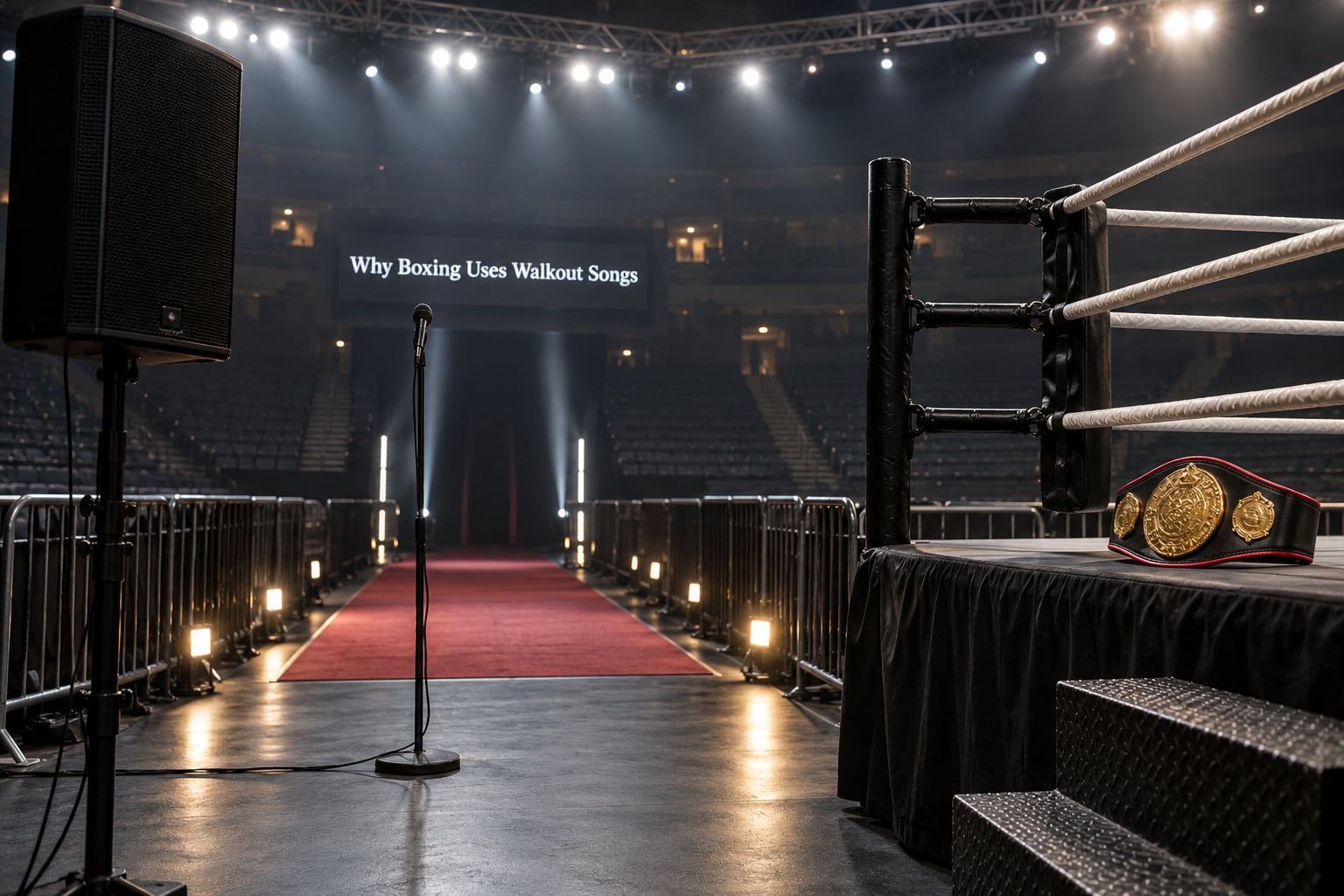
Walkout songs, also called ring entrance music or walk-up music, are the tracks a boxer plays on the walk from the dressing room to the ring. They came out of televised fight presentation, but they do the same job other sports split up across an anthem, a starting line-up and a team introduction.
The reasons come down to five things, and they are not equally about the fighter:
- Psychological priming. A familiar, chosen track puts a boxer into a repeatable pre-fight state before the noise of the crowd can take over.
- Atmosphere and crowd energy. The cue is the signal that the contest is starting. The room changes volume and attention in a way that a ring announcement alone cannot.
- Intimidation and mind games. The opponent stands in the ring and watches. Robes, posture and music are all part of the message, and the opponent has to stand through all of it.
- Identity and branding. The choice signals nickname, hometown, culture and taste, and it keeps working on every replay and every highlight clip.
- Broadcast storytelling. On television, the entrance is the one piece of narrative a viewer gets before a fight with no plot. Music gives the edit a beat to cut to.
That fifth one matters more than it sounds. A twelve-round fight does not naturally build suspense on its own, and entrance music gives a production team thirty seconds of controlled emotion to work with.
How Walkout Music Became a Boxing Tradition
Boxing ran on ceremonial introductions long before it ran on music. Fighters were announced, sometimes with a flourish and sometimes not at all, but there was no established custom of a personal sound track. What changed the practice was television, which needed a repeatable entrance format it could fill for every card, every region and every broadcast partner.
Through the 1970s and into the 1980s, televised boxing settled into a standard walkout cue. Fighters picked from a working library of popular records, which meant the same handful of tracks showed up at nearly every event. That sameness is exactly what the next wave of fighters rejected.
Then came the Rocky III moment in 1982. Eye of the Tiger turned a training montage into a global piece of sports cinema, and for a lot of fighters in the following decade the film score was the obvious choice. A generation of entrances was built around a song that meant something outside the ring, which is a useful lesson for anyone choosing a track now: borrowed meaning travels further than borrowed sound.
The 1990s and 2000s pushed the opposite way, toward music chosen entirely by the fighter. Mike Tyson used Welcome to the Terrordome; Floyd Mayweather leaned on Money (Theme Song Reprise) from the film Men in Black and kept returning to it for years. Forum consensus credits Mayweather with turning the ring walk into a deliberate performance rather than a formality, and he has said he wants to be as original as possible with his ring walks.
The current era adds live artists and full commissioned pieces rather than borrowed songs. Some cards now build an entrance around a custom track written for the fighter, which solves the rights problem and the repetition problem at once.
| Fighter | Walkout music | Era | Why it worked |
|---|---|---|---|
| Mike Tyson | Welcome to the Terrordome | 1990s | Aggressive, unpolished and completely in character for his early career |
| Floyd Mayweather | Money (Theme Song Reprise) | 1990s to present | Consistent for three decades, so it reads as brand rather than a single-night choice |
| Manny Pacquiao | Lalaban Ako Para sa Filipino | 2000s | National pride and a national audience in one cue |
| Rocky Balboa, the films | Eye of the Tiger | 1980s | The film’s score became shorthand for underdog resolve in boxing |
What a Fighter’s Walkout Song Is Meant to Achieve
Strip away the robes and the record and the aim is a specific mental state at the moment the bell is about to ring.
Creating a focused pre-fight state. Fighters describe rehearsing an entrance so the walk itself feels routine. Music that has played in every gym session before sparring can act as a switch, and the switch is the point.
Projecting confidence. Tempo and vocal delivery read as body language. A slow opening that builds says controlled; a hard, fast opening says aggressive. Fighters pick the version of themselves they want to face in the mirror across the ring.
Signalling cultural and personal influences. A Filipino fighter playing a Filipino anthem, a Mexican fighter in a charro sombrero, a British fighter on grime: the track tells the audience where the fighter is from before a word is spoken. Forum threads regularly point out that outsiders miss this layer, and that missing it is why some entrances feel strange rather than impressive.
Giving spectators a recognisable image. Change the track and you change the character people remember. Consistency is why one song can follow a fighter for a decade.
How Fighters Choose Music for a Walkout
The choice is rarely one person’s alone. The fighter leads it, a manager or trainer usually negotiates it, and a promoter or broadcast partner gets a say. In other sports the promotion is reported to overrule a fighter’s selection on certain cards; in boxing the promoter is also usually the promoter of record, which gives them practical leverage. The track then goes to production, where it has to fit a hard timing window.
That last constraint is where a lot of good intentions die. The walk from tunnel to ring is a fixed distance at a fixed pace, and the track either fits that walk or gets faded. Fan complaints about entrances getting cut off by the bell or the announcer are really complaints about bad cueing, not bad songs.
When choosing, the practical criteria are:
- Mood. Decide whether you are going up or settling in, because those need opposite tracks.
- Structure. A cue needs an opening that starts fast enough to register from the back row and a length that matches the walk.
- Lyrics. Check whether the words mean what you mean. A borrowed victory line rarely survives a losing night.
- Tempo. Walkable without rushing. Rushing an entrance is the one mistake nobody forgives on tape.
- Familiarity. A track the crowd knows gets a reaction in the first four bars. A track nobody knows gets silence.
- Clearance. A commercial track needs to be cleared for broadcast, which is why commissioned music has become more common on big cards.
- Repeatability. If you will use it at 15 and 40 fights, the track still has to work in a modern broadcast package and in front of a crowd that has heard it.
Does Walkout Music Affect a Boxer’s Performance?
Sometimes, and the effect is mostly about arousal rather than talent. Music reliably raises heart rate and energy before effort. That is useful if you need to feel sharp and fast, and a poor fit if you want to be loose and patient for twelve rounds.
The trade-off is real enough that fighters split into two camps. Hype music raises you and helps you start the way you intend to finish. Calmer music holds you at a lower temperature, which some fighters prefer because a heart rate that is already at 120 in the tunnel is harder to control once the bell goes. Pacquiao has spoken about singing before fights, and about how that habit settles him rather than fires him up.
What nobody claims is that a song makes a boxer better. The honest version is that a chosen, rehearsed routine reduces the number of unknowns in the last two minutes before a fight, and fighters like fewer unknowns. Anything beyond that is the fighter’s own story about what worked, and it is worth believing either way.
How Walkout Songs Build a Fighter’s Brand
Every consistent entrance is a business decision, whether the fighter thinks of it that way or not. The same track on every card does three jobs at once: it tells fans who the fighter is, it gives promoters something to promote, and it makes the fighter instantly recognisable in a highlight clip with no name on screen.
The strongest choices are specific rather than generic. A track tied to a nickname, a hometown or a family story gives an audience a reason to care that has nothing to do with the result. Regional music traditions do this well: Filipino entrances lean on national anthems and hometown tracks, Mexican fighters use music tied to family and national identity, West African and Nigerian fighters bring their own traditions, and UK fighters have pushed grime and drill into mainstream cards.
The failure mode is repetition. Forum complaints about walkout music are mostly about the same track appearing dozens of times a year across unrelated cards, which drains the impact and earns mockery on social media. A novelty or comedy choice gets the same reaction in the other direction. The rule of thumb fans use is simple: if the song is funny, it has to be funny on purpose.
Why Some Boxers Use Songs, Themes, or Soundtracks
Five formats cover almost every entrance, and each solves a different problem.
Original songs. Clear, memorable and safe. Used for years, and easy to license, but it says less about the fighter than the alternatives.
Recognisable hits. The crowd reacts instantly. The cost is that the song stops belonging to the fighter, and everyone else on the card can pick it too.
Film and television themes. The strongest borrowed choice, because the theme arrives carrying a story. A fighter walking out to a score is borrowing the association, which cuts both ways.
Instrumental edits and remixes. A familiar track with the lyrics stripped out gives you the emotion of the song without committing to its words. It also opens doors on clearance.
Custom commissions. Written for one fighter, one entrance. Best for branding and for clearance, and now common enough on major cards that a bespoke track is no longer a flex.
How Walkout Music Helps Create Crowd Energy
Walkout music exists for the audience as much as for the fighter, and that is the part most discussions skip.
The cue is a starting gun. When the music comes up, everyone in the building understands that the fight is now, and a card with 20,000 people goes from conversation to attention in about two seconds. That is a job announcers were doing alone for decades before walkout tracks became standard.
It also gives the crowd something to do. A known track gets clapped along to, which turns thousands of strangers into one temporary thing for thirty seconds. Without music, an entrance is a man walking. With it, it is an event.
Then there is the hush. Fighters raise a finger for silence before they climb in or before the bell, partly for their own focus and partly because the room has been loud for an hour. The silence and the music are two halves of the same ritual, and the shush is the part that asks the crowd to hold still.
Amateur and local cards run the same ritual with a smaller budget: a phone speaker, a borrowed speaker cable, and a track the fighter picked because it made the other guy at the weigh-in go quiet. The scale changes. The function does not.
Frequently Asked Questions
Do boxers get walk-out songs?
Yes. Almost every professional and amateur bout is preceded by entrance music. The boxer usually picks the track with a manager or trainer, and it is cued during the walk from the dressing room to the ring. Some cards also use music for the weigh-in and the ring introductions.
What song did Mike Tyson use to walk out to?
Mike Tyson famously walked out to Welcome to the Terrordome, the Public Enemy track that suited his early-career image of raw aggression. He used it across the period that made him one of the most recognised fighters in the sport, and it has stayed the reference point most writers reach for when they discuss a boxing walkout.
What is Floyd Mayweather’s walkout song?
Floyd Mayweather is most associated with Money (Theme Song Reprise) from Men in Black, which he returned to for years rather than changing every fight. Forum watchers credit that consistency with turning the ring walk into a performance in its own right. He has said he tries to stay as original as possible with his entrances.
What is the famous boxing song?
Eye of the Tiger is the famous one. The Rocky III theme from 1982 became shorthand for the underdog getting ready, and fighters used it for decades afterwards. Welcome to the Terrordome for Tyson and Money for Mayweather are the two other tracks most boxing fans would put on the same list.
Who chooses a boxer’s walkout song?
The fighter chooses, usually with input from a manager, trainer or promoter, and a promoter or broadcast partner may have approval on bigger cards. The final track then goes to the broadcast production team, which has to fit it to a fixed walk from the dressing room to the ring and clear it for use.
Why do boxers say shhh before they fight?
It is a request for quiet at the moment of highest tension. Fighters raise a finger to settle the crowd before the bell or during the ring introductions, partly to protect their own focus and partly because the ritual signals how serious they are. In a building that has been loud all night, the silence is the punctuation mark.
Conclusion
Boxing uses walkout songs because it needs to do in thirty seconds what other sports spread across a whole pre-game: create a mood, introduce a character and tell the crowd the fight has started.
Pick for your own state first, then for the room second. Check that the track fits the walk, clear it for broadcast, and reuse it only while it still means something to you. The best entrances are the ones a fighter would play even with an empty gym watching.