
Most boxers train three to five sessions a week: three days if you are new, four if you compete as an amateur, five if you are serious about it, and six only with a coach watching. The rest is not filler. How you structure a boxing training week decides whether you actually get sharper every month or just tired.
The quick version: give every session one job, space your hard days 48 to 72 hours apart, keep at least two full rest days, and spend about four-fifths of your ring time on technique rather than fighting at maximum effort. That is enough to build most fighters. Below is how to lay it out.
Table of Contents
- What You Need
- Step-by-Step: How to Structure a Boxing Training Week
- Step 1: Pick a session count you can repeat for eight weeks
- Step 2: Give each session exactly one job
- Step 3: Space hard sessions 48 to 72 hours apart
- Step 4: Build every session from the same block structure
- Step 5: Place strength work where it will not wreck your sparring
- Step 6: Review the week once, before the next one starts
- How to Structure a Boxing Training Week Around Recovery
- Common Mistakes
- Frequently Asked Questions
- Conclusion
What You Need
You need less than most people expect. A calendar, a note in your phone and about fifteen minutes of honest thinking about your week will do most of the work.
A coaching source or a class timetable
If you train at a gym, find out when the coached skills sessions run and aim your own schedule around them. Beginners in particular should not be inventing technical programs on their own. A coach sees the mistakes you cannot feel yet.
A session log
Write one line per session: what you did, how many rounds, and how hard it felt out of ten. That rating is your whole monitoring system. A notebook entry from six weeks ago is worth more than any article, including this one, when you decide whether the plan is working.
Equipment that lets you train anywhere
- Gloves sized for the job: heavier bags for bag work, lighter sparring gloves, plus wraps for every session
- A jump rope for warm-ups and easy conditioning
- A timer or interval clock, so rounds are not a guess
- A mouthguard, and two pairs of shoes if you also lift
- Something to hit: a heavy bag, a double-end bag, or just floor space
Your fixed anchors
Night shifts, school, a toddler, a job that sometimes runs late, a fight six weeks out. These decide your session count before any training theory does. A week built around a real constraint survives contact with Monday.
An honest look at recovery capacity
Sleep, food and how much of the week is already spoken for. This is general training planning, not medical advice, but the principle holds: if you are sleeping badly and sore all week, your session count is already too high.
Step-by-Step: How to Structure a Boxing Training Week
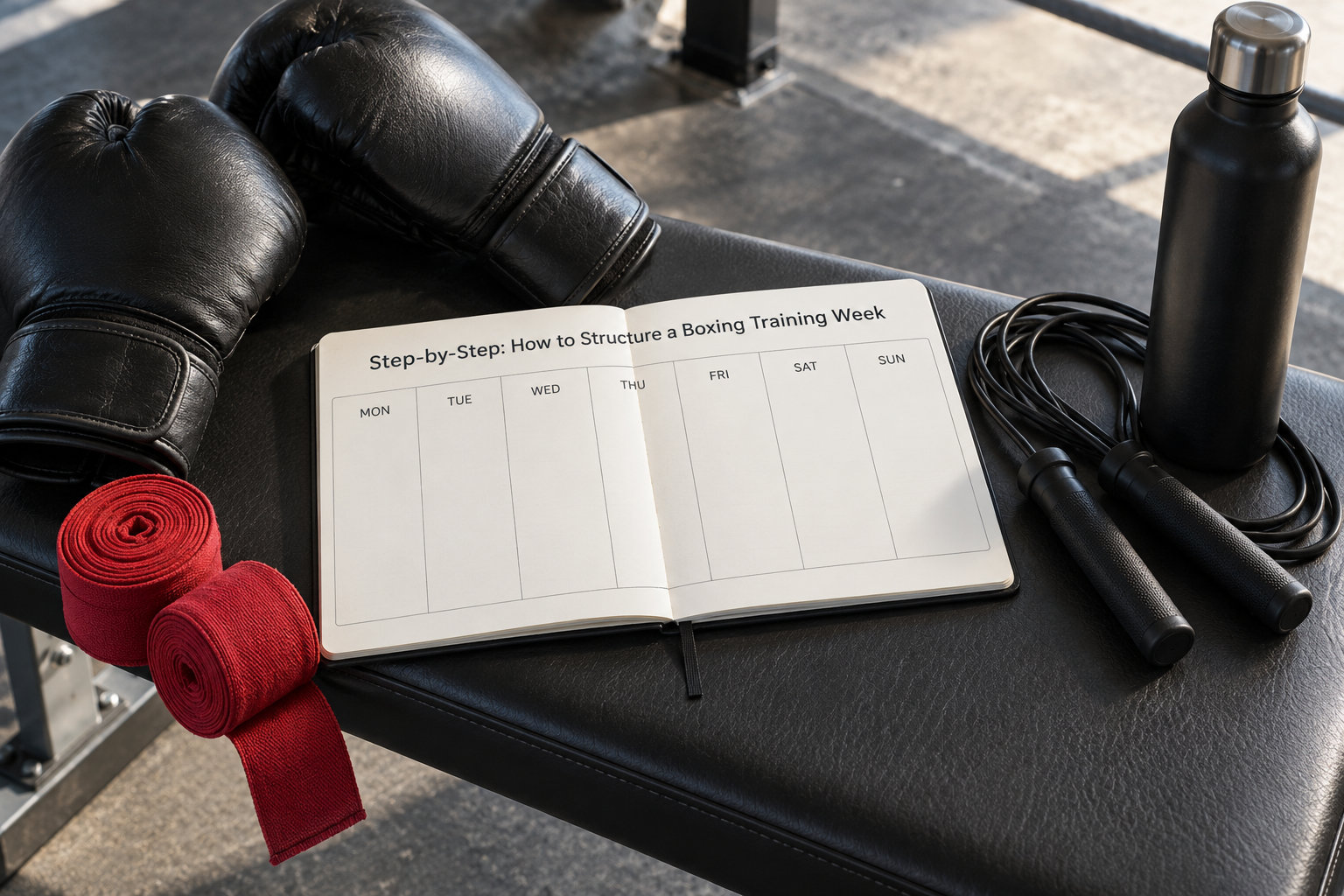
Work through these six steps once, and you will have a week you can repeat. Change one thing at a time, never the whole plan on a bad Monday.
Step 1: Pick a session count you can repeat for eight weeks
Three sessions a week suits most beginners and anyone with a demanding job. Four is the standard for amateurs who want to progress without wrecking themselves. Five fits competitive fighters who already have a technical base. Six is a coach-supervised volume, not something you add because a fighter on a video does it.
One of the most common questions in amateur boxing forums is whether three days a week is enough or whether a beginner should jump to six and rest on Sundays. Three will always beat six when the six comes with no recovery. A beginner who trains three times a week for a year gets better at boxing than the same beginner who trains six times a week for two months, hurts a shoulder and quits.
Step 2: Give each session exactly one job
A session with one purpose is easier to judge and easier to recover from. The standard jobs are:
- Technical skills: footwork drills, shadowboxing, padwork or mitt work, punch combinations, defence under pressure. This is the job most of your week should carry.
- Live rounds: sparring, or bag and pad rounds done at fight intensity with controlled contact.
- Conditioning: roadwork, interval work, or a heavy circuit built from boxing movements rather than gym machines.
- Strength: lifting, calisthenics, core and neck work, shoulder stability.
- Active recovery: a walk, easy rope, mobility, or twenty minutes of very light shadowboxing on the rest of the week.
Technical skills are the priority job. Everything else supports them.
Step 3: Space hard sessions 48 to 72 hours apart
Put your hardest technical day and your sparring or live-round day next to each other and you get two days of nothing useful. Put them apart and each one gets a full recovery night behind it.
This is the most common structural mistake I see in beginner programs. Fighters pile the bag day onto the sparring day, wonder why round three feels terrible, and decide they lack fitness when the real problem is spacing.
Step 4: Build every session from the same block structure
Use the same anatomy whether the session is 45 or 75 minutes, and your sessions stop feeling random. This is a standard 60-minute class broken into blocks:
- Warm-up, 10 minutes: skipping or jumping rope, then movement patterns, then shadowboxing rounds at low output.
- Footwork and shadowboxing, 10 minutes: stance, guard position, then three short rounds of light combination work.
- Main rounds, 20 to 25 minutes: padwork, bag work or sparring. This is where the session’s purpose lives.
- Conditioning, 8 to 10 minutes: only on conditioning days; on technical days this block stays easy or disappears.
- Cool-down, 5 minutes: light movement, breathing, and a note in your log.
Skip the warm-up and cool-down, especially when you train alone at home, and you will feel the cost a few years later in your wrists, shoulders and lower back.
Step 5: Place strength work where it will not wreck your sparring
Weight training and boxing can live in the same week, but not carelessly. The recurring forum question is where the lifting goes, and the answers that hold up are mostly about sequencing rather than dropping either one.
Two rules cover most cases. First, keep heavy leg work at least 48 hours away from hard sparring, because sore legs change your footwork before they change your strength. Second, if you can only manage one, lift first and box after; a practitioner on a well-known fight forum described running 30 to 45 minutes of low-intensity shadowboxing after lifting days specifically to keep technique sharp while the heart rate climbed.
A simple four-day split works for boxers who train three times a week on the bag or pads: two upper and two lower days, with your boxing sessions sitting between them. If you lift on two days and box on four, total volume matters more than the exact arrangement, so keep lifting sets moderate while your sparring is live.
Step 6: Review the week once, before the next one starts
Block fifteen minutes on your rest day. Look at your log and answer three questions: did I hit my session count, which sessions felt unusually heavy, and which skill will I add next week?
Then change one thing. Adding a new drill while cutting a session while adding sparring all at once is how plans fall apart.
How to Structure a Boxing Training Week Around Recovery
Recovery is not what is left over after training. It is one of the blocks you plan, and it is the block most beginners delete first.
Two hard sessions a week, not five
A useful rule from coaching practice: about 80% of your boxing time should be technique at controlled intensity, and 20% can be genuinely hard. Two hard sessions in a week is plenty for most amateurs. Everything else is technical drilling that happens to also build fitness.
What a rest day can still contain
A full rest day means no sparring, no hard bag work and no lifting. It can still hold a 20 to 30 minute walk, mobility work, or genuinely light rope skipping. The goal is blood flow and calm, not another workout wearing a different name.
For boxers who travel or work shifts, a ten-minute maintenance session on an otherwise empty day keeps the habit alive. Practitioners on martial arts forums tend to summarise this the same way: a 12-year-old might box daily, a 40-year-old can usually manage three days and needs the recovery time.
The deload week every four to six weeks
For four days, cut round counts by roughly a third, hold sparring to light technical work, and drop the conditioning block. You come out of it fresher and the following three weeks move faster.
Signs the week is too hard
- Your normal sessions feel heavy from the first round
- You cannot recover between rounds the way you used to
- Sleep is disturbed or you wake tired
- Technique that was automatic starts breaking down
- Hand and wrist soreness lingers for days
- You dread sessions you normally enjoy
Two or three of those at once means drop one session and keep the technical one. If you have persistent pain, or symptoms that worry you, stop training through it and see a doctor or physiotherapist rather than pushing the plan.
Adjustments worth knowing
- Shift workers: anchor the week to your sleep, not to Monday. Four consecutive sessions on your waking days works better than scattered ones.
- Women training around a cycle: reduce hard conditioning in the days before and during menstruation and hold technique volume steady.
- Older boxers: front-load strength and mobility, keep sparring technical, and accept a longer warm-up.
- Coming back from a layoff: start at half your old session count for two weeks. Fitness returns faster than technique memory does.
- Six to eight weeks out from a bout: most fighters keep their technical structure and gradually shift conditioning toward race-pace work, then taper in the final week.
When sparring enters the plan
Do not start live sparring to get harder. The common benchmark among amateur coaches is roughly 12 to 16 sessions of skills and pad work first, so the movement survives contact. Begin with controlled rounds, keep it to one session a week, and never place it on a heavy-leg day.
Common Mistakes
Almost every stalled beginner makes at least one of these seven mistakes, usually without noticing. Each one has a straightforward fix.
Planning every day identically
Six identical hard sessions is not a hard week, it is burnout with a calendar. Fix: name each day before you write the plan. Technical, live rounds, conditioning, strength, rest. Every day gets one label, and no more than two days share the hardest label.
Training hard on consecutive days
Hard on Monday and hard on Tuesday means Tuesday is compromised work. Fix: put at least one lighter technical session or a rest day between hard days, and never move a sparring session to the morning after heavy legs.
Adding sparring too early, or too much of it
Sparring is where injury risk lives, and it does not build fundamentals. Fix: get the 12 to 16 skills and pad sessions in first, then start with one light sparring session a week and judge it by your recovery, not by how it felt once.
Skipping technical practice entirely
Some fighters use pad work as conditioning and skip shadowboxing and footwork drills entirely. Fix: build every session around the block structure, and keep at least half your total ring time purely technical.
Copying a professional volume too early
Pros train twice a day with full support staff and professional nutrition behind them. Copying their day count on a normal life is how people end up injured and disillusioned. Fix: add a session only when four weeks of your current plan felt comfortable, and only when the extra session is technical rather than hard.
Lifting too close to hard sparring
Two competing sessions in the same 48 hours produce mediocre versions of both. Fix: separate heavy leg work and hard sparring by at least two days, and keep lifting moderate while your sparring is live.
Never reviewing progress
Months of hard training with no record is how people train hard and stay stuck. Fix: fifteen minutes a week with your log. Note rounds, effort, and one skill you are working on, then review it every four weeks and adjust one thing.
Frequently Asked Questions
How many times a week should I box?
Three to five sessions a week suits almost everyone. Beginners and anyone with a demanding job do well on three days: two technical sessions and one live or sparring day. Amateur competitors usually handle four, with technical work, sparring, conditioning and strength split across them. Five suits fighters who already have a technical base. Six is a coach-supervised volume, not a beginner default.
Do I need rest days when I box?
Yes, and they are not optional. Most fighters need at least two full rest days a week, and those days are part of the program rather than time wasted on it. A rest day means no sparring, no hard bag work and no lifting, but a 20 to 30 minute walk or light mobility session is fine. Training hard every day usually produces stalled progress and a higher injury risk.
How do I add sparring to my weekly plan?
Build the skills base first. The usual benchmark among amateur coaches is around 12 to 16 sessions of skills and pad work before a first sparring session, so your movement holds up under pressure. Then add one light sparring session a week, place it at least two days away from heavy leg work, and keep it technical at first. Add a second round only when you recover well from the first week.
How do I adjust my week during fight camp?
Keep your technical structure largely intact and shift the conditioning emphasis. Six to eight weeks out, most fighters keep their skills sessions, add race-pace roadwork or interval work in place of some conditioning blocks, and cap sparring at one session a week with controlled rounds. In the final week, cut volume by roughly a third and stop hard sparring so you arrive fresh.
What do I do when I miss a session?
Do not restart the week from scratch or try to make up missed sessions in a pile. Drop the missed session, keep the rest of the week in order, and protect the following week. If you miss a hard day, move the next hard day by 48 hours rather than compressing two hard sessions together. Missing one session in a week of five changes very little over a year of training.
How do I know if my weekly plan is too hard?
Watch for several of these together: sessions that feel heavy from the first round, poor recovery between rounds, disturbed sleep, technique that used to be automatic breaking down, hand and wrist soreness that lingers, and dreading training you normally enjoy. If you notice two or three at once, cut one session a week and keep the technical one. Persistent pain is a reason to see a doctor, not to push harder.
Conclusion
Here is the first thing to do: pick a session count you can honestly repeat for eight weeks, write one purpose next to each day, and protect two full rest days. Put your hardest technical day and your sparring two or three days apart, use the same block structure every session, and keep fifteen minutes at the end of the week for the log.
Then give it a month before you judge it. One hard session or one missed Tuesday is not a failed plan, it is a normal week. Adjust one thing at a time and the structure will carry the progress for you.