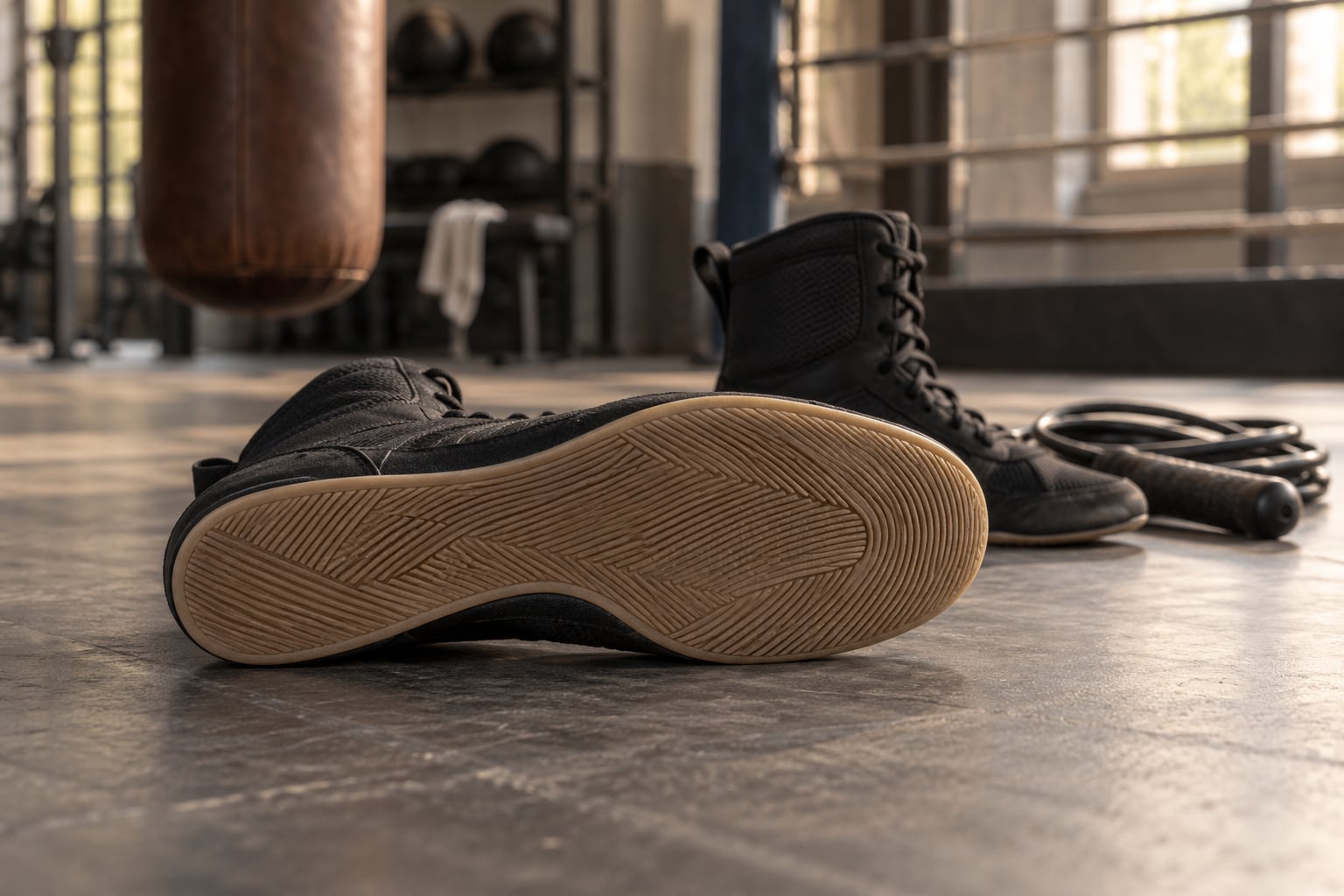
Why boxing shoes have thin soles comes down to one thing: a boxer needs to feel the floor. A low-profile outsole keeps the foot close to the canvas so you can sense exactly where you are, move weight fast, and rotate through a pivot without a slab of foam in the way. Add thickness and you add height, weight, and a layer that blunts the feedback your footwork runs on.
Coaches still teach the same calibration in 2026 that they taught decades ago. The outsole should be grippy enough that your foot does not slide out from under you, and slippery enough that you can rotate freely without the shoe catching. Hit that middle and a thin sole disappears under your foot and you just move.
Table of Contents
- What Thin Soles Do for a Boxer
- The Parts of a Boxing Shoe That Affect the Ground
- Why Boxing Shoes Have Thin Soles
- How Thin Soles Improve Traction
- Why a Low Profile Helps Balance and Footwork
- What Happens With Soles That Are Too Thick?
- Thin Soles and Protection: The Trade-Off
- Thin-Soled vs Thick-Soled Boxing Shoes
- How to Choose Boxing Shoes With Thin Soles
- How to Care for Thin-Soled Boxing Shoes
- Frequently Asked Questions
- The Key Takeaway
What Thin Soles Do for a Boxer
A thin sole keeps you rooted. It preserves the tactile feedback from the canvas, lets you rotate through the ball of your foot on demand, and stops a heavy platform from tipping you when you change direction at speed.
Think about what a stance actually asks of your feet. You are balanced on the balls of both feet, weight split roughly 60/40 back and front, turning constantly and returning to that same base after every slip. A sole that sits a few millimetres closer to the ground shortens the chain between what the canvas is doing and what your nervous system knows about it.
That feedback is what most boxers call ground feel. You are not literally reading the texture of the canvas at speed. You are reading the rate of change under your foot, whether you are still travelling or have stopped, and where your weight sits. Thin soles sharpen all three.
The Parts of a Boxing Shoe That Affect the Ground
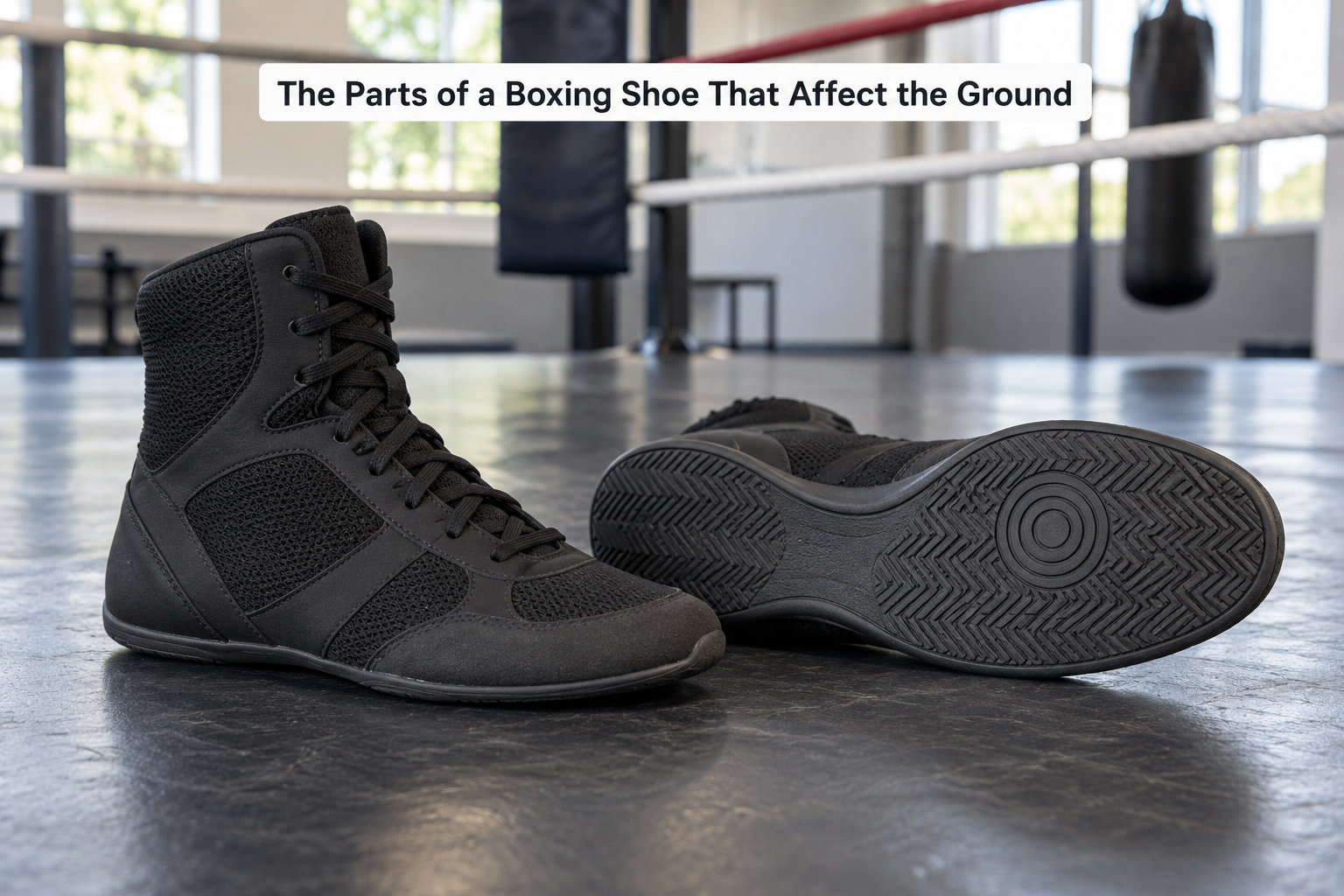
People talk about the sole as one thing, but a shoe has several layers doing different jobs. Knowing which part controls what saves a lot of confused shopping.
| Part | What it does | Main effect |
|---|---|---|
| Outsole | Thin layer of rubber in contact with the floor | Grip, ground feel, weight |
| Midsole | Foam or gel layer between outsole and foot | Cushioning, shock absorption, isolation |
| Heel and toe area | Thin heel, forefoot flex point, toe wrap | Pivot range, stability, wear |
| Upper | Mesh, suede or leather over the foot | Ventilation, lockdown, weight |
| Lacing and straps | Closure system | Foot security during lateral movement |
| Ankle collar | Padding around the top of the shoe | Ankle support, independent of sole thickness |
Two of those rows are worth pausing on. The midsole is the layer thin-soled shoes remove, and the ankle collar is the layer that decides support. They are separate design choices, which is why you can own a thin-soled high-top or a cushioned low-top.
Why Boxing Shoes Have Thin Soles
The reason is not fashion and it is not that foam is bad. It is that boxing footwork is measured in fractions of a second, and every millimetre of sole is a lever your foot has to work against.
1. Ground feel and proprioception
A thin outsole lets you sense the surface and your own foot position more accurately. That feedback is what tells you to stop pushing, start rotating, or plant before a slip. Dampen it and the correction comes late.
2. Fast pivot rotation
A pivot turns on the ball of the foot. With no foam under the ball, your foot can flatten, roll, and re-load without fighting a compressed midsole. The rotation is the punch’s escape and the counter’s reset.
3. Low weight
A low-profile outsole removes material that would otherwise sit under every step. Lighter shoes feel faster over a session, and over a three-round spar that compounds. Fighters also notice how quiet a thin sole is on the canvas.
4. Secure contact for balance
Balance comes from pressure through a small contact area, and a thin sole spreads that pressure evenly across the ball and heel rather than funnelling it into a foam edge. You hold your stance longer before you need to correct it.
5. Less wobble on an unstable base
Height under the foot raises your centre of mass relative to the sole you are balancing on. A thinner platform means less to tip. It is a modest effect, but footwork is where small errors become knockdowns.
How Thin Soles Improve Traction
A close, flexible outsole grips better because it can conform to a surface the way bare foot does. A stiff, thick platform touches the floor in a few spots and bridges over the gaps, so grip becomes uneven and unpredictable under a moving load.
That is what lets you slide, stop, and change direction on command. You do not want maximum friction. Maximum friction anchors the shoe and fights the rotation. You want controlled friction: enough to push off, low enough to pivot.
Be careful with tread, though. Boxing soles use shallow, fine patterns rather than the deep lugs on trail shoes, and not every tread behaves the same on every floor. A soft rubber outsole dragged across concrete loses its bite far faster than most buyers expect, and the same shoe on a canvas ring can feel markedly stickier than it did in the gym.
Why a Low Profile Helps Balance and Footwork
A low sole means less height to compensate for. When every layer under your foot is minimal, small corrections in the ankle, hip, and foot translate cleanly into shifts of balance, instead of being partly absorbed by the shoe.
How Thin Soles Allow Natural Foot Rotation
With nothing thick to compress, the foot rolls through a pivot the way a bare foot rolls: heel light, ball loaded, then the whole foot re-planting. That motion is the basis of the shuffle-and-pivot cycle most coaches drill for years.
None of this makes you faster on its own. Footwear cannot teach rotation or add skill. It removes an obstacle so the technique you already have can come through cleanly, and technique still decides the outcome.
What Happens With Soles That Are Too Thick?
Too thick and you trade away the very feedback you came for. Ground feel dulls because the foam absorbs small changes under your foot, and the shoe can feel vague, like you are moving it rather than with it.
Foot positioning shifts too. A raised platform tilts the foot slightly, so weight transfer happens a fraction off where you expect it, and rapid movement can feel unstable rather than cushioned. On top of that, a bulky sole is simply heavier, and weight is the enemy of a long session.
It is worth adding that thick is not always bad and thick is not the same as cushioned. Some of the most comfortable thick-soled shoes simply stack more rubber with no foam benefit at all.
Thin Soles and Protection: The Trade-Off
Why Boxing Shoes Have Thin Soles but Still Add Protection
Because a shoe that is thin everywhere would be useless. Protection in a boxing shoe is targeted rather than general: a reinforced toe wrap, a stiff heel counter, padded ankle collar, and reinforced stitched seams. These add security where kicks and pivot wear actually land, without adding a foam platform that dulls the whole foot.
Some shoes go further. Higher midsoles, extra heel padding, and reinforced arch or metatarsal areas exist for good reason. They suit long multi-round days, heavier fighters taking more impact, strength and conditioning work in shoes, and anyone whose feet or knees object to a bare minimum.
Plantar fasciitis is the case that comes up most often in gym conversations. If the arch or heel is already irritated, a feather-thin sole can keep symptoms switched on. That is a reason to add cushioning, and a reason to see a doctor or podiatrist if pain persists, not a reason to keep grinding through it.
Foot shape matters here too. Flat feet, wide feet, and high arches interact differently with a low-profile sole, and a shoe that pinches across the instep is a fit problem, not a thin-sole problem. If the shoe squeezes, going thinner will not fix it.
Thin-Soled vs Thick-Soled Boxing Shoes
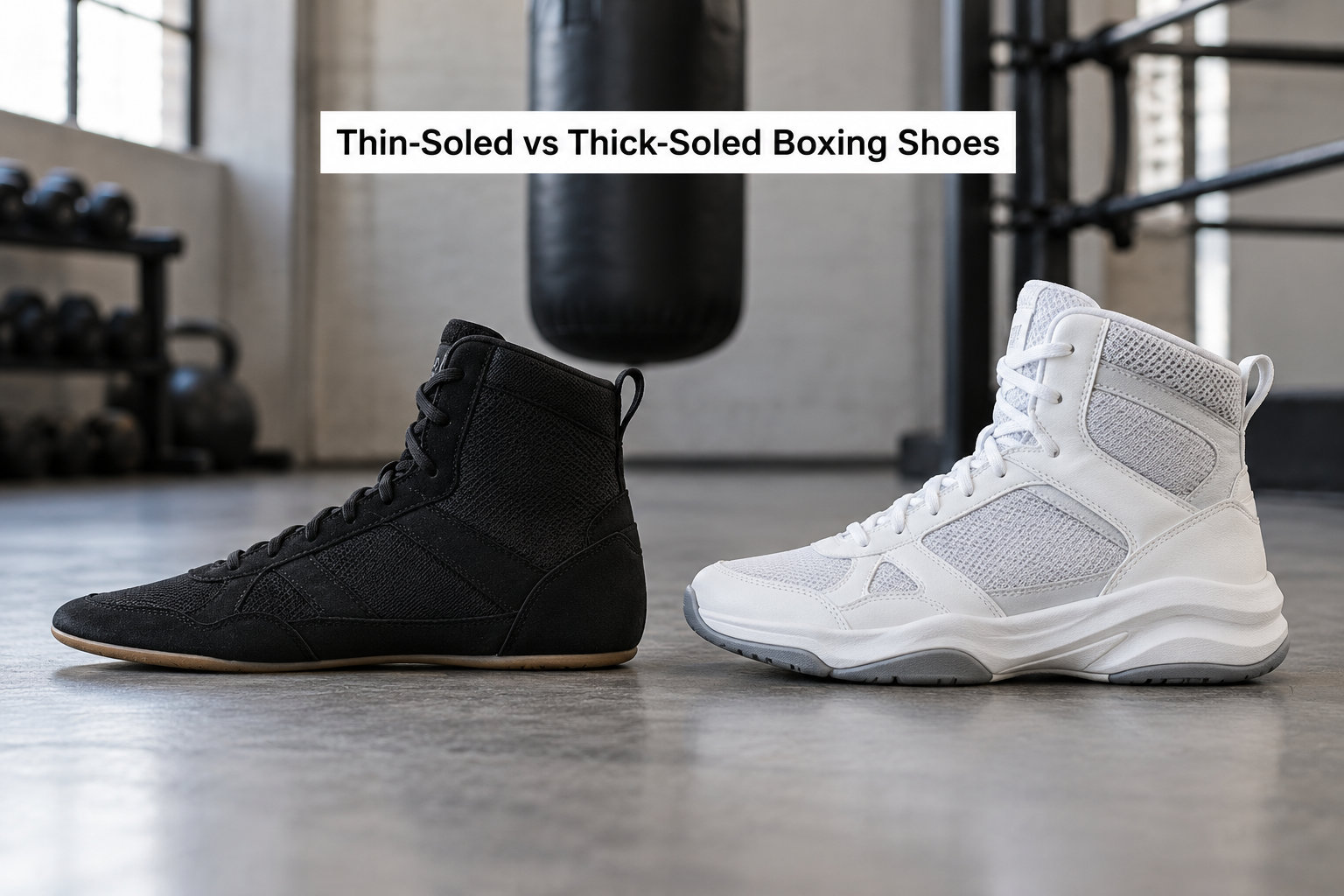
The trade-off is real on both sides, so here it is in plain terms. Thin soles win on feel, weight, and rotation. Thick soles win on cushioning and session length. Most fighters want a thin sole with targeted reinforcement.
| Factor | Thin sole | Thick sole |
|---|---|---|
| Ground feel | High, immediate feedback | Dulled by foam |
| Pivot speed | Fast, natural roll | Slower, resisted |
| Weight | Lighter | Heavier |
| Cushioning | Minimal | Noticeable |
| Surface feel on the mat | Close, tactile | Slightly muted |
| Best for | Footwork, competition, short-to-medium sessions | Long sessions, heavier fighters, sensitive feet |
| Watch out for | Toe seam wear, sore arches at first | Weight, vague feel, unstable pivots |
Surface choice shifts the balance. On a canvas ring the floor is soft and slightly grabby, so a smooth thin sole still bites. On gym mat the shoe is often the only traction you have. On concrete, expect a thin soft-rubber sole to go first.
How to Choose Boxing Shoes With Thin Soles
Start with fit, because it beats every spec on the list. Leave roughly a thumb’s width in front of your longest toe, check the heel does not lift, and confirm nothing presses across the instep. Wide feet and narrow feet need opposite shapes, and the same model does not suit both.
Then check the specs. Forefoot flex: bend the shoe at the ball of the foot and it should crease there without resistance. Outsole compound: a thin, firm rubber layer reads well, while a very soft compound wears out fast on hard floors. Tread depth: shallow and fine suits canvas and mats, deeper lugs belong to other sports.
Weight matters too, though do not chase the lightest pair to the exclusion of fit and lockdown. If your gym runs on mats and you do long sessions, a shoe with a little more structure under the arch and heel may serve you better than the featherweight option. Finally, check the collar height against your own history. A thin sole is compatible with high-top, mid-top, or low-top support, and high-tops earn their place for fighters who have rolled an ankle before.
How to Care for Thin-Soled Boxing Shoes
Thin soles wear from the forefoot, and the tell is at the toe seam. When the rubber starts to lift or the crease at the ball goes smooth, the shoe has stopped controlling your pivot and it is time to move on. Fighters who train heavily report going through pairs far faster than casual gym members, so judge on the shoe, not the calendar.
Between sessions, unlace them fully and let them air out at room temperature. Avoid radiators, tumble dryers, and car boots, which cook the glue and stiffen the upper. Wipe the outsole with a damp cloth after concrete work, and check tread depth monthly. Rotating two pairs doubles the time each one keeps its grip.
One last note for beginners. New thin-soled shoes feel strange for the first few sessions, and a lot of people read that as bad fit. Give it two or three weeks of short sessions. If it is still pinching, the fit is wrong, and no amount of breaking in will fix it.
Frequently Asked Questions
Are thin-soled boxing shoes better for footwork?
For most boxers doing shuffle-and-pivot work, yes. A thin sole keeps the foot close to the floor, so you feel the canvas, roll through the ball of the foot faster, and transfer weight more precisely. The exception is a fighter whose feet or knees already object to a minimal sole; then a little more cushioning beats ground feel.
Do boxing shoes with thin soles provide enough cushioning?
Enough for the sport, usually. Boxing involves repeated pivoting and short bounces rather than the heel-strike, forward travel of running, which is what most foam midsoles are designed for. On mats and canvas, the impact load is modest. For long multi-round days, heavy impact work, or sore heels, a modestly cushioned model is the better call.
Why do boxing shoes have a flat sole instead of a raised heel?
Because a raised heel tilts the foot and lifts the centre of mass, which works against pivoting and balance. A flat, thin sole keeps the whole foot in contact with the floor and lets you rotate from heel to ball without an angle fighting you. Wrestling shoes are the opposite, built thick and high so a grappler can drive forward without losing footing.
Can thin-soled boxing shoes cause foot or ankle pain?
They can, especially during the first few weeks, and the same is true for plantar fasciitis symptoms that are already irritated. Pain that fades as you adapt is normal; pain that sharpens with load, or swelling and lasting soreness, is not. Stop and see a doctor or podiatrist if it persists rather than training through it.
How often should a boxer replace shoes with a worn outsole?
Replace them when the forefoot crease goes smooth, the rubber lifts at the toe seam, or the tread that used to stop your foot now slides. A boxer training several times a week on hard floors may go through pairs in months, while a casual gym boxer can keep a good pair for years. Check the toe area monthly.
The Key Takeaway
Thin soles stay because a boxer needs to feel the floor, rotate fast, and stay light. Start with a secure, comfortable fit and a thin, flexible outsole matched to the surface you train on, then add cushioning only where your body asks for it. If your first week feels strange, give it a few sessions before you judge the pair.