To analyze a fighter’s style on film, pick three to five of their recent full bouts, watch them one round at a time at reduced speed with a template open, and record what repeats rather than what happened in one exchange. Set aside about 90 minutes for the first bout and less for each one after it, and the method works whether you are a coach with a fighter in front of you or a fan with a notebook. The whole thing comes down to repetition, not flash.
The habit underneath the method is simple: a fighter’s tenth bout looks a lot like their hundredth. Tendencies that show up in round two of one fight and round two of another are worth planning around, and one unexpected moment is not.
Table of Contents
- What You Need
- Step-by-Step: How to Analyze a Fighter’s Style on Film
- 1. Establish the Fighter’s Baseline Style
- 2. Watch the First Round Without Judging the Outcome
- 3. Track Distance and Ring Geography
- 4. Catalog the Fighter’s Offensive Patterns
- 5. Read Defensive Habits and Pressure Responses
- 6. Compare Rounds Instead of Isolating Moments
- 7. Study the Opponent’s Influence
- 8. Turn Observations Into a Style Profile
- Common Mistakes
- Frequently Asked Questions
- How many fights of film should I watch on an opponent?
- Should I study an opponent’s wins or their losses?
- What should I write down when watching fight film?
- How do I tell a pressure fighter from a counterpuncher on tape?
- Should I study pro fights or amateur fights to learn?
- What playback speed and tools make fight film study workable?
- Conclusion
What You Need
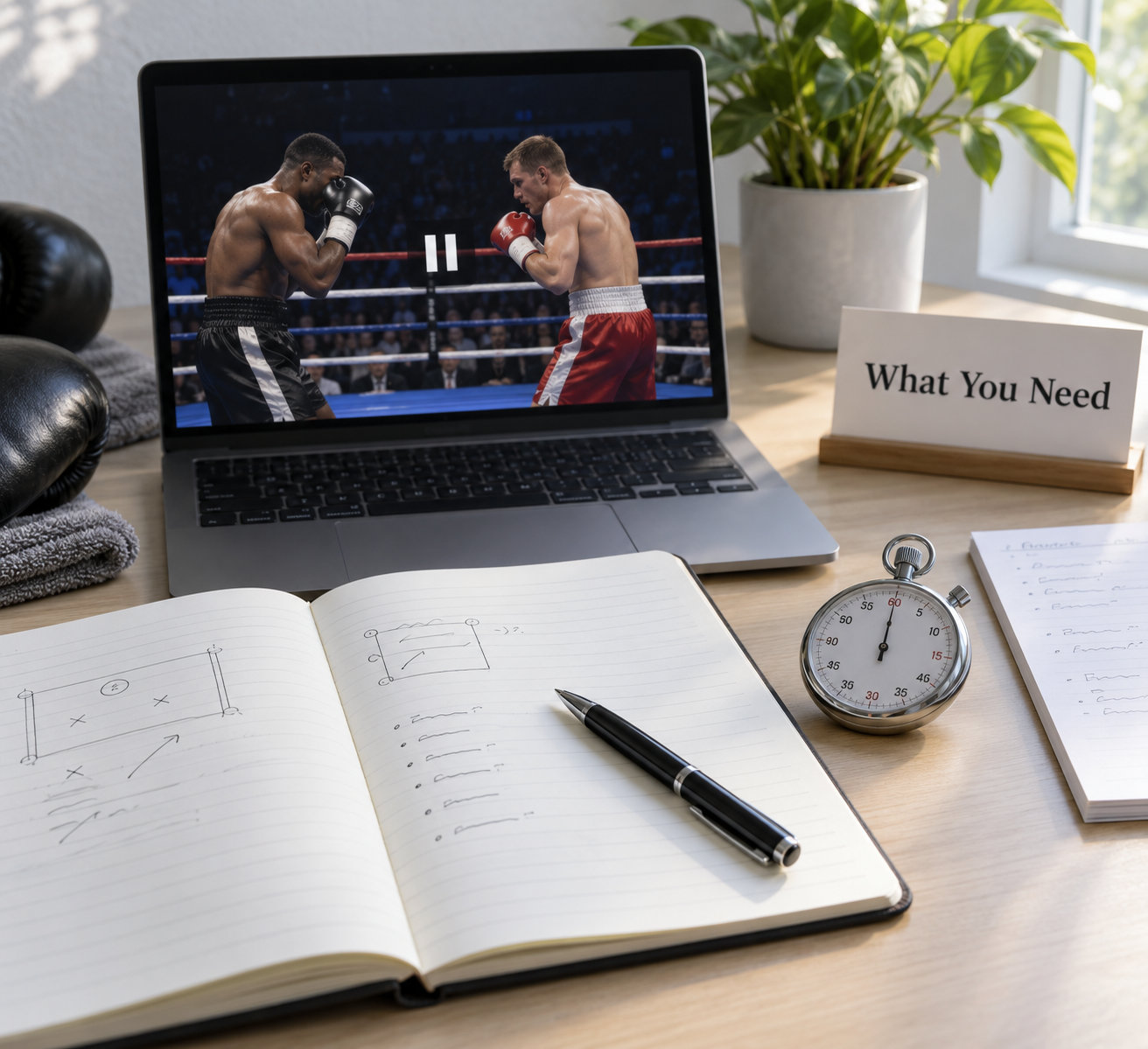
Start with footage, not gear. Three to five full fights is the working range: enough to see a pattern repeat, few enough that you will actually finish them. Recent bouts tell you who they are now, and one older bout, ideally from a different era of their career, tells you what is habit and what has changed.
Watch complete bouts rather than clips. Highlights are edited, which means every exchange that made the cut already worked. Full rounds include the ones where nothing did, and those are the ones that show you the real style.
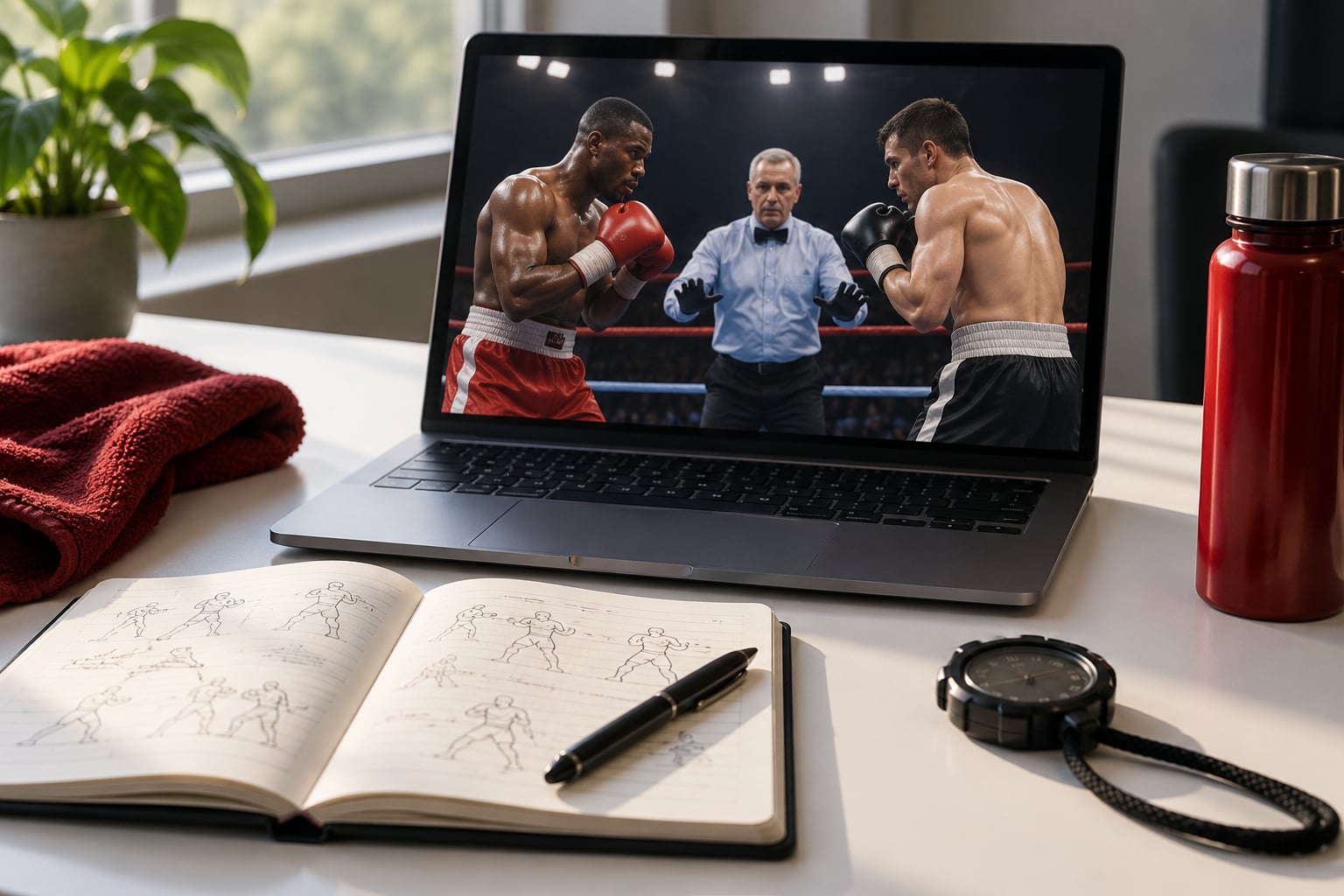
Set your playback up before you sit down. Half speed for anything happening in the pocket, three-quarter speed for range and footwork, and full speed for the first pass of each round to get the shape of it. Keep the pause key under your thumb, and use timestamps if your player supports them.
Have a template open next to the footage. Columns work better than prose for pattern work, because a column forces you to look for the same thing every round. A blank grid with one row per round and columns for distance, entries, preferred punches, defensive reactions, and adjustment is enough to start.
A second screen helps if you have one, with the template on one side and the fight on the other. If you do not, a paper notebook works fine, as long as you draw the columns before you start rather than inventing a format halfway through round three.
Pull the comp sheet for each bout if the numbers are published. Output, accuracy, and significant strike totals give you a starting label for the fighter and a way to check whether what you saw matches what the judges saw. They confirm, they do not replace the tape.
Step-by-Step: How to Analyze a Fighter’s Style on Film
1. Establish the Fighter’s Baseline Style
The baseline is the fighter’s default setting: stance, guard, and the range they prefer to fight at. Note whether they are orthodox or southpaw, where the lead hand sits at rest, how high the guard is, and which foot points toward the opponent when the action is neutral.
Then find the most common attacking action and the most common defensive action. Most fighters have one entry they lean on and one answer they fall back on. Those two things explain a surprising amount of what you will see later.
Write the baseline on a single line and date it. You will check that line at the end of every session to see whether you have been reading a style or reacting to one fight.
2. Watch the First Round Without Judging the Outcome
Watch round one straight through and write down what you see without deciding whether it worked. Distance, rhythm, foot position, jab activity, and how the lead hand defends are the five things to log.
Record their first attacking entries specifically, since openings are the most revealing part of a round. Where do they start from, which punch launches it, and do they leave or follow up behind it? A fighter who leaves after the first punch is giving up the exchange, and a fighter who follows is choosing to stay in range of the return.
Notice the lead hand when it is not punching. Does it stay at the cheekbone, or does it drop to chest height when they circle? That single detail predicts a lot of what the head shot is doing before it lands.
3. Track Distance and Ring Geography
Log where the fighter attacks, where they retreat, and how they get there. Cutting off the ring, following a retreating opponent, and choosing to work on the ropes are all decisions, and each one tells you what they want the fight to look like.
Watch what changes after a knockdown or after a big shot lands. Some fighters reset immediately and resume the same plan, which usually means the plan is deep. Others abandon it entirely, which tells you it was borrowed. Either way, the change is worth a line in the notes.
Distance also tells you the kind of fighter you are looking at. A high-volume pressure fighter throws more punches per round but gives up selection on the way in, because the shots are decided before the opponent’s hands arrive. A low-volume counterpuncher gives away very little and lands only on commitment. You can spot the difference within two rounds of watching distance rather than punch totals.
4. Catalog the Fighter’s Offensive Patterns
Break the offence down by target, sequence, speed, and purpose rather than by counting punches. Which target does the fighter favour when nothing is available? How long is the typical combination, two punches or four? Do the punches come at the same speed, or is there a slow setup in front of a fast one?
Look for counters specifically, because counters are the most exploitable punches in boxing. A counterpuncher who waits for your hand to land has already decided to be at a fixed distance, which means a fighter who varies distance can simply refuse to be there.
Note what happens after a miss. Does the fighter’s hand drop, does the weight fall forward, does he reset with a jab? A missed punch that leaves the fighter facing forward and unguarded is a habit an opponent can punish on purpose.
Body work deserves its own line. Fighters who attack the body consistently are buying head shots, and the round where the body work first appears usually predicts where the knockdown comes from.
5. Read Defensive Habits and Pressure Responses
Defence is where film study pays off most, because offence gets recorded by judges and defence does not. Watch how the fighter protects the head under pressure, and how they handle shots to the body. Do they shell up, move their head, or grab? Does the guard stay or drift?
Then watch the pressure response. Put the fighter on the ropes in your notes, since you can do that without anyone hitting you, and write down what they do in the first three seconds. Backing off, clinching, or cutting off the exit are three different answers, and each one can be trained around.
Tells are the small cues that precede a specific action, and they are easier to find than most people expect. A shoulder dip before the level change, a hand drifting toward the chest before the body shot, or a pause of half a second before the power punch are all consistent enough to prepare for. The cue only works if it appears in more than one fight, so wait for the second sighting before you build anything on it.
6. Compare Rounds Instead of Isolating Moments
The single most useful habit in film study is the round-over-round comparison. Fill in the same row for every round and read down the column. Does the jab volume drop after round three? Does the preferred range move closer as the rounds go on?
This is what separates preferred style from reaction. A fighter who goes to the body in round one of every bout he has ever fought has a preference. A fighter who goes to the body only in the last round of a fight he is winning is responding to something, and the difference matters for the plan.
Look for the same columns across different bouts, not just within one fight. Round-by-round in a single bout shows adaptation. Round-by-round across three bouts shows a rhythm.
7. Study the Opponent’s Influence
This is the trap that catches almost everyone. Some of what you see on film belongs to the fighter and some of it belongs to the person in front of them. A fighter may only throw the same right hand because every opponent they have faced has left the door open, and that habit disappears the moment someone closes it.
The way to separate them is to vary the sample. Watch the fighter against three different opponents with three different styles. Anything that shows up in all three is baseline. Anything that shows up in one is a reaction worth reading but not worth planning around.
Losses are useful here precisely because they are unusual. If the same pattern shows up in the fighter’s wins and in the fight they lost, you have probably found something real.
8. Turn Observations Into a Style Profile
Finish by collapsing the notes into one page: strengths, weaknesses, preferred range, signature attacks, defensive leaks, how they adjust, and the two or three ways an opponent can exploit what you found. That page is the scouting report, and it is the only thing worth carrying into the gym.
Notes that cannot be turned into something to work in sparring are just observations. “He does not like coming forward” is an observation. “He gives up rear position after the clinch breaks, so keep him on the ropes and exit at an angle” is a plan.
Keep the profile short. One page that a fighter can read between rounds is worth more than ten pages nobody opens again.
Common Mistakes
Judging from highlights is the most common error and the most damaging, because the best moments of a fighter’s career are also the least representative ones. Watch full rounds instead, including the ones that drag. The pattern is invisible in edited footage, so the fix only works once you sit down with the whole fight.
Treating a single bout as definitive comes next. Three to five fights is the minimum before you write anything down as a tendency, and if you only have one fight, write your notes as questions rather than conclusions.
Confusing a successful tactic with a habitual style is the subtler version. The move that landed in round five worked in round five. That says nothing about how often it is thrown, and building a plan around one success is how corners end up training something their fighter will never see again.
Ignoring defensive details is a waste of the best material available. Anyone can watch punches land. The shots that miss, the guard that drifts, and the reset after contact tell you how to create the next one, and almost nobody writes them down.
Notes that are too vague to use are the last trap. The question beginners ask most often is exactly this one: what should I actually put in the notebook. A table with a fixed set of columns solves it, because you never have to decide what to write while the fight is running.
Two habits deserve credit, by the way. Watching tape is one of the best ways to learn outside the gym, and it survives every change in coaching method for a simple reason, which is that you see the problem faster than you can describe it. And some fighters simply dislike watching themselves fight. That is normal, and a corner can work through the notes without showing the footage at all.
Frequently Asked Questions
How many fights of film should I watch on an opponent?
Three to five complete bouts, weighted toward the most recent two. That is enough to separate a habit from a one-off, and small enough to finish before fight week eats your time. Add one older bout to see what has changed, and treat anything you saw once as a question rather than a conclusion.
Should I study an opponent’s wins or their losses?
Watch both, and read them differently. Losses show you what beats them and where the plan breaks, which is the most valuable material in the whole file. Wins show you what they do when the plan works, which tells you what they will try first on fight night. Losses alone can leave you over-preparing for a problem they may not have.
What should I write down when watching fight film?
One row per round, with fixed columns: distance, entry, preferred punches, defensive reaction, adjustment, and notes. Fixed columns beat prose because you look for the same thing every round and patterns surface in the column instead of staying buried in a paragraph. Keep it to one page at the end.
How do I tell a pressure fighter from a counterpuncher on tape?
Follow the distance, not the punch count. A pressure fighter takes ground, closes it deliberately, and throws while his opponent is still leaving. A counterpuncher holds at range and throws only after his opponent commits. Watch which of the two arrives first in an exchange, then check it holds in the next round.
Should I study pro fights or amateur fights to learn?
Study the level you are fighting at first, since the range management and officiating differ a lot between the two. Then watch pro bouts for the craft, particularly how they set up attacks and use feints. Pros spar differently and move differently, so copying their distances wholesale tends not to survive the first amateur round.
What playback speed and tools make fight film study workable?
Half speed for inside exchanges and level changes, three-quarter speed for footwork and range, full speed for the first pass of each round. Pause often and timestamp notes if your player allows it. A second screen for the template helps, and a paper grid works just as well when you do not have one.
Conclusion
Do one thing tonight: pick a single complete bout, draw the columns before you press play, and log distance, guard, preferred attacks, defensive reactions, and what changes by round. Write nothing about style until you have finished the fight, and write nothing as fact until it appears in a second one.
That is the whole method. It is slower than a highlight reel for about an hour, and it is the difference between a fighter who guesses and a fighter who has a plan.