
Most people who ask how a technical decision works in boxing want the short version: it is the result awarded when a bout ends before its scheduled distance because of an accidental injury, usually a clash of heads, and enough rounds have been completed for the judges’ scorecards to pick the winner instead. The fighter ahead on the cards when the referee stops the fight wins, and that result goes on the record as a win.
The awkward part is the “enough rounds” bit. Stop a four-round bout in the first minute and you get something entirely different, because there are not enough cards to read. That single threshold is the difference between a technical decision, a technical draw and a no contest, and it is the part most fans never get told about live.
Table of Contents
- What Is a Technical Decision in Boxing?
- When Does a Technical Decision Happen?
- What Does the Referee See During a Technical Decision?
- How Knockdowns Affect the Technical Decision
- How Fouls and Illegal Punches Are Judged
- How Judges Score a Technical Decision
- Why Do Replay Reviews Sometimes Change or Confirm a Decision?
- Why Are Technical Decisions So Often Disputed?
- What a Technical Decision Means on the Record
- Frequently Asked Questions
- What counts as a technical decision in boxing?
- How many rounds are needed for a technical decision?
- What happens if a fight is stopped by an accidental head butt after three rounds?
- How are the scorecards counted after an early stoppage?
- Does a technical decision count as going the distance?
- Can replay review change a boxing result after the fight?
- Conclusion: How to Understand a Technical Decision
What Is a Technical Decision in Boxing?
Three results get mixed up constantly, so it is worth laying them side by side. A technical decision means the fight was stopped early, enough rounds had been scored, and a judge awarded it. A technical draw means the fight was stopped early and the cards were level. A no contest means the fight was stopped before enough rounds were scored, so nobody wins or loses.
| Result | What caused it | Who wins | Effect on the record |
|---|---|---|---|
| Technical decision | Accidental injury or foul stops the bout after the required minimum rounds are scored | The fighter ahead on the scorecards | Recorded as a win or a loss |
| Technical draw | Same cause, but the cards are level when the bout stops | Nobody | Recorded as a draw |
| No contest | Bout stopped too early for the cards to decide, or ended outside the rules | Nobody | No result at all |
| Disqualification | Deliberate foul, unsportsmanlike conduct, or repeated rule-breaking | The other fighter, or a technical draw under some codes | Recorded as a win or a draw, never a no contest |
Notice what is missing from that table: knockouts and stoppages. A fighter who wins by knockout did not need a card from anybody, which is why a technical decision always feels like a lesser result to the fighter who earns one. It is also why the win is legally real.
When Does a Technical Decision Happen?
The trigger is nearly always an accidental foul or an injury the referee cannot let the fight continue through. The most common version in professional boxing is a clash of heads where one fighter’s forehead or the point of the chin meets the other fighter’s head and someone is hurt badly enough to stop. Accidental low blows cause a much smaller share. So do accidental elbows to the eye, and cuts that a doctor will not clear a fighter to continue with.
Under the Unified Rules of Boxing, which most major sanctioning bodies use as their base, the standard threshold is that four rounds must have been completed. Stop the bout after four rounds and the cards decide it. Stop it after three and there is nothing to decide on, so the result is different.
Here is where fans get tripped up, because not every commission words it identically. Some state athletic commission codes phrase the same idea as a requirement that enough of the scheduled rounds were completed, and a few describe it as the equivalent of two of three rounds. The UK rules go their own way again, treating an early stoppage caused by an unintentional foul as a no decision. Before you rely on any single number for a specific fight, check which rule set governs it.
The Unified Rules also cover the awkward case where a fighter suffers an injury that was caused by a deliberate foul. If the injured fighter is ahead on the cards at the stoppage, they generally get the decision. If level or behind, several commission codes point to a technical draw rather than handing the bout to the fighter who did the fouling. Some codes go further and allow a disqualification. This is a genuinely disputed corner of the rulebook and reasonable people read it differently.
What Does the Referee See During a Technical Decision?
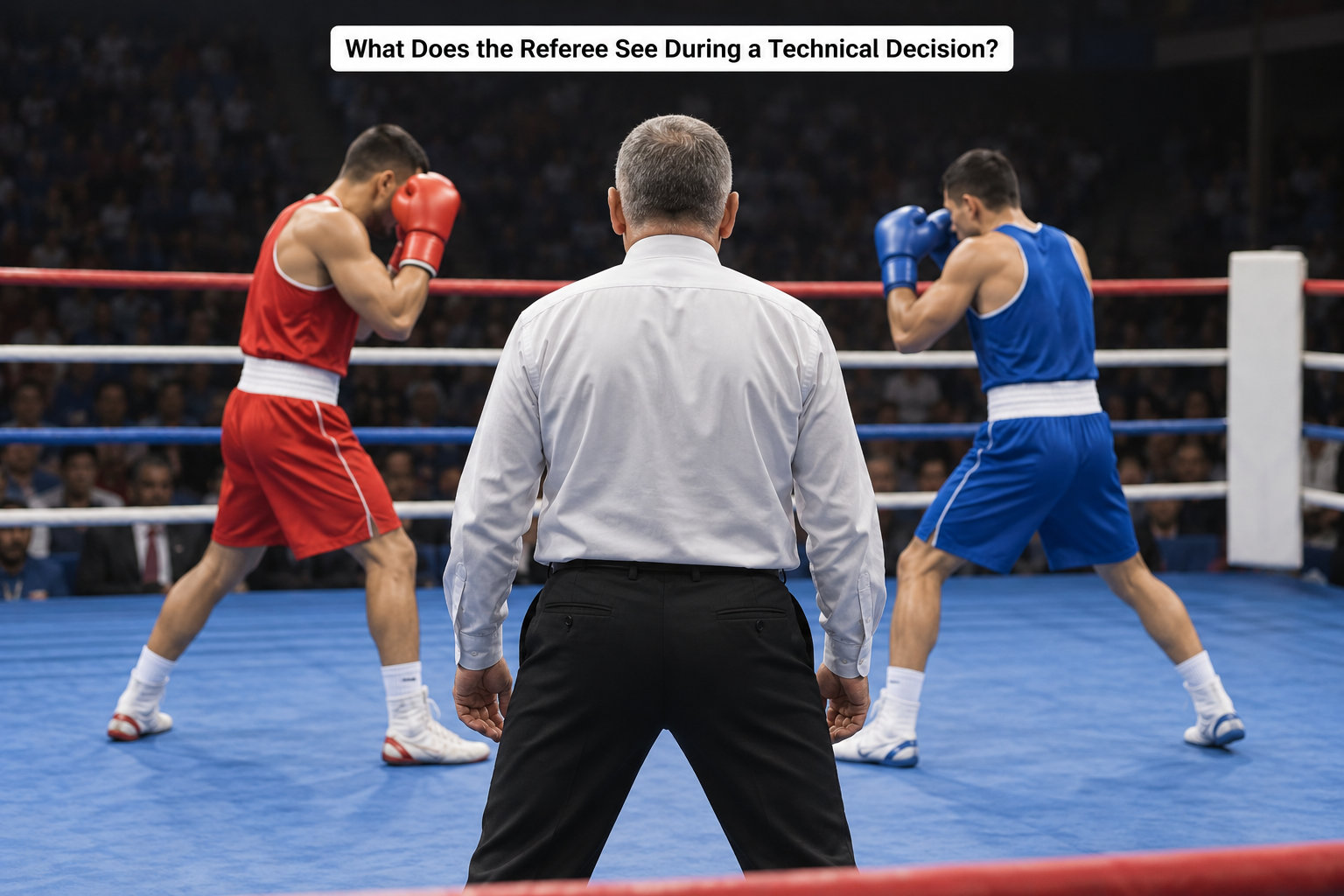
The referee is the only official who can end the fight, so everything about a technical decision runs through one person’s eyes. They work from a fixed position on the apron with the best available sightline to both fighters, which is good but not perfect. The fighters rotate, the ropes cut across the line of sight, and a fast exchange can happen partly behind a shoulder.
What the referee is actually judging is narrower than it looks. They need to see whether a blow was thrown deliberately and where it landed, whether the reaction is a genuine injury or a fighter pretending to have one, and whether a fighter is capable of defending himself. The ringside doctor handles the medical side and can ask for a stoppage without the referee having to see anything wrong.
Officials are not watching every action perfectly, and nobody should pretend otherwise. A glove that clips an eyebrow on the way past is not the same as a deliberate headbutt, and the angle matters enormously to the call.
How a Technical Decision Works in a Typical Boxing Round
Picture round six of a twelve-round title fight. Both men are trading at range, the fighter in the black trunks steps in behind a jab and the heads come together hard. One fighter’s knee buckles, he covers up and takes an unanswered shot before the referee is there.
The referee pushes the other fighter away, checks the hurt fighter’s eyes, and asks him something only he can answer. The ringside doctor is brought in. If the fighter cannot continue, the doctor waves it off and the referee signals the judges to stop scoring.
The key detail, and the one nobody sees on television, is what happens to round six itself. That round gets scored in full, as if it finished, and it goes into the total. The judges add it up at the moment of the stoppage, and if one fighter is ahead, he is declared the winner by technical decision.
How Knockdowns Affect the Technical Decision
Knockdowns and technical decisions are different mechanisms that meet in the same place. The referee controls knockdowns in the ring; the judges control what they are worth on paper.
- A slip. A punch misses and the fighter goes off balance without being hit. No count, no score change.
- A knockdown. The fighter is down, is not immediately up, or is hurt but holding on. The referee begins a count and the judge deducts a point.
- A flash knockdown. The fighter touches the canvas and pops straight back up. Older rules allowed the referee to wave off the count. Modern Unified Rules generally treat a fighter who goes down and is not in immediate control as a knockdown regardless of how quickly they rise, which removed most of those free passes.
- Taking a knee. Going down on one knee is not automatically a knockdown, because a fighter can slip and brace. A fighter who drops to both hands, sits or falls is down.
Every knockdown in a round usually turns that round into a 10-8. When a fight ends early after an accidental foul, any knockdown scored before the stoppage still counts on the cards. A fighter who was dropped twice and then went back ahead can still win the technical decision, because judges score round by round and the knockdown round has already been marked.
How Fouls and Illegal Punches Are Judged
The common fouls in professional boxing are low blows, headbutts, elbows, knee strikes, holding and pushing the head down. Below the waist is a foul in almost every rule set, and so is the deliberate headbutt. Elbows are restricted rather than banned outright in many jurisdictions, which is why an elbow that clips a fighter on the way past often gets a warning where a deliberate one ends the fight.
Referees have three practical options for a foul: warn, deduct a point, or stop the contest. A point deduction is not a private note. The referee signals it to the judges during the action, and those judges write it on their card, which is why you sometimes see a referee cross an arm or make a sharp motion and the commentators immediately mention a deduction.
That signal matters enormously for technical decisions, because it is one of the few scoring mechanisms a referee controls. A fighter who takes two point deductions and then wins the remaining rounds can still end up behind on the cards when the fight is stopped early.
The other thing a referee decides, sometimes with the commission, is intent. An accidental head clash that hurts one fighter produces a technical decision. A deliberate headbutt that produces the same injury produces a disqualification. Same injury, very different paper.
How Judges Score a Technical Decision
Three judges sit ringside and score independently. Nobody’s numbers are revealed until after the bout, so a fighter and his corner often have no idea where they stand while the fight is happening. That closed scoring is a genuine source of the frustration fans see after every bad verdict.
The system is the 10-point must. Each round, the judge awards 10 points to the fighter he judges to have won it, and fewer than 10 to the other, down to a minimum of 7.
| Round score | What triggers it |
|---|---|
| 10-10 | A genuinely even round. Rare, and not something a judge is required to give. |
| 10-9 | The narrowest margin available. Any round where one fighter was simply better. |
| 10-8 | A knockdown. One knockdown gives 10-8, two in a round is uncommon but possible. |
| 10-7 | Dominant round with a knockdown, or an overwhelming round under most codes. |
| 10-6 | A round so one-sided it is only used when the judge is stopping short of an even more extreme reading. |
Yes, a 10-8 is legal without a knockdown, and it happens. Judges have different thresholds for what counts as dominant enough, and one judge’s dominant is another judge’s 10-9. A 10-6 without a knockdown is far more unusual and is largely a question of how strictly a particular judge reads dominance.
Two rules are specific to how a technical decision works in boxing, the paper stage of it. First, the incomplete round is scored as though it had finished, and it is counted in full. Second, the cards are totalled at the moment of stoppage, not reconstructed afterwards.
Here is the arithmetic. A fight is stopped early in round eight after an accidental low blow, with seven rounds complete. One card reads 10-9, 10-9, 10-8, 10-9, 10-9, 10-8, 10-9. The first fighter’s rounds add up to 68, the second fighter’s to 61. The judges then score the partial eighth the same way, say 10-9 to the leader, and the totals become 78-70.
That card is then read out as a unanimous decision, a majority decision or a split decision depending on how many judges agree. Because scoring carries on round by round rather than as one overall impression, a fighter who was behind early can erase it in the final rounds and take the technical decision. It also means a fighter can win a decision without ever having been clearly better for a full round, as long as he was better in enough of them by one point.
Why Do Replay Reviews Sometimes Change or Confirm a Decision?
Commissions can review footage after a bout, but what they can change is limited. In most jurisdictions the review is not a general appeal of whether a judge picked the right winner. It is a check of specific, rulebook-defined things: whether a knockdown was miscounted, whether a foul was misidentified as accidental or intentional, whether the referee missed a stoppage the doctor ordered, or whether the bout was stopped outside the rules.
A replay review that finds nothing procedural leaves the cards exactly where they were, which is why so many publicised reviews end with the original decision standing. The review confirms the process was followed. It does not re-score the fight.
Judging reform debates keep circling the idea of open scoring, where fighters know the running tally between rounds. Some commissions have trialled versions of it. The argument against it is straightforward: knowing you are two rounds down changes how a fighter behaves in a way that protects the fight, and closed scoring exists partly to stop that.
Why Are Technical Decisions So Often Disputed?
Most disputed decisions come down to a handful of predictable causes.
Vantage point. Three judges do not see the same fight. Two are on one side of the ring, one is across it, and which fighter is hard to hit is often a function of angle. This is the most common and least satisfying reason.
Style preference. Judges are human and they favour clean punching in slightly different proportions. Volume punchers often feel shortchanged because a counter-puncher can land six shots to their thirty and be given the round.
Crowd pressure. In a title fight in the champion’s home arena, a room of a few thousand people pulling one way is a real thing judges have to filter out. It is also almost impossible to prove.
Closed scoring. A fighter who loses a decision and had no idea he was behind has no chance to adjust. When the cards open, the frustration is bigger than the margin.
Jurisdiction drift. The four-round threshold is not phrased the same way in every code set, and plenty of the pages explaining it online are years old. When you have three sources giving three different numbers, half the argument is about which rules apply rather than what happened in the ring.
Technical decisions draw less public fury than split decisions for a simple reason. Nobody expects much from a bout that ended in round seven, and the fighter who wins it usually gets recognised for it. The disputes that do show up tend to be about whether the foul was accidental at all.
What a Technical Decision Means on the Record
It counts. A technical decision is recorded as a win or a loss, the same as any decision, and it counts as a completed bout for title and ranking purposes in most cases. It is not the same as going the distance, because the scheduled rounds were not finished, and that distinction shows up in statistics that track distance.
The practical difference from a no contest is worth sitting with. A no contest leaves a boxer’s record untouched, which sounds safer until you realise what it costs: no win, no loss, no purse performance worth writing down, and a blank in a career line. A technical decision at least goes in the books.
Frequently Asked Questions
What counts as a technical decision in boxing?
A technical decision is awarded when a bout is stopped before its scheduled distance because of an accidental injury or foul, usually a clash of heads, and enough rounds have been completed for the scorecards to decide the winner. The fighter ahead on the cards at the moment of stoppage wins, and the result is recorded as a win or loss on their record.
How many rounds are needed for a technical decision?
Under the Unified Rules of Boxing, four rounds must be completed for the scorecards to produce a technical decision. Stop a fight before that and the result becomes a technical draw or a no contest instead. Wording varies between commissions, so check the rule set governing the specific bout before relying on a single number.
What happens if a fight is stopped by an accidental head butt after three rounds?
With only three rounds scored, there are not enough scorecards to award a technical decision under most rule sets, so the bout is recorded as a no contest. The fighter who suffered the accidental head butt does not get a win, and neither does the other fighter. No result of any kind appears on either record.
How are the scorecards counted after an early stoppage?
The incomplete round is scored as if it had been completed and is counted in full, then the judges total their cards at the moment the referee stops the bout. A technical decision, majority decision or split decision is then read based on how many cards agree. Nothing is reconstructed or re-scored afterwards.
Does a technical decision count as going the distance?
No. The scheduled rounds were not finished, so a technical decision is recorded as a decision win or loss but not as a bout that went the distance. Most title and ranking bodies treat it as a completed bout, which is why the win still counts officially for championship purposes.
Can replay review change a boxing result after the fight?
Commissions can review footage, but they check defined procedural errors such as a miscounted knockdown, a foul wrongly judged accidental or intentional, or a bout stopped outside the rules. They do not re-score the fight. When a review finds no procedural error, the original scorecards stand unchanged.
Conclusion: How to Understand a Technical Decision
A technical decision is not a special verdict handed down by the referee. It is an ordinary set of scorecards read out at a moment when the fight happened to stop early, provided enough rounds had been scored first. Once you see it that way, most of the confusion goes away.
When one looks controversial, check four things in order. Start with what the referee actually saw, since the call starts there. Then check which rule set governs the bout, because the rounds-completed threshold is not phrased identically everywhere. Read the scorecards if they are available, since a narrow split tells you a different story from a shutout. And look for replay evidence of the specific error being claimed, keeping in mind that reviews confirm process rather than re-score fights.
Everything above reflects the current published rule sets as of 2026. Rules vary by commission and change from time to time, so verify against the governing body’s own text before relying on any of it.