
What is the 10 point must system? It is the scoring method used in professional boxing and mixed martial arts, where the judge must award 10 points to the fighter who wins a round and 9 points or fewer to the fighter who loses it. Blow away your opponent and the gap gets wider: 10-8, 10-7, or lower. It sounds simple, and the arithmetic is simple, but the judgment behind each round is not.
Most people first meet this system in the worst possible way. A fighter gets dropped, the building shakes, and the broadcast cuts to a graphic showing a decision that makes no sense. The graphic is the total of three ringside scorecards, and you have no way to audit it, because nobody shows you the round-by-round numbers.
Updated for 2026.
So here is the whole system in plain terms, plus a way to score a fight yourself at home.
Table of Contents
- What Is the 10 Point Must System in Boxing?
- How Does the 10-Point Must System Work?
- What Do 10-9, 10-8, and 10-7 Rounds Mean?
- What Happens If a Boxer Is Knocked Down?
- How Do Referee and Judge Deductions Affect the Score?
- How Is the Final Boxing Score Decided?
- What Is the Difference Between the 10-Point Must System and the Must-Win Rule?
- Frequently Asked Questions
- Conclusion
What Is the 10 Point Must System in Boxing?
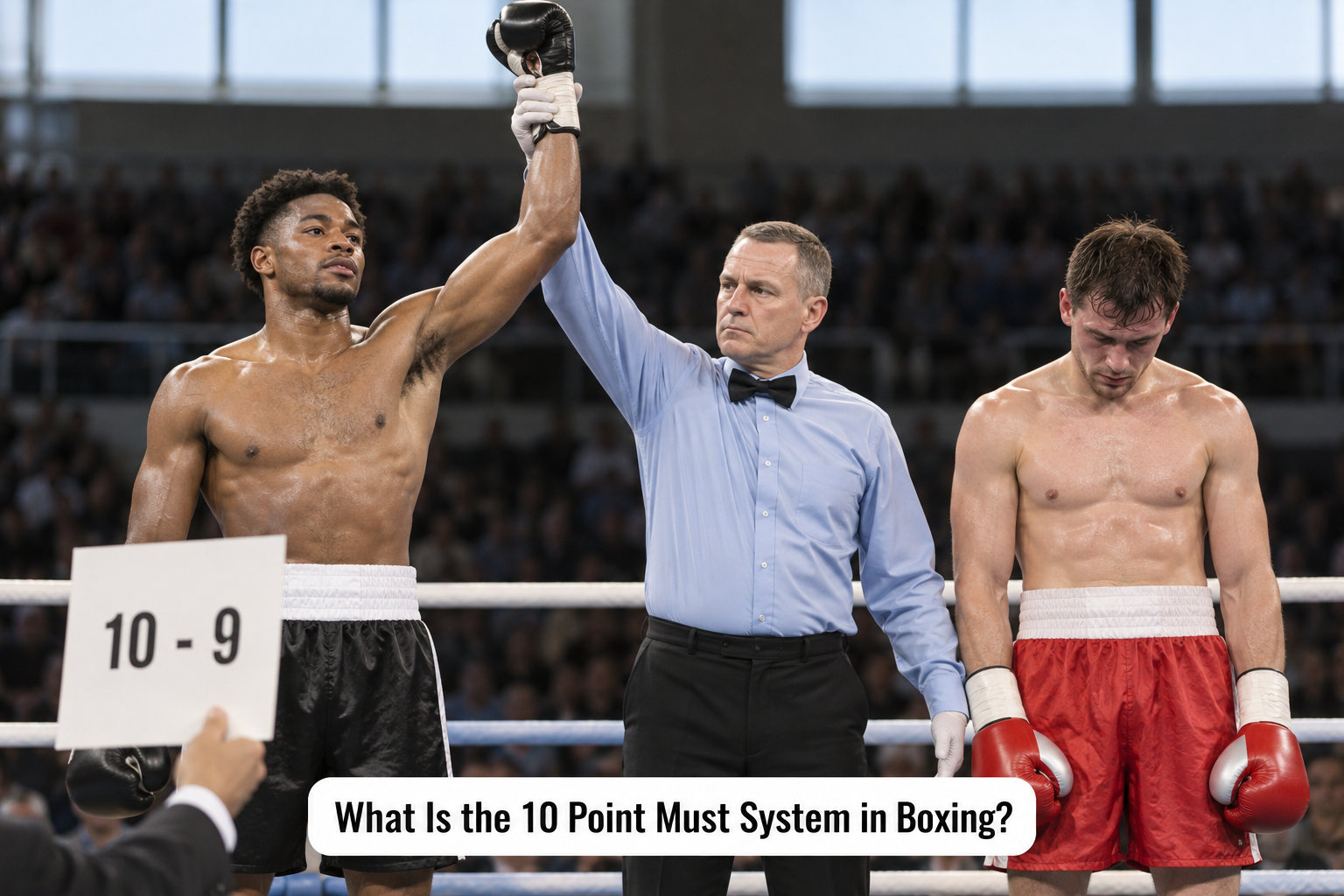
The word “must” is doing the heavy lifting. Judges are not free to score a round 9-9 because it felt close enough. Somebody has to win the round, and that person gets 10 points.
Here is the short version of every score you will see on a card:
- 10-9 — the standard round. One fighter was clearly better, but not overwhelmingly.
- 10-8 — a dominant round, or a round containing a knockdown.
- 10-7 — rare. Usually a round with a knockdown plus a sustained beating, or a round where the loser took a point off.
- 10-10 — an even round, allowed in both sports, almost never scored in practice.
- Point deduction — a foul takes a point off a fighter, recorded separately from the round score.
Everything else in this guide is detail on those five lines. If you remember nothing else, remember that the loser of a round only ever gives up a point, and a knockdown round can cost two.
How Does the 10-Point Must System Work?
Three judges sit ringside, each with a scorecard. At the end of every round, the referee collects the three cards and hands them to the ring clerk, who totals them. The judge who scored the round higher wins it, and the fight’s total is simply those three cards added together.
Why three judges instead of one referee
For most of boxing’s history, one referee decided the winner, usually by counting rounds won. The 10-point system was introduced by the World Boxing Council in 1968 as a more rational way to handle the sport, and three ringside judges became standard over the following decades.
The switch was about removing bias. One tired official at ringside cannot see everything in a twelve-round fight, and neither can a camera operator. Three officials, each with a clear view, means three chances to get it right, and also three chances to disagree with each other.
Sanctioning bodies and commissions write the judging criteria into their own rulebooks, so the precise wording of what judges reward varies slightly between organizations.
What Do 10-9, 10-8, and 10-7 Rounds Mean?
Every round score sits on the same scale, and the gap between the two numbers is the whole story. Here is the reference I wish more broadcasts printed on screen.
| Score | When It Is Awarded | What It Means |
|---|---|---|
| 10-9 | One fighter wins the round but the other stayed competitive | A normal round. Most rounds of most fights are 10-9 |
| 10-8 | A knockdown, or dominance across the full round | The loser took a step backward, visibly |
| 10-7 | A knockdown plus sustained punishment, or a round with a point deduction | Very rare, and usually the round that decides the fight |
| 10-10 | A genuinely even round | Legal under the rules, rare on the card, and disputed by some organizations |
| 9-9 or lower | The winner took a point off for a foul | The round score and the deduction are recorded separately |
A quick mental model helps here. A 10-9 is a one-point win and a 10-8 is a two-point win, but on the totals both count as exactly one round won, which is the root of most scoring arguments. The only way a decisive round becomes part of the total is if judges agree to widen the gap, and they only do that when the round is lopsided enough to say so.
What Happens If a Boxer Is Knocked Down?
A knockdown is not automatically a 10-8 round, and this is the single most common misunderstanding among new fans. The referee must first call an official knockdown, and judges are not permitted to ignore one once it is called. From there, they weigh how bad it was and what happened next.
The usual considerations are the severity of the knockdown and how long the fighter was down, how much of the round was spent recovering rather than competing, and how much punishment followed. A fighter who is dropped early, hurries back to his feet, and keeps trading still had time to earn a competitive 10-9. A fighter who is dropped late and spends the last seconds covering up probably does not.
Forum consensus on BoxingForum24 lands in the same place: a knockdown round is usually scored 10-8 when the two fighters were roughly even on impact otherwise. The knockdown is the trigger for a closer look, not the whole analysis. BoxRec forum users go further, arguing that judges should be able to score 10-8 even when the referee skips a full count, which is exactly the argument that came out of the Davis versus Roach discussions.
One more wrinkle worth knowing. A fighter who is dropped and cannot continue loses the fight by knockout before any scoring matters, and a fighter who is dropped but rises can still lose a round badly. The knockdown feeds the score, it does not replace it.
How Do Referee and Judge Deductions Affect the Score?
Point deductions are recorded separately from the round score, and this is where a lot of confusion comes from. When a referee takes a point for a foul, a 10-9 does not become a 9-9. Instead, the round is still scored 10-9, and the deduction is marked on the card, then subtracted from the fighter’s total at the end of the fight.
In practice that means a single accidental low blow costs a fighter one point on a 120-point total, which is the same weight as losing a round by a single point. Judges and referees do deduct points, most often for holding in boxing, and for low blows, elbows, headbutts and other violations. The referee judges fouls in the moment; the three scorecard judges assess quality.
In MMA the deductions land the same way, with low blows the most common offender. Control time is where deduction confusion meets something else entirely, since control with no damage is not a deduction, it is simply a round that was not won. That is the “lay and pray” complaint from r/MMA, and it comes up again on r/ufc, where fans ask how effective grappling is scored when one fighter holds position for four minutes straight. The Unified Rules put effective striking and grappling first, then aggression, then fighting area control, so time spent holding somebody down with no attempt to advance or damage ranks last.
How Is the Final Boxing Score Decided?
Each judge’s card is added up separately, and the three totals are compared. A fighter who wins on at least two of the three cards wins by decision. That is why one card disagreeing does not blow up the result, and why a split decision means two judges saw it one way and one saw it the other.
| Result | What the Cards Have to Say |
|---|---|
| Unanimous decision | All three judges scored it for the same fighter |
| Majority decision | Two judges for one fighter, one for the other |
| Split decision | Two judges for one fighter, the third for the other |
| Unanimous or split draw | The cards do not produce a winner, or a majority decision requires a fourth judge |
| Technical decision | One fighter cannot continue, and enough rounds were scored to decide it |
The totals are pure arithmetic once you know the two rules. Each won round is worth 10 points and each lost round is worth 9, so a twelve-round fight won seven rounds to five is scored 115-113, six rounds apiece is 114-114, and ten rounds to two is 118-110. A three-round MMA fight scored 30-27 means every round went 10-9 and the fighter won the fight, while 29-28 means two rounds to one. Deductions come off those totals at the end.
Technical decisions carry a minimum-round requirement for a reason. A bout that stops early, through injury for example, cannot be scored on incomplete rounds, so officials wait until enough rounds are on the cards before stopping it. Fans on r/Boxing keep running into this and assume the fight was robbed, when in practice the rules prevented a decision being made on one round.
You will also hear “going the distance,” which simply means nobody was stopped and the result is a decision rather than a finish. A no contest is a separate outcome entirely, used when a fighter is injured by something outside the fight, and it is not scored like a decision.
What Is the Difference Between the 10-Point Must System and the Must-Win Rule?
These are two different things that sound identical, and mixing them up causes most of the arguments I see in comments.
The 10-point must system is the scoring procedure. It tells judges that somebody must get 10 points for the round, and it defines what the loser gets. It is mandatory and it applies to every round of every bout.
The must-win rule is a condition attached to a result. Some championship bouts require a fighter to win the final round by a knockdown to keep a title, and other rules describe rounds a boxer must win to be awarded a decision. Those provisions are written into a bout’s own rule set, and they change what happens to a fighter, not how a round gets scored.
So a fighter can lose the fight on the cards while satisfying a must-win provision, and a fighter can win a 10-8 round without satisfying any must-win requirement at all.
Frequently Asked Questions
What is the 10 point must system in boxing?
It is the method judges use to score combat sports. The fighter who wins a round must be given 10 points, and the fighter who loses it gets 9 points or fewer. A dominant round or one with a knockdown is usually 10-8, a knockdown plus heavy punishment is 10-7, and a genuinely even round can be 10-10. Three judges score every round separately and the cards are added at the end.
How is boxing scored on a 10-point system?
Three ringside judges score each round on their own card. At the end of the round the referee collects the cards and the ring clerk totals them. Each judge’s card is added up across the fight, and a fighter who wins at least two of the three cards wins by decision. Fouls are deducted separately and subtracted from the total at the end.
How does 10-8 scoring work?
A 10-8 is awarded when one fighter dominates the round, or when the referee calls a knockdown and the other fighter does not recover well enough to keep the round competitive. Judges weigh knockdown severity, how long the fighter was down, how much of the round was spent recovering, and how much punishment followed. A knockdown does not automatically make a round 10-8, but judges cannot ignore an official knockdown either.
What happens if a boxer is knocked down but gets up?
Nothing automatic. The referee has to call an official knockdown first, and the judge then decides whether the round was 10-8 or 10-9 based on severity, duration, recovery time and what happened for the rest of the round. A fighter dropped early who gets straight back to work can still take a competitive 10-9. The knockdown informs the score, it does not replace it.
Why do MMA fighters get point deductions?
Deductions are for fouls, most often low blows, and also for headbutts and other illegal strikes. In boxing, judges and referees do deduct points, most often for holding. A deduction is marked on the card separately from the round score, so a 10-9 stays a 10-9 and the point comes off the fighter’s total, which has the same effect on the final decision as losing a round by a single point.
Conclusion
Watch three things on any scorecard graphic. Who won each round, how wide the gap was, and whether anyone took a point off. The winner of the round is the number that matters, the gap explains why a fighter lost two rounds and still won the fight, and deductions quietly rewrite totals that otherwise look even.
The 10 point must system is simple arithmetic wrapped around hard judgment. Once you know which part is the rule and which part is a judge’s opinion, most decisions that look like nonsense start to make sense.