Learning how to jump rope like a boxer comes down to one change from ordinary skipping: instead of bouncing evenly on both feet, you put roughly 90% of your weight on one leg and let the other foot lightly tap the floor. That side-to-side weight shift is the boxer skip, and it is how fighters build calf endurance, rhythm and ring conditioning without pounding their joints. Most beginners get it in a few sessions, not a few minutes.
Here is the honest version of what that looks like. Learning to jump rope like a boxer is about eight drills, most of which happen without a rope at all. Set aside 15 minutes on a non-slip surface and go through them in order.
Table of Contents
- What You Need
- Step-by-Step: How to Jump Rope Like a Boxer
- 1. Choose a Comfortable Rope and Set Up Your Space
- 2. Find Your Boxing Stance
- 3. Practice Turning the Rope With Your Wrists
- 4. Start With Small Boxing-Style Jumps
- 5. Use Alternating Footwork and Fight-Like Rhythm
- 6. Build Speed Without Losing Form
- 7. Try Beginner Boxing Jump-Rope Combos
- 8. Finish With a Cool-Down and Record Progress
- Common Mistakes
- Frequently Asked Questions
- Conclusion
What You Need
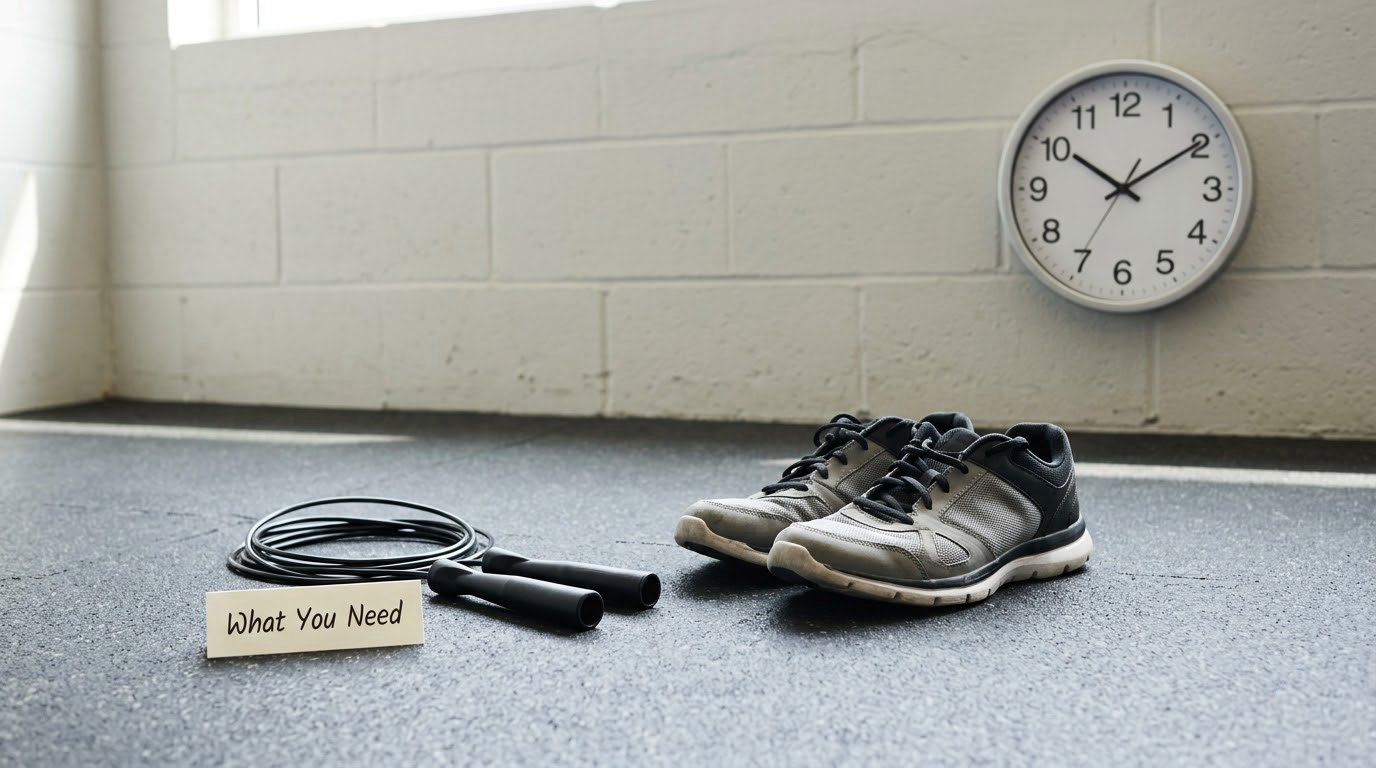
Almost nothing. You need one rope, flat floor, and about 15 minutes. The gear matters far less than people think.
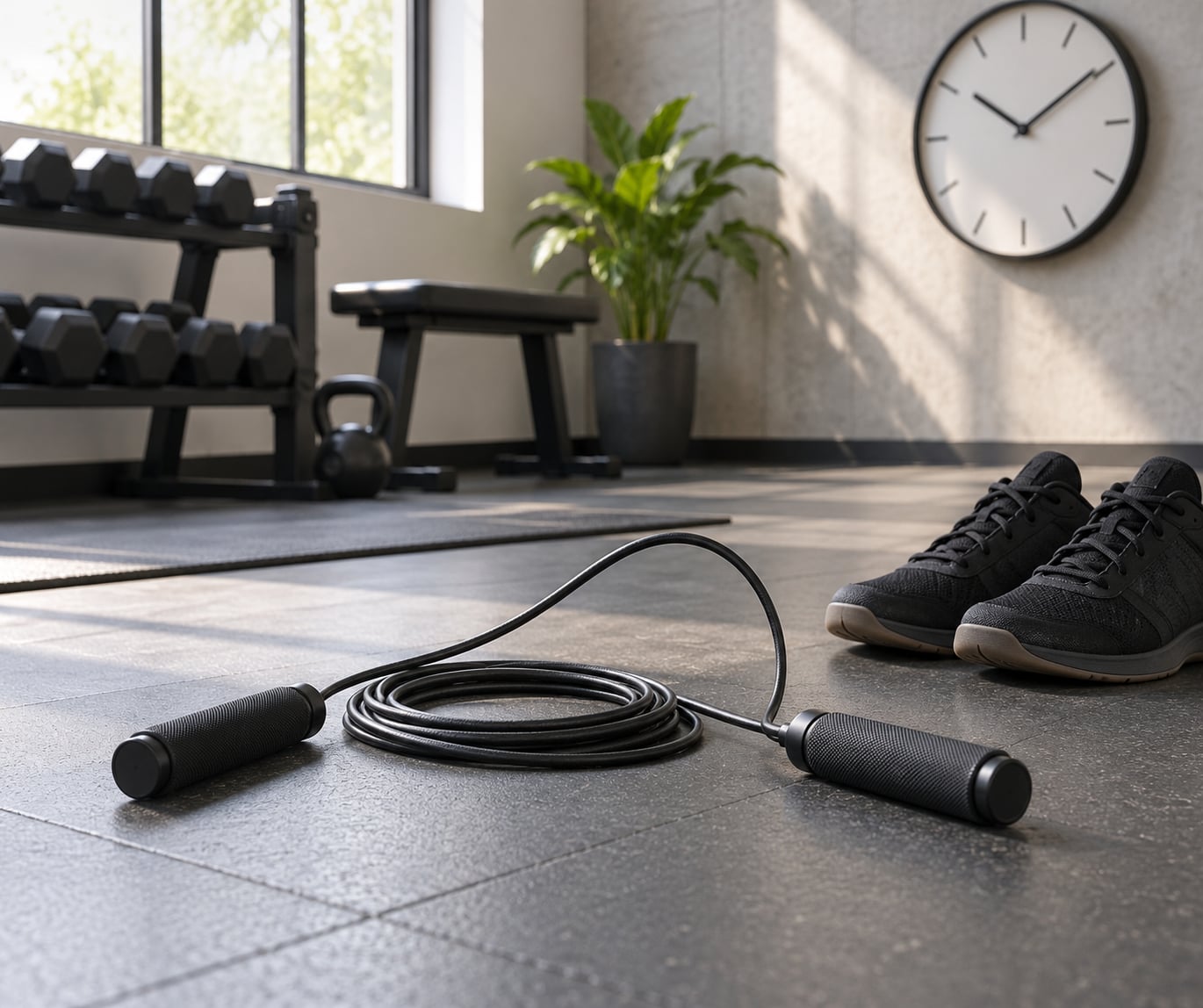
The rope. Boxers overwhelmingly use a basic PVC or nylon speed rope with ball-bearing handles and plastic-coated cable. It is cheap, adjustable and fast. Check for one thing: the cable coating. Bare steel cable bites into hands and floors after about ten minutes, so avoid it unless you’re deliberately doing weighted work later.
Rope length. Stand in the middle of the rope on the marked spot and lift the handles toward your armpits. If they reach your armpits, the length is right. Too short and your elbows have to fly out, too long and you hump your shoulders. Most ropes are adjustable, so measure yours rather than trusting the label.
Grip. Hold the handles lightly, thumbs on top, index finger on the side, and let the handle rest in the crook between thumb and index finger. A loose grip is not optional. Grip hard and your forearms will burn inside two minutes.
Where you stand. A sprung gym floor, a rubber mat or carpet beats concrete every time. Skip rope is often described as low impact, and it is compared with running, but that is true only at low jump height on a forgiving surface. Asphalt and hardwood are where sore ankles come from.
Shoes. Court shoes or wrestling shoes with a flat, wide sole and some arch support. Cushioned running shoes are not ideal because you land on a raised, springy platform that encourages you to jump higher than you should.
A warm-up. Two minutes of ankle rocks, calf raises, butt kicks and light jogging first. Skipping cold is how people end up limping after their first session.
Step-by-Step: How to Jump Rope Like a Boxer
1. Choose a Comfortable Rope and Set Up Your Space
Measure the rope, check the coating, and move the coffee table. Clear a patch of floor roughly three feet wide and as deep as you are tall. Rope catches on things at ankle height long before you’d notice it coming.
Now stand on the middle of the rope and pull the handles up to your armpits. Adjust the length there if you can. Finish by holding the handles in a relaxed boxing-ready position: elbows bent near 90 degrees, tucked against your ribs, hands out in front of your shoulders and roughly hip height.
You’ll know the setup is right if your shoulders feel like they’re hanging rather than bracing. If your traps are already tight, the rope is too long or your hands are too high.
2. Find Your Boxing Stance
Boxers don’t stand square, and they don’t skip square either. Step your feet to roughly shoulder width with the lead foot angled slightly forward. In an orthodox stance that means left foot forward, weight about 60% on the back foot and 40% on the front when you’re just standing.
Bend your knees a few degrees. Keep your chin down, your core braced and your weight slightly forward on the balls of your feet, heels barely loaded. The slight forward lean is a boxing habit and it shortens the distance your ankles have to travel on each bounce.
Keep your shoulders down and your hands loose. This is the single most important position in the whole drill: boxer jump rope technique starts from a relaxed, bladed stance that you can hold for minutes instead of seconds.
3. Practice Turning the Rope With Your Wrists
Put the rope down. Hold imaginary handles at your sides and rotate your wrists as though turning a doorknob, letting your forearms follow a fraction of the way. Do 20 of these. Then pick up the rope and jump without it turning, letting it slap the floor in front of and behind you.
This isolates the movement that beginners miss. If your arms feel like they’re doing the work, the rope is too long or you’re rotating from the shoulder. Bring the elbows in, bend to roughly 90 degrees, and let the movement live in the wrists and forearms.
You know it’s right when you can skip while talking in full sentences. Arms-tired-while-legs-are-fresh is the clearest sign you’re turning with your arms instead of your wrists.
4. Start With Small Boxing-Style Jumps
No rope yet. Hop on your right leg, keeping about 90% of your weight there, and let the left toe flick the floor just in front of your heel. Do 10 reps. Switch sides and do 10.
That toe contact is called a lazy tap, and it’s the whole trick. The tapping foot barely leaves the carpet. Now do 10 hops alternating sides so each side takes a turn as the supporting leg.
Jump height is the next cue, and it’s the counter-intuitive one: 1 to 2 inches of clearance is all you need. Land softly on the balls of the feet, heels skimming the floor, knees absorbing the landing. If your head is bobbing an inch with every bounce, you’re jumping too high and you’ll tire in a round.
5. Use Alternating Footwork and Fight-Like Rhythm
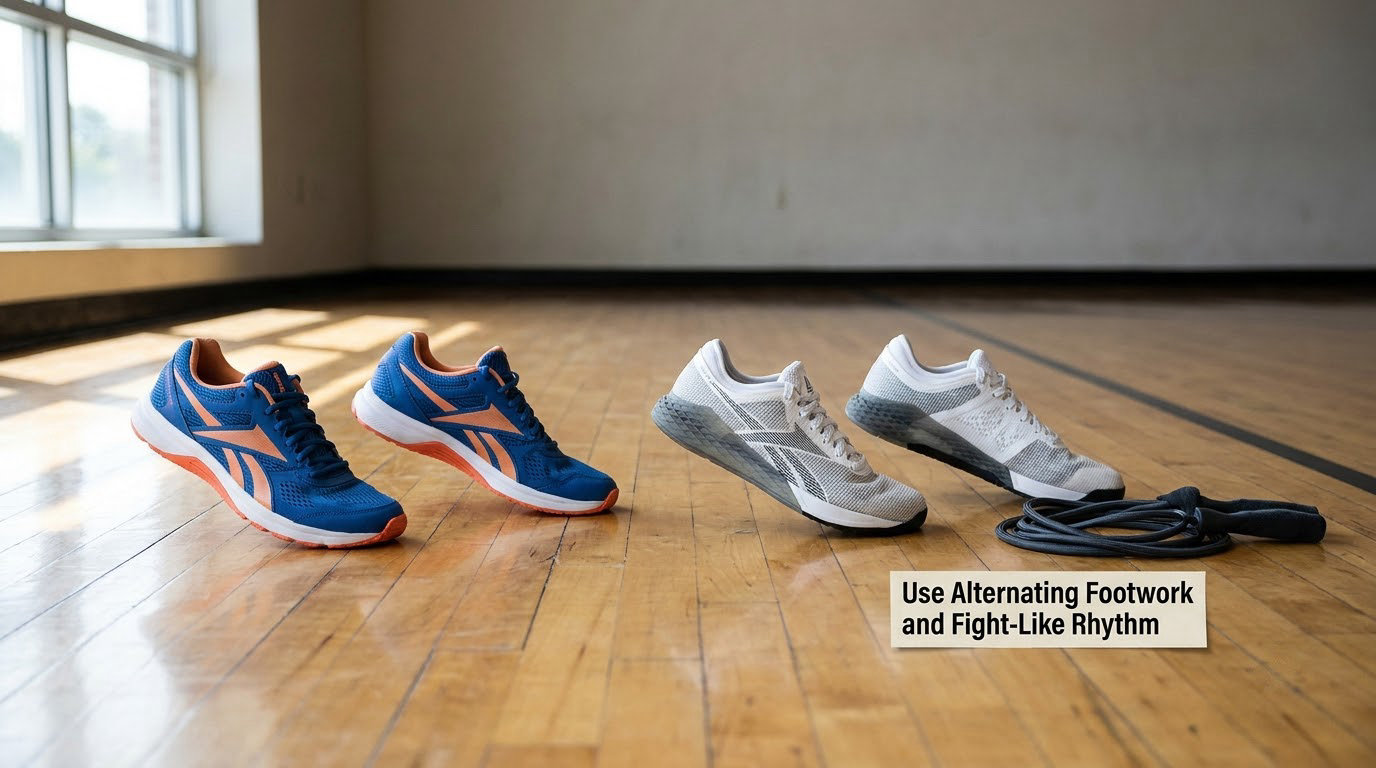
With the lazy tap and low bounce in place, find the count. Most beginners settle between 120 and 160 bounces a minute, which is roughly two bounces per second. Tap a foot on the floor to find it if you need an external cue.
Think of the rhythm in pairs, like a fight round: bounce-tap, bounce-tap, with the weight shifting left, right, left, right. That side-to-side shift is exactly what you do moving in a ring, just without the ring. The boxer shuffle is not a fast movement so much as an efficient one.
You know this step landed when you can hold the pattern for 30 seconds and still land softly on every rep. If one foot keeps carrying all your weight, the supporting side is lazy. If both feet are bouncing equally, drop back to step 4.
6. Build Speed Without Losing Form
Speed comes from a faster rope turn and a lower jump, not from a bigger bounce. Hold the handles even closer to your hips, shorten the circle of the rope, and keep the height at 1 to 2 inches. If you jump higher when you speed up, you’re doing it wrong.
Add speed in intervals rather than trying to hold your fastest pace for a whole set. A common beginner structure is 20 seconds fast, 10 seconds easy, repeated five times. Total work is 100 seconds and you’ll still be breathing normally after the first round.
Another useful measure is a pace spike. Fighters often rope easy for two minutes, then spike hard for the last 30 seconds of a round. Beginners can do the same: steady rhythm first, then a burst you couldn’t sustain. That’s a far better simulation of a fight than pacing evenly the whole way through.
7. Try Beginner Boxing Jump-Rope Combos
Once 60 seconds of clean boxer skip is boring, add patterns. Keep them simple until each one is solid for 30 seconds.
- Basic bounce. Two feet, both heels light, knees soft. A good active rest between harder patterns.
- Boxer skip. One supporting leg at 90%, other foot lazy-tapping. Your base pattern.
- Alternating feet. A normal skip with two-foot landings but the boxer skip’s low height and wrist turn.
- Double unders. Two rope rotations per jump. Move here last; it’s a coordination drill before it’s a speed drill.
- Toe flick. A few extra single-leg hops between patterns to shock the calves into firing quickly.
A simple session: 60 seconds of basic bounce, 60 seconds of boxer skip, 30 seconds rest, repeat twice, then three rounds of the boxer skip with a full minute of rest between them. That round structure mimics a fight more closely than one long continuous set.
If a combination starts falling apart after 15 seconds, go back to the pattern below it. Regressing for a session isn’t lost progress; it’s how you keep building a clean base.
8. Finish With a Cool-Down and Record Progress
To stop, ease the rope over your head rather than dropping it, then walk it for 30 seconds until your breathing settles. Immediately after, while the calves are still warm, stretch them: a heel drop off a step, 30 seconds each side, and a wall-calf stretch for the same time.
Write down three numbers before you leave: longest continuous skip, fastest interval you held without losing form, and whether your calves hurt during or only after the session. Those three lines are more useful than any video, because they show you whether you’re actually improving or just sore.
Give most beginners a four-week ramp before judging yourself. Week one is 100 skips a day in three or four short sets. By week two you’re aiming for three continuous minutes. Weeks three and four add intervals and one combo pattern at a time.
Common Mistakes
Almost every beginner problem on jump rope is one of six things. Each has a specific fix, and each is easy to self-diagnose by watching yourself from the side.
1. Jumping too high. Beginners think skipping means leaving the ground. It doesn’t. You want 1 to 2 inches of clearance, and you should be able to see the floor between your shoes and the ground. Fix: film yourself for 10 seconds and count how many times your head moves up and down. If it’s obvious, halve your height.
2. Turning the rope with your arms. Watch your elbows in a mirror. If they swing away from your ribs, or your shoulders shrug on every turn, the rope is rotating from the shoulder. Fix: pull the rope down over your head once a day for a week and feel the difference in your forearms versus your traps.
3. Shoulders and upper back tense up. Tension up top steals the rhythm and causes arm fatigue. Fix: check your shoulders every 30 seconds and consciously drop them. A shrug reset mid-set is more effective than trying to hold the correct position the entire time.
4. Landing on locked knees. Straightening the legs fully on each landing sends force into the knee joint. Fix: land with the knee already soft, on the balls of the feet, heels skimming rather than planting.
5. Skipping around the whole body. Big hip and shoulder movement makes the rope arrive late and throws your landing out of position. Fix: keep the hips under you and the hands at the sides of your body, turning the rope in a plane just in front of your thighs.
6. Progressing too fast. This is the mistake that ends sessions early. Nobody gets a reliable rhythm on day one, and people who chase a full boxer skip immediately tend to trip, land stiff and decide they’re bad at it. Fix: master the basic bounce for one minute before you add a lazy tap, and the lazy tap for 30 seconds before you alternate.
Two more things worth knowing. First, if your rhythm only lasts a few seconds before it falls apart, that’s normal early on and it’s usually a wrist problem, not a foot problem. Second, on r/jumprope, beginners who stepped back to a plain basic bounce for a few sessions often found their arm position and timing sorted themselves out, which is exactly what step 4 is for.
Frequently Asked Questions
What type of jump rope do boxers use?
Boxers use a basic speed rope with ball-bearing handles and plastic-coated PVC or nylon cable. The coating matters more than the price: bare steel cable frays hands and floors within minutes. Rope length is set by standing on the middle of the rope and pulling the handles up to your armpits. Most beginners are fine on a standard adult length once they stop swinging from the shoulders.
How long should I jump rope as a boxer?
Three minutes of continuous skipping is the standard beginner goal, and most fighters work in fight-round structure: 3 rounds of 3 minutes with 60 seconds of rest between them. Beginners often start with intervals instead, such as 20 seconds fast and 10 seconds rest, repeated five times. Build up to continuous work over about four weeks rather than starting with full rounds.
Is jumping rope a good exercise for boxers?
It is one of the best conditioning tools available, mainly because it trains rhythm, calf endurance, balance and rapid side-to-side weight transfer in very little space. The boxer skip adds the lateral weight shift a fighter needs in a ring. At a low jump height on a forgiving surface it is far gentler on joints than running, though it is not impact-free.
Is it normal for my calves to be sore after jump roping?
Some soreness in the first week or two is normal, especially if you are new to any plyometric work. What is not normal is sharp pain in the shin bone, pain that lasts more than about a week, or ankle pain that makes you limp. Stretch your calves while they are still warm, keep jump height low, use a forgiving surface, and see a doctor if bone pain persists.
What does 100 skips a day do?
One hundred skips a day is a fine starting habit rather than a workout. It builds the wrist coordination and calf tolerance most beginners lack, and done daily for a few weeks it usually turns into several minutes of continuous skipping without anyone noticing the effort. Think of it as technique practice, not conditioning, and add time only once the 100 feels easy.
Should one foot stay down when jump roping like a boxer?
Nearly. Put about 90% of your weight on the supporting leg and let the other foot lightly tap the floor with the toe, called a lazy tap. Hovering with the foot off the ground wastes energy and hurts balance. Hovering confusion is the most common beginner mistake, and the tap should be a light brush, not a kick.
Conclusion
Do one thing this week: pick a rope, measure it to your armpits, and spend 15 minutes on the no-rope drills before you turn the rope on. Ten single-leg hops per side, then ten with a lazy tap, then 30 seconds of alternating rhythm on each side.
Only then add the rope, and stay at 1 to 2 inches of jump height with your wrists doing the turning. Three continuous minutes is the goal for the month. Speed and fancy combinations come after that, and only if the basics still look good on video.