Boxing main events usually begin between 10:30 p.m. and 1:00 a.m. in the host city’s local time, and much later for viewers watching from another continent. The reason why main events start so late is simple arithmetic, not laziness: a full undercard, six changeovers, ring ceremonies and broadcast padding all sit in front of the headline bout.
Promote a 7 p.m. card and the headliner lands somewhere near midnight. Promote a 5 p.m. card, as many European promotions do, and the same fighter walks out at 9:30 p.m.
The rest of this guide breaks down what actually sits between the advertised start and the first punch of the main event, and why the people who set those times are usually not the people running the show in the ring.
Table of Contents
- What Time Do Boxing Main Events Usually Start?
- How Does the Undercard Affect the Main Event Start Time?
- Why Do Broadcasters Schedule the Main Event at Midnight?
- How Do Venue Logistics and Fight Order Change the Schedule?
- Why Can a Main Event Run Even Later Than Advertised?
- Frequently Asked Questions
- Is midnight a normal time for a boxing main event?
- Why do two main events on the same card have different labels?
- How do I convert a boxing start time to my time zone?
- Are boxing main events always on pay-per-view?
- What time should I tune in to catch the undercard?
- How long does a boxing card run from start to finish?
- Conclusion: What Time Should You Tune In?
What Time Do Boxing Main Events Usually Start?
Main events commonly run from 10:30 p.m. to 1:00 a.m. local time on big cards, and closer to 9 p.m. on smaller regional shows. What changes the figure is the venue, the number of bouts, the broadcaster and the audience the broadcast is built for.
The first thing to untangle is that the advertised time is usually the first fight of the broadcast, not the headliner. A promoter who lists 7 p.m. means the opening bout is scheduled to start around 7 p.m. The main event is the last item on the list, and lists take time.
Regional viewing patterns make the same night look very different depending on where the screen is:
| Where you are watching | Typical local card start | Typical main event | What it feels like |
|---|---|---|---|
| US East Coast | 7:00 p.m. ET | 11:00 p.m. to 1:00 a.m. ET | Late but manageable |
| US West Coast | 4:00 p.m. PT | 8:00 p.m. to 10:00 p.m. PT | The friendliest time zone |
| United Kingdom | 12:00 a.m. BST | 4:00 a.m. to 6:00 a.m. BST | The most common complaint |
| Central Europe | 1:00 a.m. CEST | 5:00 a.m. to 7:00 a.m. CEST | Frequently a sunrise viewing |
| India | 4:30 a.m. IST | 8:30 a.m. to 10:30 a.m. IST | Breakfast-time boxing |
| Australia | 9:00 a.m. AEST | 1:00 p.m. to 3:00 p.m. AEST | Weekend daytime viewing |
British and European fans cop the worst of it because a United States prime-time card lands squarely in the small hours. Australian viewers get the friendliest deal, usually a Saturday or Sunday morning fight with a headline bout at lunchtime.
How Does the Undercard Affect the Main Event Start Time?
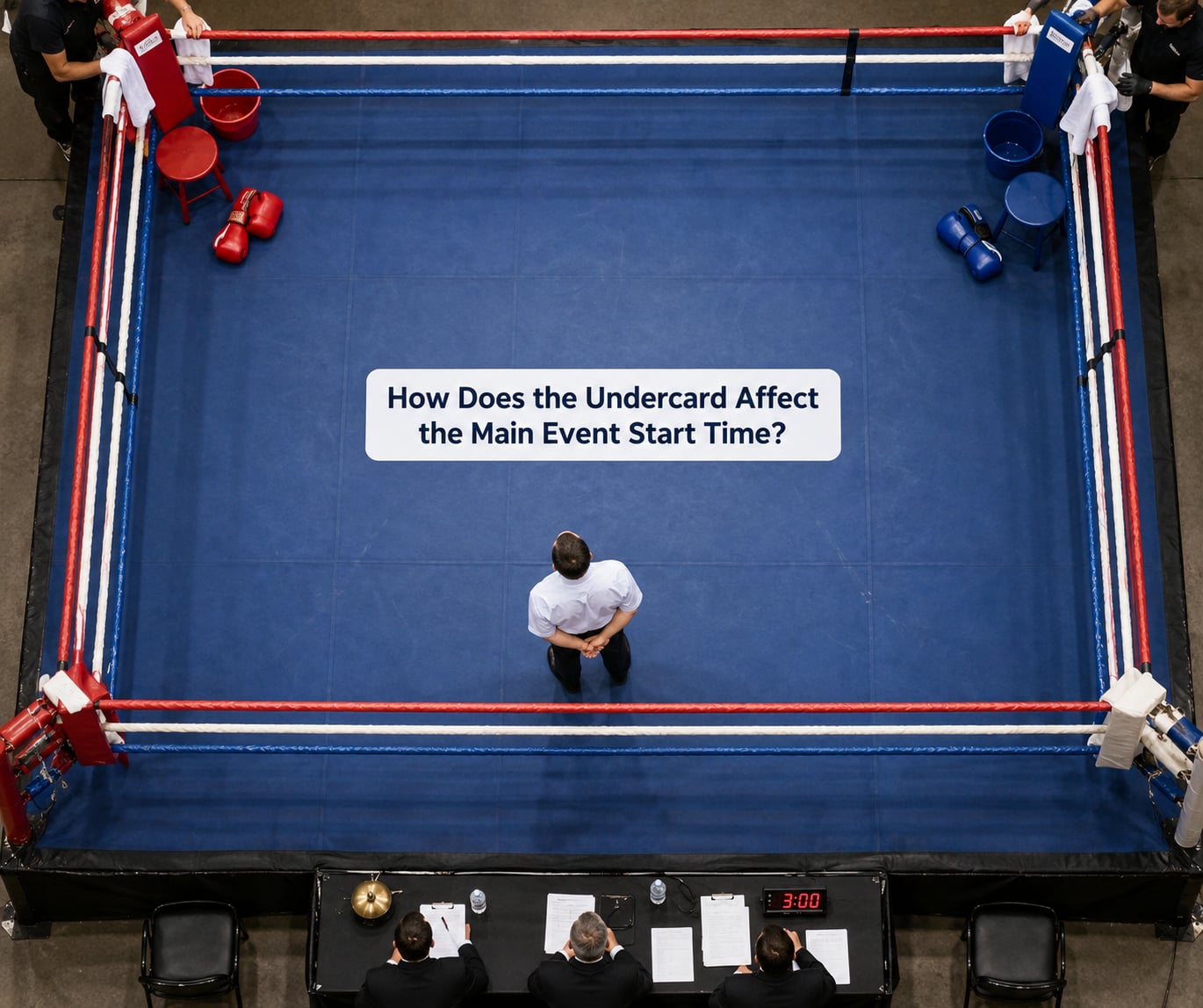
The undercard is the single biggest driver. Every bout before the main event adds roughly 20 to 30 minutes of wall-clock time once you count the fights, the corners and the officials meeting in the middle, the break between rounds, and the changeover to get the next fighter ready.
A worked example makes the drift obvious. Take a card advertised at 7:00 p.m. with four undercard bouts and a five-bout main card:
| Scheduled | What happens | Realistic outcome |
|---|---|---|
| 6:30 p.m. | Doors, ring build, fighter arrival | Undercard prep |
| 7:00 p.m. | Opening bout | 7:05 p.m. |
| 7:30 p.m. | Undercard bout two | 7:45 p.m. |
| 8:00 p.m. | Undercard bout three | 8:20 p.m. |
| 8:30 p.m. | Undercard bout four | 8:50 p.m. |
| 9:15 p.m. | Main card opens | 9:20 p.m. |
| 10:00 p.m. | Co-main | 10:10 p.m. |
| 11:00 p.m. | Support bout | 11:15 p.m. |
| 11:45 p.m. | Main event ring walk | 11:55 p.m. |
The advertised 7:00 p.m. became a midnight headline bout with nothing unusual happening. Each individual delay was small. Added together they consumed nearly five hours.
Changeovers are where time quietly disappears. Between bouts the crew wipes the canvas, replaces gloves, re-ties the shoelaces that loosened, checks gloves and mouthpiece, and the referee briefs both fighters. Six changeovers at ten minutes each is a full hour nobody put on the poster.
Why Do Broadcasters Schedule the Main Event at Midnight?
Because the midnight main event is the product the broadcaster is selling. Pay-per-view income is dominated by North American buyers, so the card is built to put the biggest fights in front of the largest possible audience during United States evening hours, even if that means a 4 a.m. start for the rest of the world.
Prime time is the anchor. A broadcaster wants the headline bout inside or just after its evening window, when the audience is awake and the advertising inventory is worth the most. Everything before it is filler built to reach that moment.
The other half is international coordination. Streaming platforms now sell the same card in dozens of markets at once, and a start time that lands at 2 p.m. in Los Angeles and 6 p.m. in New York covers the two biggest paying regions in one window.
Not every broadcaster pads the same way. Subscription streaming services carry no advertising breaks, so a card on that kind of platform often runs tighter than a televised one, with fewer drawn-out post-fight interviews and less ceremonial filler between bouts. The headline bout still lands late; the padding before it is just thinner.
One useful distinction: a local start time and your local start time are not the same thing. A card promoted as 10 p.m. might mean 10 p.m. at the arena. The broadcast start you see advertised is a separate figure set for television.
How Do Venue Logistics and Fight Order Change the Schedule?
Plenty of the delay is built into the room before anyone throws a punch. Venues have curfew deadlines, broadcast teams have handover windows, and both limit how long a card can drift.
| Factor | What it involves | Typical effect on the schedule |
|---|---|---|
| Venue curfew | Hard stop for the building | Cap on total card length |
| Broadcast handover | Feeds, commentary, replays, ad pods | Ten to twenty minutes per window |
| Fighter arrival | Travel, hotel release, weigh-in recovery | Late walkouts, shortened rounds in rare cases |
| Medical checks | Pre-fight examination | Several minutes per bout |
| Ring ceremonies | Title presentations, anthem, sponsor displays | Five to fifteen minutes |
| Fight order | Marquee bout placed last | The main event is always last by design |
| Security and crowd flow | Separating the crowd from a busy floor | Slows entry between segments |
Promotions also order cards backwards from the headline. A famous name needing a proper crowd, a title belt that needs presenting, and broadcast partners who want a tidy sweep before the commercial break all argue for putting the best fight last.
That is why “fight order” is the thing fans should look at first. The main event slot is not a position anybody can accidentally lose.
Why Can a Main Event Run Even Later Than Advertised?
Because a scheduled late start and a live delay are two different problems with two different causes. The first is built into the plan. The second is what happens when the plan stops working.
| Cause | Scheduled or live | Who controls it | How long |
|---|---|---|---|
| Full undercard with long bouts | Scheduled | Promotion | Planned into the timeline |
| Commercial and ceremonial padding | Scheduled | Broadcaster and promotion | Built in by design |
| Long fight going the distance | Live | The fighters | 5 to 15 minutes |
| Walkout running long | Live | The fighter and his team | 5 to 10 minutes |
| Title introduction | Live | Promotion | 5 to 15 minutes |
| Weather or venue issue | Live | Venue and officials | Can be an hour or more |
| Technical or feed problem | Live | Broadcast crew | Minutes to an hour |
Weather is the classic live example. An outdoor card hit by storms has been pushed back by an hour while the crowd waited under cover, and that hour lands directly on the main event.
Weight cutting is the other one. When a fighter misses weight, the bout is often moved later on the card to give more recovery time, which pushes everything behind it back.
Frequently Asked Questions
Is midnight a normal time for a boxing main event?
Yes. On major cards the main event regularly starts between 10:30 p.m. and 1:00 a.m. in the host city’s local time. The advertised figure is normally the first fight of the broadcast, not the headline bout. Full undercards, changeovers and ring ceremonies add three to five hours between the two.
Why do two main events on the same card have different labels?
A card often carries a main event and a co-main event, and sometimes a supporting bout between them. Each label is a separate scheduled slot, and running order can change on the night. Treat any listed time as an estimate and expect the actual sequence to shift as earlier bouts finish.
How do I convert a boxing start time to my time zone?
Take the Eastern Time figure, convert it to your own zone, then add two to three hours for the headline bout rather than the first fight. London is five hours ahead of Eastern Time during British Summer Time and Central Europe is six hours ahead during summer time. In winter both offsets shrink by one hour.
Are boxing main events always on pay-per-view?
No. Championship bouts often go behind a pay-per-view paywall, but plenty of headline fights appear on free-to-air television in at least one country, and streaming platforms carry selected cards as part of a subscription. Regional simulcasts differ, so check what is available locally rather than assuming.
What time should I tune in to catch the undercard?
Tune in at the advertised first-bout time if you want the whole card. If you only want the co-main and main event, add about two hours for a standard undercard and a little more if the card carries extra bouts. Latecomers often arrive just before the headliner and miss the fight they actually came for.
How long does a boxing card run from start to finish?
A small regional card might run ninety minutes. A full championship card with five undercard bouts, three main-card bouts and extended ceremonies commonly runs four to five hours, and a difficult fight on the undercard can stretch that further. Always-fighters can extend a card by half an hour or more.
Conclusion: What Time Should You Tune In?
Late main events are the result of a full card and broadcast planning, not a lack of excitement. Check three things before fight night: the venue’s local start time, the advertised main event time, and how that lands in your own time zone.
If you want the whole night, tune in at the advertised first-bout time. If you only want the headline fight, add two hours and settle in. And remember why main events start so late, because that gap between the poster time and the ring walk is where the entire schedule has been hiding.