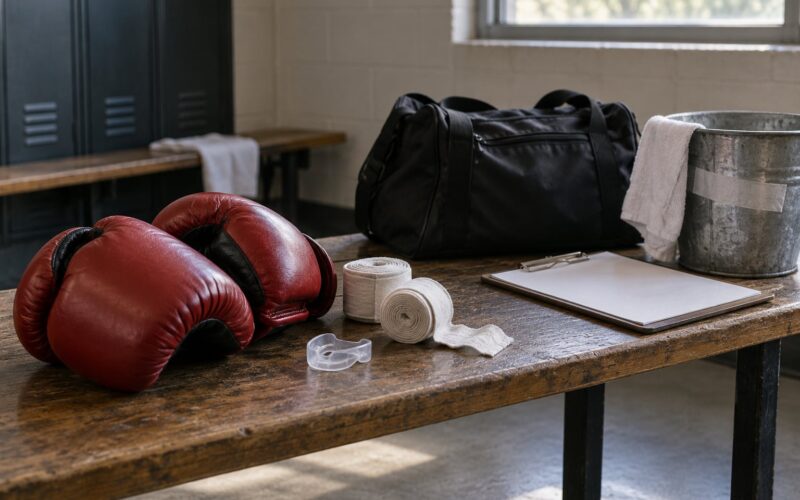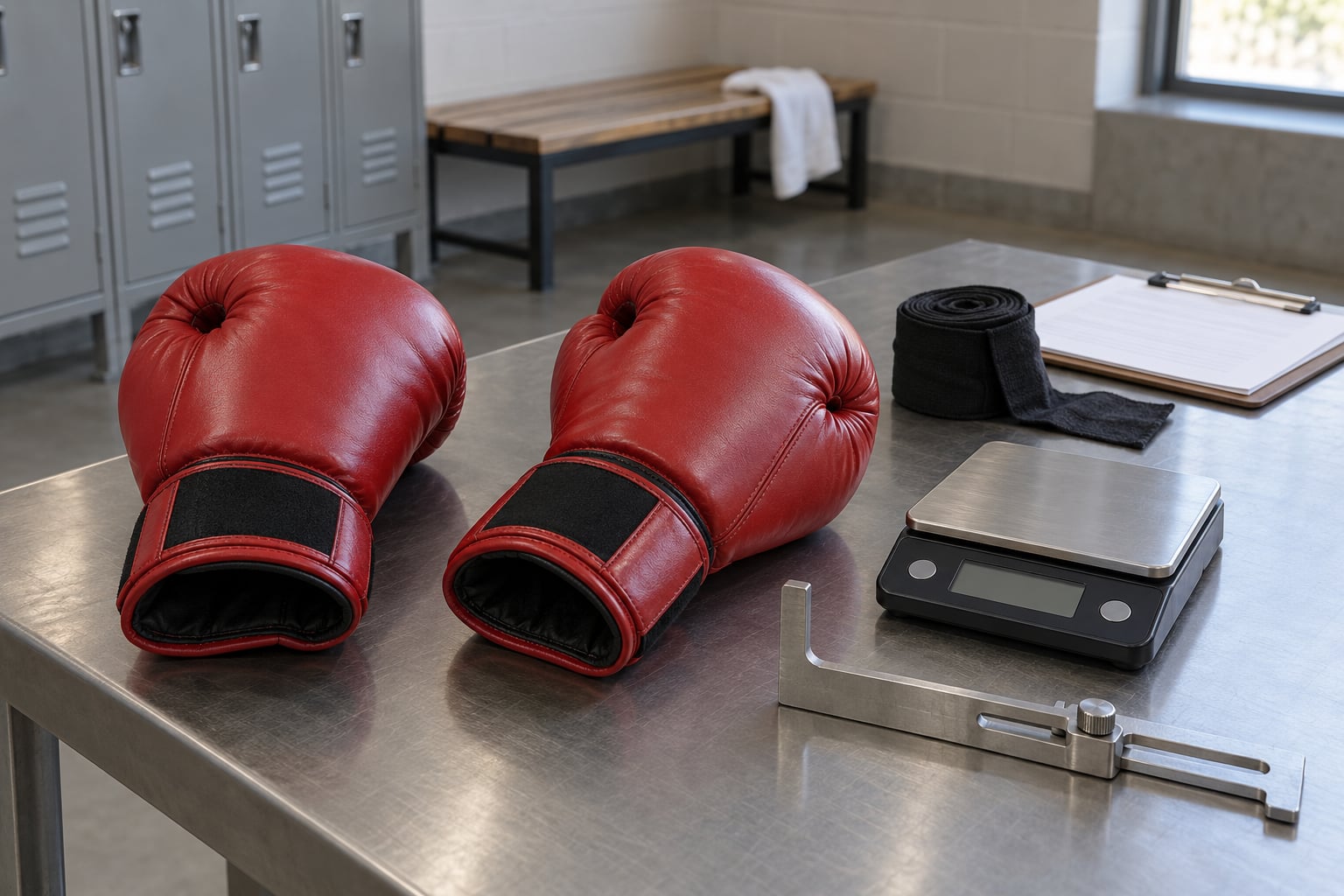
Boxing gloves are checked before a fight by a state athletic commission event inspector or the inspector’s designee, and then again by the referee once both boxers are in the fighting area. The inspection covers the gloves and the hand wraps underneath them: they must be dry, clean, free from cuts and defects, correctly laced, free of foreign substances, and their padding must sit in its original position. Gloves that fail are replaced before the contest begins.
That is the short answer, and it is written into the rules of most US commissions. What those rules rarely spell out is who does what, what a failed check actually looks like, and why a boxer cannot simply turn up with a familiar pair of gloves and expect the official to wave them through.
The rest of this guide pulls the procedure together from the published rules of several commissions, because no single page anywhere does that. Rules differ by state, and a fighter who moves between commissions is the one most likely to get caught out by a detail.
Table of Contents
- What Happens During a Pre-Fight Glove Check?
- Who Checks Boxing Gloves Before a Fight?
- How Gloves Are Checked Before a Fight Step by Step
- What Do Boxing Inspectors Look For on Gloves?
- How Much Should a Pair of Boxing Gloves Weigh?
- Why Are New or Different Gloves Rejected?
- What Is the Difference Between a Glove Check and a Medical Check?
- Can Boxers Use Their Own Gloves?
- What Happens If Gloves Fail Inspection?
- Frequently Asked Questions
- Conclusion
What Happens During a Pre-Fight Glove Check?
The pre-fight glove check is a physical inspection, not a formality. An official takes the gloves, looks at them, feels the padding, checks the lacing, confirms the wraps underneath, and checks them against the rules for the bout. The same official usually weighs them or confirms they are the correct weight class for the division.
Two separate checks are folded into what spectators read as one moment. The first is the administrative sweep the referee does before action: ring ropes, canvas, apron, then personal equipment including gloves, mouthpiece, groin protection and trunks. The second is the detailed equipment inspection that confirms the gloves meet the commission’s standard.
The timing varies by jurisdiction, which is one of the more confusing parts for a first-time fighter. Wisconsin’s Administrative Code SPS 114 states that “the inspector or the inspector’s designee shall inspect the bandages, gloves and dress before a boxer enters the ring.” Indiana’s 68 IAC 11-385 puts it slightly later, requiring the referee to inspect the boxing gloves “when the professional boxers have entered the fighting area.”
| Jurisdiction | What the rule says | When it happens |
|---|---|---|
| Wisconsin (SPS 114) | The inspector or the inspector’s designee shall inspect the bandages, gloves and dress before a boxer enters the ring | Back in the dressing room, before entry |
| Indiana (68 IAC 11-385) | When the professional boxers have entered the fighting area, the referee must inspect the boxing gloves | In the ring, after entry |
| Virginia (18VAC120-40-411.21) | Gloves must be clean, free of cuts and have good laces, with no displacement or lumping of padding material; those found defective shall be replaced before the contest begins | Before each contest |
| Maryland (COMAR 09.14) | Gloves shall be examined before a contest by a Commission representative and the referee | Before the contest |
| Colorado (4 CCR 740-1) | Whenever the gloves of a contestant touch the canvas floor, whether by accident or by knockdown, the referee shall physically inspect the gloves and wipe them clean | Repeated in-fight, on contact with canvas |
| Washington (WAC 36-12) | The referee shall inspect the boxers’ bodies and gloves to make sure no substances have been applied to the detriment of an opponent | Pre-bout and after knockdowns |
| South Carolina (20-26-1) | The referee shall inspect the gloves and make sure that no foreign substances have been applied to either the gloves or any part of the boxer’s head or body | Pre-bout |
| Kentucky (KRS 229) | Gloves for all main events shall be dry and free from defects; the laces on gloves shall be tied on the back of the wrist and taped; the padding shall be uniform | Before main event bouts |
Table note: these are published state and administrative code excerpts, summarised from each commission’s own rules. Wording is quoted or closely paraphrased from the cited sections.
Who Checks Boxing Gloves Before a Fight?
More than one person touches the process, and the division of labour is where most confusion sits. The event inspector or the inspector’s designee is the person carrying the commission’s authority. In Virginia’s rules, gloves “shall be inspected by the event inspector or his designee before each contest.” That inspector can be a commission staffer, a designated official, or in some jurisdictions a trusted person approved by the commission.
The referee has a separate set of duties that overlap with the inspector’s without being identical. Washington’s professional boxing rules put the substance check squarely on the referee: “The referee shall inspect the boxers’ bodies and gloves to make sure no substances have been applied to the detriment of an opponent.” The body check matters as much as the glove check, because grease or petroleum jelly on a fighter’s face or head is treated under the same clause.
The boxer and the trainer do their own version of the check days earlier. Nobody in the ring is going to tell a fighter that the padding in his glove has shifted; that has to be caught in the gym or the corner discovers it after the fight.
The ringside physician has a different job entirely. That person examines the fighter, not the equipment, and can stop a bout or refuse to let one start on medical grounds regardless of what the gloves look like.
Is the check real, or is it an honour system?
It is written regulation, and it is applied by several named officials at different points. Forum scepticism about glove checks is common enough that it is worth answering directly: participants in combat-sports forums repeatedly ask whether the inspection is genuine, and the answers from long-post-count members are consistent. “The gloves are always checked,” is the recurring response on the Sherdog forums, along with references to the regulatory consequences for promoters who skip it.
One ritual people describe seeing at commission-regulated MMA bouts is an official signing across the wrist tape in marker, which functions as a visible sign-off that the glove passed inspection. That account comes from forum participants rather than from published commission rules, so treat it as community report rather than a documented procedure. The underlying requirement is documented; the Sharpie is folklore built on top of it.
How Gloves Are Checked Before a Fight Step by Step
The order matters more than most fans realise. Referee manuals describe a pre-bout sweep that starts with the ring itself and works outward to the fighters’ personal equipment, which is why you sometimes see a referee handling the ropes while a commission official is already looking at gloves across the ring.
- Ring and canvas check. Ropes, canvas, apron and corners are checked before anything fighter-specific. Colorado’s code makes this relevant later in the fight, since a canvas contact is what triggers a fresh glove inspection.
- Call to the fighters. Both boxers are summoned and their names checked against the paperwork for the bout.
- Gloves presented. The gloves are brought to the official. In professional boxing these are normally gloves supplied by the promoter, not gloves carried in by the fighter.
- Visual inspection. Condition, cuts, holes, wear-through, laces, wrist closures and markings are looked over.
- Padding checked by feel. The official works the padding to confirm it sits where the manufacturer put it, with no lumping or displacement.
- Weight and type confirmed. The gloves are checked against the class and any organisation-specific requirement.
- Hand wraps inspected. Wraps come off or are opened enough to be checked for illegal materials, excessive length, or padding placed where it should not be.
- Substance check. Gloves and the fighter’s body are checked for foreign substances.
- Pairing and matching. Both fighters’ gloves are confirmed as a matched pair in type and appearance.
- Approval. The official signs off. Only then do the boxers put the gloves on for the opening bell.
Why does the referee wipe the gloves on his shirt?
That long-standing gesture gets asked about constantly, and the answer is that the shirt wipe is the foreign-substance check. A referee wipes down the gloves in front of you to look for grease, resin, wax, or anything else applied to the surface that should not be there. Washington’s rule about inspecting bodies and gloves “to make sure no substances have been applied to the detriment of an opponent” is the substance of it.
It also serves a second purpose. A wipe reveals a loaded surface. If a glove has been worked over with something abrasive so that the effective striking surface is sandpaper rather than leather, a wipe across the palm and knuckles can leave a mark on the fabric that would not appear on a clean glove.
What happens if the gloves touch the canvas mid-fight?
They get inspected again, immediately. Colorado’s boxing rule is unusually explicit about the trigger: “Whenever the gloves of a contestant touch the canvas floor, whether by accident or by knockdown, the referee shall physically inspect the gloves and wipe them clean.” A glove dragged across a dirty canvas can pick up anything at all, so the wipe is a reset rather than a formality.
This is also why a knocked-down boxer is often wiping their gloves on their trunks while the count runs. The referee is waiting to complete that inspection before the fight resumes.
What Do Boxing Inspectors Look For on Gloves?
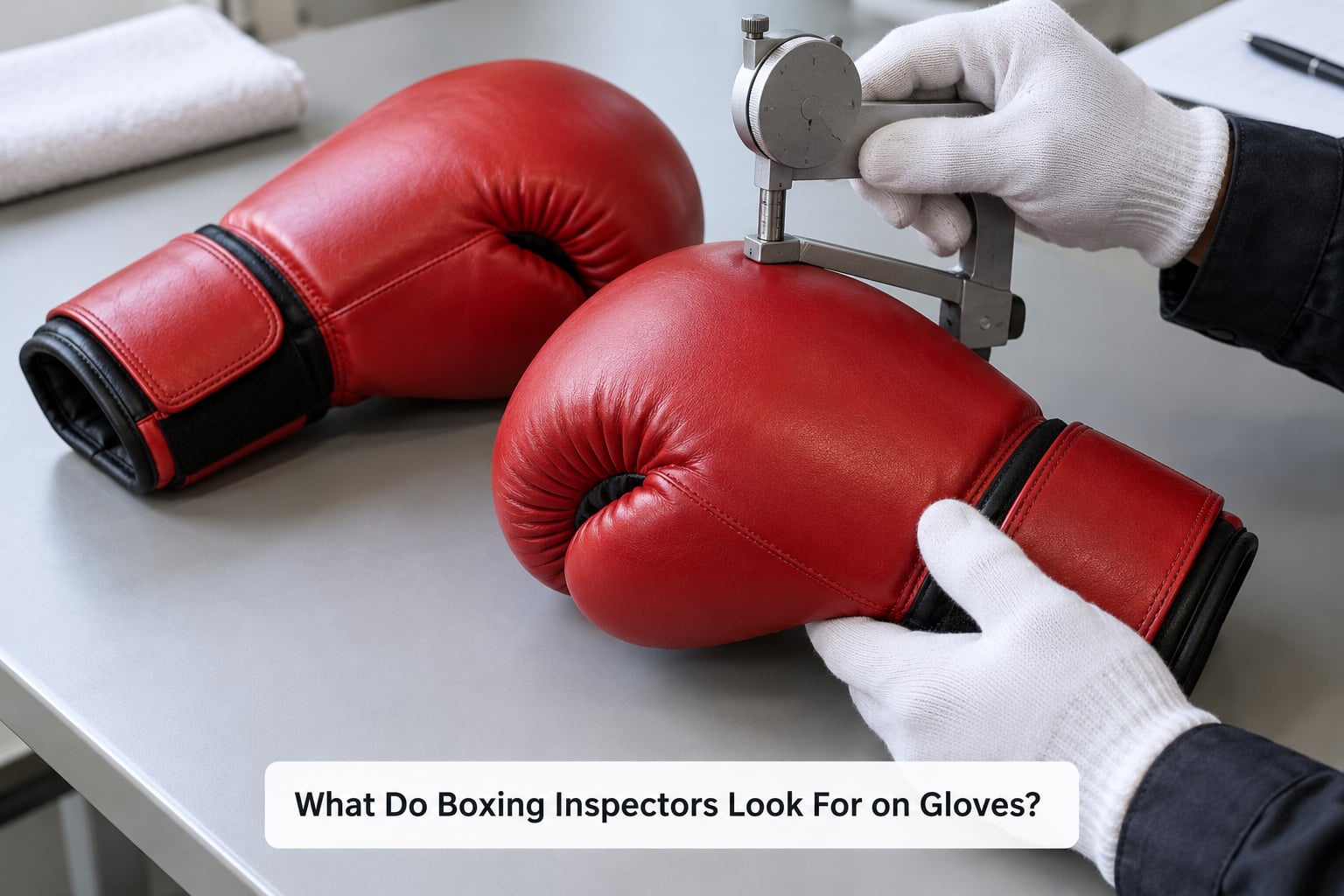
The inspection points are remarkably consistent across commissions, which makes sense given that most codes borrow language from one another. Here is what an official is actually checking, with the regulatory basis for each.
- Dry and free from defects. Kentucky’s KRS 229 opens with the requirement that gloves for all main events “shall be dry and free from defects.”
- Clean and free from cuts. Virginia’s 18VAC120-40-411.21 requires that gloves be clean and free of cuts. Holes and worn-through surfaces fall under the same clause.
- Sound laces. Virginia requires “good laces.” Kentucky adds the specific arrangement: the laces “shall be tied on the back of the wrist and taped.”
- Padding in its original position. No displacement and no lumping of padding material, again in the words of the Virginia code. Maryland’s COMAR treats a misplaced or lumpy pad as a defect in its own right.
- No foreign substances. South Carolina’s rule covers both gloves and the fighter: the referee checks “that no foreign substances have been applied to either the gloves or any part of the boxer’s head or body.”
- No abrasive or loaded seams. This sits inside the foreign-substance and defect clauses. A glove treated to injure rather than punch is a modified glove, and it fails the same test.
- Correct weight and type for the bout. Checked against the class rules and, where an organisation applies, its own specification.
- Matched between both fighters. One fighter in heavier gloves than his opponent is not a permitted advantage in any commission code.
Wisconsin’s code adds a narrow exception that says more about intent than the ban it sits in: no foreign substances may be applied to gloves except for wrapping around the wrist area to safely secure the laces. The allowance exists because tape at the wrist is standard practice; anything beyond that is a substance.
How Much Should a Pair of Boxing Gloves Weigh?
There is no single number that works everywhere, and anyone who quotes you one universal figure is describing their own commission. Gloves are specified by ounces and sometimes by weight class, and the limit that applies is the one written into the rules of the body sanctioning the event.
Several variables move the figure. The governing commission sets the baseline. A sanctioning organisation may set its own, and a promoter staging on a commission licence operates under that commission’s rules first. The bout itself may carry an agreement between the fighters and promoter about permitted glove weight that sits within the rule’s limits.
Scale tolerance is the detail most people miss. Commission rules generally allow a small margin above the nominal weight to account for manufacturing variation and for the fact that gloves carry a wrapper, a wrist section, and a closure. That margin is small and defined in the code, not left to judgement.
Weight alone also does not settle anything. A glove at exactly the right weight can still fail on padding, lacing or condition, and a glove that looks heavier than its label can still pass if the measurement point defined in the rules falls in a lighter area. The check is the glove against the rule, not the label against the glove.
Sizing works the same way. Gloves are ordered by ounce weight and by fit, and a glove that fits comfortably in the gym can sit wrong on the night once the fighter is taped, warmed up and nervous. Hand swelling and sweat both change how a glove feels, which is one reason commission rules give the official the final call on fit.
Why Are New or Different Gloves Rejected?
Rejection is usually mundane rather than dramatic. The common failure conditions are:
- Wrong dimensions or weight. The glove does not match the class specification or falls outside the tolerance in the code.
- Defective condition. Cut leather, a hole, a blown seam, a dead wrist closure, or padding that has shifted and no longer sits flat.
- Lacing that fails the standard. Frayed laces, a closure that will not hold, or laces not tied and taped at the back of the wrist.
- Unauthorised modification. Anything added to or taken away from the glove, including material worked into the seams or surface.
- Missing or mismatched identification. Where a commission requires the glove to carry an approval mark, an unmarked glove cannot be verified as approved.
- Fit. A glove that restricts the hand, sits badly at the wrist, or comes apart on the opening bell.
- Wraps. A glove can pass on its own account and still be rejected because of what is wrapped underneath it.
“New” is not a category that helps a glove. A brand-new glove can fail on weight or dimensions, and a well-used glove that has been kept in shape can pass. Age is not what is being judged; condition and specification are.
What Is the Difference Between a Glove Check and a Medical Check?
They are separate procedures with separate purposes, and conflating them causes real confusion at the worst possible moment. The glove check is equipment approval by an official with authority under the commission’s rules. The medical check is a physical examination by a physician whose job is the fighter’s health, not the equipment.
A glove can be perfectly legal and still be wrong for a particular fighter. A fighter with a wrist injury, recent hand surgery, or damaged knuckles needs a glove and a wrap configuration that protects the injury, and that decision sits with the ringside physician and the commission, not with the equipment standard alone.
The same split applies to wraps. The wraps under boxing gloves are called hand wraps. They are inspected alongside the gloves, and most codes regulate the two together because the wrap is inside the glove where nobody can see it once the bout starts. Illegal wraps include ones with hard padding or inserts, ones that extend past the wrist into the forearm, and ones with foreign material inside the layering.
Whether a fighter should wrap at all depends on the rules of the body governing the event and, in amateur boxing in some jurisdictions, on the level of competition. Novice rulesets commonly restrict or ban wrapping for safety reasons.
Can Boxers Use Their Own Gloves?
In most professional bouts, no. The gloves are supplied by the promoter or organizer and the commission approves what arrives. Forum participants with long posting histories on the Sherdog boards state the same thing plainly: fighters do not carry their own gloves into a sanctioned professional bout.
Amateur boxing works differently. Tournament organizers supply gloves, and in many tournaments the rules go further and specify the exact model and weight, which removes the fighter’s choice entirely. Some amateur bodies allow a fighter’s own gloves to be used after inspection.
MMA adds another layer. Commission-issued or commission-approved gloves are standard in many jurisdictions, and the taping is done at a specific point with an official present rather than in open view at a corner.
Where an organisation does allow sponsor-supplied or fighter-preferred gloves, the approval is a formality with a deadline, not a preference. The gloves need to reach the commission in advance, be measured, and be approved before fight week. Bringing a pair that has never been seen by an official and expecting a same-night waiver is a good way to spend the night watching someone else’s gloves.
What Happens If Gloves Fail Inspection?
Usually the answer is replacement, and the codes say so directly. Virginia’s rule states that gloves found defective “shall be replaced before the contest begins.” The substitution has to come from somewhere, which in practice means the promoter or organizer supplies a pair that has already passed.
The sequence typically runs like this. The official identifies the failure, a different pair is brought from the organizer’s approved supply and swapped in, the replacement goes through the same inspection, and the start time moves to accommodate the delay. A bout can lose several minutes or much more, and promoters build that slack into a schedule for a reason.
A glove that fails mid-fight is a different problem. If the padding opens up or the wrist fails during action, the referee can stop the contest and the boxer may have to continue with a replacement or with wraps alone, depending on the jurisdiction. A referee can disqualify a boxer for equipment violations, and does not always need to warn twice first.
In the worst case the contest does not happen. A promoter whose commission will not approve a glove has no bout to run, and that is a postponement or cancellation rather than a delay. It is rare, but it is the reason promoters who have been burned tend to check gloves early.
Frequently Asked Questions
Are UFC fighters’ gloves checked before a fight?
Yes. In commission-sanctioned MMA the gloves are supplied or approved by the governing body, and an official inspects them before the fighter enters the cage. The check covers the glove surface, the wrist taping, the closures and the hand wraps underneath. Whether a given promotion’s gloves are commission-issued varies by jurisdiction, so check the rules of the body regulating the event.
What do boxing referees inspect before a fight?
A referee works outward from the ring. Ropes, canvas and apron come first, then personal equipment: gloves, mouthpiece, groin protection and trunks. On the gloves the specific duties are checking for foreign substances on the glove and on the fighter’s head and body, confirming the padding is where it should be, and re-inspecting and wiping the gloves whenever they touch the canvas after a knockdown.
What are the wraps under boxing gloves called?
They are called hand wraps, and they are inspected alongside the gloves because once the gloves are on, the wraps cannot be seen. Codes regulate them for length, for hard padding or inserts, and for anything added inside the layering. Wraps that extend well past the wrist into the forearm are a common point of failure at inspection.
What are illegal hand wraps in boxing?
Illegal wraps include ones with hard padding, knuckle supports or inserts, ones carrying foreign material between the layers, and ones wrapped far past the wrist into the forearm. In some amateur rulesets wrapping is restricted or banned outright for younger competitors. The inspector unwraps or opens enough of the wrap to see what is inside, so what is hidden under the glove is exactly what gets checked.
What happens if a boxing glove fails inspection?
The glove is replaced before the contest begins, which is the remedy named directly in Virginia’s rules for gloves found defective. The replacement comes from the promoter’s approved stock and goes through the same inspection, and the start time slips to allow it. A glove that fails during the fight can stop the action, and in serious cases the bout is postponed or cancelled rather than started late.
Conclusion
Start with the gloves themselves. Keep them dry, laced properly at the back of the wrist, free of cuts, and with padding sitting where it was put. Have them checked by your corner well before fight night, because nobody at ringside is going to tell you the padding has shifted.
Then check the rules of the commission and organisation sanctioning your bout, since the weight, the glove supply and the inspection timing all vary by jurisdiction. Leave room in the schedule for the check itself. A glove inspection that takes two minutes is routine; one that fails at the door costs you the fight card.