How boxers build core strength is simpler than most gym programs make it sound: they train the trunk to rotate fast, resist twisting, drive from the hips and brace under impact. Medicine ball throws, landmine rotations, Pallof presses, planks, hanging leg raises and hard bag rounds do the work. Crunches on their own will not.
The rest of this guide covers what that core strength actually is, which muscles matter, the drills coaches reach for and how to fit them into a real weekly boxing schedule. Everything here is general training information, not medical advice. If core work causes sharp pain, or you are coming back from a rib, back or neck injury, talk to a doctor or a physiotherapist before you load it up.
Table of Contents
- What Is Core Strength in Boxing?
- Why Do Boxers Need Core Strength?
- Which Muscles Make Up the Boxer’s Core?
- How Do Boxers Build Core Strength Safely?
- Best Core Exercises for Boxers
- How Should a Boxer Structure Core Training?
- Common Core Training Mistakes Boxers Should Avoid
- How Can Boxers Measure Core Progress?
- Frequently Asked Questions
- Conclusion
What Is Core Strength in Boxing?
Core strength for boxing is the trunk’s ability to produce force, control it and resist being moved. It is not a measurement of how many crunches you can do, and it has nothing to do with what your stomach looks like.
Three separate qualities get bundled into the phrase, and boxers need all three. Rotational power is what you use to fire a hook. Anti-rotation stability is what keeps your hips pointing where you want them while a jab lands on your jaw. Hip-drive endurance is what lets you keep that shape for twelve rounds instead of folding at the knees in round four.
A useful way to think about it: core strength is stiffness under load, not flexibility. The training target is a trunk that can go rigid for the two or three seconds a punch takes, then relax and move again.
Why Do Boxers Need Core Strength?
Every punch is a kinetic chain, a linked sequence where force starts at the ground, travels up through the legs, passes through the hips and torso, and finishes at the fist. The torso is the link that converts hip rotation into shoulder rotation. If it is weak, that force leaks out before it reaches the hand.
The practical effect shows up in three places. Punches land harder because more of the chain survives the trip. Balance survives footwork because the trunk stops wobbling between steps. Defence survives contact because the ribcage does not fold when a hook comes in low.
The four pillars below are how coaches break the whole job down. Each one transfers to a specific moment in a fight.
| Pillar | What it does in the ring | How to test it |
|---|---|---|
| Rotational power | Converts hip drive into hook, cross and uppercut speed | Medicine ball throw distance at the same weight |
| Anti-rotation stability | Keeps hips square when a punch or shove lands | Pallof press hold, or balance on one leg under light contact |
| Hip-drive endurance | Holds stance and knee position deep into a round | Posture check after two hard bag rounds |
| Impact resilience | Braces the ribs and spine against body shots | How you feel and move the next morning after hard sparring |
That last pillar is the one amateurs ask about most. A long-running thread on r/amateur_boxing opens with a fighter fed up of being dropped by body shots and asking for a core program that will not destroy his discs or neck. It is the most honest description of the problem I have read on this topic, and the answer is not more crunches.
On the r/boxingtips side of the same conversation, the recommendations are heavy downward movements, explosive wall ball slams and loaded Turkish get-ups. Notice what they all have in common: they load the trunk in a direction, under control, rather than repeating a small movement to failure.
Which Muscles Make Up the Boxer’s Core?
Keep it short. A boxer does not need an anatomy lecture, they need to know which regions to feel working.
The abdominals, especially the obliques on the sides and the deep transversus across the lower belly, do the bracing. The erectors and multifidus along the spine hold the back half of the cylinder. The hip flexors lift and drive the thigh when you rise off the back foot, and the glutes are where that drive is generated in the first place.
Two more earn their place. The upper back and shoulder blades keep the ribs stacked over the pelvis instead of letting the torso fold forward. And the diaphragm matters more than most people expect, because bracing is partly a breathing problem, not only a muscle problem.
Medicine ball rotations hit the obliques, the erectors and the hip rotators in one shot. That combination is why the drill transfers so well to a hook.
How Do Boxers Build Core Strength Safely?
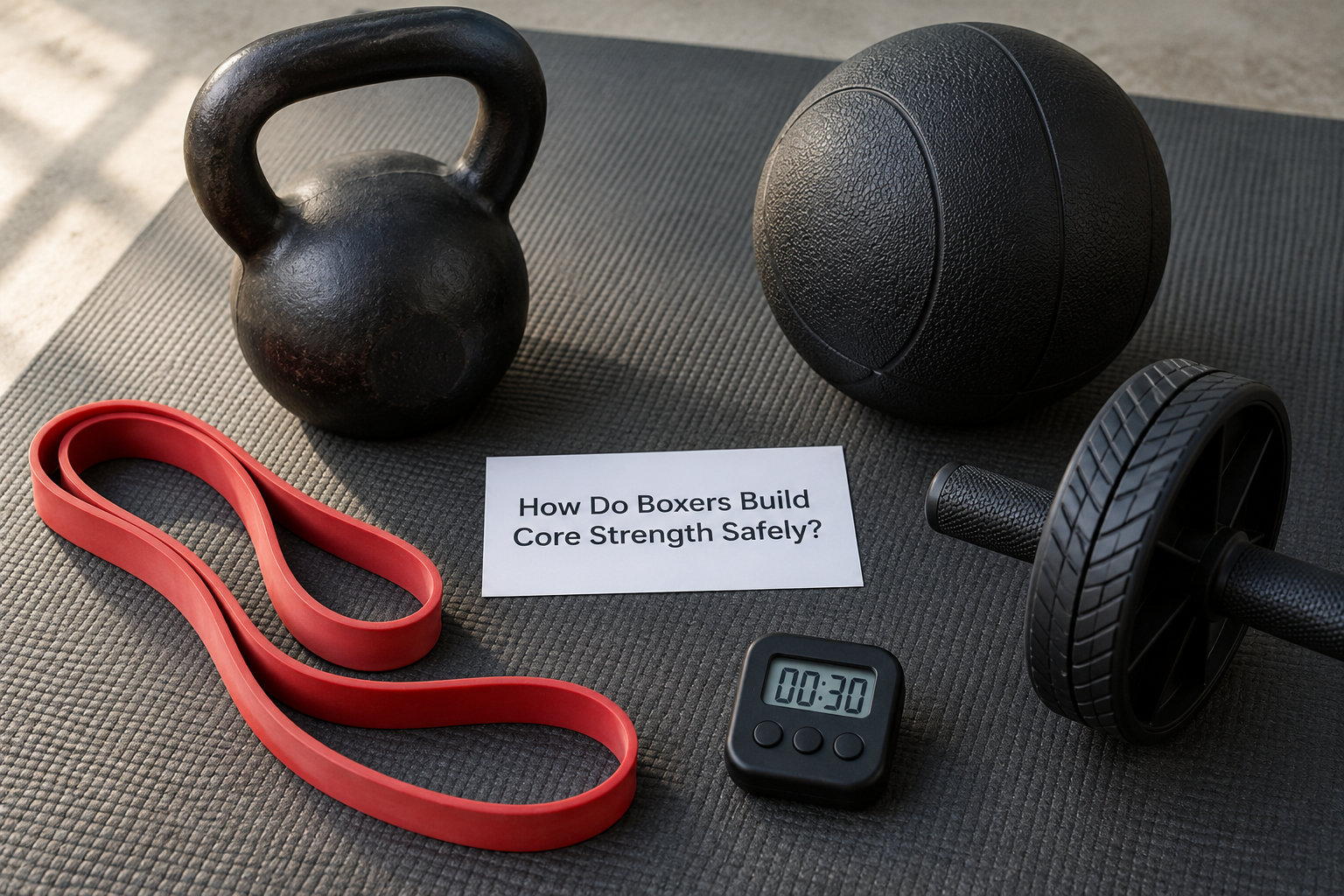
Six principles cover almost everything a safe boxer needs. They apply whether you train three days a week or six.
How boxers build core strength in six principles
Brace before you move. Take a breath into the belly, tighten as if preparing for a body shot, then move. If you can hold a conversation mid-set, the brace is not there.
Move through ranges you control. The rep stops when the trunk loses position, not when a number says so. Quality reps at low volume build the pattern; sloppy reps teach the opposite.
Progress before you add volume. When a drill gets easy, make it harder, not longer. A harder Pallof press with a longer stance beats two extra minutes of the same hold.
Load in multiple directions. Push, pull, rotate, carry and squat. Boxing arrives from every angle, and a core trained only in one plane gets exposed the first time you slip a hook.
Keep the spine neutral. Rounding under load is how amateurs end up with sore backs instead of strong middles. If your lower back is taking over, the load or the position is wrong.
Leave rest in the programme. The trunk recovers with the rest of you. Two hard core sessions a week with full rest between beats five mediocre ones followed by a sparring session that feels broken.
On the neck and disc question that comes up constantly: the head should stay in line with the spine, chin slightly tucked, during crunches, sit-ups and any hanging work. No exercise needs a head thrown back or a neck loaded to build a stronger middle. Stop anything that gives you tingling, numbness or shooting pain, and see a physio.
Best Core Exercises for Boxers
These are the drills I would put in a fighter’s week. Each one trains a different pillar, so the list works best when you rotate across the row rather than doing the whole table in one session.
| Drill | Pillar | Sets x reps | Rest | Equipment |
|---|---|---|---|---|
| Medicine ball rotational throw | Power | 4 x 4 | 2-3 min | Medicine ball and wall |
| Landmine 180 rotation | Power | 3 x 6 each side | 90 sec | Landmine or long bar |
| Pallof press | Anti-rotation | 3 x 10 each side | 60 sec | Band |
| Plank with shoulder tap | Anti-rotation | 3 x 12 taps | 60 sec | None |
| Hanging leg raise | Hip flexor endurance | 3 x 8 | 60 sec | Pull-up bar |
| Turkish get-up | Impact resilience | 3 x 3 each side | 2 min | Kettlebell |
| Farmer carry | Impact resilience | 4 x 40 m | 90 sec | Two dumbbells or a sandbag |
| Sled push | Power | 4 x 20 m | 90 sec | Sled and plates |
| Bear crawl hold | Anti-extension | 3 x 30 sec | 60 sec | None |
| Wall ball slam | Power | 4 x 6 | 60 sec | Wall and medicine ball |
| Side plank with reach | Anti-lateral flexion | 3 x 8 each side | 45 sec | None |
| Body-shot bag round | Impact resilience | 2 x 3 min | 60 sec | Heavy bag |
Medicine ball rotational throw. Stand side-on to a wall, load the hips back, then throw through the floor and across the body so the ball lands behind your back foot. Four reps per side is plenty. The prescription coaches keep repeating is 3-5 reps with 2-3 minutes of rest, because the point is peak power, not a conditioning set.
Landmine 180. The bar starts at your hip and travels as you rotate and rise through it. It teaches the same path a hook takes, with enough load to make you care about position.
Pallof press. Stand in a band anchored at chest height and press straight out, then resist the band trying to twist you back. This is the single best anti-rotation drill for a boxer, because a punch arriving off-centre is exactly the problem it solves.
Hanging leg raise. Controlled, no swinging, chin tucked. The target is the hip flexors, which are what actually lift you out of a defensive slide when your legs are heavy.
Turkish get-up. Slow, unglamorous, and the best body-shot drill I know of for what it trains. An awkward load held overhead and in a lunge teaches the trunk to stay organised when the shape is compromised.
Body-shot bag round. Two or three minutes of nothing but high elbows, tight ribs and controlled exhale on every impact. This is the drill that connects the other eleven to the thing fighters actually fear.
How Should a Boxer Structure Core Training?
Placement matters more than exercise choice. Core work belongs before pad rounds, when you are fresh, or at the end of a session that did not already wreck you. Never before sparring, and never the night before.
| Level | Sessions per week | Work per session | Notes |
|---|---|---|---|
| First months in the gym | 2 | 2 sets of 6-8 drills, 10-12 reps or 20-30 sec holds | Technique over load, bodyweight is fine |
| Amateur competitor | 3 | 2-3 sets of 4-6 drills, prescribed reps | Add medicine ball twice a week |
| Pro or fight camp | 4 | 3-5 sets, heavier medicine ball, longer carries | Match volume to sparring load |
A typical amateur week looks like this: rotational power and one anti-rotation drill after two hard bag rounds on Monday, carries and hip flexor endurance on Wednesday after roadwork, and a mixed power session on Friday before light technical work. Keep at least one full day with no loaded core work.
Fight camp changes the shape. In the off-season you build the base with volume and bodyweight. Across the eight to ten week build you shift to heavier medicine balls and fewer, faster reps. In fight week you keep the load light and drop anything that leaves you sore, which means the get-ups and carries usually go first and the technical rotation drills stay.
If you also lift weights, the community advice is well worth hearing twice: slow, grinding, high-rep lifting adds dead weight, tightens the shoulders and leaves you flat for sparring. Keep your lifting explosive, skip heavy shoulder-dominant pressing, and do not chase ab isolation work in the gym on top of your boxing programme.
Common Core Training Mistakes Boxers Should Avoid
Relying only on crunches. Crunches train spinal flexion, not the bracing that resists a punch. Keep some, drop the volume.
Holding your breath. A held breath locks the brace but spikes pressure and drops your output within a round. Exhale through pursed lips on every effort.
Training the abs to look lean. Visible abs are a side effect of leanness, not a training target. Fighters chasing that look usually end up underfed and slow.
Chasing high rep counts. Sixty reps of a move you cannot brace through teaches nothing but endurance in a shape you cannot use.
Skipping the back and hips. A strong front with a weak back is a sore-back program waiting to happen.
Training core before footwork or sparring. You will punch worse, not better, and you will learn to guard against fatigue rather than build capacity.
Progressing too fast. Adding weight or duration every week without a deload is the fastest route to a grunt instead of a result. If technique degrades, back up a step.
How Can Boxers Measure Core Progress?
Forget the mirror. Four tests tell you far more, and each takes two minutes.
Medicine ball throw distance. Same ball, same wall, same distance from the mark, measured twice a month. This is the closest thing to a stopwatch you get for rotational power, and improvement shows up even when everything else looks the same.
Pallof press hold. Time a clean 10-second hold each side. Aim for a quiet body with no hip rotation at all.
Posture check under fatigue. After two hard rounds on the bag, film yourself for ten seconds. Shoulders down, ribs tucked, chin level. If the head drifts forward, your endurance is the limit, not your strength.
Pad work rotational speed. Have a coach time how quickly you can change the head position when the pad moves. This is the transfer test, and it matters more than any gym number.
The honest measure, though, is sparring. Fighters who build the trunk properly tend to keep their frame, keep their feet under them and get up more easily after a body shot. Track that over a camp and the rest of the numbers follow.
Frequently Asked Questions
Should boxers do abs every day?
No. Daily ab work tends to add soreness without adding much strength, and tired boxers punch worse and defend badly. Two to four sessions a week, with a full rest day between heavy core sessions, fits most amateur and professional schedules. If you want daily movement, keep one day light with mobility or walking instead of loaded trunk work.
How many core workouts should a boxer do each week?
Beginners usually do well with two sessions, amateur competitors with three, and professionals in camp with four. The deciding factor is your sparring load: the more rounds and contact you take, the more rest your trunk needs. Each session should be short and specific, not an exhausting circuit that spoils the rest of the week.
Is it better for boxers to do crunches or planks?
Planks and their variations, such as shoulder taps and Pallof presses, are more useful because they train the brace that resists a punch. Crunches still have a place for general conditioning and spinal control, but they should not be your only core work. Pair one anti-extension or anti-rotation drill with one rotational power drill and the balance is far better.
How long should a boxing core workout last?
Twelve to twenty minutes is plenty, and twenty-five at the outside. The trunk trains well with low volume and full rest, which is the opposite of most generic circuits. If your core session is dragging past half an hour, you are almost certainly working too close to failure. Cut the sets and add a day of rest between sessions.
Can core training replace boxing footwork or strength training?
No. Core strength is one quality among several, and it works best alongside footwork, bag and pad rounds and a properly dosed strength programme. Skipping footwork to add core sessions will cost you defence and ring position. Skipping the bag will cost you the coordination that makes trunk strength usable at all.
What should a boxer do if core exercises cause pain?
Stop the exercise and distinguish soreness from pain. General fatigue in the abdominals is normal; sharp pain, tingling, numbness or anything that travels down a leg is not. Do not train through it. See a doctor or physiotherapist, particularly if you are returning after a rib, back or neck injury, and get clearance before you resume loaded core work.
Conclusion
Start with three medicine ball rotational throws a side and a Pallof press after your next bag session. Ten minutes, twice a week, with a full rest day between, will teach you more about your own core than any circuit of crunches.
That is the short version of how boxers build core strength: rotation for power, bracing for stability, hip work for endurance and loaded drills for impact tolerance. Give it a month, re-test your medicine ball distance, and let the numbers tell you whether it is working.