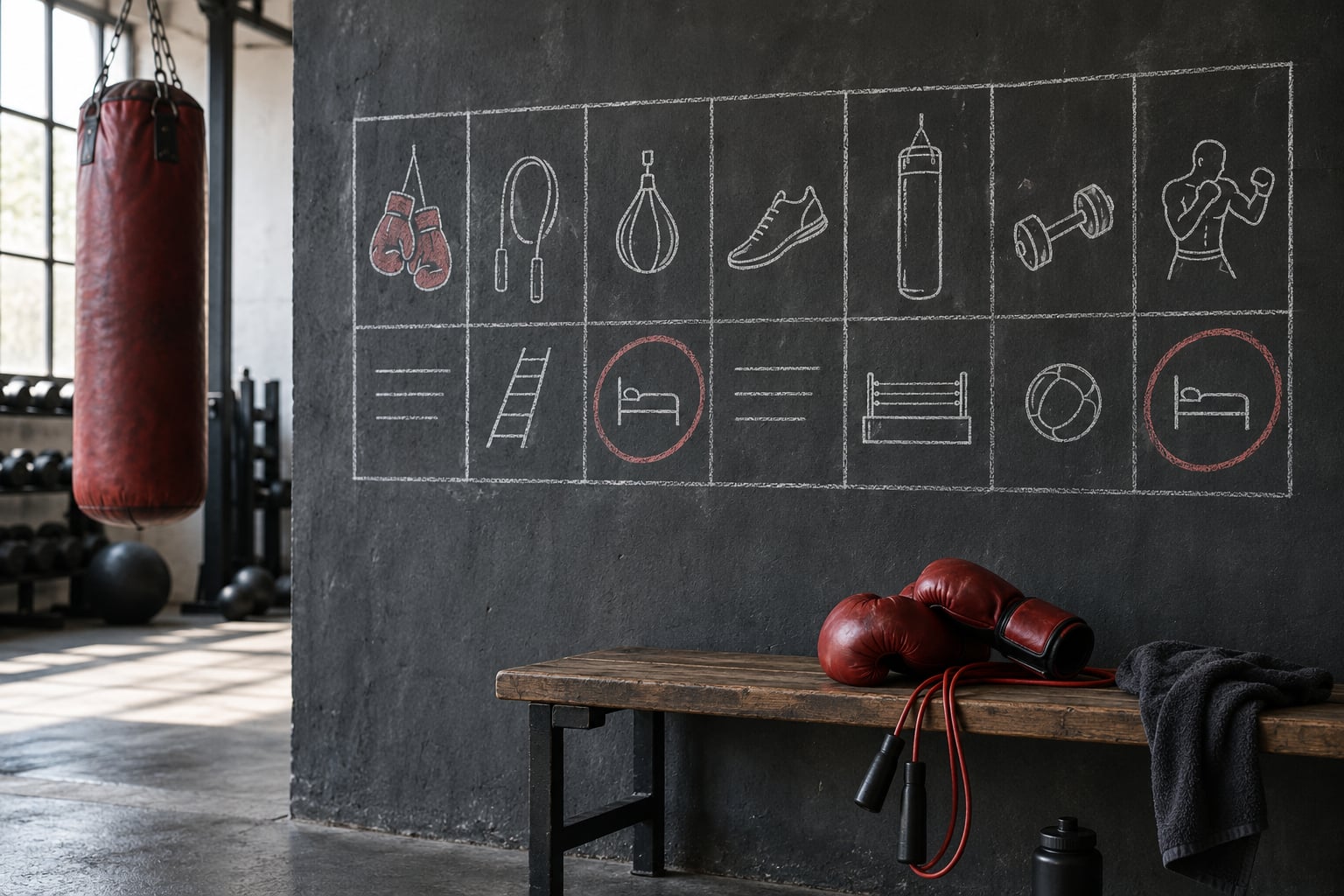
Most recreational boxers do best with two to four training days a week. Beginners usually start at two or three, and experienced fighters move to four or more once their recovery is proven. So the short answer to how many days a week to box is simple: start at the lowest number you can recover from comfortably, hold it for a few months, then add one session at a time.
More is not automatically better. Boxing is a coordination sport before it is a conditioning sport, and coordination improves when a skill is repeated with rest in between rather than hammered in one long session. What follows is a practical framework you can apply in 2026, whatever your current level or weekly time budget.
Table of Contents
- How Many Days a Week Should You Box?
- What Is the Best Training Frequency for Your Goals?
- What Should One Boxing Session Include?
- How Do Exercise, Strength Training and Recovery Fit Around Boxing?
- How Can You Tell Whether You Are Recovering Enough?
- How Should You Increase Your Boxing Frequency Safely?
- Frequently Asked Questions
- Conclusion: Start With a Schedule You Can Recover From
How Many Days a Week Should You Box?
Two to four days suits most people who train for fitness and skill, and the range by goal is narrow and well established. Complete beginners do best on two or three sessions, general fitness and fat loss work sits at three or four, serious skill development needs four or five, and competitive fighters in camp run five to six or more.
| Tier | Days per week | Hours per week | Session mix | Best for |
|---|---|---|---|---|
| Starter | 2 | 1.5 to 2.5 | Two technique classes, light conditioning | Complete beginners testing whether they enjoy the sport |
| Beginner | 3 | 2.5 to 3.5 | Two classes plus one bag or pad session | Learning stance, guard and the first combinations |
| Developing | 4 | 3.5 to 5 | Two classes, one pad session, one solo bag or conditioning session | Fitness and fat loss with visible technical progress |
| Skilled | 5 | 5 to 7 | Technique, pads, regular sparring, separate strength work | Serious skill development toward competition |
| Competitive | 6 or more | 8 to 12 in camp | Two sessions a day at times, sparring and strength blocks | Amateur and professional competition |
That last row is a ceiling, not a target. Professionals train around a full-time job, a nutritionist and a physio, and many of them still cut volume out of camp weeks. Copying a professional week as a beginner is the fastest way to feel burned out in about a month.
How many days a week to box by experience level?
Experience changes the shape of the week more than the number of days. A beginner needs one clear, technically focused session. A competitive fighter needs hard days separated by recovery days.
| Level | Suggested sessions | Typical session length | Intensity | Important caveat |
|---|---|---|---|---|
| Complete beginner | 2 | 45 to 60 minutes | Light to moderate | Focus on stance and footwork, not conditioning |
| Intermediate | 3 to 4 | 60 to 75 minutes | Moderate, one harder day | Pad work starts replacing bag-only sessions |
| Competitive amateur | 4 to 6 | 75 to 90 minutes | Mixed, sparring once or twice | Sparring needs a recovery day on either side |
| Professional | 6 or more | 90 to 120 minutes | High, periodised across camp | Needs strength work, nutrition and medical support |
| Masters competitor | 3 to 4 | 60 to 75 minutes | Moderate | Recovery takes longer than it did at 25 |
Leave at least one full day between demanding sessions, and never stack two hard sparring sessions back to back. Most coaches will tell you the same thing: the training you recover from is the training that counts.
What Is the Best Training Frequency for Your Goals?
Your goal decides the week. Someone training for a first fun run and someone building toward a bout can train the same three days and get very different results.
| Goal | Best frequency | What each session looks like | Why |
|---|---|---|---|
| General fitness | 3 days | Class, bag work, short conditioning block | Enough volume to build work capacity without wrecking recovery |
| Fat loss | 3 to 4 days | Two boxing sessions plus conditioning or roadwork | Boxing supplies the intensity, extra cardio supplies the volume |
| Technique and skill | 4 to 5 days | Short technical sessions, pads, bag rounds | Skill work needs spacing to consolidate between sessions |
| Amateur competition | 5 to 6 days | Sparring, fight-specific pads, strength work | Racing distance, tolerance and power under pressure all need rehearsal |
| Professional preparation | 6 days or more in camp | AM and PM sessions, sparring, recovery protocols | Volume is built around a supported lifestyle |
Technical quality and conditioning pull in opposite directions. A session packed with exhausting rounds teaches you to move badly when tired, which is exactly what you do not want in a ring. Keep most sessions technically clean and put your conditioning in one deliberate block, usually at the end.
Sparring changes the arithmetic entirely. Two or three hard sparring rounds cost far more than the same time on pads or the bag, so fighters who add sparring usually cut something else. A common amateur pattern is two gym classes a week plus your own roadwork on the other days.
What Should One Boxing Session Include?
A standard session runs 45 to 90 minutes and follows the same order every time, which is what makes progress measurable.
Start with 10 minutes of warm-up work: skipping rope, shadow boxing, movement through the hips and shoulders. Then spend 15 to 25 minutes on technique, because this is the part that actually changes how you fight. Bag or pad work usually follows for 20 to 30 minutes. Add a conditioning block of 15 to 20 minutes if that is your focus for the day. Finish with 5 minutes of stretching and breathing to come down properly.
Sparring slots in as an optional 3 to 5 rounds for fighters whose coach has cleared them for it. Hard sparring earns its own recovery day on either side of it, which is one of the clearest reasons to keep it off a busy week.
If your week is tight, a 30-minute session still beats nothing. Ten minutes of rope and shadow boxing, fifteen minutes of jab-cross and footwork drill, five minutes of conditioning. Do it three times and you will progress faster than someone training once for two hours and skipping a week.
How Do Exercise, Strength Training and Recovery Fit Around Boxing?
Boxing does not need to be your only exercise, but it does need to be the anchor. Fix your boxing days first, then fit everything else around them.
Two or three strength sessions a week work well, kept to the main lifting patterns and separated from boxing by at least six to eight hours where you can manage it. A rough example for a four-day boxer: Monday boxing, Tuesday strength, Wednesday boxing, Thursday rest or mobility, Friday boxing, Saturday strength, Sunday boxing and roadwork. Someone boxing three days could put strength on two of the remaining days and leave the rest for walking, mobility or nothing at all.
Aerobic work comes easily with boxing itself, so extra running is optional rather than required. It does become useful if your goal is fat loss, where the extra volume handles calories that three boxing sessions will not.
Be careful stacking conditioning before sparring or heavy leg work before a hard bag session. Fatigue changes your movement, and boxing punishes sloppy movement more than almost any other sport. If a session is meant to be technical, keep the hard effort out of it.
How Can You Tell Whether You Are Recovering Enough?
Good recovery looks boring: your technique holds up at the end of a session, ordinary soreness settles within a day or two, your speed on the pads is steady week to week, and you still want to go when the day arrives. If all four hold, your frequency is probably right.
The warning signs are harder to ignore. Persistent fatigue that sleep does not fix, a drop in speed or power that stays for two or three weeks, getting sick more often, joint pain that lingers between sessions, motivation that disappears entirely, or technique that looks rusty at the start of every class. Two or more of those at once means cut a session for a week before you cut everything.
The other failure runs the opposite way, and nobody talks about it. One or two days a week with the same class and the same drills will get you fit, but skill progress stalls. Watch for a class you have attended so often that nothing new is being taught, no measurable improvement after about twelve weeks, and an inability to throw a combination without thinking about it.
Speak to a doctor or physiotherapist about joint pain, repeated injuries, chest pain, dizziness or fatigue that will not shift. Get cleared before returning if you have had an injury, and do not train through pain that changes how you move.
How Should You Increase Your Boxing Frequency Safely?
Add one session at a time, and add a short one. Going from two days to three days is a manageable step. Going from two days to five in the same month is not, whatever your fitness level says.
Keep most of your sessions technically moderate when you add volume. The new day should be easy bag work, pad drills or shadow boxing, not the hardest sparring of your week. Then hold the new arrangement for eight to twelve weeks before adding another.
A typical progression looks like this: two technique sessions a week for three months, then a third bag or pad session on the middle of the week. Another three months of that, then a fourth day and, if you compete, a first session of sparring with a coach watching. Every second or third week can go lighter, which keeps a bad week from turning into a bad month.
Coming back after a break is different from progressing. Rebuild the habit first at a frequency lower than where you left off, hold it for a month, and treat the old familiar sessions as harder work than they used to be. Muscle memory will still be there, but your conditioning and your joints are not where you left them.
Frequently Asked Questions
Is boxing twice a week enough?
Two days a week is a solid starting point, and it is enough to build fitness, learn the stance and see real progress in combinations within a few months. It is not enough for competition. Most people who want better technique add a third short session once two weeks of training have gone well. Judge your frequency by technique improving and by wanting to go, not by the calendar alone.
Can cardio workouts replace extra boxing sessions?
Partly. Cardio builds an engine and burns energy, but it does not teach you to move like a boxer or to read a punch. Most people who train boxing three days and run two get fitter than people who train boxing once, and fitter is not the same as better. If you only have room for two boxing sessions, keep both and add one easy technical day rather than replacing them with cardio.
How can I box three times a week around a busy schedule?
Book all three sessions at once, spaced across the week, and treat them like any other appointment that cannot move. Two evenings plus one weekend morning covers most people. Shorter sessions help more than perfect ones: 30 to 45 focused minutes three times a week beats an hour once plus two missed weeks. Ask your gym which class times repeat weekly and pick the two or three you can attend without negotiation.
Should beginners do strength training on boxing rest days?
Yes, and it fits neatly. Two or three light-to-moderate strength sessions on non-boxing days build the force behind your punches without interfering with pad work. Keep them away from the hardest boxing days by six to eight hours if you can. Skip the gym entirely if it is going to eat your sleep, because sleep is doing more for your progress than any second training session.
When should I reduce my boxing frequency or see a doctor?
Drop a session or two if fatigue lingers for more than a week, your speed is falling across several sessions, you keep getting ill, or you feel unmotivated to train at all. Take joint pain that stays between sessions, swelling, repeated injuries, chest pain or dizziness seriously and see a doctor before you train again. Reducing frequency for a couple of weeks costs you almost nothing and resuming too early has cost fighters months.
Conclusion: Start With a Schedule You Can Recover From
Beginners should usually begin with two or three sessions a week and hold them. Anyone training for competition works from the higher tiers, but reaches them by adding one short session every few months rather than jumping straight to a professional week.
Book one easy technical session this week, write down how you felt during it and the morning after, and let that decide when the next one goes in. Knowing how many days a week to box matters less than whether you recover from the days you pick. Two to four a week is where most people get the best return from boxing, and the boxer who recovers well beats the one who simply trains more.