If you want one number to start from, divide your body weight by two. That is how much a heavy bag should weigh for most adults, which usually lands somewhere between a 70 lb and a 100 lb bag. Beginners tend to start lighter, and experienced fighters and power-focused trainees go heavier. We reviewed this guide for 2026, and the short version is that your body weight sets the range, then your training style, experience and available room decide where inside that range you sit.
Table of Contents
- How Much Should a Heavy Bag Weigh? Quick Guide
- What Is the Right Heavy-Bag Weight for Boxing?
- How Heavy Should a Heavy Bag Be for Beginners?
- How Much Does a Heavy Bag Weigh for Different Training Styles?
- Heavy Bag Weight by Bag Type
- How Do You Choose the Right Heavy-Bag Weight?
- How Heavy Should a Heavy Bag Be for Home Use?
- What Size Heavy Bag Should You Buy?
- How to Choose a Heavy Bag for Technique, Power or Conditioning
- How to Set Up and Use a Heavy Bag Safely
- Frequently Asked Questions
- Conclusion
How Much Should a Heavy Bag Weigh? Quick Guide
The honest answer has two halves: a number and a range. Half your body weight is the number most coaches and manufacturers land on, and the table below breaks that into bands you can pick from.
| Bag weight | Who it suits | How it feels | Main limitation |
|---|---|---|---|
| 40 to 50 lb | Children, small teenagers, adults drilling hand speed | Moves on every punch, easy to keep in rhythm with | Very little resistance; hard punches skim off the surface |
| 50 to 70 lb | First-year adults, technique and fitness work | Rebounds nicely and returns to centre quickly | Limited feedback on power, so it flatters bad technique |
| 70 to 100 lb | Most adults, general boxing and kickboxing training | Stays put under a jab and absorbs hooks and uppercuts | Not enough to build real punching power |
| 100 to 130 lb | Experienced boxers, MMA strikers, heavier athletes | Barely swings, so every punch meets genuine load | Demands wrist and shoulder strength you may not have yet |
| 130 to 150 lb and up | Advanced power work, Muay Thai, commercial gyms | Almost stationary unless you really load it up | Too heavy and too demanding for most home setups |
Notice what changes as the number climbs. A light bag gives you timing, rhythm and cardio because it keeps moving. A heavy bag gives you resistance and force production because it refuses to move. Neither is better; they train different things, and that is why picking a bag outside your range usually wastes your effort.
What Is the Right Heavy-Bag Weight for Boxing?
The half-body-weight rule works because it roughly matches the mass you have to shift through your hips and core when you punch. Take your body weight, halve it, and you have a sensible starting point: a 140 lb person starts near a 70 lb bag, a 180 lb person near 90 lb, a 220 lb person near 110 lb.
You will also see a percentage version of the same idea, usually 40 to 50 percent of body weight. It lands in almost the same place, with a slightly wider cushion at both ends. Some guides quote fixed numbers instead, telling every adult to buy a 70 lb or an 80 lb bag regardless of size, which is where the confusion starts.
Here is the same rule written out as a lookup table, so you can skip the maths. The middle column is half your body weight. The last column is where I would actually start, given that most people are still cleaning up their technique.
| Your body weight | Half your body weight | Realistic starting bag |
|---|---|---|
| 110 lb | 55 lb | 50 lb |
| 120 lb | 60 lb | 50 to 60 lb |
| 130 lb | 65 lb | 60 lb |
| 140 lb | 70 lb | 60 to 70 lb |
| 150 lb | 75 lb | 70 lb |
| 160 lb | 80 lb | 70 to 80 lb |
| 170 lb | 85 lb | 80 lb |
| 180 lb | 90 lb | 80 to 90 lb |
| 190 lb | 95 lb | 90 lb |
| 200 lb | 100 lb | 90 to 100 lb |
| 210 lb | 105 lb | 100 lb |
| 220 lb | 110 lb | 100 to 110 lb |
| 230 lb | 115 lb | 100 to 120 lb |
| 240 lb | 120 lb | 110 to 130 lb |
| 250 lb | 125 lb | 120 to 140 lb |
If you fall between two rows, take the lower one. Plenty of commercially filled bags skip the lighter sizes entirely, so a 125 lb person often ends up looking at an empty shell or a water-filled bag instead.
Here is why the sources disagree. A manufacturer selling bags has no incentive to tell a 130 lb beginner to buy a 100 lb bag, because it will come back as a safety complaint. A coach wants you training power, so they start heavier than you need and let technique catch up. Both are reasonable positions, and the reconciliation is simple: treat half your body weight as the middle of the band, then move inside the band based on experience and goals.
One more adjustment matters more than any other. Add roughly 10 lb if you already box regularly, throw clean hard punches and want to develop power. Subtract roughly 10 lb if you are new, returning from injury, or training technique and cardio rather than force.
How Heavy Should a Heavy Bag Be for Beginners?
Most beginners should start in the 50 to 70 lb range, even if half their body weight is higher. The first months on a bag are about stance, guard, footwork and not telegraphing your punches, and a slightly lighter bag lets you work at full speed while still giving your hands something to push against.
Start lighter for two practical reasons. A light bag is easier to correct, because it comes back at you fast enough that you can see the mistake repeated instead of buried in the bag’s movement. And it is far kinder to a wrist that is still learning to stay aligned under load. Wrists are the first thing to give out, and one sore week is usually enough to kill a new habit.
There is a distinction worth naming here, because people mix it up. A bag that absorbs your punches is a training bag for technique, speed and conditioning. A bag that resists your punches and barely moves is a power bag. Progressing from the first to the second is the natural order, and plenty of experienced boxers still prefer a mid-weight bag for everyday sessions and switch to something heavier only for dedicated power rounds.
As a rule, move up 20 to 30 lb when your jab and cross land cleanly without leaning, your feet stay under you through long combinations, and you can finish a hard session without your hands feeling cooked.
How Much Does a Heavy Bag Weigh for Different Training Styles?
Weight follows the work you want to do. Different styles need different resistance, and a bag tuned for one is usually wrong for another.
- Technique and defence drills: 50 to 70 lb. You want speed and repetition, and a bag that drifts lets you practise angles, slips and counters in a realistic rhythm.
- Cardio and conditioning: 50 to 80 lb. Medium weight keeps intervals honest without wrecking your hands, and interval training on the bag burns through an ordinary 20 minute session.
- Power development: 100 to 150 lb. You need a bag that stays put, because power is only measurable against something that refuses to move. Most beginners should not buy into this band yet.
- Combinations and rhythm work: 70 to 100 lb. Bags in this band return to a consistent position after each combination, which is exactly what you need to build timing.
- Kicks, knees and elbows: 100 to 130 lb, on a bag long enough to strike low. Kickers and clinch fighters load their bags harder than fighters who only punch, so they generally need more mass.
- MMA and hybrid striking: 70 to 100 lb. Most MMA work blends boxing volume with kicking, so a mid-weight bag with enough length for low kicks covers it.
- Home gym or apartment: 70 to 100 lb maximum. Heavier bags swing harder, transfer more force into the structure above them and are far louder.
Heavy Bag Weight by Bag Type
Bag style changes what the listed weight means. A teardrop bag of the same number as a straight cylinder feels noticeably heavier because of where its mass sits, and a freestanding bag is mostly base. Check dimensions as well as weight before you commit.
| Bag type | Typical size | Typical filled weight | Note |
|---|---|---|---|
| Standard hanging heavy bag | 3 to 4 ft long, 14 in diameter | 40 to 100 lb | Classic boxing shape, best for hands, hooks and uppercuts |
| Muay Thai or full-length bag | 5 to 6 ft long, 14 to 16 in diameter | 100 to 150 lb | Longer, so you can throw knees, teeps and low kicks |
| Uppercut or angle bag | About 3.5 ft, angled | 70 to 100 lb | Angled end gives a realistic upward target |
| Teardrop, banana or wrecking ball | 2.5 to 3 ft, tapered | 70 to 100 lb | Low centre of mass makes the same weight feel heavier |
| Freestanding bag | Bag 2.5 to 3.5 ft on a weighted base | Working bag 20 to 40 lb, base commonly 150 to 300 lb | Listings quote total weight; the striking zone is far lighter than that number suggests |
| Water or aqua bag | Varies, usually filled in place | Adjustable, often 40 to 100 lb | One bag can grow with you, but water weight shifts as it moves |
| Adjustable-fill bag bought empty | Varies | Whatever you put in it | Useful for small fighters and for re-weighting later; fill quality varies |
Two material choices change how a bag feels. Filler matters most: textile scraps give a soft, forgiving bag that absorbs shock well, sand settles over time into lumpy and uneven weight, foam is joint friendly and quiet, and water absorbs impact without rebound. Shell material matters less for training: genuine leather outlasts vinyl in most cases but breaks in over months, while synthetic leather or canvas feels fine from day one and costs less.
| Filler | How the bag behaves | Trade-off |
|---|---|---|
| Textile scraps | Soft rebound, absorbs shock well, moves with the punch | Loses shape over years and gives less true weight feedback |
| Sand | Dense and dead, very little give on impact | Settles into lumps and hard bottom-heavy patches |
| Water bladder | Absorbs impact with no rebound, quiet, spares your joints | Weight shifts as it sloshes, so the feel changes mid-round |
| Foam | Firm but joint friendly, holds shape, quiet | Bulkier for the same listed weight |
| Rubber crumb or reweighted drum weights | Very dense and stable, good for power work | Hardest on the hands and the most punishing to fill yourself |
A bag full of textile does not give the same feedback as a bag packed dense with rubber, even when both are stamped with the same weight. Dense filler resists and stays put; soft filler absorbs and moves. That difference is often what people mean when they say a bag feels heavy even though the spec sheet does not.
How Do You Choose the Right Heavy-Bag Weight?
Work through this in order and you will land on a number you can defend.
- Check your discipline. Fist-only boxing allows a lighter bag than kickboxing, Muay Thai or MMA work, where kicks, knees and elbows need a heavier target.
- Convert your body weight. Divide by two for the middle of the band. For example, 180 lb of body weight gives a 90 lb bag.
- Adjust for experience. Add about 10 lb if you have boxed for a year or more and your technique holds up under a hard shot. Subtract about 10 lb if you are a complete beginner or coming back from a wrist, elbow or shoulder injury.
- Adjust for session length. Long daily sessions, three rounds minimum, tolerate a heavier bag than short weekend work. A bag you cannot finish three rounds on is too heavy.
- Check the room before you choose. Ceiling structure, mounting hardware, chain clearance and floor protection can force a lighter bag than your training style wants. Read the section on home use below before you order.
- Trust the feel test. After a few good combinations the bag should still be roughly where you left it. If it drifts out of reach, it is too light. If you cannot move it at all, it is too heavy.
If you want one bag that grows with you, an unfilled shell or a water-filled bag is the practical option. Fill it to half your body weight now, then add filler or water as your technique improves. Fighters at the lighter end often find that the lightest commercially filled bag is already too heavy for them, which is exactly the situation an adjustable bag solves.
What happens when your bag is the wrong weight
A bag that is too light has a signature sound and a signature failure. It drifts out of reach halfway through a combination, so you start chasing it instead of punching it, and your rhythm falls apart. You can hit it as hard as you like and it never tells you anything, which is why light bags flatter bad technique and hide bad timing.
A bag that is too heavy fails the other way. It does not move, so there is no power transfer to develop, and you are just landing on a wall that absorbs nothing. The load travels back through your wrists, elbows and shoulders on every punch, and over a long session that is where the soreness comes from. New trainers feel it in the wrist first, then the shoulder, and knees take a share too if you are throwing combinations hard.
There is a quick tell for each. Throw four or five good punches and look: if the bag has slid a foot or more from where it started, it is too light. If it barely moved and you had to brace your core to shift it, it is too heavy. Landing somewhere in between, where it absorbs and returns, is the feel you are after.
Bag weight for teenagers and younger trainees
For under-16s, body weight matters more than age because a 14-year-old 130 lb boxer and a 14-year-old 90 lb boxer should not be handed the same bag. Below about 100 lb, stay in the 40 to 60 lb range and keep sessions short. Younger trainees should be choosing a bag they can move easily, because the skill being built is technique, and their joints have years of growth left to protect.
How Heavy Should a Heavy Bag Be for Home Use?
Home use adds constraints that a commercial gym never has. A 130 lb bag swinging through a living room is a different proposition from one hanging in a warehouse with a reinforced ceiling.
The most important question is what you are hanging it from. Bag weight, chain and hardware together create a dynamic load that is much larger than the static weight suggests, because every punch and every swing pushes on the mount. Check the manufacturer weight rating for your mount or stand, use the hardware they specify, and mount into structural framing such as a joist rather than into drywall or a light fixture. If you are not confident what your ceiling framing is, or you are dealing with electrical or structural changes, get a qualified contractor or handyman to look at it first rather than guessing.
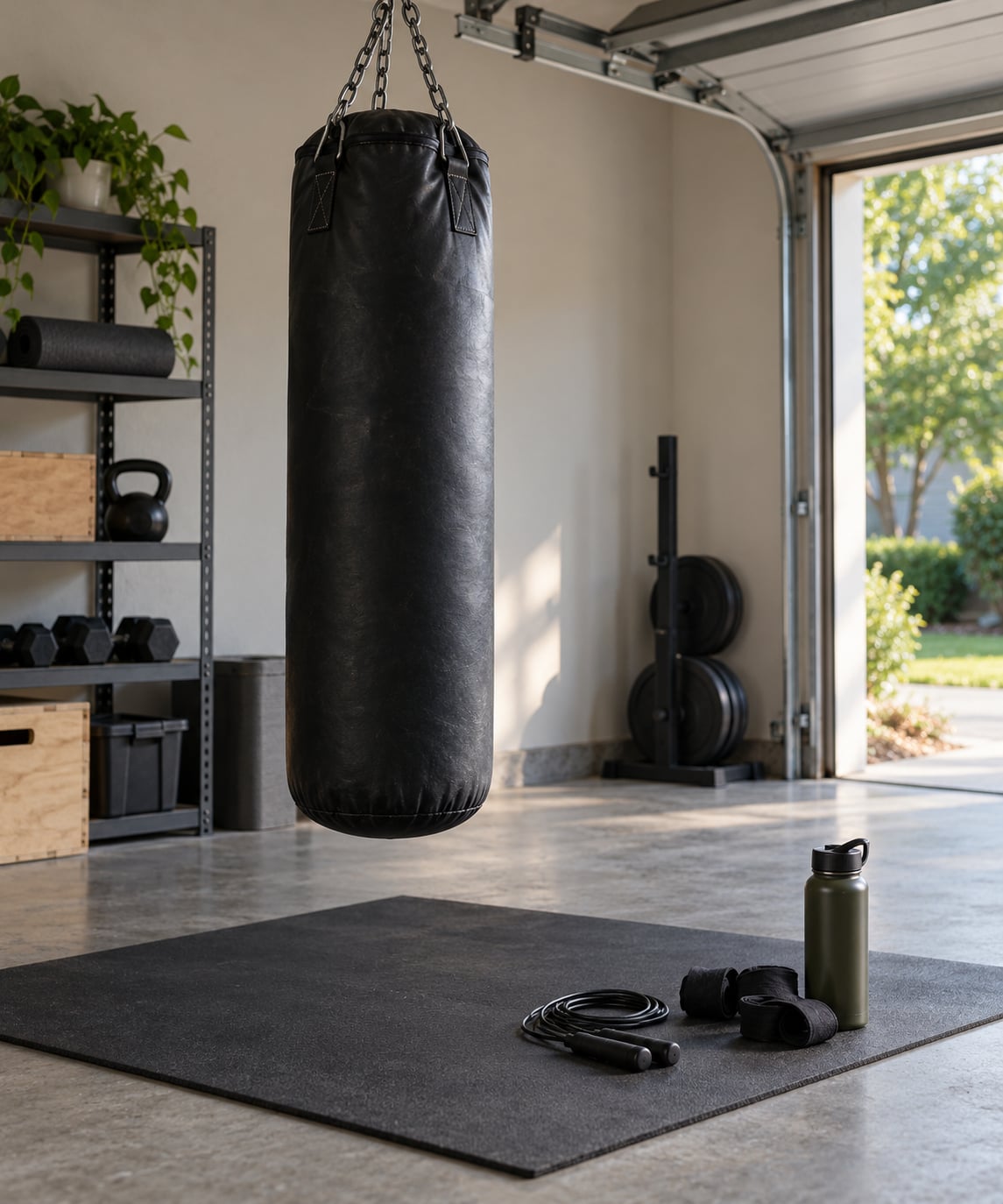
Apart from the mount, think about clearance and neighbours. A 100 lb bag can swing a foot or more past its rest position, and that motion has to happen without hitting a wall, a door, a light fixture or a television. Bags that swing unpredictably are also the loudest, since the bottom of the bag slaps the floor. Put mats or a rated bag base protector underneath, and check the noise early rather than after your neighbours have.
For most apartments and garages, 70 to 100 lb is the practical ceiling. Anything heavier needs more ceiling height, more clearance and a mount you are genuinely certain about.
What Size Heavy Bag Should You Buy?
Weight only means something once you can reach the right part of the bag. Size is what decides whether you can hit the surface you are actually training.
Length is the first thing. A 3 to 4 ft bag mounted with its bottom around shin-to-knee height suits fist work, jabs and hooks. A 5 to 6 ft bag is what kickers, knee throwers and clinch fighters need, because the extra length gives a low target for kicks and a mid-height target for knees. Shorter users often benefit from a longer bag with a proper hanging point, since a 4 ft bag hung too high becomes a wall to punch rather than a bag to work.
Diameter matters less but still counts. The common range is 14 to 16 inches, and anything in that range feels familiar to most people. Wider bags are easier to hit square and reduce the chance of knocking your hands around on a low shot.
Watch for the mismatch case: a very heavy bag that is too short to strike low. At 120 lb you will want kicking and knee targets, and a 3 ft bag that ends around hip height cannot give them to you. Buy the length your sport needs first, then pick a weight inside that bag’s sensible range.
How to Choose a Heavy Bag for Technique, Power or Conditioning
Whichever goal you pick, buy for the work you do most often. A bag you love training on will always beat a theoretically correct bag that sits in the corner.
For technique, choose a lighter bag in the 50 to 80 lb band and prioritise rebound and consistent shape. For power, choose a heavier bag in the 100 to 150 lb band and accept that early sessions will be frustrating until your technique catches up. For conditioning, weight matters far less than how the bag moves and how the surface responds, so pick something in the middle that you can hit hard for ten rounds.
Commercial gyms rarely hang one weight. A typical fight gym has a lighter bag for pad-and-bag rounds and a heavier one for power work, and nobody reaches for the heaviest bag as a default. A 100 lb bag does not make a room a professional gym, and buying one on day one mostly buys you sore wrists.
How Much Should a Heavy Bag Weigh?
If you have read nothing else: half your body weight is the target, with a band of roughly 40 to 50 percent of body weight around it. Lighter suits control, speed and technical work, while heavier suits power and advanced training. No single weight is required for everyone, and your experience level, your sport and the room you train in decide where inside the band you actually belong. If you are starting from nothing, take the lighter end of your band and move up only when your technique earns it.
How to Set Up and Use a Heavy Bag Safely
Bag work is repetitive, which is exactly why small mistakes turn into injuries over months. A few habits handle most of the risk.
- Wrap and glove up. Hand wraps support the wrist and knuckle alignment, and bag gloves are thinner than sparring gloves so you can still feel the bag. Loosening your wrist as fatigue builds is how most beginners hurt themselves.
- Clear the space and mark your distance. Make sure the bag’s full swing range is empty, then pick a consistent stance so you are not reaching forward into punches.
- Inspect the bag and hardware. Check stitching, the chain, the swivel and the mount before each session. A bag that has shifted its fill or a mount that has worked loose will not tell you before it fails.
- Warm up before you load up. Bag rounds are where tired technique turns into a pulled shoulder or a tweaked knee. Start light and build the round rather than opening with maximum output.
- Stop when form goes, not when the timer goes. Once you are leaning, dropping your guard or punching flat-footed, the extra rounds are doing nothing for you.
Bag weight adds load to your wrists, elbows, shoulders and knees, and it does so every session. If you have existing joint pain, are returning from injury, or feel sharp pain in a wrist, elbow, shoulder or knee while hitting the bag, stop training through it and speak to a doctor or a physiotherapist before you train again. Nothing here is medical advice, and a heavier bag is never worth an injury.
Frequently Asked Questions
Is a 70 lb punching bag good?
A 70 lb bag is a solid all-rounder for most adults. It suits people up to about 140 lb body weight for everyday boxing, stays roughly in place under a jab, and still rebounds enough for you to practise rhythm and footwork. If you are a beginner, or you train mostly cardio and technique, something in the 50 to 70 lb range is easier on your wrists. Leave room for the swing.
Is a 40 lb punching bag too light?
For adults doing real boxing work, yes, 40 lb is light. The bag drifts away from you after a few punches and gives almost no resistance to develop against. It works fine for children, small teenagers, and adults who want a bag purely for fast hand-eye work. The answer is not to buy something you can barely move, it is a bag around 60 to 80 lb that holds its position.
Is a 100 lb punching bag good?
A 100 lb bag is a good choice for experienced boxers and for anyone above roughly 190 lb who wants to develop power. It absorbs hard shots without drifting much. For a first heavy bag it can be more than your wrists and shoulders want on day one, because you feel every mistake. Most beginners do better starting at 60 to 80 lb and moving up later.
Should I get a 70 lb or 100 lb punching bag?
Take the 70 lb if you are new, under about 150 lb, training three or four times a week, or focused on technique, speed and conditioning. Take the 100 lb if you have boxed regularly for a while, weigh 180 lb or more, and want your punches to meet real resistance. Buying the heavier bag early rarely builds power faster, it mostly builds fatigue and sore joints.
Is an 80 lb punching bag good?
An 80 lb bag sits in the sweet spot for most adults. It holds position under straight punches, absorbs hooks and uppercuts without drifting across the room, and forgives imperfect technique. It works for boxing, kickboxing and general MMA striking at home. Move to something heavier once your jab and footwork are steady, because a bag that barely moves teaches you nothing about timing.
What percentage of body weight should a heavy bag be?
Most guidance lands between 40 and 50 percent of your body weight, which is the half-body-weight rule with a small margin built in. A 180 lb boxer ends up around 75 to 90 lb. Percentages work poorly at the very light and very heavy ends, so use your feel as the final check: after a few good combinations the bag should still be roughly where you started.
Conclusion
Start at half your body weight and stay a little under it while your technique is still forming. If you are new to bag work, buy a 60 to 80 lb bag in a length that suits your sport, mount it properly, and run three rounds rather than ten. Move up 20 to 30 lb when your feet stay under you and your punches land clean on the last combination of a session, and buy an adjustable bag if you would rather not make that decision twice.