Why body shots take fighters out comes down to four targets — the liver, the solar plexus, the spleen and the floating ribs — and an automatic nervous system response rather than a concussion. A clean shot to one of those areas can steal a fighter’s breath, drain the strength from his arms and legs, and leave him unable to continue, sometimes within seconds.
A fighter with a famously strong chin can be dropped by a punch to the ribs, while a fighter who looks slow on the feet can absorb the same punch without changing expression. The difference is targeting, timing and what the punch does to the body underneath the skin.
This is general information about how blunt impact affects the body during a fight. Anyone with real pain after being struck in the torso should get assessed by a doctor or a ringside medical team rather than trying to work through it.
Table of Contents
- What Happens When a Body Shot Lands?
- Why Do Body Shots Cause So Much Pain?
- How Does a Body Shot Disrupt a Fighter’s Breathing?
- Why Body Shots Take Fighters Out Faster Than Head Shots
- What Factors Make a Body Shot More Dangerous?
- How Fighters Can Reduce the Effects of Body Shots
- What Should Happen After a Fighter Takes a Bad Body Shot?
- Can Fighters Suffer Long-Term Damage From Repeated Body Shots?
- Frequently Asked Questions
- What body shot is most likely to knock someone out?
- Is a body shot more dangerous than a punch to the head?
- Why do some fighters absorb body shots better than others?
- Can a body shot cause internal bleeding?
- Why do body shots make fighters stop covering up?
- Should a boxer continue after taking a painful body shot?
- What to Remember About Body-Shot Knockouts
What Happens When a Body Shot Lands?
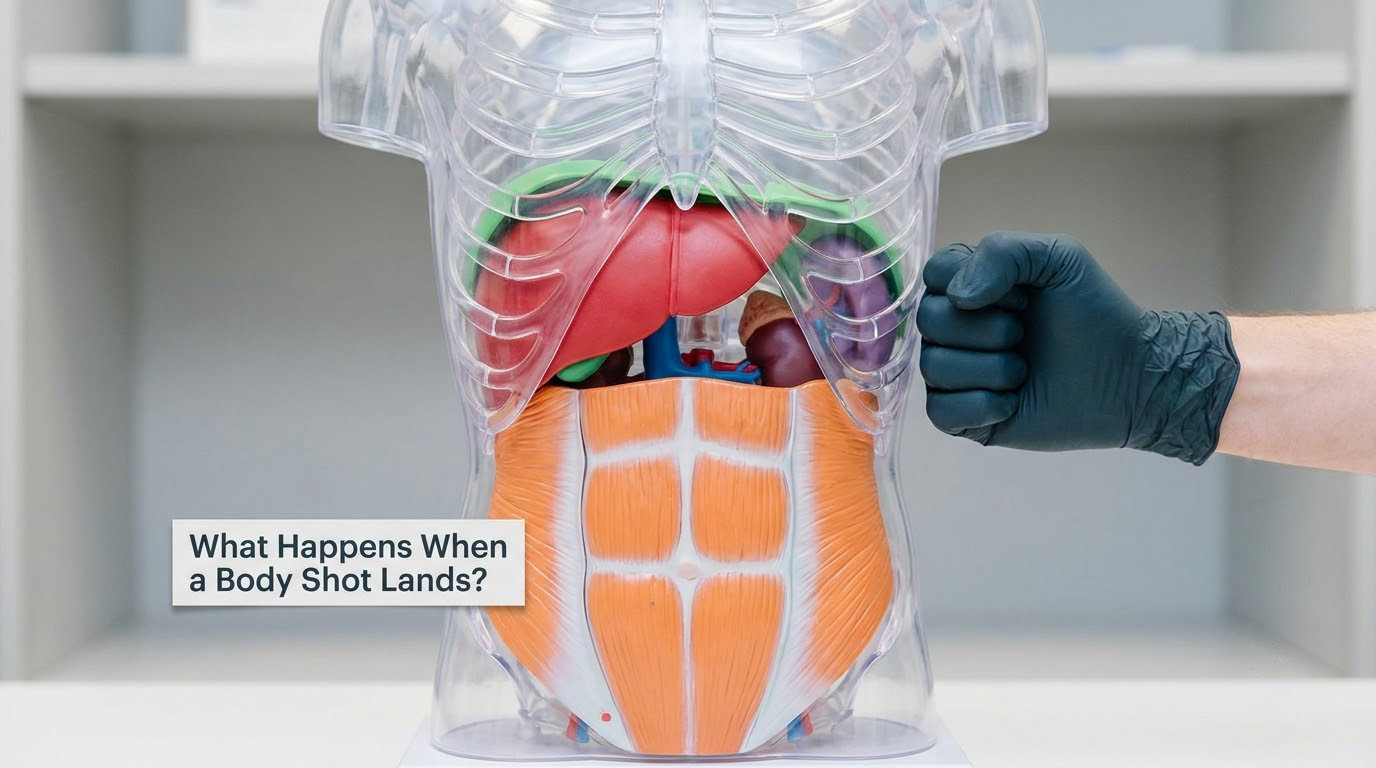
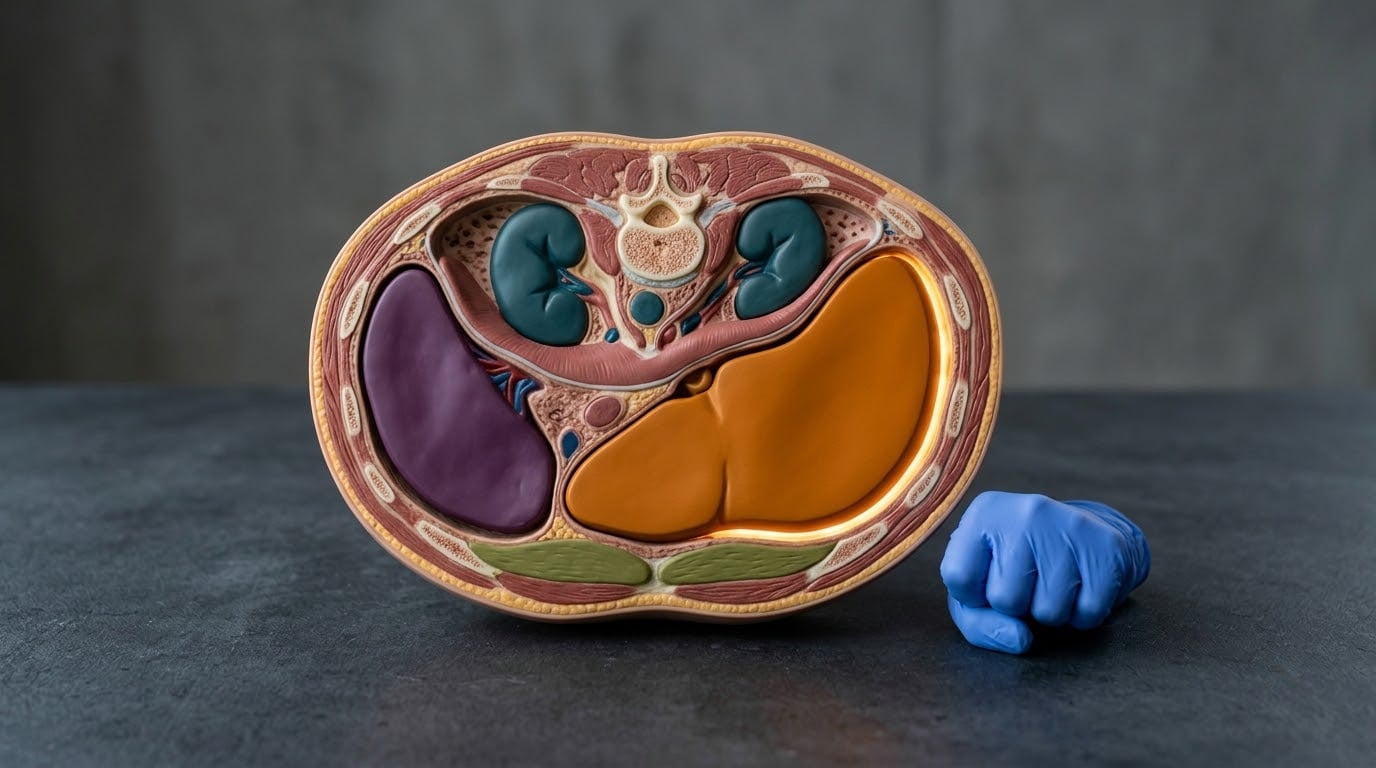
The punch lands, the abdominal wall takes the impact, and the tissue underneath moves. Muscles contract hard and reflexively, the diaphragm is jolted, and the organs in the upper abdomen are compressed against the spine and the back of the ribcage.
Two things happen at once. The first is pain, which is severe and immediate. The second is a change in how the body is running — blood pressure falls, breathing changes, and the muscles that were bracing a moment ago go loose.
A fighter hit there usually reacts in a recognisable order: the face tightens, the arms drop or spread, the feet stop moving, and the body folds forward or sideways. If the shot is clean enough and lands on a target that was already tender, the fighter may go down without ever losing consciousness.
That distinction matters, because commentators and viewers use “knockout” for both a fighter who is unconscious and a fighter who is simply unable to stand. What you are watching on the canvas is more often a body that has temporarily shut down rather than a brain that has been switched off.
Why Do Body Shots Cause So Much Pain?
The head is a good shock absorber. It is round, it can move a little on the neck, and it is built to take glancing blows without serious consequence. The torso is nothing like that.
The body wall is a flat, braced panel rather than a rounded structure, and it cannot move much once the core is tight. So the force that a head would absorb and redirect, a body wall takes in full and passes straight through to the organs underneath.
Add concentrated points of pressure — a rib edge, the base of the sternum, the lower edge of the ribcage over the liver — and you get small, focused areas of high pressure instead of a broad, diffuse hit. That is why the pain feels sharp and deep rather than spread out.
The automatic response to pain like that is to tighten and withdraw. A fighter’s shoulders drop, elbows pull in, and the torso turns away, which is exactly the shape a body puncher is looking for.
Can a Body Shot Damage the Liver, Kidney, or Spleen?
Yes. Blunt force to the upper abdomen can bruise an organ, tear tissue, or cause bleeding inside the body cavity, even when the punch does not break skin or leave a visible mark on the outside.
| Organ | Where it sits | What impact can do | Warning signs to watch for |
|---|---|---|---|
| Liver | Right upper abdomen, tucked under the lower ribs | Bruising, laceration, bleeding into the abdomen | Severe right upper abdominal pain, nausea, shoulder-tip pain, faintness |
| Spleen | Left upper abdomen, under the lower ribs | Capsular tear or rupture, bleeding | Left side abdominal pain, dizziness, low blood pressure, collapse |
| Kidney | Upper back and side, behind the lower ribs | Contusion, laceration, blood in urine | Flank pain, blood in urine, ongoing pain after the fight |
| Lung | Above the diaphragm under the ribs | Rib fracture, contusion, pneumothorax | Sharp breathing pain, difficulty breathing, sudden breathlessness |
Location, punch angle and how the punch was thrown all change the result. A glove landing flat across the ribs distributes force very differently from a knuckle or fist point landing under the rib edge, and a punch delivered while the target’s elbow is dropped exposes an area that is protected a moment earlier.
A cracked rib, worsening abdominal pain, unusual shortness of breath, dizziness, vomiting or collapse after a hard body shot are all reasons to stop and get professional medical attention straight away. Nobody reading an article should try to diagnose themselves or anyone else.
How Does a Body Shot Disrupt a Fighter’s Breathing?
The diaphragm is the sheet of muscle you use every time you inhale. It sits under the lungs and above the abdominal organs, and it is attached all around the lower ribcage.
When a punch lands under the ribs, that sheet is compressed and forced upward while the abdominal muscles clamp down underneath it. Air that was about to be drawn in is pushed back out, sometimes in a short, sharp involuntary exhale that the fighter cannot control.
That leaves a fighter in an odd position: chest tight, core braced, breathing shallow. Getting comfortable air back in takes deliberate effort, and recovering from a shot can take much longer than getting over a punch to the head.
The consequence in a fight is arithmetic. If each exchange costs a fighter some capacity to breathe, then the round he looks fine in can become the round he cannot finish. Body work is often less about one shot and more about how long a fighter spends recovering from shots he never went down from.
Why Body Shots Take Fighters Out Faster Than Head Shots
A head shot works on the brain’s ability to steer the body. A body shot works on pain, breathing and blood pressure at the same time, and those three together remove far more of a fighter’s options than a punch to the head usually does.
Pain competes with focus. A fighter absorbing a head shot can often keep his hands up and his eyes on his opponent; a fighter in liver-shot pain often stops thinking about defence at all. Breathing impairment reduces the pace he can set, which changes the whole contest. A drop in blood pressure dulls reaction and makes the legs feel strange.
Repetition is the real multiplier. A single clean head shot rarely decides anything, and a single clean body shot rarely finishes anyone either. What decides fights is the accumulation — tissue swelling, breathing muscle fatigue, and a target that becomes more sensitive every time it is struck. A later-round shot to the same spot can end a fight that the same punch could not have finished in round two.
That is not a reason to think either punch is safe. Head trauma carries its own well-documented risk, and internal injury from body work is real. The point is that the two mechanisms are different, which is why a fighter can be fully conscious and yet unable to continue.
Does a Body Shot Cause a Knockout or Make a Fighter Give Up?
Three different things are described by the same phrase in commentary, and they are worth separating.
A physiological knockout from body work means the body’s own protective responses have taken over — blood pressure has dropped, breathing has been disrupted, and the fighter cannot make the legs work properly. The fighter is conscious but unable to act.
A referee stoppage from severe pain happens when a fighter cannot defend or cannot answer questions, even though nothing catastrophic has been found. The referee sends the fighter back to the corner and the corner decides the fighter is not continuing.
A voluntary withdrawal is a fighter choosing not to continue because the pain has made them afraid. Fighters who describe hard body shots often talk about this one more than the other two. The shot did not injure them badly and it did not knock them out — it simply convinced them that the next one would be worse.
What Factors Make a Body Shot More Dangerous?
The punch matters and so does the fighter, and it helps to keep those two things apart. People often ask whether a body shot is dangerous in itself; it is the combination that produces bad outcomes.
| Factor | On the punch side | On the fighter side |
|---|---|---|
| Accuracy | Landing under the lower ribs on the right side rather than on the guard | Being tall or long in the torso, which gives a bigger target |
| Angle and distance | Pointing the fist upward into the gap under the rib edge | A tall opponent dropping their elbow or turning away mid-punch |
| Timing | Landing as weight comes forward, especially late in a round | Expired legs and an open mouth from earlier work |
| Repetition | Ten, twenty, forty clean shots to one spot | Soreness already building from earlier exchanges |
| Condition | A short, stiff punch delivered with hip rotation | Weight cuts, dehydration, poor cardio, recent injuries |
| Protection | A high guard that leaves the ribs below the elbows uncovered | Instinct to cover the head and forget the body entirely |
A fighter who has just cut weight is worth a paragraph of its own. Dehydration reduces circulating volume, and a lower circulating volume makes a drop in blood pressure harder to recover from. That is one reason body work often looks more effective in the later rounds of a championship fight than it did early on.
How Fighters Can Reduce the Effects of Body Shots
Nobody makes body shots harmless, but a few habits reduce how much damage a punch does.
Elbows matter more than people expect. A high guard covers the head and temples while leaving a strip of ribcage exposed between the elbow and the hip, and that strip is exactly where a body puncher wants to land.
A braced core changes what the punch meets. Tension in the abdominal wall and a tucked elbow give the ribs something to push back against instead of letting energy travel inward to the organs. It is uncomfortable work and it costs breath, which is why it degrades over a long round.
Controlled exhaling through the nose on impact keeps the diaphragm from being jammed at the worst possible moment. Footwork keeps the ribs away from a square punch. Conditioning to the midsection builds tolerance, though it never removes the sensitivity an organ develops after being struck repeatedly.
What no technique can do is make a fighter safe from internal injury. Anyone who takes a hard shot and keeps feeling it afterwards should stop training and see a doctor.
What Should Happen After a Fighter Takes a Bad Body Shot?
Medical evaluation comes before the next round, always. A fighter who has taken a hard shot and is still in pain should be seen by the ringside physician or at a hospital, not talked through it in the corner.
The general warning signs that matter most are worsening abdominal pain, pain that spreads to the shoulder or back, unusual shortness of breath, dizziness or faintness, and any sign of shock such as paleness, confusion or a rapid weak pulse.
Splenic injuries sometimes present with dull pain that a fighter shrugs off in the moment, and internal bleeding can progress quietly over hours. This is why observation after a bout matters as much as the count in the ring.
None of this is individual medical guidance, and nobody should try to judge their own injury by reading symptoms online. A doctor makes that call, and the only safe assumption for a non-specialist is that serious internal trauma deserves prompt professional attention.
Can Fighters Suffer Long-Term Damage From Repeated Body Shots?
Yes, and it is one of the reasons weight-class management and medical history matter so much to promoters and doctors.
Repeated blunt impact to the same area can leave scar tissue, thickened tissue, and an organ that is less compliant than it was. A fighter who has absorbed years of heavy body work may feel the difference on the first hard night, in a way a head does not always signal so clearly.
Cumulative effects also complicate recovery. Fighters who train through soreness rather than resting it, or who compete shortly after previous damage, have less margin for another bad shot.
The honest summary is that body work leaves a record. What that record means for any individual fighter can only be assessed with imaging and by a clinician, not from the outside.
Frequently Asked Questions
What body shot is most likely to knock someone out?
The liver shot, thrown short and tight under the lower ribs on the right side, is the one most often credited with ending fights. It works through the vagus nerve and the resulting drop in blood pressure rather than through brain injury. A solid solar plexus punch to the diaphragm produces the most dramatic immediate drop, but it fades faster. Neither is guaranteed, and both are dangerous.
Is a body shot more dangerous than a punch to the head?
They are dangerous in different ways, so comparing them is misleading. A head shot risks brain injury whose effects may be delayed. A body shot risks organ damage, internal bleeding and rib fractures, and its disabling effect usually clears within a minute. A fighter can be fully conscious and unable to continue after a body shot, which is why it ends fights more abruptly.
Why do some fighters absorb body shots better than others?
Protection, conditioning and habit all matter. A tight core, elbows covering the ribs, good footwork and a disciplined habit of bracing on impact reduce what the punch reaches. Fighters with long experience under body attack also adapt, because they have learned to exhale and stay tall through contact. Nobody becomes immune, and the sensitivity of a repeatedly struck area still builds over a fight.
Can a body shot cause internal bleeding?
It can. Blunt force to the liver, spleen or kidney may bruise or tear tissue and cause bleeding into the abdomen, even when there is no external wound and the fighter feels able to continue. Signs that warrant urgent medical attention include worsening abdominal pain, pain spreading to the shoulder or back, dizziness, faintness, pallor and shortness of breath. Assessment belongs with a doctor, not with the person who was hit.
Why do body shots make fighters stop covering up?
Because covering up is a response to threat aimed at the head, and body work attacks a part of the body that a high guard does not cover. A fighter who keeps both gloves high leaves the ribs between elbow and hip exposed, which is where a body puncher lands. Pain then forces an involuntary reaction, and pulling the elbows down opens the head instead. Once that exchange starts, the guard rarely recovers in time.
Should a boxer continue after taking a painful body shot?
No. Pain that does not settle within a minute, or that comes with difficulty breathing, dizziness, nausea or fading vision, means the fight should stop until a doctor has assessed the fighter. Continuing while in pain also damages technique and judgement, which raises the chance of a head shot landing. Stopping is a decision for the fighter, the corner, the referee and the ringside physician together.
What to Remember About Body-Shot Knockouts
A body shot ends a fight through pain, disrupted breathing, impaired movement or actual injury, and usually without the fighter ever losing consciousness. That is why body shots take fighters out faster than head shots: they take away options instead of switching the fighter off.
If you take one thing from this, remember that the fighter who goes down from a liver shot is often fully awake and in agony, not unconscious. And if you felt a hard body shot yourself, get checked by a doctor instead of deciding it is nothing.