How long a boxing career lasts comes down to talent, weight, injury and plain opportunity. Most professionals box for 10 to 15 years and collect somewhere around 100 to 150 sanctioned bouts along the way. Plenty end far sooner. A few compete into their 40s and 50s. There is no fixed retirement age, and the spread is enormous.
That range is not an official statistic. It is the working consensus you hear repeatedly in amateur gyms, on fight-night commentary, and in the careers of fighters whose debut and final bout dates are easy to look up. Treat it as a planning tool rather than a rule.
What follows breaks the answer into parts: the typical timeline, the career-span numbers behind it, the factors that shorten or extend a run, and how weight class changes the arithmetic. If you are weighing the professional path yourself, start here, then go talk to a coach who knows your build.
Table of Contents
- How Long Does a Boxing Career Typically Last?
- Boxing Career Length by the Numbers
- What Determines How Long a Boxer Can Compete?
- What Are the Main Stages of a Professional Boxing Career?
- Why Do Some Boxers Retire Early?
- Why Do Some Boxers Compete for 20 Years or More?
- How Does Weight Class Affect Career Length?
- Can a Boxer Retire and Come Back?
- How Do Boxers Know When It Is Time to Retire?
- Frequently Asked Questions
- What is the average length of a professional boxing career?
- How long can a boxer compete at the highest level?
- Is 35 too old to start a professional boxing career?
- Do heavier boxers usually have shorter careers?
- Can a professional boxer make a comeback after retiring?
- What is the most common reason boxers retire early?
- Conclusion
How Long Does a Boxing Career Typically Last?
The short answer is roughly 10 to 15 years of professional competition for a fighter who has a real career, with the shortest documented runs lasting under two years and the longest spanning three decades.
There is no age at which a boxer is told to stop. Careers end when a specific combination of things happens: an injury that will not heal, a decline in output, a promoter who stops returning calls, a bill that cannot be paid. Some of those arrive at 19, some at 51.
How long a boxing career lasts from first amateur bout to last professional fight
Add the amateur years and the total is longer than most people expect. Ethnographic research on the path into the sport found it can take more than six years before a fighter is ready to turn professional, and most boxers spend longer than that in amateur ranks building a record and a name.
So a realistic full timeline looks something like this: 6 to 10 years of amateur boxing from the first real gym session, then 10 to 15 years as a professional, with a short amateur career of two or three years on the far end of the range. Add in the gap many fighters take for school, work or money and the total stretch from first sparring to final bout routinely runs 20 years.
Boxing Career Length by the Numbers
Real records are the best corrective to vague consensus. These are fighters with well-documented pro debuts and final professional bouts, spanning very different divisions and very different lengths of run.
| Fighter | Division | Pro debut | Final pro bout | Years as a pro | Notes |
|---|---|---|---|---|---|
| Nipper Daly | Flyweight | 1914 | 1928 | About 14 | Retired at 18 with a 99-11-8 record |
| Archie Moore | Light heavyweight / heavyweight | 1945 | 1984 | Roughly 39 | Still winning titles in his late 40s |
| Roberto Duran | Lightweight | 1968 | 2001 | About 33 | Played through three weight divisions |
| George Foreman | Heavyweight | 1967 | 2005 | 38 | Includes a 12-year layoff and comeback |
| Larry Holmes | Heavyweight | 1973 | 1985 | 12 | Walked away from the sport at his peak |
| Sugar Ray Leonard | Welterweight | 1977 | 1997 | 20 | Includes an eight-year retirement break |
| Bernard Hopkins | Middleweight / light heavyweight | 1992 | 2012 | 20 | Around 28 counting his amateur years |
| Manny Pacquiao | Multiple weight classes | 1995 | 2017, plus a 2018 return | Over 20 | One exhibition after his final sanctioned bout |
| Mike Tyson | Heavyweight | 1987 | 2004, plus later exhibitions | 17 | Sanctioned competition only |
| Floyd Mayweather Jr. | Lightweight to super middleweight | 1996 | 2017 | 21 | Finished 50-0 |
Billy Bird, an English fighter who turned pro in 1912, is often cited for a bout total above 350. At the other end of the table, Nipper Daly is the uncomfortable case: a 99-11-8 record banked by 18, after a run of concussions that made one more fight feel like a gamble. A career that ends just past a teenager’s birthday is not rare in the record books.
Note what the table does not show: the amateur years underneath each pro span. If you are comparing careers on raw professional length, you are comparing only the visible fraction of the work.
How many fights a boxer takes per year
Frequency is not constant across a career, and it changes the arithmetic more than people expect.
- Rookie years, first 2 to 3 years: commonly 3 to 4 bouts a year while a fighter builds a record, learns to manage cuts, and gets used to professional calendars.
- Establishing years: 2 to 3 fights a year is typical as opponents get tougher and fights get longer.
- Prime, title contention: 1 to 2 fights a year, occasionally less for a fighter who wants one big night rather than two.
- Late career and comebacks: 1 a year or one every 18 months to 2 years, with training built around recovery rather than volume.
Multiply a 12-year professional run by an average of two bouts a year and you land close to 30 fights. The heavy hitters on the total-bout side of the record books, people like Bird and a number of early 20th-century professionals, got there by fighting far more often than the modern schedule allows, often before unified commissions formalised the rest periods and medical suspensions that exist now.
What Determines How Long a Boxer Can Compete?
Natural ability sets the ceiling, but eight other factors decide how close you get to it. They interact, and a boxer strong in one area can be undone by another.
- Ability. The first thing. Being able to do something an opponent cannot do is what gets you booked again.
- Age at the professional debut. Turning pro at 20 gives roughly six more years of runway than turning pro at 26, and starting in your mid-30s compresses the entire arc.
- Weight class. A division sets your opponents’ hands, your cut, and how quickly your chin wears out.
- Injury history. One bad concussion can end a career in a single night. A long tail of smaller knocks adds up quietly.
- Coaching and camp quality. The best coaches protect a fighter from cuts, manage weight without depleting them, and slow the schedule when a body needs it.
- Financial support. Boxing does not pay well unless you reach the very top, so most fighters need a day job, and a job limits training hours and the number of fights they can take.
- Access to opportunities. Proximity to a promoter, a manager with relationships, and a gym that books its own fighters is worth more than most people expect.
- Motivation and support at home. Fighters who have a reason to be at the 6 a.m. session after a bad loss tend to last longer.
The financial point deserves emphasis, because it is the one that is least visible. Community consensus among working boxers is roughly eight hours of training a day, five or more days a week. Holding a job alongside that is a genuine grind, and one of the most common reasons capable fighters never get to the 10-year mark is simply that the bills arrive first.
What Are the Main Stages of a Professional Boxing Career?
A boxing career is a process, not a single timeline. These stages look the same almost everywhere, whether you are a heavyweight in a big gym or a 122-pounder working out of a room in a church hall.
Amateur development, 6 to 10 years
Most fighters spend their first stage building a record in amateur ranks, learning the fundamentals properly, and getting tested against styles they have not seen. Ethnographic work on the amateur-to-pro transition found it can take more than six years. This is the longest phase and the least visible, and it happens for fighters who never turn pro at all.
Debut and the building years
A handful of low-drawing fights against unbeaten prospects, a few setbacks, and a promoter relationship that either grows or does not. Three to four bouts a year is common here. Most careers that reach double figures are decided in this window, not later.
Title contention
Ranking fights, eliminators, and a first title shot. This is where a career is usually made and, just as often, where the damage is done. A fighter who has absorbed hundreds of hard rounds to get here is now spending those remaining rounds against the best available opposition.
Prime years
One to two fights a year, higher quality, and the stretch most fighters remember as the best of their working lives. It can last anywhere from two years to a decade.
Decline and retirement
Fewer opportunities, longer gaps, and results that no longer match the fighter’s own memory of what they can do. Some retire cleanly here. Others take one more fight to settle a score or cover a cost, and occasionally win it, which makes the retirement even harder to schedule.
Why Do Some Boxers Retire Early?
Concussions and cumulative brain trauma are the most serious reason, and the one hardest to measure from the outside. A 2019 US Government Accountability Office report on boxer health, safety and welfare noted that the length of a boxer’s career and the total number of bouts across training, sparring and competition combined have been linked to the severity of neurological injury.
That is the hard part: the exposure that matters is cumulative, and the symptoms can surface years after a fighter stopped. Several other pressures end careers sooner, and most fighters meet more than one of them.
- Repeated head trauma. Concussions, and the long tail of symptoms that sometimes follows a career of them. A fighter who cannot absorb one more shot has no negotiation left.
- Accumulating damage elsewhere. Shoulders, knees, hips and the lower back break long before the head does for some fighters, and a reconstructed knee or a compressed spine ends things quietly.
- Diminishing returns. The style that made a fighter elite depends on attributes that fade. Speed goes first, then the ability to hurt a man who does not want to be hurt, and the round-by-round output that once set them apart.
- Inconsistent form. A record of losses to opposition the fighter should have handled is the clearest signal a team has. When the pattern shows up on paper, the conversation starts.
- Difficulty getting fights. Rankings stall, opponents take other dates, and a fighter without a promoter making calls has a boxing career on paper and nothing else.
- Money. Fighting past the point where the purse covers training, travel and the day job taken to fund it is a real and common situation.
- Burnout and family. A partner, a child, or a body that does not recover between camps. Some fighters choose the family, which is the healthiest ending on this list.
Some of these overlap. Fatigue, a bad neck, and a stack of medical bills do not wait politely for one another.
Why Do Some Boxers Compete for 20 Years or More?
A run past two decades is not luck alone. The same handful of traits show up again and again among fighters who stayed in the ring long after the smart money said to leave.
- A style that does not depend on a single attribute. Boxers who rely on defence, angles and timing have something to teach at 40 that a pure power fighter does not.
- Good defensive habits. Moving your head, giving ground well, and not getting hit flush keeps the accumulated-damage bill lower. A fighter who has not been caught cleanly since 25 has a head start at 45.
- Sensible weight management. Making weight by starving yourself for three days every eight weeks wears a body down faster than the fights do. Fighters who cut properly last longer.
- Coaching that evolves with the fighter. The camp and the plan change in the late stages. A 42-year-old does not train for a 42-year-old the way he did at 26.
- A support system that survives the bad years. Long careers are usually long partnerships. A manager, a coach or a spouse who stays through a four-fight losing run is doing as much work as the fighter.
- Willingness to change. Accepting a smaller fight, a different division, or a lower ambition is what separates a long career from an early retirement disguised as stubbornness.
Bernard Hopkins boxed as a professional for 20 years and retired at 51, with roughly 28 years in the ring once his amateur years are counted. Oleksandr Usyk turned professional at 29 and has said publicly that he intends to box until 41, which would put him near three decades in the sport. Neither run is a template. Both are reminders that the 10-to-15-year average is an average, not a ceiling.
How Does Weight Class Affect Career Length?
Weight class shapes the timeline in four separate ways, and they often pull in the same direction.
Weight cutting. A lighter fighter gives up more to make weight, and repeated dehydration is hard on the cardiovascular system and the brain. Fighters in the lower divisions often feel the accumulated cost of a decade of camps earlier than their heavier counterparts.
Punch resistance. Being on the receiving end matters. A heavyweight’s career is shaped by how many clean shots a chin can take, and a heavyweight who cannot take them usually gets the same message delivered for the last time in the form of a stoppage.
Recovery demand. Heavier divisions take more out of you between camps, which usually means fewer fights per year. Fewer fights per year over the same span of years means more of a career spent at low activity, which can be its own form of decline.
Size of the competitive pool. There are far more credible professional boxers at middleweight and welterweight than at flyweight or at the top end of heavyweight. More competitors means more opportunity to get booked, and therefore more chances to build a long run. It also means more competition for the same handful of title positions.
The pattern that shows up in the record books is that lighter and lower-weight fighters tend to peak earlier and have shorter championship windows, while heavyweights more often have their best years later and more often get a chance at them. Neither group is protected from a short career. The short careers in the flyweight and junior flyweight ranks are among the shortest in the sport.
Can a Boxer Retire and Come Back?
Yes, and a lot of the most discussed careers are comeback stories. A retirement in boxing is rarely final.
A comeback usually involves a long period of training without sanctioned fights, a rebuilt aerobic base, a decision about weight, and a target that is not necessarily a title. The hard part is the first opponent: a fighter who has been inactive is matched against someone who has been active, and the mismatch is not subtle.
Archie Moore won a world title at 49 and kept competing for years afterwards. George Foreman walked away at 28, spent more than a decade outside the ring, and came back to win a heavyweight title. Sugar Ray Leonard retired in his early 20s, lost on his return, and fought on afterward. Mike Tyson fought exhibitions long after his sanctioned career ended.
Comebacks succeed for predictable reasons. The fighter kept training through the layoff, stayed at a weight where the punch still lands, and accepted a level of competition below where they had been. Comebacks fail when a fighter wants the old version of themselves back within a year.
How Do Boxers Know When It Is Time to Retire?
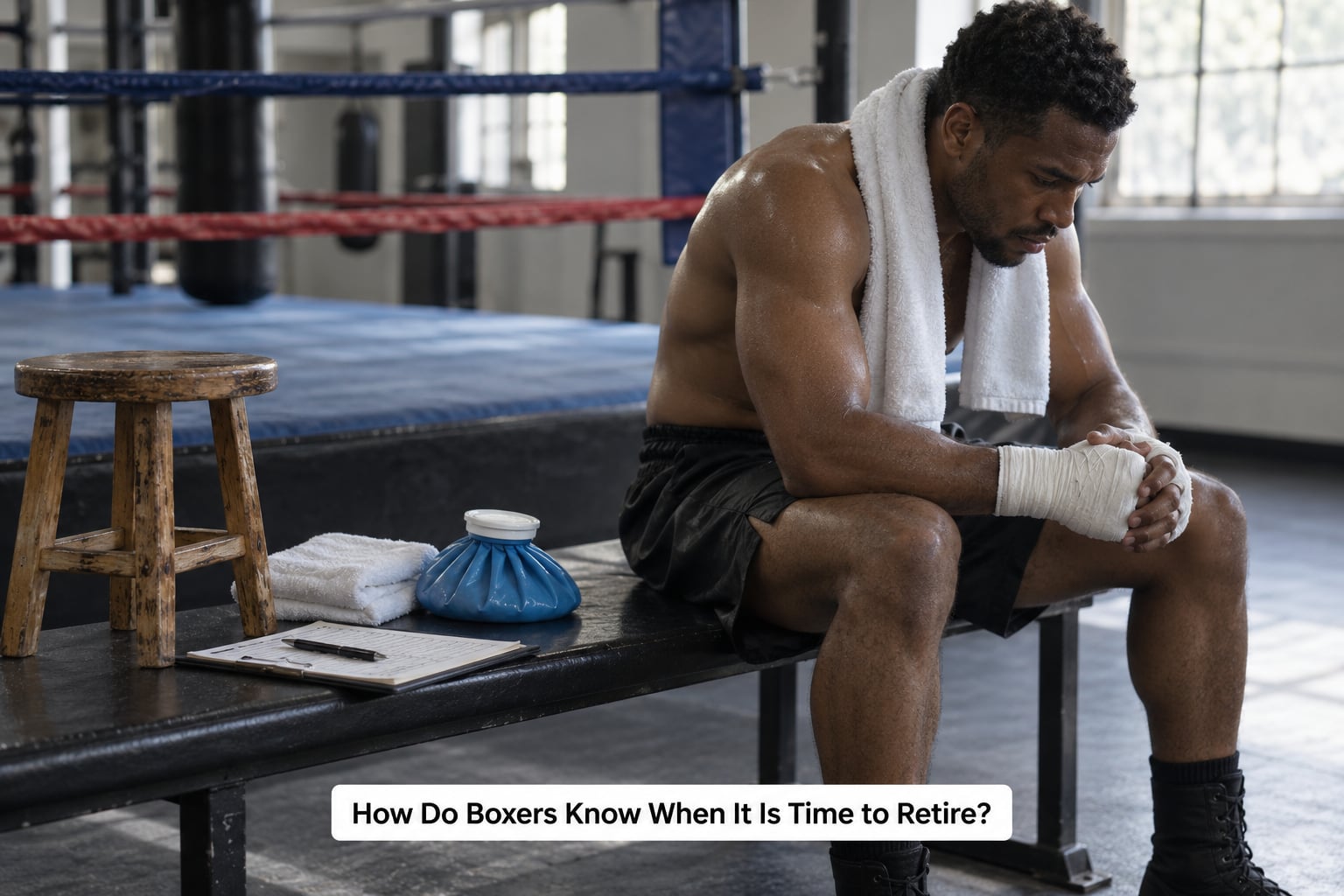
There is no single signal. Fighters and their teams usually read a cluster of them, and the decision tends to be obvious in hindsight because it is usually years overdue in the other direction.
- Results that no longer track the reputation. Losing to a fighter the boxer should beat, repeatedly, is data.
- Injuries that never fully settle. The knock that is still there eight weeks later, the shoulder that needs a block every round.
- Recovery time stretching. A camp that used to take three weeks now takes two months, and the fighter is still sore after.
- Confidence going quiet. Not fear of a specific fight so much as a general sense that the win is not there any more.
- Motivation shifting. Training because a fight is booked rather than because the work matters.
- Medical concerns. Anything a doctor has flagged, especially involving head health, deserves weight over a purse.
- Life pulling in another direction. A family that needs a more predictable income, or a body that has stopped recovering in any meaningful way.
For a fighter considering the professional path, the most useful thing you can do is ask a coach who has managed careers on both sides of that line. It is a much easier conversation to have at 24 with a healthy record than at 34 with a damaged one.
Frequently Asked Questions
What is the average length of a professional boxing career?
Most professional boxing careers run somewhere between 10 and 15 years, with fighters logging roughly 100 to 150 sanctioned bouts at an average of two to three fights a year. Add 6 to 10 years of amateur development and the full span from first gym session to last professional bout is usually 20 years or more. The spread around that average is enormous, so treat it as a planning range rather than a promise.
How long can a boxer compete at the highest level?
A championship-level peak usually runs 2 to 5 years, though plenty of elite fighters have kept winning at the top into their late 30s and 40s. Reaching the highest level at all takes longer than most people expect, because it depends on the amateur years first. Fighters who debuted very young, as Muhammad Ali and Roberto Duran did, have a much longer runway to sustain a title run than fighters who turn pro late.
Is 35 too old to start a professional boxing career?
Thirty-five is late, not impossible. Fighters who start training in their late 20s and 30s do reach the professional ranks, and there are documented cases of men who began at 27, turned pro at 36, and won a title in their home region. The realistic expectation is a shorter, later peak and fewer high-level opportunities. Most promoters invest in fighters they expect to be around for five to eight years, not fifteen.
Do heavier boxers usually have shorter careers?
Not in years, usually the opposite. Heavyweight careers often run longer in total because the competitive pool is smaller, opponents are easier to find, and recovery between camps allows fewer but more spaced-out fights. What heavier fighters tend to lose sooner is punch resistance. Once a heavyweight starts taking clean shots consistently, careers in that division end quickly. Lighter divisions are more likely to see careers cut short by weight cutting and accumulating damage.
Can a professional boxer make a comeback after retiring?
Yes, and boxing has more comebacks than most sports. George Foreman retired at 28 and returned more than a decade later to win a heavyweight title. A comeback usually means years of unsanctioned training, a rebuilt conditioning base, and a first fight against an active opponent. The fighters who return successfully kept training through the layoff and accepted a step down in competition. Archie Moore and Sugar Ray Leonard are two more standard examples.
What is the most common reason boxers retire early?
Cumulative head trauma is the most serious and most cited reason, followed closely by the injuries that break a body up. A 2019 US Government Accountability Office report on boxer health noted that career length and total bout exposure across training, sparring and competition are linked to the severity of neurological injury. In practice, money and a lack of fights end just as many careers, and often quietly rather than in the ring.
Conclusion
So how long a boxing career lasts depends less on a number than on a handful of things you can partly control: debut age, weight class, how you manage cuts, how many fights you take per year, the quality of the coaching around you, and whether the money works. Most professionals box for 10 to 15 years. A few reach 20 or 30. Some never make it past the first few bouts.
Judge longevity by whether a fighter is performing and recovering, not by an age on a record. If you are starting out, build the amateur years properly, cut weight sensibly, learn defence, and talk to a coach about the pro path earlier than feels comfortable. That conversation is a lot easier while you are still healthy.