
A boxing concussion protocol is a fixed sequence a fighter follows after a knockout or suspected brain injury: ringside assessment by a physician, a mandatory period out of competition, a graded return to training, and finally medical clearance to fight again. Knowing how boxing concussion protocols work matters because a knockdown tells you very little about how badly the brain was actually hurt.
That gap between what you can see in the ring and what may have happened inside the skull is the whole reason protocols exist. A boxer can lose consciousness for two seconds and be fine, or stay on his feet through twelve rounds of mistimed shots with measurable problems nobody spotted. The protocol is built around that uncertainty rather than around the highlight reel version of it.
This is general information about how these safeguards are structured, not medical advice. Anything that follows a real head injury belongs in front of a qualified clinician, not a search engine.
Table of Contents
- What Happens When a Boxer Is Suspected of Having a Concussion?
- Who Is Responsible for Protecting the Boxer?
- How Is a Suspected Boxing Concussion Evaluated?
- What Happens During a Graded Return to Training?
- When Can a Boxer Return to Competition?
- How Are Symptoms Tracked After a Suspected Concussion?
- What Should Fighters, Trainers and Promoters Do?
- Frequently Asked Questions
- Can a boxer hide a concussion and still be allowed to continue?
- How long does a boxer have to wait after a suspected concussion?
- Why can a fighter feel fine yet still be medically unsafe to continue?
- Are boxing concussion protocols the same in every country?
- What should happen if symptoms return during a graded return to training?
- Conclusion
What Happens When a Boxer Is Suspected of Having a Concussion?
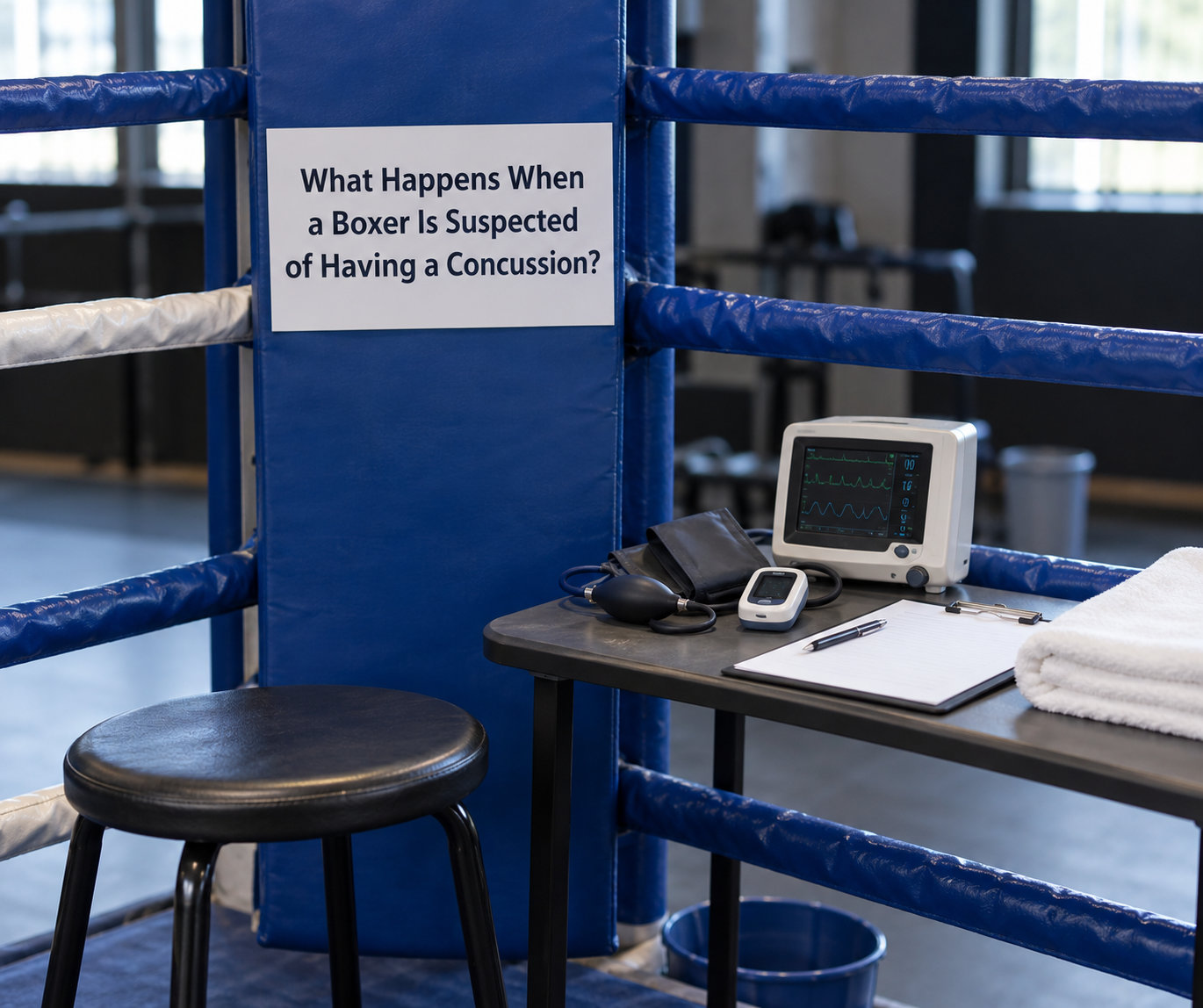
A suspected concussion means the boxer’s brain function may have been disrupted by a blow, even when nothing looks broken. Concussion is a functional injury rather than a structural one you can see on the surface, which is exactly why visible signs are not required for the protocol to start.
The pause-for-recognition stage usually covers five things a doctor watches for in the seconds after a hard shot. Confusion or an odd response to a simple question, loss of balance or an unsteady stance, a headache the fighter volunteers or denies badly, unusual behaviour such as slurring or repeating himself, and a noticeably slowed reaction time.
Then the bout stops. The decision to end the fight on medical grounds sits with the referee and the ringside physician, and for the purposes of the protocol it is not negotiable by either fighter or either corner.
One clarification worth keeping straight: a concussion does not require a knockout. A fighter who was never counted down and never lost consciousness can still have sustained one, which is why ringside doctors keep repeating that fights in which a boxer was visibly out on his feet still count.
Who Is Responsible for Protecting the Boxer?
Protection is shared, and the roles are not interchangeable. Knowing which person does what is the fastest way to understand how boxing concussion protocols work in a real building on a real night.
- The referee counts knockdowns, applies the commission knockdown rules, and stops the contest when a fighter cannot continue safely.
- The ringside physician examines the boxer, decides whether the injury is consistent with a concussion, sets the suspension, and can stop a fight at any point.
- The trainer and second watch for the behavioural signs a doctor might miss in a loud room, and are responsible for the corner not encouraging a fighter to continue.
- The boxer reports symptoms honestly, which is the single hardest part of the whole system.
- The governing commission or boxing authority writes the mandatory minimums that apply regardless of any individual’s medical opinion.
There is a clean line inside all of this: removing a boxer from danger is not the same as diagnosing a concussion. The referee stops the fight on observable grounds. The doctor examines, assesses and decides what the injury is. Keeping those two jobs apart is what stops a tired official from overruling a physician in front of a crowd.
Promoters have no role in the medical decision at all, and the pressure point that regularly causes trouble is financial. A main event that ends early costs money, so the instinct to resume action is real, and the physician’s authority exists specifically to resist it.
How Is a Suspected Boxing Concussion Evaluated?
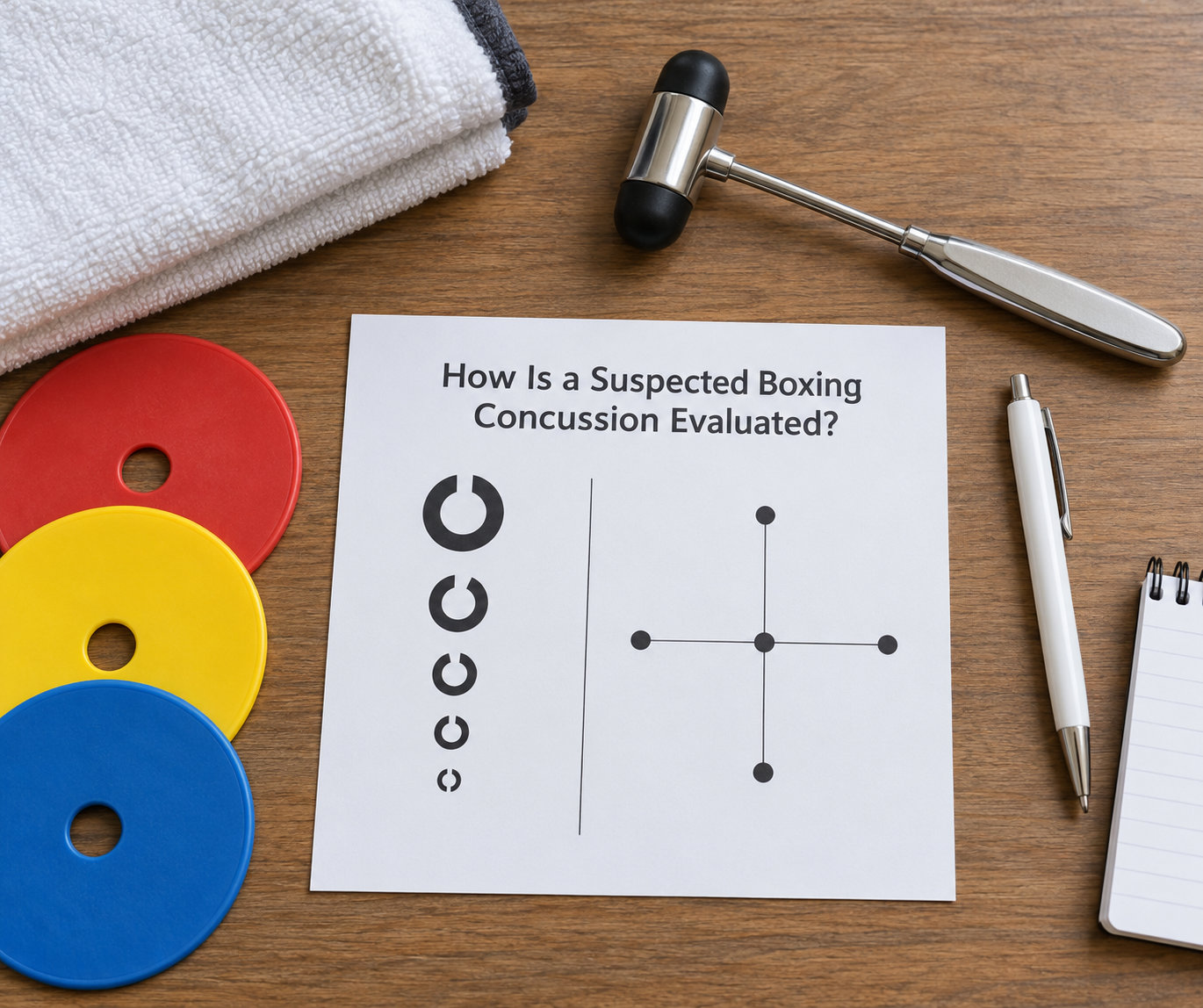
Evaluation is a structured bedside check, not a guess and not an online diagnosis. The doctor works through history, visible signs, balance and coordination, neurological screening, and a review of the blow itself, then decides whether the boxer needs imaging, a referral, or simply time.
| Assessment area | What is checked | What an abnormal result may mean |
|---|---|---|
| Symptom history | Headache, dizziness, confusion, nausea, light or noise sensitivity, sleep change | Symptoms that were not present before the bout suggest a concussive injury |
| Loss of consciousness and amnesia | Whether consciousness was lost, and memory before and after the blow | Gap around the punch points to post-traumatic amnesia and a higher grade |
| Balance and coordination | Walking heel-to-toe, standing on one leg, tandem walking | Instability suggests impaired coordination circuits |
| Eye tracking and pupils | Smooth pursuit, pupil size and reaction, focusing | Abnormal findings raise concern for a more significant injury |
| Neurological screening | Reflexes, strength, sensation, speech, orientation to time and place | Focal deficits point away from a simple concussion and toward imaging |
| Mechanism of the blow | Punch type, glove mass, head-to-canvas impact, neck injury | Canvas impacts add rotational acceleration and raise the concern level |
Standardised tools such as the SCAT5 exist for concussion screening in general sport, and ringside doctors also record level of consciousness on the Glasgow Coma Scale. A concussed boxer typically scores in the mild range, and the score alone never clears anyone. Imaging such as a CT or MRI is not routine for a straightforward case, because most concussions look normal on a scan, which is precisely the problem.
The realistic goal of evaluation is not a label. It is getting the boxer away from risk and routed to the right level of care.
What Happens During a Graded Return to Training?
Coming back is a ladder, not a switch. After the suspension window ends, activity is reintroduced in stages, and each stage has to be tolerated without symptoms before the next one starts.
- Relative rest — no training, minimal exertion, symptom monitoring, and no alcohol or anything that clouds a symptom diary.
- Light daily activity — walking and ordinary movement at a level that does not provoke symptoms.
- Light exercise — stationary cycling or similar, at an intensity that raises the heart rate without triggering symptoms.
- Non-contact training — bag work, pad work, footwork and conditioning, with no head contact.
- Controlled contact — light technical sparring, progressing only if the previous stage caused nothing.
- Full training — normal sessions including sparring at full intensity, tolerated consistently.
Why boxing concussion protocols work only when each stage is completed
Each step exists because the failure modes show up there and nowhere else. A boxer can be symptom-free walking around and then get dizzy halfway through pad work, and the only way to find out is to try pad work. Skipping ahead converts a manageable staged recovery into a second hit while the first one is still settling.
Clearance is based on recovery, not on a number of days. Two boxers can each complete a 60-day suspension and be at completely different points, and the boxer who feels recovered can still have deficits that only appear under exertion. That is why the stage has to be completed and not merely survived.
If symptoms return or get worse at any step, the boxer goes back down the ladder rather than pushing through. Progress that reverses is progress that never happened.
When Can a Boxer Return to Competition?
Returning to the gym and being cleared to fight are different decisions made by different people, and the gap between them is where most of the confusion in this topic lives.
Fight clearance is more demanding than training clearance because of what competition actually demands. Boxing means repeated deliberate blows to the head, often with glove and headgear weight adding to the impact, and a fighter needs to absorb those again and again while moving, not standing still. Tolerating bag work tells you very little about tolerating a trade in the pocket.
On top of that, many commissions and authorities require written medical authorisation before a boxer can be scheduled. The examining doctor may want to see documented recovery from a graded return, symptom records, and sometimes the opinion of a neurologist who is independent of the fighter’s corner. An attending physician at the event can impose restrictions on the day, including withdrawing clearance, and those restrictions outrank a promoter’s schedule.
Rules differ between governing bodies, so the applicable rule book is the one that matters, not the one a fan read last week. Where you fight determines which suspension and clearance rules actually bind you.
How Are Symptoms Tracked After a Suspected Concussion?
Monitoring is mostly unglamorous record-keeping, and it is the part that gets skipped. Fighters keep a dated log of headache severity, dizziness, confusion, sleep quality, balance and any activity that provoked symptoms, reviewed at intervals with a clinician rather than judged once at the door.
The dates matter more than the entries. A timeline shows whether a symptom is settling or holding steady, and it gives the doctor something concrete when a fighter insists they feel fine but cannot explain a two-point drop in something measurable.
Follow-up continues beyond the initial rest period, and for a good reason. Deficits that are invisible at rest frequently appear when the workload rises, so a boxer can clear the first fortnight and fail at the third. Symptom tracking is what catches that before the next sparring session does.
What Should Fighters, Trainers and Promoters Do?
Most of the useful action is unglamorous: remove the boxer from danger immediately, write down what happened while it is fresh, keep the action and medical record intact, avoid unsupervised return decisions, and follow the rule book of the commission or venue where the fight took place. In amateur settings with no ringside physician, this is the only protection there is, which is why safeguarding bodies publish their own guidance for parents and coaches.
Several symptoms mean urgent medical care rather than a rest and a phone call tomorrow. Those include symptoms that worsen rather than settle, repeated vomiting, a seizure, any loss of consciousness, unequal pupils, weakness in an arm or leg, difficulty speaking or slurred speech, and worsening confusion.
Nobody should decide alone that a head injury is fine. If you are reading this because someone in your gym was dropped recently, the next step is a clinician, not a corner argument.
Frequently Asked Questions
Can a boxer hide a concussion and still be allowed to continue?
A boxer can deny symptoms, and the protocol is written for that. The referee watches visible signs, the ringside physician runs a structured assessment, and the corner is expected to stop encouraging a fighter who is confused, unsteady or slow. Denial also works against the boxer later, because a hidden concussion still carries a mandatory suspension once it is identified. The people best placed to catch concealment are usually the ones who know the fighter’s normal answers and normal balance.
How long does a boxer have to wait after a suspected concussion?
There is a mandatory minimum set by the governing body, and it varies widely between commissions and countries. Some suspensions run in weeks, others in months, and a boxer with loss of consciousness or ongoing symptoms is normally held far longer and referred for further assessment. Treat the published minimum as a floor rather than a clearance date. Return still depends on symptom recovery and a completed graded return to training.
Why can a fighter feel fine yet still be medically unsafe to continue?
Concussion disrupts brain function rather than tissue you can see, so symptoms can be absent at rest and appear under load. Balance, reaction time and symptom threshold often shift only once intensity rises, which is why sparring and competition are tested separately from walking and pad work. A fighter’s own report is useful but not sufficient. Medical decisions rest on the structured assessment and, where rules require it, on written clearance.
Are boxing concussion protocols the same in every country?
No. Suspension lengths, knockdown counting, documentation requirements and clearance procedures are set by different governing bodies, so a rule quoted from one country may not apply where the fight is actually held. The structure of the sequence tends to be similar, but the numbers are not portable. Check the rule book of the commission or authority governing the bout, and follow the attending physician’s restrictions on the night regardless of what was announced beforehand.
What should happen if symptoms return during a graded return to training?
The boxer drops back to the last symptom-free stage and stays there until a clinician is satisfied again. Pushing through a relapse is how a recoverable staged return turns into a second impact while the first injury is still unresolved. Symptoms that return with force or come with worsening headache, vomiting, weakness or confusion need assessment straight away rather than a scheduled appointment. The graded ladder exists to catch exactly this situation early.
Conclusion
How boxing concussion protocols work comes down to five things: prompt removal from danger, assessment by qualified medical personnel, a mandatory suspension set by the governing body, activity reintroduced in stages, and clearance decided on recovery rather than on a date. The published minimum is a floor, not a green light, and the ladder only works if every step is actually completed.
For any real suspected concussion, get the boxer in front of a clinician rather than guessing at a recovery window, and follow the rules of the commission or venue where the fight takes place.