Peekaboo is a boxing style built around a very high guard, constant head movement and short, explosive counters thrown from inside. Cus D’Amato developed the system in his Catskill gym and Mike Tyson became its most famous fighter, with Floyd Patterson and Jose Torres earlier proving the approach worked. This guide explains what the style actually is, what it looks like, and how to spot it in a fight.
One warning before we start: if you searched for the children’s game, this is not it. Here, peekaboo means a boxing style, and the name is only a nickname, not D’Amato’s own word for it.
Table of Contents
- What Is the Peekaboo Style in Boxing?
- What Does a Boxer’s Peekaboo Stance Look Like?
- How Does the Peekaboo Style Work?
- Why Do Boxers Use a Peekaboo High Guard?
- Who Invented and Popularized the Peekaboo Style?
- Peekaboo Style vs. Conventional High Guard
- What Are the Advantages and Risks?
- How Can You Recognize the Style in a Fight?
- Frequently Asked Questions
- Conclusion
What Is the Peekaboo Style in Boxing?
The peekaboo style is a defensive system in which a boxer holds both gloves high against the cheekbones, tucks the elbows and chin behind them, and moves the head continuously while walking forward behind the guard. Punches slip past or are absorbed by the forearms, angles are created, and the boxer answers from inside with short hooks and uppercuts.
D’Amato called it a tight defense. The “peekaboo” label came later, from commentators and writers describing the way the gloves all but hide the head, with the fighter appearing and disappearing behind them.
That naming detail matters because it keeps the style from being confused with a generic high guard. Almost every good boxer holds their hands somewhere near their face. Peekaboo is specifically about what happens after that: the hands stay glued to the head, the fighter gives ground very little, and defense turns directly into offense.
What Does a Boxer’s Peekaboo Stance Look Like?
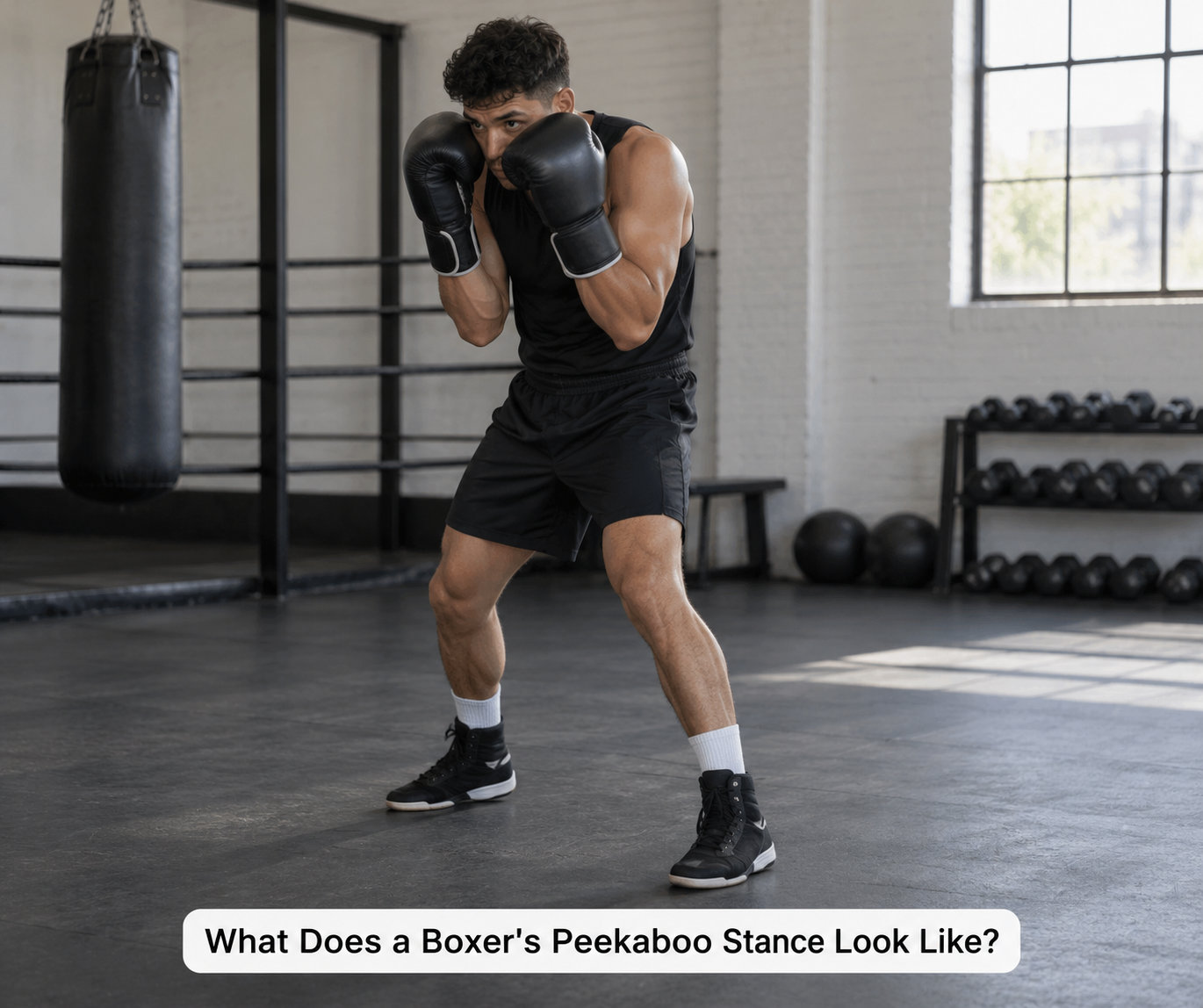
From the broadcast camera, a peekaboo boxer looks compact and hard to hit. The gloves sit high enough that the knuckles are level with or above the eyebrows, the elbows stay pinned close to the ribs, and the chin is tucked behind the glove line rather than in front of it.
The stance is usually bladed rather than square, which shortens the target a taller opponent’s jab is aiming at. Feet stay about shoulder width apart with the weight slightly back, the knees soft, and the body held lower than in a tall, upright stance.
Watch the elbows rather than the hands. In a normal guard the elbows hang or flare out to protect the ribs at the cost of leaving space under the arms. In peekaboo they clamp in, and that is what closes off the body shots an opponent wants to land.
One thing to be clear about: the boxer still sees. The gloves are not pressed flat over the eyes, and a trained fighter keeps the head moving enough to catch glimpses around his own hands. A boxer who actually hides his whole face behind the gloves has made a mistake, not a style.
How Does the Peekaboo Style Work?
The system runs in a loop, and the sequence below describes it rather than prescribing a fixed routine. Good peekaboo boxers improvise from the same principles.
- Establish the guard. Hands high, elbows in, chin tucked, weight back, ready to step forward rather than retreat.
- Read the attack. Watch the shoulders and hips, not the hands. A shoulder dip usually means the punch is already committed.
- Make a compact defensive response. Slip, bob under, or roll the shoulder across the incoming punch. Blocking with a straight arm breaks the shape and gives the punch time to extend.
- Create an angle. The point of the head movement is to end up beside the punch rather than in front of it.
- Step in behind the slip. The rear foot drives forward as the head moves, so forward pressure and defense happen at the same time.
- Counter into the opening. Short hook, uppercut, or a straight shot to the body, thrown while the opponent is still recovering from their own punch.
Step five is where the style lives. A boxer who slips and stays where they were has just dodged. A boxer who slips and steps inside has turned a defensive move into an attack, and that is what makes the style so hard to solve.
Why Do Boxers Use a Peekaboo High Guard?
The reason is reach. A shorter boxer cannot win a straight-arm punching contest against a longer opponent, so the high guard takes the jab away and forces the fight into a range where the shorter fighter’s hooks and uppercuts work.
A second reason is economy. Every punch that lands on the guard costs the opponent energy and tempo. Over enough rounds that adds up, and it is part of why the style is associated with fighters who apply pressure rather than box and move.
The third reason is rhythm. A guarded opponent who cannot land cleanly starts second-guessing, and a boxer who thrives on uncertainty likes that. The guard also protects the chin during the awkward moments right after a punch, when most boxers are most vulnerable.
Managing forward pressure is the fourth. There is nowhere for an advancing opponent to push you if you are already chest to chest, cutting off the ring before the exchange even starts.
Who Invented and Popularized the Peekaboo Style?
Cus D’Amato is credited with developing it, working out of his gym in the Catskills and building the system around a fighter who is quick, compact and hard to hit. He did not describe it as peekaboo, and he was careful about who he let use it.
Floyd Patterson was an early champion who fought in the D’Amato style, using a lighter, more footwork-driven version. Jose Torres, a light heavyweight champion in the 1960s, showed the approach could work with more length than expected. Mike Tyson then made it unmistakable for a global audience in the mid 1980s, pairing the guard with relentless forward pressure and a famously short punching distance.
It is worth being accurate about the attribution. Nobody single-handedly invented every element. High guards and shoulder rolls appeared in boxing well before D’Amato, and trainers like Freddie Roach favored similar compact high-guard work for different purposes.
Angelo Dundee, for example, used a high guard with heavy shoulder rolling, but that is closer to a defensive shell than to the peekaboo counterpunching system. D’Amato’s contribution was the specific combination: permanent high guard, permanent forward movement, and counters thrown off the defense.
The style lives on in fragments. Artur Beterbiev, Oleksandr Usyk and Vergil Ortiz all fight with high guards and short, compact attacks, though none of them should be described as a peekaboo boxer in the Patterson or Tyson sense.
Peekaboo Style vs. Conventional High Guard
Peekaboo is an interpretation of high-guard boxing rather than a completely separate defense. The differences show up in movement and intent.
| Element | Peekaboo Style | Conventional High Guard |
|---|---|---|
| Hand position | Gloves stay at the cheekbones for most of the round | Hands high but relaxed, dropping between exchanges |
| Defensive movement | Slip, bob, shoulder roll, usually with a forward step | Blocks, parries, and steps back along the ring |
| Counters | Short hooks and uppercuts thrown off the defensive movement | Counters rare or slow, defense treated as rest |
| Ring movement | Presses forward, cuts off the ring, fights in the pocket | Moves laterally, keeps range, prefers the outside |
| Tactical use | Neutralizes reach and jab, invites the inside fight | General purpose defense used across styles |
| Common limitation | Expensive, timing-dependent, wide angles become hard to see | Fewer specialized weaknesses but less fight-ending offense |
What Are the Advantages and Risks?
The advantages are real. The guard is excellent against jabs and straight punches, it takes away an opponent’s preferred range, and it lets a shorter boxer win fights he would lose at long range. A good peekaboo fighter is also extremely difficult to hurt, which matters over twelve rounds.
The risks are just as real, and fans should keep them in mind.
- Limited vision. Hands that close to the face create blind spots, particularly on the outside angle where a wide hook travels.
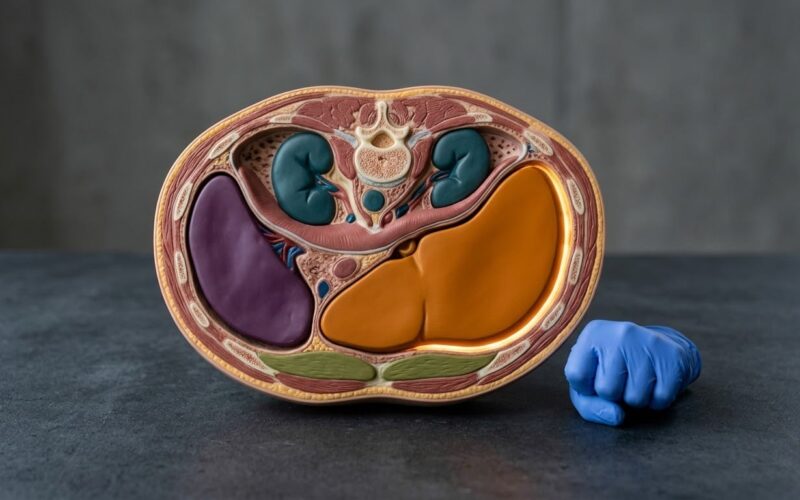
- Pressure build-up. Body shots do not always stop the advance. Repeated shots to the liver and ribs compound across rounds, and that came up repeatedly in forum discussion about the style’s long-term cost.
- Dependence on timing. The whole system rests on reacting correctly. Against a fighter who varies rhythm and does not follow the expected pattern, it can look like guessing.
- Exposure when countering. The moment a peekaboo boxer commits to a hook, the guard opens. A simultaneous counter beats the technique more often than it beats a normal guard.
- Predictability. Once a habit is visible, it can be exploited. Fighters who have trained against high guards report exactly that.
- Energy cost. Amateurs report that a full round in the peekaboo guard leaves them gassed. Sustained forward pressure plus constant head movement is one of the most demanding things in the sport.
How Can You Recognize the Style in a Fight?
Watch for a handful of things together, because no single clue proves anything.
- Gloves that stay glued to the cheekbones through most of the exchange.
- Elbows that clamp to the ribs instead of flaring.
- Short punching distances, with many shots thrown from inside.
- Head movement that continues even when the fighter is not under pressure.
- Forward movement that does not reverse after a missed punch.
- Counters that arrive immediately after slipping rather than after blocking.
What Is the Peekaboo Style in a Real Fight?
Take a heavyweight matchup where one fighter keeps his gloves at his temples for a full round, elbows welded to his body, and spends almost the entire time walking the other man toward the ropes.
When a jab lands on the guard, he does not reset. He steps in and throws an uppercut from underneath. That single sequence, guard held, no retreat, counter thrown off the slip, tells you more than any commentary package would.
Now compare it with a fighter who also keeps his hands high but drifts backward, blocks in straight lines and only attacks when the round resets. Different mechanics, similar-looking silhouette. The distinction between peekaboo and a plain high guard lives in the footwork and the timing of the counters, not the hand position alone.
Frequently Asked Questions
Does peekaboo mean a boxer never blocks with both gloves?
No. The gloves do most of the work early in an exchange, but a peekaboo boxer will still cover up when a shot is too fast or too straight to slip. What defines the style is that the hands return to the cheekbones immediately, the fighter steps forward instead of backing off, and the block turns into a counter rather than ending the exchange.
Is peekaboo the same as a high guard?
A high guard is the equipment. Peekaboo is what the boxer does with it. Most competent fighters hold their hands somewhere near the face, so a high guard on its own tells you very little. Peekaboo describes a boxer who keeps that guard permanently, gives ground almost never, and attacks off the defensive movement itself.
Why do peekaboo boxers keep their gloves close to their face?
Three reasons, mostly. The gloves absorb jabs and straight punches that would otherwise land on the chin. The tucked elbows close off the ribs against body shots. And with the hands high and the head moving, an opponent has to fight around a wall while also chasing a moving target, which is exactly the pressure the style is built to create.
Can a beginner boxer safely copy the peekaboo style?
You can learn the guard, but I would not make it your whole style yet. It costs a lot of energy and beginners who bob and weave without fast footwork tend to run themselves down within a round or two. Learn to hold the guard and slip on the bag first, build footwork speed alongside it, and check with a coach before entering sparring rounds in that stance.
Which famous boxers are most closely associated with peekaboo?
Mike Tyson is the name most people picture, and Floyd Patterson and Jose Torres came before him with cleaner, more footwork-driven versions of the same system. Cus D’Amato is the trainer behind all three. Modern fighters such as Artur Beterbiev and Oleksandr Usyk use similar high guards and short attacks, but they are not usually counted as peekaboo boxers.
Conclusion
Peekaboo is a boxing style built on a permanent high guard, minimal retreat, and counters thrown off the defense itself. The hands are the entry point, but the style lives in the footwork and the timing.
So when you watch a fight, look past the silhouette. Watch whether the fighter gives ground after a missed punch, whether the counters come off a slip rather than a block, and whether the guard comes back up the instant it is disturbed. That is where the peekaboo style actually shows itself.