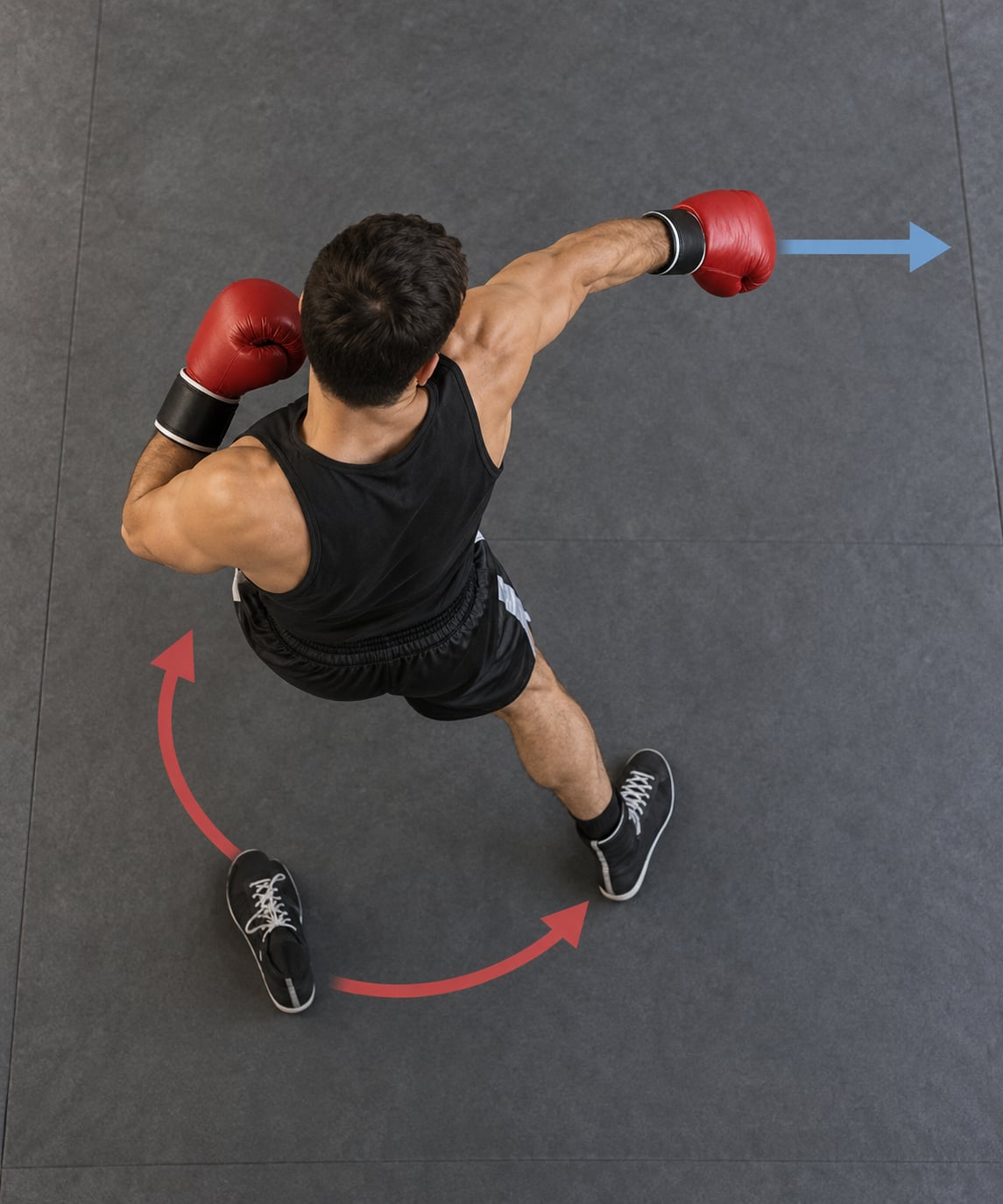
What is a check hook? A check hook is a lead hook thrown while pivoting away from an advancing opponent, so you score and escape the center line in the same movement. The punch lands as their weight carries them past you, and you finish the beat facing a new angle rather than walking backwards. That is the whole idea — everything else is technique.
The punch exists because backing up is a losing habit. If you reverse whenever an opponent crowds you, they set the distance and you spend the rest of the fight on their terms. The check hook lets a boxer answer forward pressure with forward rotation instead of retreat, which is why it shows up everywhere from amateur gyms to championship rounds.
Table of Contents
What Is a Check Hook?
Stripped down, it is a compact hook thrown by the lead hand while the lead foot pivots and the rear foot arcs around the outside. The pivot moves your body off the opponent’s attack line at the exact moment their head arrives, so the punch connects from an angle they never saw coming.
The oldest coaching comparison is a matador and a bull: the pressure fighter charges, the check hook lets them pass harmlessly, and the counter lands on the flank they exposed. Old-school forum advice describes it the same way — the opponent flies past you harmlessly, leaving them exposed to your counterpunch — and that outcome is exactly what you are training for.
How it works in three beats:
- The punch — a tight lead hook, elbow bent roughly 90 degrees, travelling a short horizontal arc to the jaw or the body.
- The footwork — the lead foot pivots and the rear foot steps around, carrying your hips off the line they are walking down.
- The result — their momentum overshoots, they land in a mirror match, and you are already loaded for the next shot.
Handedness matters. For an orthodox boxer this means throwing the left hook while pivoting clockwise around the lead foot. A southpaw throws the right hook and pivots the other way — counterclockwise around their lead foot. The principle is identical, only the direction flips.
How a Check Hook Differs From Other Boxing Punches
The footwork is the real distinction, not the punch. A lead hook thrown without the pivot is just a shorter, weaker jab-side hook. Here is how the movements separate:
| Punch | Path and rotation | Typical range | Tactical role |
|---|---|---|---|
| Check hook | Short horizontal arc, lead foot pivots, rear foot arcs around | Short, but taken while they are entering yours | Interrupt and escape at the same time |
| Jab | Straight line down the center, minimal rotation | Long to mid | Measure, set up, push them back |
| Conventional hook | Wide arc, full hip and shoulder rotation, feet set | Mid to long | Power shot from a stable base |
| Uppercut | Upward arc from a low dip, knees and hips drive | Very close | Break a high guard or punish a dropped elbow |
| Back-check | Elbow or forearm driven backward as they enter | Point blank | Stop forward motion without swinging |
Coaches also use overlapping names. A side-step hook moves the whole body laterally instead of pivoting on the lead foot; a pull-back hook leans off the line and lets the rear hand follow. Same family, different footwork, and mixing the labels up is the fastest way to get bad instructions from the wrong person.
How to Throw a Check Hook Correctly
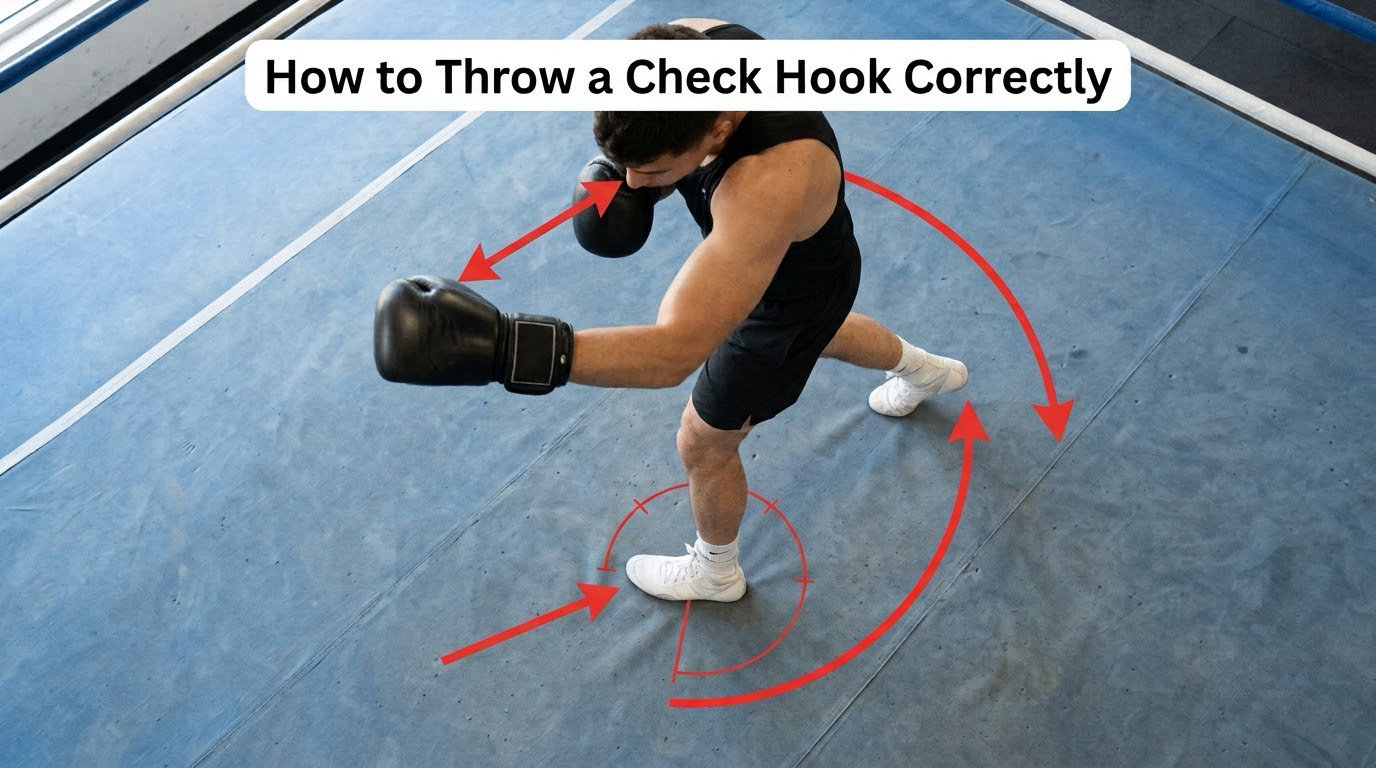
Work through it in this order rather than trying to feel the whole thing at once:
- Set your stance with the lead foot slightly forward, knees soft, chin tucked behind the lead shoulder.
- Read the entry — the opponent has to be coming. Thrown at range, the punch has no purpose and your rotation is wasted.
- Pivot first, punch second — the lead foot turns and the rear foot begins its arc. The hand follows the rotation rather than starting it.
- Keep the elbow in at about a right angle, forearm horizontal, wrist neutral. Short path, not a big wind-up.
- Land as they arrive on the jaw or, if they have a tight high guard, the body.
- Reset to guard on the new line immediately, using the rotation you just created.
Check Hook Mechanics: Why the Movement Works
Balance comes first. If your weight is centred before the pivot, the turn is free. If it is sitting on the rear leg, you will fall off the line and the punch gets dragged behind it.
The kinetic chain runs foot to hip to shoulder to fist, and the hips do the heaviest work. A hook thrown with the arm alone is heavy and short. A hook thrown with the hips behind it is compact and fast, which is why the check hook hits harder than most beginners expect from something so small.
The lead hand guards the chin throughout. The moment you drop it to load the hook, you have handed over a free counter, and in the clinch-range exchanges where this punch lives that trade is a bad one. Exhale sharply on impact, keep the shoulders loose, and finish back in a stance you can defend.
When Boxers Use a Check Hook
Against a pressure fighter who has closed the gap and is swinging in volume. This is the punch’s home address, and the majority of coaches introduce it exactly here.
On the ropes, where there is nowhere to retreat. Instead of covering up and giving up the round, you pivot and work off the ropes.
After a slip or a block. If you move your head off the centre line and they swing through, you are already turning into the hook with no extra footwork needed.
As a setup rather than a shot. The hook itself does not have to land hard to be useful — it can occupy their hands, drop their guard an inch, or make them lean in so the uppercut or straight right behind it has an easier job.
As a feint. Beginning the pivot and stopping is a legitimate way to make someone commit forward, which is exactly the entry your real check hook wants.
When Not to Use the Check Hook
Tell taller fighters this one first, because it is the most common complaint beginners bring to a forum: after the jab they are already too close, so there is no room to pivot and the hook has nothing to land on. The fix is range management, not a different punch. Step back off the line before you jab, use a longer jab, or jab and immediately circle out rather than standing and punching.
It also is not the answer against a fighter who simply out-ranges you at every angle, and it is awkward when you have no jab to keep them honest. Without a lead hand in the fight, an opponent can load up on the entry you are trying to check.
Check Hook vs Back-Check: What’s the Difference?
People use both words, so it is worth being precise. The back-check is defensive: as the opponent enters, you drive the elbow or forearm backward into their chest or face to break their forward movement without swinging at all. No hook, often no rotation, purely a stop.
The check hook is offensive and rotational. You pivot off the line and land a punch while they are still arriving, so their forward motion becomes the reason the shot lands.
Back-checks are a close-range survival tool, better as a reset between exchanges than as an attacking option. Check hooks need a little more space and an opponent who is actually coming. Used together they are not redundant: check to create space, back-check when they refuse to respect it.
Common Check Hook Mistakes and How to Fix Them
- Elbow bent too far, punch thrown as a bight — straighten the arm at impact instead of curling the whole punch into a semicircle.
- Pulling the elbow behind the back — that is a back-check motion, not a hook. Keep the elbow in front of the ribs.
- Over-rotating the feet — spinning until you face the wrong way leaves you unable to punch or exit. Turn enough to clear the line, no further.
- Telegraphing — dropping the lead hand or hitching the shoulder before the pivot tells them the punch is coming. Start the turn with the foot.
- Tensing the shoulder — a rigid shoulder kills speed and robs the punch of feel. Loose until the moment of contact.
- Dropping the opposite hand — the lead hand stays on the chin the entire time, even at full extension.
- Leaning away instead of rotating — leaning takes you off balance and out of range. Pivot so your body stays between your feet.
- Not returning to guard — the recovery is part of the punch. Finish the beat in a stance you can defend, not with your arm still extended.
How to Practise a Check Hook Safely
Progress slowly and stop while you are still fresh. Most injuries in pad work come from grinding through a technique that has already broken down.
Warm up properly first — a few rounds of footwork, then light shadowboxing with the pivot slow enough to feel the rear foot land. On the bag, work one repetition at a time with your coach calling the pivot; the check hook is a footwork drill that happens to include a punch, not the other way round. Focus mitts come next, at half speed, with the holder stepping in to give you a real entry to pivot around.
Controlled sparring is the last step, and you should earn it. Keep it technical, agree a rule that nobody gets tightened, and have a coach watch for the over-rotation habit before it becomes the default.
One rules note for amateurs: the check hook is a legal punch. What gets flagged is a simultaneous full spin, dropping your guard deliberately, or a wild swing with no contact. Pivot and throw it like any other shot.
Frequently Asked Questions
Is a check hook stronger than a normal hook?
A check hook carries less raw power than a full hook thrown from a stable stance, because the feet are turning rather than planted. What it gains is accuracy and surprise, which matters more when an opponent is walking into it. Practised well, it lands cleanly often enough that the trade feels even.
Can a beginner learn a check hook easily?
Yes, but not first. Get comfortable with a jab, a basic hook and your stance work before adding rotation, or the pivot becomes something you panic through. Most coaches introduce it in the gym rather than in a first session. Expect a few weeks of awkward reps before it stops feeling strange.
Should a check hook land on the chin or the body?
Both work, and the guard you are facing decides which. Against a fighter holding a tight high guard, the body shot gets through and hurts their breathing. Against a taller opponent with a high elbow, the jaw is the target. Beginners usually find the body easier to land while they are still learning the rotation.
Is a check hook the same as a back-check?
No. A back-check is a defensive stop thrown with the elbow or forearm to break incoming forward motion without swinging. The check hook is offensive: you pivot off the line and land a hook as the opponent arrives. The confusion comes from coaches using both words loosely in the same gym.
Is a check hook useful against a taller opponent?
It is, provided you solve the range problem first. Taller fighters tend to crash in after the jab and end up with no room to pivot, which is the usual reason it fails for them. Manage distance with a longer jab and immediate movement off the line, and the taller fighter’s own forward momentum becomes the thing that makes the hook work.
Conclusion
The check hook is not a small, safe version of a hook. It is a compact rotational punch whose whole force comes from turning off the opponent’s line at the moment they cross it, and that is why it lands clean on fighters who have already committed to coming forward.
Start slow. Shadow the pivot, work it on the bag one rep at a time, then pads, and only add speed and resistance once the rotation survives contact. If you are stuck, the problem is almost always range or over-rotation, not the punch.