The cross arm defense works by raising both forearms in front of your face and chest so they overlap across the centerline, hiding your chin and sternum behind a single rigid wall of bone and muscle. Your head stays tucked behind the arms, and because both hands are already loaded near your face, you can fire a counter the moment the punch lands and dies. That is the whole idea: absorb on the arms, cover head and body at once, answer immediately.
Plenty of searchers land on this term confused. Cross arm defense, cross guard, cross armed guard, double arm block, cover up and Philly Shell get used interchangeably in gyms and on forums, and they are not the same thing. This guide sorts the names out, breaks the position down part by part, shows how to enter and exit it safely, and is honest about the matchups where it gets ugly.
Table of Contents
- How the Cross Arm Defense Works in Boxing
- What Is the Cross Arm Defense?
- Why Boxers Use the Cross Arm Defense
- How to Set Up the Cross Arm Defense
- The Difference Between the Cross Arm Defense and a Shell
- When the Cross Arm Defense Works Best
- Common Cross Arm Defense Mistakes
- Drills and Footwork for Learning the Defense
- Frequently Asked Questions
- Conclusion
How the Cross Arm Defense Works in Boxing
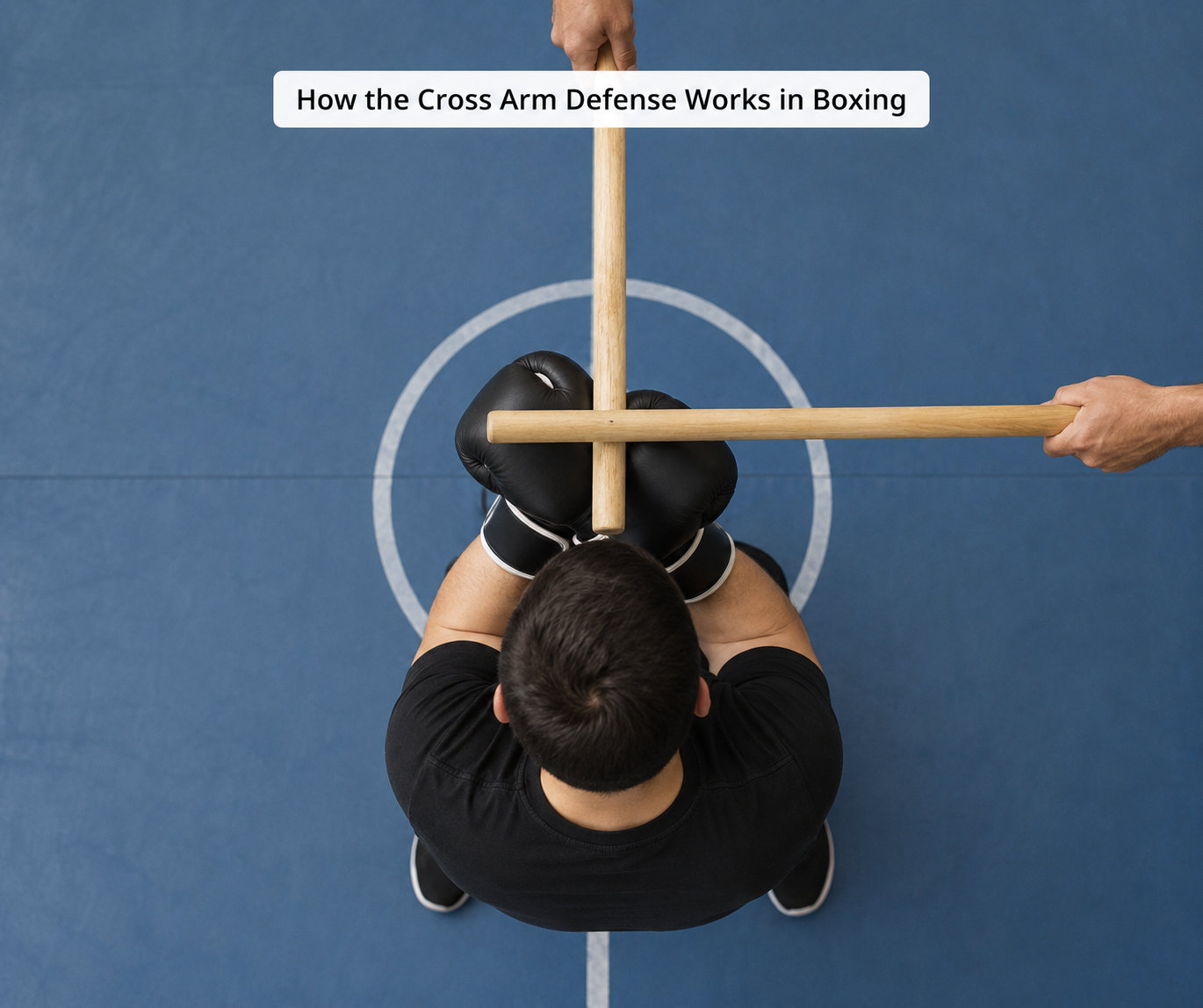
The cross arm defense works by crossing both forearms in front of your head and torso so the rear arm shields your chin and the lead arm covers your body. The crossed arms present a wide, rigid surface that absorbs punches instead of deflecting them, hiding your head and sternum at the same time while your weight stays back and your eyes stay on your opponent. Because both hands are already loaded near your face, you can fire a counter the instant a punch dies on your arms, which is the real reason boxers use it.
Everything else about the position follows from that one idea. You are not trying to win an exchange with your arms; you are buying yourself a fraction of a second and a clean sight line to the target that was just used up punching you.
A boxer on a popular forum described a cross-arm opponent as armadillo-like, and that is the right mental picture: no clean target, nowhere obvious to put the next punch, and an invitation to keep swinging into forearms until your own hands go numb.
What Is the Cross Arm Defense?
The cross arm defense is a guard position, not a single block. You hold both forearms up and slightly across your body, overlapping or touching so there is no clean lane between them, with the rear glove near the cheekbone and the lead glove lower across the chest.
Here is what each part is doing:
- Rear arm and glove. Positioned at the side of the chin and cheekbone. This is the arm that matters most in boxing, and it is the one you protect hardest.
- Lead arm and glove. Laid across the sternum and ribs, angled so the bicep covers the body line a hook would travel.
- Elbows. Tucked down and in, not flared out. Flared elbows open a lane under the armpit and give a hook somewhere to land.
- Head. Down behind the lead shoulder and behind the rear glove, chin tucked rather than pushed forward. Beginners habitually push the chin forward, which puts the hardest target exactly where the glove used to be.
- Weight. On the back foot, roughly sixty forty, so a punch that lands on the arms pushes you away instead of rocking you onto your front foot.
- Shoulders. Rounded up, not shrugged toward the ears. Tight shoulders tire your forearms twice as fast.
It sits on a spectrum with the standard high guard rather than standing apart from it. A high guard is the home position you return to; the cross arm defense is a tighter, more committed version of that home position that you adopt for a beat while under pressure or while stepping into range.
Why Boxers Use the Cross Arm Defense
It earns its place in a game plan for four reasons, and they are worth keeping separate because each one answers a different problem.
It covers the head and the body with one shape. Most guards ask you to choose. The crossed arrangement hides your chin on one side and your sternum on the other with a single, compact silhouette, so there is no third punch to worry about while you handle the first two.
It intercepts the jab before it fully extends. A jab is a straight line, and a raised forearm is the easiest thing in the sport to put in front of a straight line. Taking the jab on the glove or the forearm stops the hand from ever reaching your face, and it stops the second punch behind it.
It shrinks the angle on a cross. A rear cross wants to travel through the center of your guard or around your lead shoulder. When your forearms are angled inward and crossed, the narrowest lane your opponent has to find is no longer the centerline, so the punch either lands on bone or misses entirely.
It buys you read time. A guard that absorbs is not winning the exchange yet. What it does is give you a fraction of a second to see what came, decide whether it was a jab or the start of a combination, and answer. That delay is the whole product.
How to Use the Cross Arm Defense Against Common Punches
Against a jab, cross the arms and take it on the lead forearm with your weight already back, then step off the line rather than firing immediately. Your exit is a short jab or the first step of a retreat.
Against a cross, meet it with the rear glove at the chin and the rear forearm angled inward, absorbing onto the back leg, then answer with a short left hook or a body shot as the arm comes back through. Trying to answer a cross with your own cross is how beginners get caught, because your hand is still extended when the hook arrives.
Against a lead hook, you have two choices. Slide the cross arm left with the punch and step off at forty-five degrees, which is the safer answer, or pivot on the rear foot and roll under it if you have trained the shoulder roll. Staying square with crossed arms against a hook is asking to be turned.
Against an uppercut, drop the crossed arms slightly to smother the angle rather than raising them, and step back. Trying to catch an uppercut on crossed forearms means meeting it with the elbow gap, which is exactly the target the punch is designed for.
Against a combination, which is where this guard is really tested, do not try to solve the whole sequence at once. Absorb the first shot, let the second die on the arms, and start your feet. Most boxers who get hurt with this guard are not beaten by any single punch, they are beaten by the punch that arrives in the second you needed to reset your stance.
How to Set Up the Cross Arm Defense
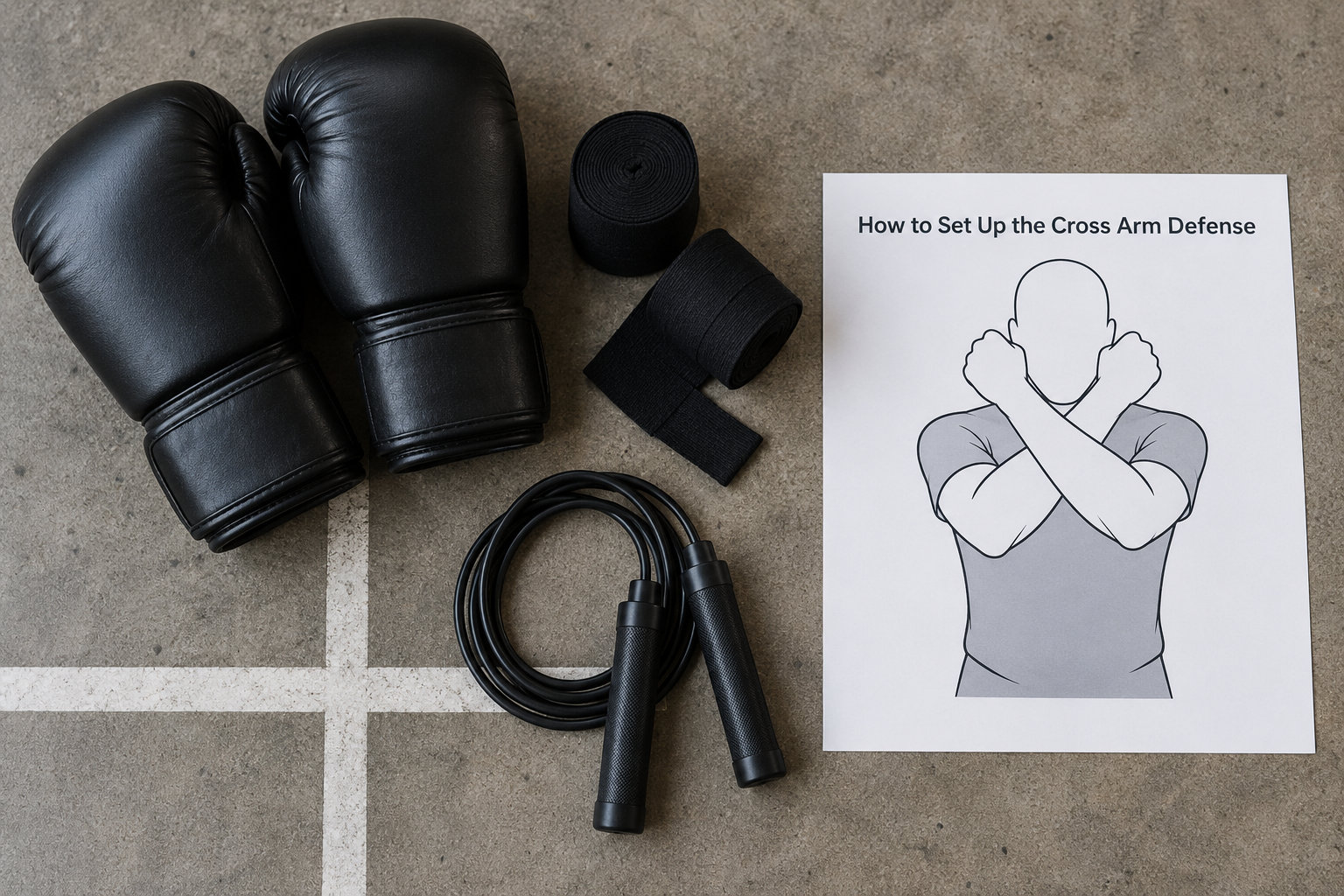
Set the position up from a relaxed stance first, never from tension. Tense arms at the start and you will be holding a heavy barbell in front of your face within two rounds.
Start in your normal stance with hands at the cheekbones and your weight balanced, eyes on your opponent, jaw unclenched. Breathe out as you set up.
Take one small controlled step. Step off the centerline rather than forward into it. On a heavy bag, step in slowly enough that you can hold the position for a full second after you arrive.
Bring the rear glove to the chin first and anchor it there. This is the step beginners rush, and the result is a guard with nothing behind it.
Lay the lead arm across the body so the lead glove covers the sternum and the lead bicep blocks the hook lane. The arms should touch or overlap near the elbow. If you can see daylight straight through the middle, close it.
Tuck the chin behind the lead shoulder and pull the elbows down. Keep the back knee soft and let your weight sit over the rear leg.
Check your sight line. If you cannot see both of your opponent’s shoulders, you have either dropped your guard too low or turned your head away from the center. A guard that blinds you is worse than no guard at all, because you cannot answer what you cannot see.
Hold it, then leave it. Three seconds at full commitment, then return both gloves to the cheekbones and reset your stance. Practice the exit as hard as the entry, because getting back to a balanced stance is the part most people neglect.
Talk it through with a coach before you load it up with resistance. Hand position and forearm angle feel wrong until somebody points at them once.
The Difference Between the Cross Arm Defense and a Shell
They are not the same thing, and neither one is universally better. The cross arm defense is a static shield built out of crossed forearms; the Philly Shell is a responsive system built around the shoulder roll and a tucked chin. Neither is a shorthand for good defense, and the honest answer is that head movement plus a tight guard beats either one on its own.
| Element | Cross arm defense | Standard high guard | Philly Shell |
|---|---|---|---|
| Arm orientation | Forearms crossed or overlapped across the centerline | Gloves at the cheekbones, elbows in, hands separate | Lead glove low, rear glove tight, chin tucked behind the lead shoulder |
| Head protection | Strong; chin hidden behind rear arm and glove | Moderate; depends on how tight the hands stay | Strong, but only if the chin stays tucked |
| Body protection | Strong; lead arm covers the sternum | Weak; the body is open by design | Weak; the body is traded away for head protection |
| Movement | Slow to set up, slow to exit, heavy on the forearms | Fast in and out, keeps you mobile | Responsive but requires timing and repeated practice |
| Counter options | Short counters once the punch dies on the arms | Best counters, hands are already loaded | Counters land well off the roll, usually as a slip response |
| Difficulty | Moderate; mostly a matter of discipline and forearm strength | Low | High; it collapses the moment the tuck is late |
| Best used for | Closing distance on a pressure fighter, or reading a taller opponent | Everything, at every level, most of the time | Punch counters and opponents who overcommit to the head |
Note the row that surprises people. The high guard wins on movement and counters, which is why nobody fights a whole match out of a cross arm guard. A cross arm defender who cannot get back to a fast guard has given up the advantage that makes boxing fun.
When the Cross Arm Defense Works Best
It works best against taller or longer opponents, because their punches travel further and your forearms get to the line first. An amateur on one of the big coaching forums pointed out that it suits taller boxers such as Winky Wright, who used a tight, disciplined guard built on reach and head movement rather than brawling.
It also works when you are the one walking forward. If you need to close distance on a pressure fighter, the crossed arms are the safest way to do it, and the punch you land after arriving is often your best one. That offensive reading of the guard is the most useful thing about it.
Southpaw matchups are workable but require care, because their lead hook travels down the exact diagonal your rear arm is protecting. You can handle it by sliding the cross in the same direction as the hook, which carries your chin with it, or by pivoting away from the lead foot.
Cautious entries work well too. When you are the shorter fighter walking a taller opponent toward the ropes, the guard removes the guessing and lets you arrive with something left to throw.
Now the limitations, because they are real. It is expensive: holding crossed arms for twelve rounds tires your forearms before it tires your legs, and the guard degrades visibly in the later rounds. It slows you down, and a slow fighter against a fast one is having a bad night. It can hide your vision if you drop your head too far. And it can be broken outright, which is covered below.
Common Cross Arm Defense Mistakes
Crossing the wrists. Wrists folded under each other have no bone structure behind them, so they fold flat under the first real shot. Fix it: arms touch near the elbow, wrists stay stacked, never folded.
Flaring the elbows. Elbows out to the sides open the lane under the armpit and hand a hook its target. Fix it: pull both elbows down toward the ribs as you set up.
Leaning back or sitting down. Weight on the back foot is correct; weight off the back foot is not. If you are sitting on your heels and drifting backward, you cannot load a counter or move off the line. Fix it: back knee soft, chin down, hips under you.
Tight shoulders. Shrugging toward your ears burns forearm endurance faster than any punch does. Fix it: roll the shoulders up and let them hang, and drop them the moment you are back in guard.
Standing still in it. The position is a response, not a place to live. Feet that stop moving turn the guard into a static target. Fix it: work on the angle the whole time you hold it.
Telegraphing. Dropping the lead hand before the cross comes gives your opponent a free shot every time. Fix it: cross on the arrival of the punch, not on the wind-up.
Staying in it too long. Holding a committed guard for ten seconds drains you and signals that you have nothing else. Fix it: three seconds committed, then reset.
Failing to return to a balanced stance. Coming out of the guard with the hands still crossed leaves you unable to throw anything. Fix it: gloves back to the cheekbones and feet square before you counter, even if it costs you a beat.
One more that coaches mention constantly: gloves should be touching your forehead on impact, and you must keep your eyes on your opponent the whole time you are in the position. Both are easy to lose under pressure and both decide whether the guard survives contact.
Drills and Footwork for Learning the Defense
Shadowbox the position first, before anything resists you. Set up the cross, hold it for three seconds, walk off the line, reset. Ten slow repetitions on each side teaches more than a fast minute of flailing.
Mirror work is where you catch the flaws. Stand in front of a mirror and look at your elbows, your chin and your hands, and check them one at a time. Most people see their chin forward before they ever feel it.
Bag work next, on a heavy bag held at head height so you are working at true range. Step in, cross, absorb, reset. Ask a coach to hold a stick or pad at chin level and tap your guard with light contact so you feel where the gaps are.
Focus-mitten reactions are the bridge to real pressure. Have a coach call single jabs at half speed and enter the cross on the call. The coaching point is not speed, it is whether your chin stayed behind your arms and whether you reset on the way out.
Partner jab work is where most learning happens. Use a partner who throws slow, single jabs with a held pad, and move in and out of the guard. Keep the intensity light, because the point is to practice the position, not to take head shots.
Light-movement footwork drills tie it together: cross, angle off, reset, cross again, this time on the other line. The exit is what you are rehearsing, because the entry is the easy half.
Work with a coach for the first few sessions rather than drilling it alone. For anything involving contact, hand or wrist pain, or a history of joint problems, get a doctor’s view before you load the position up, and let your coach watch the setup. Most of the injuries people associate with this guard come from bad setup, not from the position itself.
Frequently Asked Questions
Is the cross arm defense the same as a high guard?
No, and the difference is one of degree rather than kind. A high guard is the default home position with both gloves at the cheekbones and the body open. The cross arm defense tightens that shape by overlapping the forearms so the lead arm also covers the sternum. You return to a high guard between exchanges and cross the arms when you need to absorb, read, or walk forward under pressure.
Should the lead arm cross over or under the rear arm?
Standard boxing usage is the rear arm at the chin and the lead arm lower across the body, so the arms meet near the elbow rather than stacking glove on glove. Yoel Romero is the well-known outlier, running both forearms high in MMA, which closes off the body and relies on pawing and level changes instead. Beginners should stay with the lower lead arm because it protects the body shot.
Can the cross arm defense cause hand or wrist injuries?
It can, and almost always because of setup rather than the position itself. Folded wrists, locked elbows, and tension in the forearms turn an absorbing arm into a rigid lever, and that is how the small bones take the shock. Build the position slowly, keep the wrists stacked rather than folded, and see a coach before you spar it hard. If you have existing joint problems, ask a doctor first.
What punches can I throw after using the cross arm defense?
The short counters are the point of the position. Once a punch dies on your forearms, your hands are still near your face, so a short jab, a left hook to the body, or a compact right uppercut all start from a loaded position. Longer shots rarely do, because your stance is not yet square and your weight has not come forward. Reset your stance first, then throw.
Is the cross arm defense effective against southpaw boxers?
It works, but it needs adjusting rather than repeating. A southpaw lead hook comes down the same diagonal your rear arm is protecting, so holding the position unchanged gives that punch a home. Slide the cross in the direction of the incoming hook so your chin travels with it, or pivot away from their lead foot. Both are simple. Standing still and hoping is what gets you hurt.
Conclusion
The cross arm defense is one idea executed well: cross the forearms, hide the head and the body behind them, take the punch on bone instead of glove, and answer with something short. It is not a style you live in, and it is not a substitute for a tight guard or head movement.
Learn it in the right order. Start with the crossed position and no resistance at all, mirror and shadow work until the elbows and chin are automatic. Add footwork so you can enter and leave the guard without crossing your feet. Then work controlled reactions with a coach holding pads or a partner throwing slow single jabs, keeping the contact light. Fight out of it once it feels stable, and spend the rest of your career finding out whether it suits you. Fighters like Archie Moore, Gene Fullmer, George Foreman and Ken Norton made it look like an art form; that came from thousands of rounds, not from a good description.