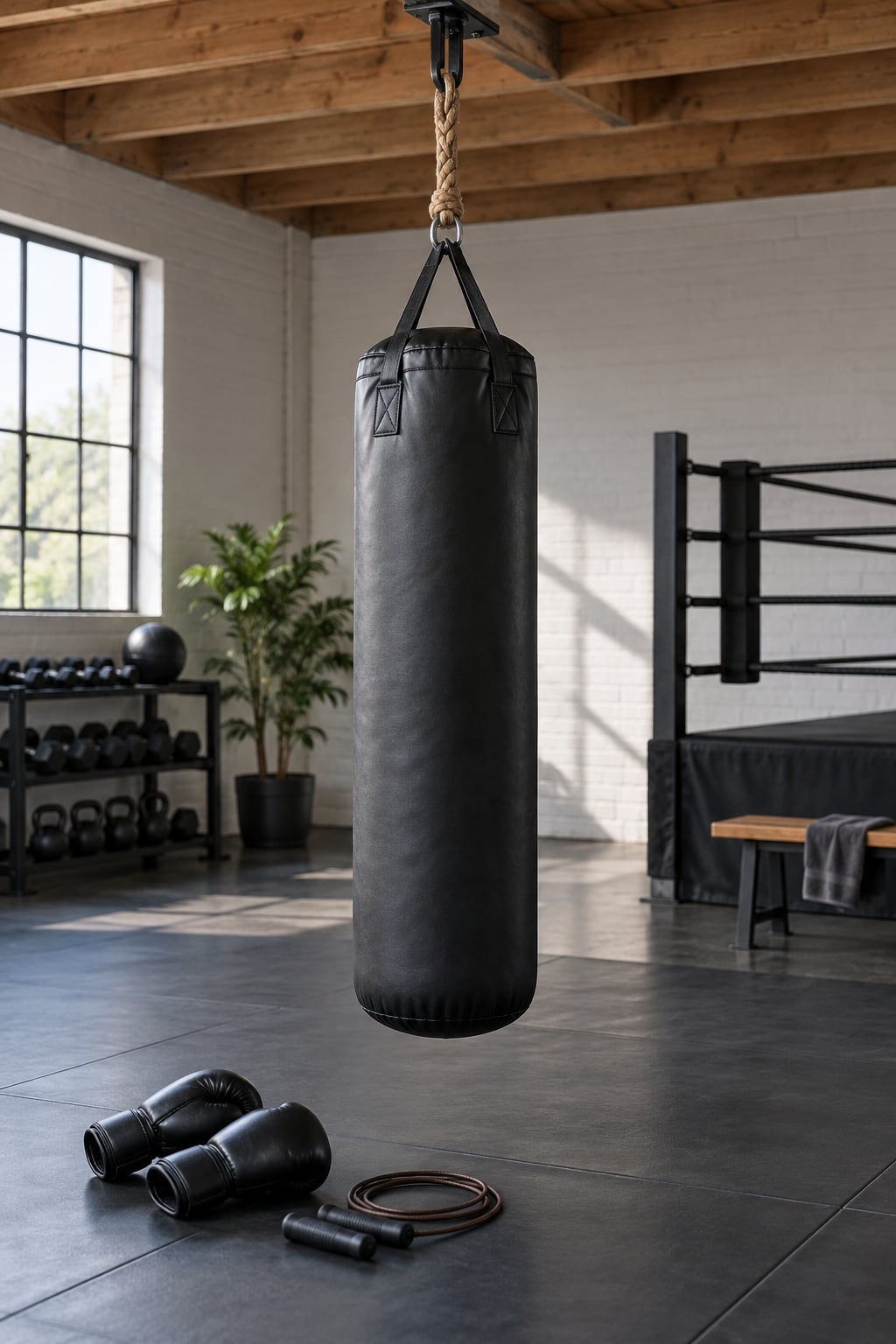
A slip bag is a small weighted bag on a rope, roughly fist-sized, and hitting it makes it swing back at you. That is the whole trick behind what a slip bag trains: because the bag moves on a loose rope, you have to read it, slip off the centreline, and fire back, so it builds head movement, defensive timing, balance, footwork and the counter-punch that follows a slip. It is one of the few home-gym tools that gives you a moving target without needing a partner.
Plenty of people treat it as a novelty, swinging at it for a few minutes and moving on. Used well, with the bag hung about chin height and filled with something heavy enough to move, it is closer to a sparring partner that never talks back. I’ve broken down what it develops, what it genuinely does not, and how to build up to it.
Updated for 2026 with the setup details coaches actually check before anyone starts hitting one.
Table of Contents
- What a Slip Bag Trains at a Glance
- Which Muscles Does a Slip Bag Develop?
- How Does a Slip Bag Improve Boxing Technique?
- How Is a Slip Bag Different From a Heavy Bag?
- Can a Slip Bag Replace Punching Bags or Sparring?
- How Do You Use a Slip Bag Safely?
- How Do You Progress With a Slip Bag?
- Frequently Asked Questions
- Conclusion
What a Slip Bag Trains at a Glance
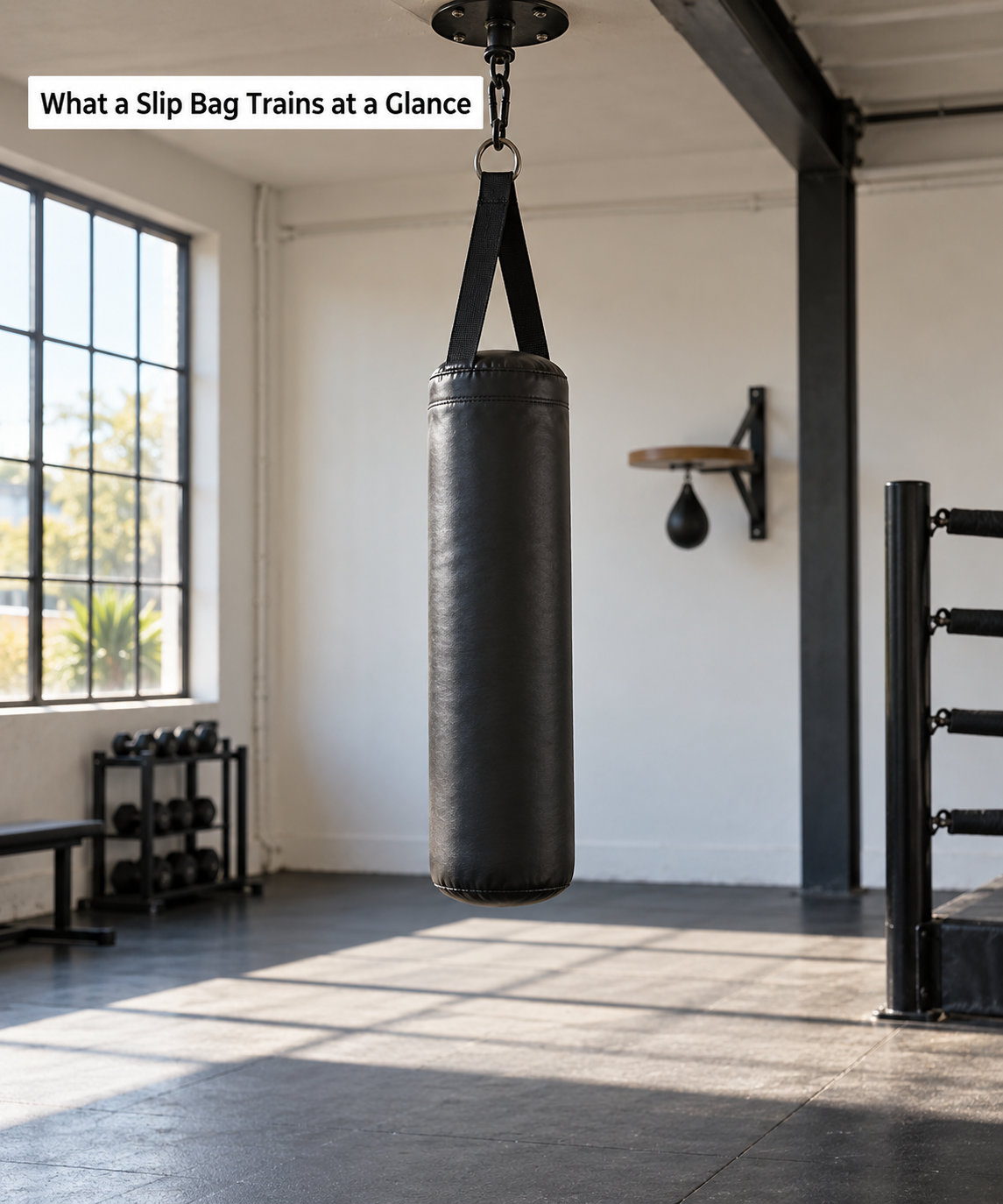
In short, what a slip bag trains is defensive skill under time pressure: slipping, rolling and pulling off the centreline, then countering into the space the bag just left. Everything else is downstream of that. The table below is the short version; the sections after it explain how each one gets developed.
| Training quality | What it looks like in a session | Main muscles involved | Ring attribute it serves |
|---|---|---|---|
| Head movement | Slip, roll, pull, bob and weave off the swinging arc | Neck, upper traps, obliques, hip rotators | Defence, avoiding the return shot |
| Reaction and timing | Reading the rope, choosing the slip before the bag arrives | Eyes, nervous system, forearm stabilisers | Reading an opponent, counter-punching |
| Balance | Staying upright mid-slip while the weight is off the back foot | Glutes, hamstrings, calves, core | Staying planted under fire |
| Footwork and distance control | Stepping off the line, resetting, pushing the bag away and following it in | Adductors, glutes, calves, feet | Ring cutting, controlling range |
| Counter-punch technique | Slip, then straight right or hook into the gap, then recover | Glutes, hamstrings, lat, core, shoulder girdle | One-two punching, countering |
| Conditioning | Short rounds of continuous work with limited rest | Full body, sustained | Fight fitness, high-intensity rounds |
What a Slip Bag Trains in a Typical Session
A twenty-minute session might run three rounds of slips and counters, two rounds of bob and weave work, and a couple of rounds where you push the bag away with a straight and follow it back in. In that twenty minutes you will have moved your head more than you would in an hour of shadowboxing, because every strike needs a defensive answer first.
The bag also keeps the cardiovascular cost up without any jumping or running, which is why it turns up as a conditioning tool in a lot of home programs. It just does not build the same engine as real roadwork, and I would treat that as a side benefit rather than the point.
Which Muscles Does a Slip Bag Develop?
Two different muscle jobs are happening, and it is worth separating them. The slip itself is a lower-body and core action driven by the hips and legs, while the counter-punch that follows is a full-body kinetic chain action. The neck and traps are along for the ride, stabilising rather than driving.
The power group is the legs and hips. Glutes and hamstrings push you off the line and give the punch its base, adductors do the side-to-side stepping that makes a slip fast, and the calves keep you light on the balls of your feet. Rotating through the hip and obliques is what separates a counter that lands from one thrown with the arm alone.
The stabilisers do the quiet work. The core keeps the trunk from folding when you bend the knees and twist, the shoulder girdle holds the arm out in guard, and the neck manages the head position. Runners describe the first fortnight of slip bag work as all neck, and they are not wrong, because the neck is responding rather than leading.
What you build is strength endurance, not maximal strength. Nobody adds kilos to a bench press from a slip bag. The adaptation is that your muscles hold a position under load for two or three minutes at a time, repeatedly, week after week, which is a very different thing from moving the heaviest weight you can lift once.
How Does a Slip Bag Improve Boxing Technique?
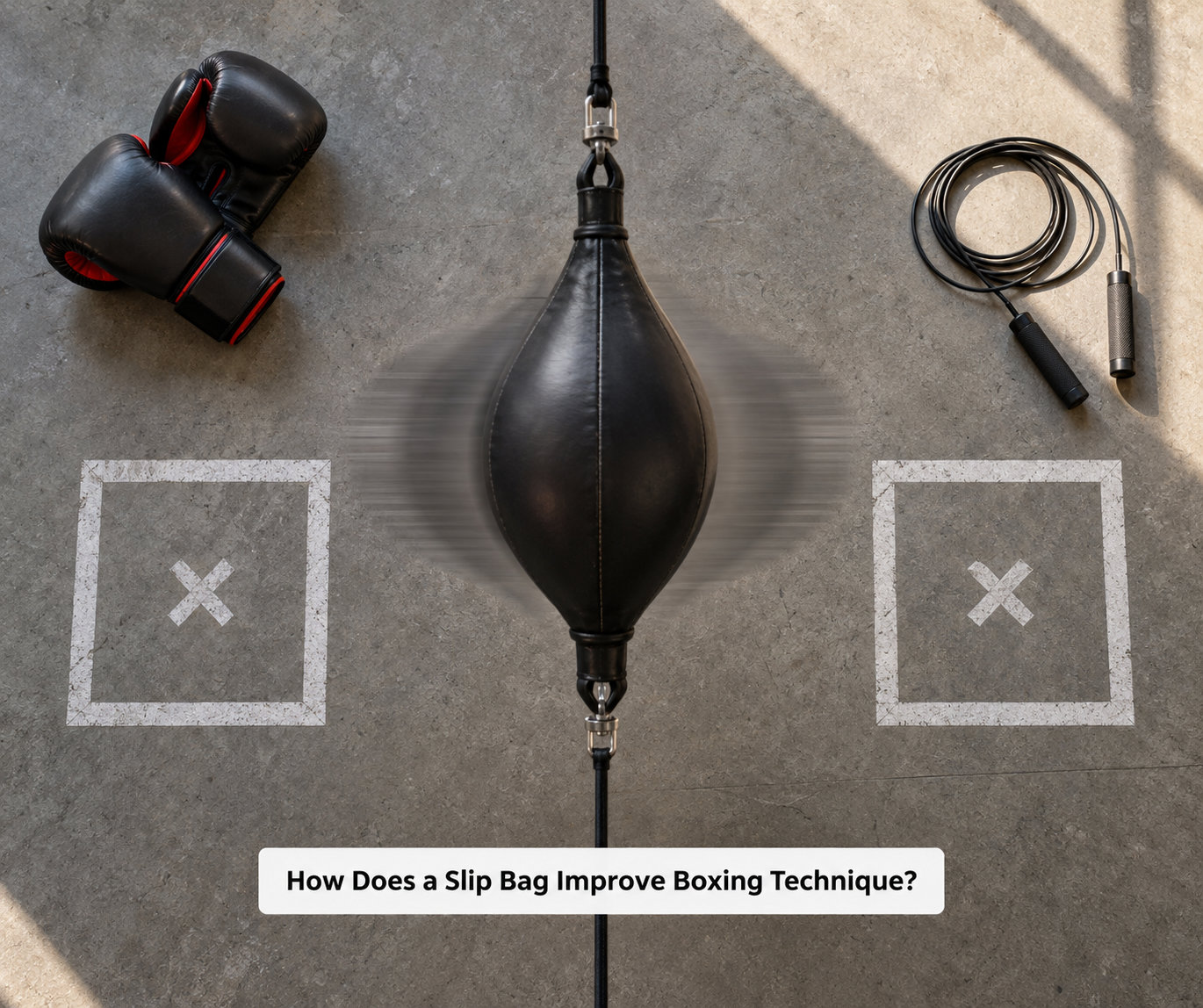
The bag punishes sloppy technique more than a heavy bag does, and that is where most of the technical gain comes from. A heavy bag sits still, so you can wind up, drop your guard and still get a satisfying thud. A slip bag swings away from you, and a bad habit simply misses or takes a rope to the shoulder.
That produces a few specific corrections. Your guard comes back up immediately after every strike, because the bag comes straight back. Your feet keep moving after a punch, because a stationary boxer gets hit by the returning bag as often as by the punch. And your eyes stay on the target, because a slip chosen too early is a slip into nothing.
Punch selection improves too. There is no second bag waiting to take a jab and a cross in one combination, so you learn which single shot fits the opening you made. A lot of boxers who love three-punch flurries find the slip bag teaches them to fire one punch properly and reset, which is a lesson heavy bags teach badly.
Breathing gets sorted out too, because three hard rounds without exhaling is a lesson everyone learns once and only once. Breathe out sharply on the strike, not on the slip, and the technique holds up when you are tired.
How Is a Slip Bag Different From a Heavy Bag?
They fail in opposite directions, which is why a good gym has both. The heavy bag gives you a fixed target, heavy resistance, and the ability to go hard on conditioning and power. The slip bag gives you an unpredictable target, almost no resistance, and far better defensive work. Neither substitutes for the other.
| Criterion | Slip bag | Double-end bag | Heavy bag |
|---|---|---|---|
| Target movement | Random swing on a rope | Both ends rebound in a fixed pattern | Fixed, only moves when hit |
| Main training value | Head movement, balance, counters | Hand-eye coordination, rhythm, accuracy | Power, conditioning, combinations |
| Unpredictable timing | Yes, fully | No, learnable rhythm | No |
| Load on the body | Low | Low to medium | High |
| Space needed | Small, about two metres clear | Small | Large swing area |
| Best used for | Slip, roll, bob and counter drills | Speed, timing, accuracy circuits | Rounds, power, fatigue work |
| Does not replace | Pad work, sparring, heavy-bag power | Defense, conditioning rounds | Defensive skill, footwork |
Worth being honest about the speed bag in the same breath. It is a rhythm and coordination tool that also happens to burn a lot of calories, and the coordination it builds is useful. It does not train defence, because the ball is not trying to come back at your head. Boxing forums tend to phrase this the same way: a speed bag is a tool for accuracy, a slip bag is a tool for surviving.
Can a Slip Bag Replace Punching Bags or Sparring?
No, and anyone who tells you otherwise is selling something. A slip bag has no speed control, no intention, and no body. It cannot jab, feint, or punish you for over-committing, so none of the fight skills that decide rounds come from it.
The scepticism shows up constantly in r/amateur_boxing threads, and it is fair. Boxers there ask whether swinging at a random bag teaches anything you cannot get from a double-end bag or from sparring. The honest answer is that it teaches one specific thing they value highly: keeping your balance while slipping and counter-punching, and coming off a slip with a punch at a real target rather than into empty air.
What the bag cannot do is replicate opponent timing, because the rope has no plan. So treat it as a supplement. Boxers who get the most from it use it to sharpen a specific defensive habit, then go to pad work or sparring to test that habit against a person who reacts. Sessions built around that order tend to stick; sessions where the bag replaces partner work tend not to.
The same logic applies to heavy-bag rounds. A slip bag will never build the punching power and conditioning that a heavy bag builds, and losing that is a real cost. If your week only has room for one bag, pick the one matching your goal: defence and balance, or power and fitness.
How Do You Use a Slip Bag Safely?
General information here, not medical advice, and a coach is worth more than any article. Some practical rules that keep most injuries off the mat.
Check the anchor before every session, and use a joist rather than a plasterboard ceiling. The bag should hang at chin level or slightly below, on roughly two metres of rope, filled with about a kilogram of rice or sand so the fill stays put at the bottom. A bag that swings lower than your chest turns every slip into a bad habit.
Give yourself clear space. You need about two metres in every direction, more if you are moving around the bag, and a ceiling high enough that you are not punching into joists. Clear the floor of anything you could catch a foot on, and keep an eye on who else is training nearby.
Use hand wraps under your gloves, or boxing gloves rated for bag work, and keep the wraps snug. A loose wrap rolling around the knuckle while a rope swings is how people hurt fingers. The rope is stiff and short-ranged, so it catches wrists and knuckles more often than a heavy bag does.
Do not train through neck pain. A sore neck the morning after a first session is common, sharp neck pain during or after is a stop signal, as are dizziness, tingling in the hands, and anything that feels like a knock to the head. If any of those persist, see a doctor or physiotherapist rather than pushing another round.
Keep sessions short. Most coaches start people at three rounds of two minutes with a minute’s rest, two or three times a week, and build from there. Slip bag work is easy to do for twenty minutes and easy to do far too much of.
How Do You Progress With a Slip Bag?
Progression here means cleaner and more varied, not heavier or longer. Anyone who gets harder is training the wrong thing. The ladder below works from a standing start to a real fight-round effort, and each step is usually a few weeks apart.
Step one is the pull. You take a step back off the centreline, hands up, and let the bag swing through without swinging at it. Most beginners start here and stay longer than they think they need to. Only add a punch when the slip is automatic.
Step two is the slip and counter. Slip off the arc, then fire a straight right into the space the bag vacated, and get your guard back. Counting the slip, the counter, and the recovery out loud tends to tighten it up fast.
Step three is footwork. Push the bag away with a straight hand, let it swing out, then step in behind it. This trains following an opponent back, controlling distance, and moving your feet while your hands are occupied.
Step four is the bob and weave. Bend the knees rather than the waist, stay on the balls of your feet, and keep your eyes on the bag. This is where quality separates fast from sloppy.
Step five is combinations under pressure. One or two punches only, but with intensity, and short rest. By then you should be able to hold a technique for three hard minutes, which is roughly a round.
Frequently Asked Questions
Is a slip bag good for beginners?
Yes, and it is one of the better first pieces of bag equipment. The movements are small, the load is light, and you can practise the three fundamentals of defence, slipping, rolling and pulling, without risk to a partner. Start with the pull only, no punch, until the movement stops being a conscious effort.
Do slip bags build muscle?
Not in the way weight training does. What slip bag work builds is strength endurance, meaning your muscles hold a position under load for two or three minutes, repeatedly, over months. It supports your boxing by making technique survive fatigue, but it will not add meaningful size or maximal strength on its own.
How often should I train with a slip bag?
Two or three sessions a week is plenty for most people, and the quality of those short sessions matters far more than frequency. Beginners usually do well with three rounds of two minutes and a minute of rest, adding a little time every few weeks. Daily slip bag work tends to produce neck soreness without extra skill.
Are slip bags better than heavy bags for boxing?
Neither is better, they train different things. A heavy bag builds power, conditioning and combination work against a fixed target. A slip bag builds head movement, balance, footwork and counter-punching against an unpredictable one. Most fighters use both, and pick whichever matches what they are currently weak at.
What gloves should I use with a slip bag?
Hand wraps under your gloves every time, kept snug so they cannot bunch around the knuckle. Boxing gloves rated for bag work are enough; you do not need sparring gloves, and they will be too bulky to slip past a swinging bag. If your wraps feel loose, retape them before you start.
How long should a slip bag session last?
Fifteen to twenty-five minutes is the useful range, worked in short rounds rather than one long block. Anything longer and the technique decays as you tire, which teaches you bad habits instead of good ones. Rest a full minute between rounds, and stop while your form is still clean rather than pushing to a final round.
Conclusion
What a slip bag trains is defensive skill against a moving target: slipping off the centreline, holding your balance, and countering into the space you just made, plus the footwork and strength endurance to do it when tired. It does not replace heavy bags, pad work or sparring, and it cannot teach you to read an opponent, so use it to sharpen one habit and then test that habit with a person. Start with the pull, no punch, keep sessions short, and have a coach look at your setup before you begin.