
A boxing camp is a periodised block of training built for one opponent and one date. Most professional camps run six to twelve weeks, with eight weeks as the standard, and they move through five phases in order: a base built on general fitness, an intensification block, fight-specific work on the actual opponent, a taper that cuts volume while keeping intensity, and a short fight week. Get that sequence wrong and a skilled fighter shows up flat, hurt, or over the weight.
Most people asking how boxing camps are structured want the same thing: the week-by-week picture, not a list of gym exercises. So below is the whole structure, phase by phase, with what each week looks like, what changes inside a session, and where camps most often go wrong.
One note before we start. Everything here is general sports information drawn from how professional and amateur programmes are typically built. Individual plans depend on a fighter’s history, injuries and medical status, so anyone under a coach should get advice from that coach and a qualified medical professional rather than copying a schedule off a web page.
Table of Contents
- How Boxing Camps Are Structured
- How Long Does a Boxing Camp Usually Last?
- The Main Phases of a Boxing Camp
- How Is a Typical Boxing Training Day Organized?
- What Happens During Fight Week?
- How Do Trainers and Support Staff Build the Camp?
- How Do Boxers Lose Weight Safely for a Fight?
- How Does Sparring Change During Camp?
- How Do Recovery and Monitoring Shape a Camp?
- What Are the Most Common Boxing Camp Mistakes?
- Frequently Asked Questions
- Conclusion: Start With the First Practical Step
How Boxing Camps Are Structured
A boxing camp is a fixed-length training block that takes a fighter from wherever they are now to being ready for a specific bout. Structure is the point: the workouts, volume and intensity change on a planned weekly curve, so the fighter arrives sharp on one Saturday night rather than exhausted from twelve weeks of the same work.
The camp does two things that ordinary training does not. First, it converts general preparation into fight preparation. Roadwork and heavy bag rounds build an engine; padwork and sparring build a way of using that engine against a moving opponent with plans of his own. Second, it manages the fighter’s condition, which means nutrition, weight, sleep, injuries and recovery get scheduled rather than dealt with when they become a problem.
What separates fight-specific work from general preparation
General preparation raises the ceiling: aerobic base, general strength, technical fundamentals, volume. Fight-specific work is narrower and harder to fake, because it depends on knowing what the opponent actually does. Which punch they drop after the jab, whether they go to the body, how they behave when hurt in round four.
A camp usually sets macro goals first — arrive at fight weight with the engine intact, sharpen the left hook, survive twelve rounds — and then breaks them into micro goals per session. Fighters and coaches who do this well talk in micro goals, because “survive twelve rounds” is not something you can work on at 6am on a Tuesday.
How the weekly structure works
Inside a phase, the week itself has a rhythm: a hard day, a lighter technical day, another hard day, then rest. Fighters on the subreddit r/amateur_boxing describe training five or six times a week with long morning runs, which is a normal shape for an amateur with a job or school around the camp. Full-time professionals often run two sessions a day, six days a week, with one true rest day.
What does not change week to week is the phase logic. Each week of the intensification block is slightly harder than the last, then it stops getting harder. Camp is not a contest to see who can suffer longest.
How Long Does a Boxing Camp Usually Last?
A normal professional boxing camp lasts about eight weeks. The working range is six to twelve weeks, and what moves a camp within that range is the fight level, the notice a fighter gets, the fighter’s current condition, and how much technical work has to be rebuilt rather than sharpened.
Regional and undercard bouts often take six to eight weeks, mostly because they come with short notice. Title fights commonly run ten to twelve weeks, because the opponent is assumed to be a fully prepared professional who is already in form. Amateur tournament camps sit at six to eight weeks, and Olympic qualifying runs longer because the competition format demands repeated fights in a short block.
| Situation | Typical length | What drives it |
|---|---|---|
| Regional or undercard debut | 4 to 6 weeks | Short notice, limited time to rebuild |
| Standard professional bout | 6 to 8 weeks | The eight-week pro standard |
| Title eliminator | 8 to 10 weeks | Opponent assumed to be in peak condition |
| Title fight | 10 to 12 weeks | Longer build plus more tactical rehearsal |
| Amateur tournament | 6 to 8 weeks per tournament | Multiple bouts inside one week |
| Short-notice call | 3 to 4 weeks | Only maintenance, not building, is possible |
A compressed camp of three or four weeks is a real thing and it changes the shape of the plan. You cannot build a base in a month, so the work becomes maintenance and sharpening: keep the engine from fading, install the game plan, and pray the fighter was already fit. Fighters on the BoxRec forum draw the same line, sorting camps into short camps, invitational camps for advanced boxers, and long camps for major fights.
The Main Phases of a Boxing Camp
Every camp, however it is arranged, moves through five phases. Here is how boxing camps are structured phase by phase, using an eight-week camp as the reference.
- Foundation (weeks 1 to 2). Base conditioning and technique. The fighter rebuilds work capacity, fixes obvious technical flaws, and any injuries from the last camp get assessed and treated. Volume is high, intensity is moderate. Sparring rarely happens here beyond controlled technical rounds.
- Intensification (weeks 3 to 4). Volume stays high but the quality of the work rises. Sparring begins and builds week by week. Strength work shifts from heavy to power-oriented. The fighter is getting tired and getting sharper at the same time, which is exactly the intent.
- Peak or fight-specific work (weeks 5 to 6). The heaviest sparring of the camp lands here, usually against partners brought in to imitate the opponent’s style and height. Tactics for this specific fighter get drilled in pad sessions rather than explained.
- Taper (weeks 7 to 8, roughly). Volume drops by half or more while intensity stays sharp. Long runs shorten, sparring becomes short and controlled, extra gym work stops. The fighter is not getting fitter; they are getting fresher while holding what they built.
- Fight week (the final seven days). Short sessions, one piece of sparring at most, weigh-in managed, sleep protected, nothing new introduced.
| Week | Primary focus | Sparring | Milestone |
|---|---|---|---|
| 1 | Base conditioning, assessment | None or technical only | Weight plan agreed |
| 2 | Technical repair, volume build | Light, controlled | Camp baseline measured |
| 3 | Intensity up, strength shifts to power | Moderate, 4 to 6 rounds | Opponent study begins |
| 4 | Peak volume, first hard sparring | Heavier, partner-specific | Game plan drafted |
| 5 | Heaviest sparring of the camp | 8 to 10 rounds, style-matched | Tactical scenarios rehearsed |
| 6 | Sharpening, conditioning for fight distance | Reduced, high quality | Final strength session |
| 7 | Taper begins | Short, controlled rounds | Weight down, close to fight weight |
| 8 | Fight week | Minimal or none | Made weight Saturday |
The numbers in that table are representative rather than fixed. A coach working a southpaw might start sparring earlier and run lighter rounds; a fighter coming off an injury might extend the foundation phase and shorten peak. The sequence is the standard, the arithmetic is not fixed.
How Is a Typical Boxing Training Day Organized?
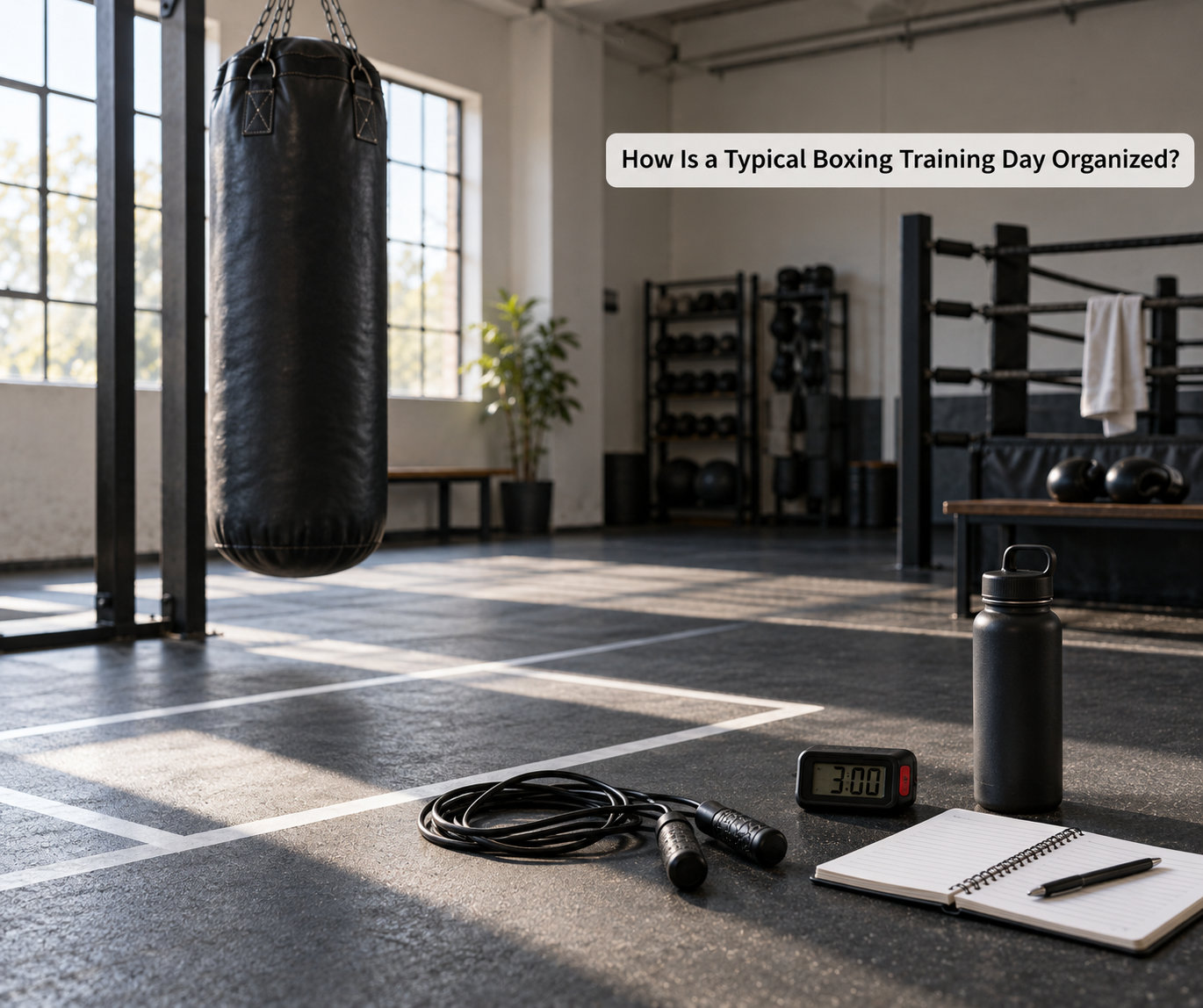
A camp day usually runs in the same order: roadwork, skills, pads, bag, then conditioning and recovery. Order matters because a fighter should not start punching hard before the body is warm and the technique has been reminded.
The building blocks of a session
Roadwork or jump rope opens the day. Amateur fighters commonly run three to five miles in the morning, and veterans on r/MuayThai advise that three sessions a week is plenty if you already run consistently — long daily mileage is a habit to inherit, not a test to pass.
Shadowboxing follows, usually six to eight rounds, working technique and rhythm without resistance. Padwork is where the fight plan actually gets installed: the coach throwing the opponent’s habits back at the fighter so the response becomes automatic.
Heavy bag work adds output and power, in sets of three-minute rounds with short rests. Speed ball and double end bag come in when the coach wants hand-eye and head movement without taking more damage. Sparring has its own block, later in the day or the week, never bolted onto the end of a hard bag session.
The classic mistake is stacking everything. Rope, then twelve rounds of hard bag, then sprints, then pads, leaves nothing for tomorrow. Camp days are usually two moderate-to-hard sessions separated by a rest window, not one endless session.
A double-session day in the intensification phase
6:00am — roadwork, five miles easy. 6:45am — stretch and mobility. 7:00am — shadowboxing and padwork, technical, moderate output. 8:00am — breakfast and rest. 12:00pm — heavy bag rounds and speed ball. 1:00pm — strength and conditioning session. 3:00pm — nap or pool recovery. 5:00pm — second technical session, padwork with game-plan scenarios. 7:00pm — dinner. 9:00pm — foam rolling or massage, lights out early.
A single-session amateur day
6:30pm — roadwork or rope, thirty to forty minutes. 7:15pm — shadowboxing and padwork with a coach. 8:00pm — bag work, six to eight rounds. 8:30pm — conditioning circuit or core and mobility. 9:00pm — home. Four or five evenings like that cover most of what an eight-week camp needs for someone who cannot train through the day.
What Happens During Fight Week?
Fight week is seven days of deliberately doing less. The purpose is not to add anything; it is to arrive rested, made weight, and with nothing in the body that has not already been tested in sparring.
Training drops to short, sharp sessions. A boxer might do a few rounds of padwork, light bag work, a little roadwork, and skip the gym entirely on the last two days. Sparring either ends early in the week or becomes a short, controlled session with a familiar partner, because a cut or a surprise is not worth taking at that stage.
Weight management takes over attention. The fighter is already close to fight weight by Friday, and the remaining approach belongs to the cut team rather than to the training plan. Media duties fill the gaps: press, weigh-in, interviews, tape. Those look like interruptions but they are the schedule, and they burn energy the fighter cannot replace.
Travel happens in the middle of the week, usually, so the fighter is in the fight city with time to settle. Sleep gets protected more ruthlessly than anything else. On fight night the fighter wakes having done almost no training for several days, which feels wrong to anyone who has trained hard for two months, and it is the entire reason they feel sharp.
How Do Trainers and Support Staff Build the Camp?
The camp is written by a head coach, but it is delivered by a corner of six or eight people. Knowing who owns which part of the plan matters, because fighters who get mixed messages about weight, sparring or strength work usually have more than one coach’s opinion in their head.
- Head coach — owns the overall plan, the game plan and the weekly call on load. This is the person deciding whether the camp can absorb another hard sparring day.
- Assistant and corner coaches — run the sessions, hold the pads, run the line in sparring, and watch for the technical detail the head coach cannot catch while doing the same.
- Strength and conditioning coach — programs the gym work, handles the power transition, and manages how much lifting survives into fight week. This is a separate job from boxing coaching in most serious camps.
- Nutritionist — owns body composition and fuelling through the whole camp, and co-owns the weight plan with the fighter and coach. Not an afterthought in the final fortnight.
- Cutman — the person working between the fighter and the weight cut on fight week, and the one with a trained hand on a swelling or a cut.
- Physiotherapist or doctor — assesses injury risk, treats the small things before they become large, and decides when a session gets modified.
- Manager and promoter — handle the schedule, the venue, the contract and the media calendar. Managers and promoters rarely touch the training plan and absolutely shape the calendar it runs inside.
Common friction between these roles is not personality, it is scope. When the head coach wants three hard sparring days and the strength coach sees fatigue markers moving the wrong way, somebody has to make the call, and the camp works better when it is clear who does.
How Do Boxers Lose Weight Safely for a Fight?
Weight management is a camp phase, not a fight-week event. The bulk of it happens from the moment the date is confirmed, and by the final ten days or so the fighter should be close enough that the last push is small.
The safe structure looks like this: start early, eat in a modest deficit rather than a crash, protect protein so muscle stays on the frame, and let training carry the rest. Fighters moving down from a heavier amateur class often find this the hardest part of the whole sport, and the honest version of that problem is that the weight class choice made months earlier is the one that decides it.
Then comes the short cut in the last week, run by professionals — a cutman and a nutritionist working together, with the fighter’s physician involved if there is any history worth flagging. It typically means carbohydrate reduction, fluid restriction and careful supervision, because the scale number is not worth a medical event.
What not to do is DIY. Laxatives, saunas, dehydration, diuretics and last-minute fasting can drop the number and cost a fighter the engine, the focus and in some cases much more. Anyone with a history of disordered eating, or who is cutting a large amount, should be under medical and nutritional supervision rather than following internet advice.
How Does Sparring Change During Camp?
Sparring progresses across the camp rather than starting at full volume. In the foundation phase there is little or none. By intensification it builds in short, controlled rounds. In the fight-specific phase it is the highest-quality sparring of the camp, against partners picked to resemble the opponent. In the taper it drops sharply, mostly for the head.
Partner selection is the part most amateur fighters get wrong. A sparring partner who is nothing like the opponent teaches different reactions than the ones required on fight night, so late-camp partners should be chosen for style, height, reach and pressure as much as for toughness. So should the weight difference be modest, and clear rules agreed in advance, because a bigger sparring partner is a different sport.
Accumulated head load is the genuine concern practitioners raise, and it deserves a straight answer. Regular hard sparring accumulates damage that a single session will not show you, which is why fighters damaged by long sparring wars are discussed so often in boxing forums. Manage it the way a coach would: hard sparring clustered rather than spread, hard headgear or a fresh partner for the sessions that really matter, rounds agreed in advance, and a willingness to stop a sparring block early if the fighter’s own assessment says so. Anyone with concussion symptoms — headache, nausea, confusion, sensitivity to light — stops training and gets seen by a doctor, not another round.
Timing also matters more than most fighters expect. Too early and nobody is sharp enough for the rounds to teach anything; too late and there is no time to correct what the sparring exposes.
How Do Recovery and Monitoring Shape a Camp?
Recovery is a scheduled block, not a leftover. Sleep gets treated as a training variable because it decides how much of the morning’s work survives into the afternoon, and camp is one of the few periods in a fighter’s year where sleep gets deliberately increased rather than sacrificed to another session.
Rest days sit inside the week on purpose. Fighters describe feeling drained four weeks into a camp, and that feeling is data rather than weakness; it usually means the load is ahead of the recovery, and the answer is a lighter week or a rest day, not more suffering.
The recovery menu includes food that supports the work, foam rolling, massage, stretching and mobility, ice baths and cold-water immersion, pool work when the joints need it, and time genuinely off. Monitoring runs alongside: weight trends, resting heart rate, sleep quality, morning soreness, mood and confidence in the gym. None of it is exotic, and all of it gives the coach something to adjust instead of guessing.
Progressive training has to be balanced against recovery rather than treated as a contest of endurance. More work only produces more fitness when recovery keeps up, and the taper is where that logic gets its payoff: the fighter keeps intensity, loses volume, and arrives at peak readiness on fight night.
What Are the Most Common Boxing Camp Mistakes?
Most failed camps are not fitness failures. They are planning failures, and they repeat.
- Changing everything at once. A new gym, a new coach, a new weight class and a new fight date in the same camp guarantees you spend the first three weeks rebuilding instead of progressing.
- Leaving weight until late. Trying to lose a large amount in the final fortnight means the fighter is hungry and depleted through the heaviest sparring of the camp.
- Dropping strength training completely. Practitioners call it one of the most common mistakes of fight camp. Heavy lifting comes down as camp progresses, but strength work is reduced rather than deleted, because the gains made in the first half of camp persist for weeks afterwards and carry into the fight.
- Sparring wars. Proving toughness against bigger, harder partners in week four buys nothing and can end the campaign with a cut or a concussion.
- Copying workouts instead of programming a plan. Fighters who grab a famous fighter’s routine get that fighter’s weaknesses too, and no progression at all.
- Borrowing endurance training wholesale. Long slow distance running builds an aerobic base a boxer half uses, and none of the twelve-round specific engine. Anaerobic and sport-specific work does the job.
- Treating exhaustion as the goal. Camp is a process of arriving fresh, and the last ten days matter more than the last thirty.
- Ignoring the non-training load. Family stress, school, a full-time job and broken sleep all count against the plan, and the amateur who trains five evenings a week has to fit the schedule around those rather than pretend they do not exist.
Frequently Asked Questions
How long is a normal boxing camp?
About eight weeks for a standard professional bout, with six to twelve weeks as the working range. A regional debut on short notice might be four to six weeks, while a title fight often runs ten to twelve weeks. Amateur tournament camps sit at six to eight weeks. What sets the length is the fight level, the notice available, and how much condition the fighter already has.
How many rounds of sparring should a boxer do in camp?
There is no single number, because rounds are graded by intensity rather than counted alone. Early-camp sparring is short and controlled, typically four to six rounds. The fight-specific phase carries the heaviest load, often eight to ten rounds across a session or two. During the taper it drops sharply, and fight week is usually sparring-free or limited to a short controlled session.
Should I lift weights during a boxing camp?
Yes, but less of it, and differently. Strength work is reduced rather than cut out, which practitioners repeatedly identify as one of the most common mistakes of fight camp. Heavy loading drops early as the emphasis shifts to power and strength-speed work, then the final session lands a couple of weeks out. The strength built in the first half of camp persists into fight night.
What is a taper in boxing?
The taper is the dial-back period at the end of a camp where training volume drops sharply while intensity stays high. Long runs shorten, sparring becomes brief and controlled, and extra gym sessions stop. Nothing new is introduced. The purpose is to shed fatigue while keeping the adaptations already earned, so the fighter shows up on fight night fresh rather than flat.
How many training sessions a day do boxers do in camp?
Most full-time professionals run two sessions a day, six days a week, with one true rest day and a lighter version of the week built around it. Amateur fighters with a job or school usually manage one session in the evening, five or six evenings a week, and it can produce a perfectly good camp. The number matters less than the rhythm, the progression and the recovery between sessions.
What is the difference between an amateur and a professional boxing camp?
An amateur camp is shorter, usually six to eight weeks, built around technique development, conditioning through sparring, and tournament scheduling with several bouts in one week. A professional camp runs longer, up to twelve weeks for a title fight, and is built around one opponent, one game plan, professional weight management and a larger corner team. The phase structure itself is the same.
Conclusion: Start With the First Practical Step
How boxing camps are structured comes down to a sequence: build a base, raise the intensity, install the fight plan against this opponent, cut the volume without losing sharpness, then do almost nothing for the last seven days. Eight weeks is the professional standard and six to twelve is the working range, but the phases matter more than the exact number of weeks.
The first practical step is to fix the four things everything else depends on: the fight date, an honest assessment of where the fighter actually is right now, a measurable set of goals for the bout, and a schedule built around safe progression with recovery inside the week. Get those right and the rest is execution.