To watch boxing like a judge, you do two things: you set yourself up to actually see the fight instead of reacting to it, and you write down a score for every round using the 10-point must system. In a professional bout, three ringside judges score each round on the same four criteria — clean punching, effective aggression, ring generalship and defence. Nobody watches the same fight you do, which is why your card and theirs will often disagree. Both things are learnable in an evening.
The skill is not about being right. It is about having a card you can defend round by round, and a reason for every number you wrote.
I have watched more fights with a pen in my hand than without, and the biggest change was physical, not intellectual. Judges sit ringside in near silence, score between rounds without talking to each other, and never hear a word of commentary. Once you copy that setup, the whole sport opens up. What looked like two men trading punches turns into a contest over territory, and what looked like a busy round turns out to be mostly noise.
Here is how to build the setup first, then the scoring routine you can repeat every fight, updated for 2026 fight cards.
Table of Contents
- What You Need
- Step-by-Step: How to Score Each Round
- 1. Know the Rules and Ring Area
- 2. Establish a Ring-Position Baseline
- 3. Count Only Clean, Effective Punches
- 4. Compare Work in the Three Areas
- 5. Judge Defence Without Overvaluing It
- 6. Weigh Ring Control and Aggression
- 7. Check the Action for Fouls and Point Deductions
- 8. Keep an Honest Round-by-Round Record
- Common Mistakes
- Frequently Asked Questions
- Conclusion
What You Need
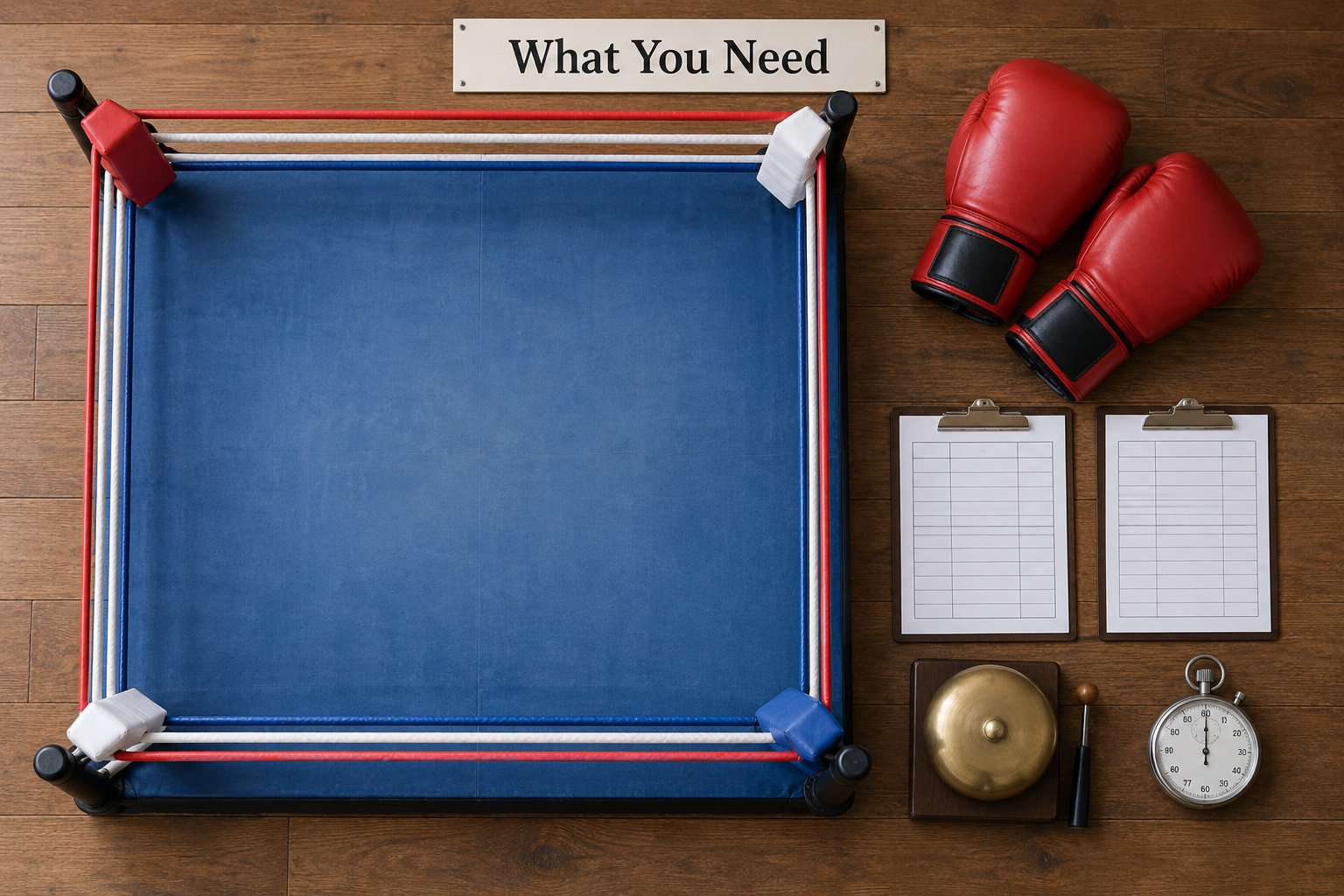
You need less than you would expect: a rule baseline, a pen, and a way to pause.
Start with the rules, because every judgement you make sits on top of them. Professional fights in the United States, Britain and most of the world run on the Unified Rules of Boxing, promoted by the sanctioning bodies — the World Boxing Council, the World Boxing Association and the International Boxing Federation. Amateur competition uses the IBA ruleset, and USA Boxing sets the rules for most US amateur boxing. The differences show up in scoring, which we get to later.
Know the ring before you know anything else. A boxing ring is twenty feet across, with a set of ropes on each side and a neutral corner. Officials and judges talk about it in quarters: the centre, the ropes, the away, the pocket. A fighter who has taken the away and put his opponent on the ropes is not just landing punches; he is controlling where the fight happens. That distinction is the whole game once you can see it.
Rounds run three minutes in professional boxing, with one minute of rest between them. Amateur bouts are three rounds of two minutes. Knowing the clock matters, because fatigue changes the ring-position map in the final sixty seconds and judges score the round they see, not the round they expected.
Then define a clean punch before you watch one. A punch counts when it lands with the knuckle part of the glove on a legal target area, cleanly and with force. The target is above the belt line — head and body. A punch that lands on the gloves, or that is caught on the shoulder as the head turns away, is not a scoring punch, however hard it was thrown. Fighters land a lot of shots on each other that judges do not see. Sound is not proof. Check where the glove contacted and how the receiver reacted: a wobble, a stagger, a step back to reset, or a hand dropping to the ribs, all of them tell you more than the noise did.
Finally, get a scoring tool. A notebook is fine, or a plain note on your phone. What you need is a grid with a row per round and a column per fighter, because the arithmetic only works if you are not doing it in your head at the end.
Step-by-Step: How to Score Each Round
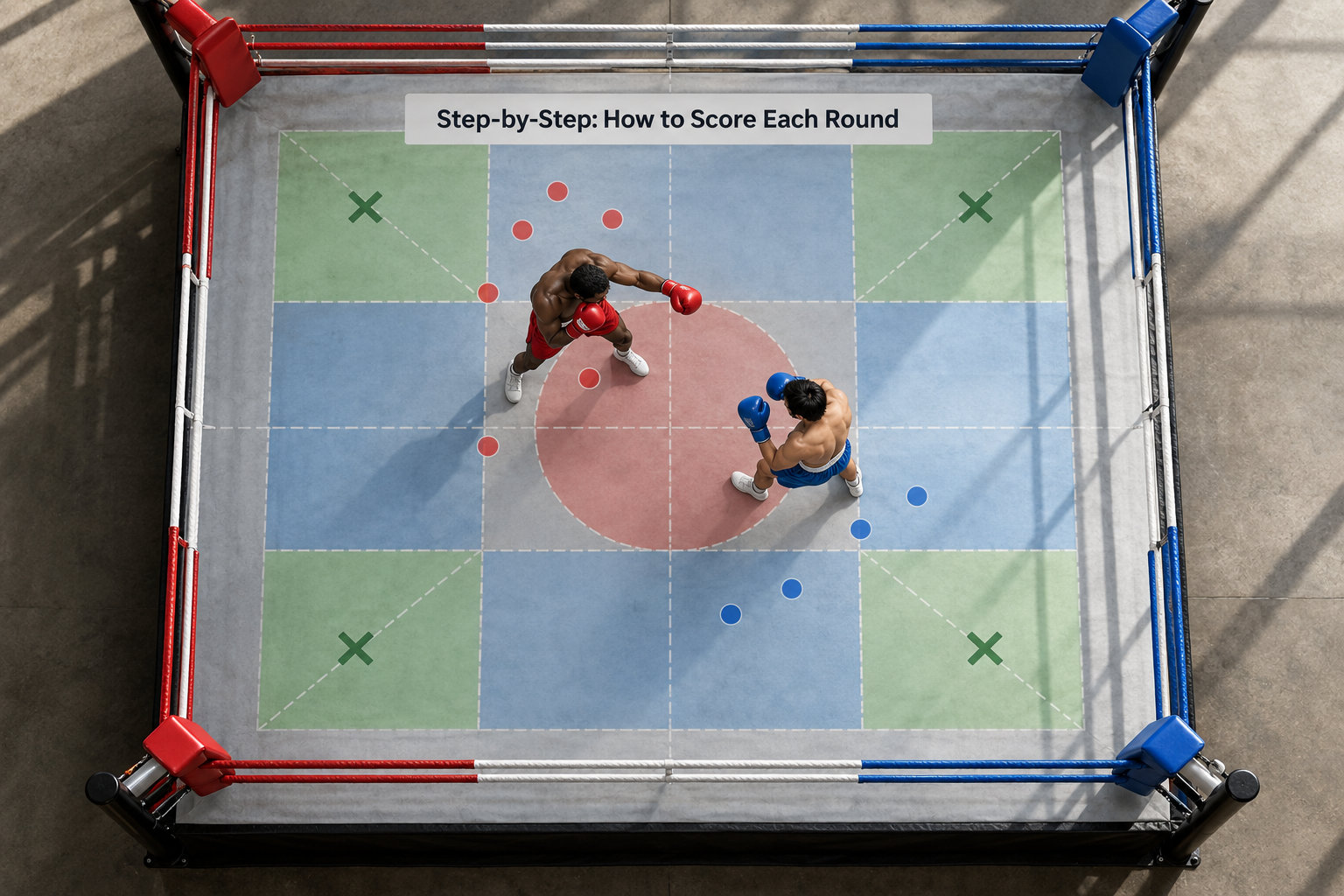
Run the same eight steps every round, in the same order. Consistency matters more than accuracy on any single round — it is what stops you from writing a card that is really a story about the fight you wanted to see.
1. Know the Rules and Ring Area
Before you count anything, know what a judge is allowed to count. A scoring punch lands with the knuckle part of the glove on a legal target area, which is the head and the body above the belt line. A punch that lands on the gloves, the back of the opponent’s head as he turns, or the floor does not count. Blocking is not a scoring punch either, and neither is holding.
Four major fouls will interrupt a round if you let them pass: low blows, headbutts, elbows, and holding or pushing. Get these right and the rest of your card will be sound, because every foul can cost a point and a point flips a 10-9 into a 10-8.
At close range, the scoring is about clean contact rather than damage. A short punch on the temple from a fighter who has slipped inside the guard is worth more than a hard shot into a tucked elbow. Watch for the knuckle part of the glove, not the forearm or the flat of the glove, which is a foul.
2. Establish a Ring-Position Baseline
At the start of each round, answer one question: who is deciding where this fight happens?
Someone holding the centre is choosing the range. A fighter pressing on the outside, working with the jab and making his opponent come forward, is choosing the pace. A fighter who has taken the away and put his opponent near the ropes or in a corner is choosing the finish. A fighter being pushed backwards round after round is not losing a round, but he is answering a question someone else keeps asking.
Note where the round ends as well as where it started. Movement across the ring is a change of position, and a change of position is scored. A round that starts in the centre and ends in the pocket of the pressure fighter is not neutral, no matter how even the punching looked.
3. Count Only Clean, Effective Punches
This is where most beginner cards go wrong. Count accuracy, not volume.
A punch that misses because the opponent slipped, ducked or stepped off the line was still thrown, and it still counts for nothing. A punch that lands clean on the guard or on the shoulder while the defender’s head is already moving is not a scoring punch. When both fighters trade at the same instant, judges credit the one whose glove actually made contact on a legal target, and there is no way to be certain from the broadcast angle — the honest call is an even round.
The useful cue is the reaction, not the sound. If the receiver’s head snaps, his feet reset, or he covers up and gives ground, the punch landed. If his head never moved and the glove did not reach skin, it did not. Experienced scorers on boxing forums make the same point about punch stats: volume is the easiest number to count and the least useful one.
4. Compare Work in the Three Areas
Judge the round in three zones and weight them the way judges do: head, body, and the space in between.
Head work comes with risk, because a missed head punch often ends with a counter right behind it. Body work is the cheapest place to be accurate, and consistent body punching is scored because it accumulates. Long-range work is measured by control of the distance: the jab that keeps an opponent from stepping in, the feint that draws a reaction, the shot that scores just as your opponent steps off the line.
Look at the defenders’ answers. Head movement, a tucked chin, elbows closing the ribs, and a pivot that turns the hips away from a punch all reduce what lands. Defence does not erase scoring, but a punch thrown into a slipping opponent at the wrong moment is a punch that did not happen.
5. Judge Defence Without Overvaluing It
Good defence is scored positively. A slip, a roll, a block that lands on the gloves and kills the punch, and a pivot that moves an opponent off the line all count in favour of the fighter doing them.
What does not count is running. A fighter who spends the last ninety seconds circling away from his opponent has defended nothing and made no fight. Nor does holding, leaning, or using the ropes to break an exchange. The distinction is simple: did the defender do something to the punch, or did he just put distance between himself and the danger?
A good rule for your notes is to score defence when it creates an opening later. A defender who slips a hook and immediately counters has made the defence part of an attack, and judges treat it that way.
6. Weigh Ring Control and Aggression
Effective aggression means pressure that lands, not movement. A fighter who comes forward, throws accurate shots and forces his opponent to give ground is doing the thing aggression is supposed to do. A fighter who bounces on his toes and looks busy is doing a lot of nothing.
The old 80/20 rule of thumb is useful here: if a fighter is landing about four of every five punches he throws, his aggression is being rewarded as pressure. Miss more than that and it becomes wild, and wild aggression is not scored even when the crowd loves it.
Ring generalship is the hardest thing for a new viewer to see, and it is the most common blind spot. Watch the second half of the fight, not the first. Fighters who win rounds late by taking away the neutral corner, cutting off the exit, or reversing the position are usually the ones with the better card, and the pattern only becomes obvious once you have watched the whole round.
7. Check the Action for Fouls and Point Deductions
Watch the referee, not just the fighters. The referee gives a warning first, and a point deduction follows for low blows, headbutts, elbows, holding, and pushing. Two low blows in one round is a round-ending situation in many jurisdictions, and the referee will step in and warn the fighter’s corner directly.
Do not deduct for every foul you think you saw. A referee who warns and moves on has decided it was not serious enough to score. If the referee writes on his card, the point is official, and your round total drops for the fighter who fouled.
One more thing to track: knockdowns. A knockdown is scored as a 10-8 by the referee, but the judges are not obliged to follow. Many experienced scorers do not hand out a 10-8 without a knockdown, because the professionals so rarely give one. If your card is full of them, go back through the rounds and ask what you were rewarding.
8. Keep an Honest Round-by-Round Record
Write the round down at the bell, while it is fresh, and do not go back and change it later. That single rule fixes most bad cards.
Use these three numbers and nothing else:
- 10-9 — a clear but competitive round. One fighter’s clean punching or ring control edges the other’s over three minutes.
- 10-8 — a dominant round. Usually triggered by a knockdown, or by one fighter landing almost everything for the full three minutes.
- 10-7 — a round that was nearly a shutout. A knockdown followed by a second knockdown, or sustained punishment with no answer.
- 10-6 — rare and close to a maximum. A knockdown plus a beating severe enough that the referee should have stopped it.
There is no 9-9 round and no 10-10 round in professional boxing. That is what the must in 10-point must means: every round goes to somebody, and the loser of that round gets nine points or fewer. The myth that a close round can be a draw is one of the most common things a new viewer gets wrong, and it comes from the days when drawn rounds were permitted.
Here is the grid. Copy it and use it for every fight.
| Round | Fighter A | Fighter B | Knockdown | Deduction | Why |
|---|---|---|---|---|---|
| 1 | 10 | 9 | — | — | |
| 2 | 9 | 10 | — | — | |
| 3 | 10 | 9 | — | — | |
| 4 | 10 | 9 | — | — | |
| 5 | 9 | 10 | — | — | |
| 6 | 10 | 9 | — | — | |
| 7 | 9 | 10 | — | — | |
| 8 | 10 | 9 | — | — | |
| Total | 77 | 75 |
Once the totals are in, compare the totals, not the number of rounds each fighter won. Here are the totals you will see most often.
| Card | How it adds up | Result type |
|---|---|---|
| 120-108 | 12 rounds won by 10-8, none drawn or even | Dominant unanimous decision |
| 119-109 | 11 rounds by 10-8, one 10-9 | Unanimous decision |
| 118-110 | Ten rounds by 10-8, two 10-9 | Unanimous decision |
| 117-111 | Nine rounds by 10-8, three 10-9 | Unanimous decision |
| 116-112 | Eight rounds by 10-8, four 10-9 | Unanimous decision |
| 115-113 | Seven rounds by 10-8, five 10-9 | Unanimous decision or split decision |
So 116-112 means eight rounds to four, decided by the judges who wrote 10-8 in those eight rounds. The gap of four points is the gap between the totals, not the number of rounds. A 115-113 card is the closest a judge can get while still declaring a winner in the pros, and it is where the arguments start.
Common Mistakes
Counting wild swings. A punch that misses is a punch that was thrown. Score accuracy, not intent.
Rewarding movement. A fighter who never stops moving has not made the fight. Pressure only counts when it forces something out of the opponent.
Favouring the flashier fighter. Style is not output. A counter-puncher who lands twenty clean shots has out-boxed a pressure fighter who throws a hundred and lands fifteen, and the judges will score it the same way.
Treating the body as a separate round. Body work accumulates inside the round you are scoring. It is not added to a head total at the end, and it does not get its own number.
Forgetting fouls and deductions. A point taken off turns a 10-9 into a 10-8, which is a round. Track the referee, not just the fighters.
Changing your standard mid-fight. If you gave round one to the pressure fighter on volume, do not hand round six to the counter-puncher on accuracy. Write each round on its own terms, and grade the card afterwards.
Calling it from the highlights. A round breakdown shows two clean punches that a three-minute sequence surrounded by misses. Nobody can score a fight from a clip, and a clip will always make the harder-looking fighter look worse.
Two habits fix most of the above. Score at the bell, before the commentary tells you what happened. And watch the space between the fighters, not the fighters themselves — the gap, the angle and the ropes tell you who is controlling the round, and the punches confirm it afterwards.
Frequently Asked Questions
How do judges score points in boxing?
Three judges in professional boxing, or five in amateur boxing, score every round independently using four criteria: clean punching, effective aggression, ring generalship, and defence. The winner of each round receives 10 points and the loser receives 9 or fewer on the 10-point must system. Judges write their cards between rounds without consulting each other, and the three totals decide the result by unanimous decision, split decision, majority decision, or draw.
What does 116 to 112 mean in boxing?
It means eight rounds to four over twelve. The judges gave the winner eight 10-8 rounds and four 10-9 rounds, for 116 total, while the opponent took four 10-9 rounds for 112. The four-point gap reflects how often the rounds were dominant, not how many rounds were won.
What is a 10-8 round in boxing?
A 10-8 round is a dominant round, scored 10 to 8. A knockdown usually triggers one, as does a round where one fighter lands almost everything. The referee scores knockdowns automatically, but the judges may still write 10-9, which is why 10-8 rounds are rarer than most viewers expect.
What is the 80/20 rule in boxing?
It is a rule of thumb for judging effective aggression: if a fighter lands roughly four of every five punches, his forward pressure counts as effective and scores. Below that, the same pressure looks wild and is not rewarded. It is a guideline rather than an official rule, and it helps separate a real pressure fighter from one who is simply busy.
Why does my scorecard never match the judges’ card?
Three structural reasons. The four criteria conflict, so two judges can favour different fighters in the same round. Each judge sits at a fixed seat with a slightly different angle, so they see different punches. And they score round by round in silence, while viewers carry a narrative about the whole fight. All three are reasons to keep scoring, not to stop.
How do I get better at scoring boxing?
Score one round at a time instead of whole fights, and say your reason out loud before you write the number. Track ring position, knockdowns and fouls in a small grid, and compare your card with the official one afterwards. Ring generalship comes last and takes the longest, so keep notes on where the round ended.
Conclusion
Pick one round from the next fight, mute the commentary, and score it alone. Watch the space between the two fighters rather than the fighters themselves, note the clean punches, the ring control, the defence, the aggression and any fouls, then write 10-9, 10-8 or 10-7 and say why. After the fight, pull up the official card and compare. That single exercise teaches more than a full evening of reacting to commentary, and it is the fastest way to watch boxing like a judge.