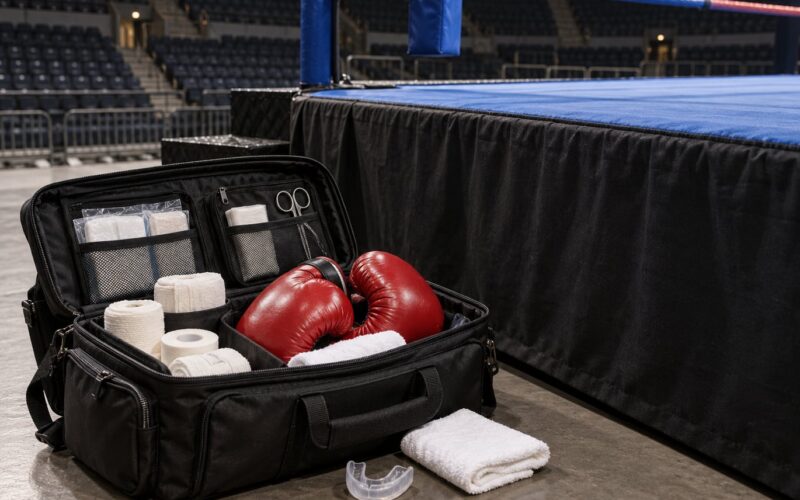
A punch lands on a fighter’s brow and within a minute the eye is shut. What closes it is not the eyeball itself but the loose, thin tissue around it: trauma ruptures tiny capillaries, blood and inflammatory fluid pool in that tissue, and because there is almost no connective tissue there to absorb it, the puffiness pushes the lids forward until they meet. And no, cutmen do not cut the eye open to fix it. That is a movie convention, and professional boxing does not do it.
Most of the time the swelling is cosmetic and fades on its own. The problem is that the same blow that closes the lid can also break a bone, tear the retina or injure the eyeball, and the swelling hides all of it. This guide covers what is actually happening in that tissue, what a corner can safely do, and the signs that mean stop now and see a clinician.
Table of Contents
- What Happens When a Fighter’s Eye Swells?
- Why Swelling Closes a Fighter’s Eye After a Punch
- Common Causes in Boxing and Other Contact Sports
- What to Do Immediately After Eye Swelling
- How Long Does Swelling Usually Last?
- Warning Signs That Need Urgent Medical Care
- How Swelling Can Affect a Fighter’s Eyesight
- Frequently Asked Questions
- Conclusion
What Happens When a Fighter’s Eye Swells?
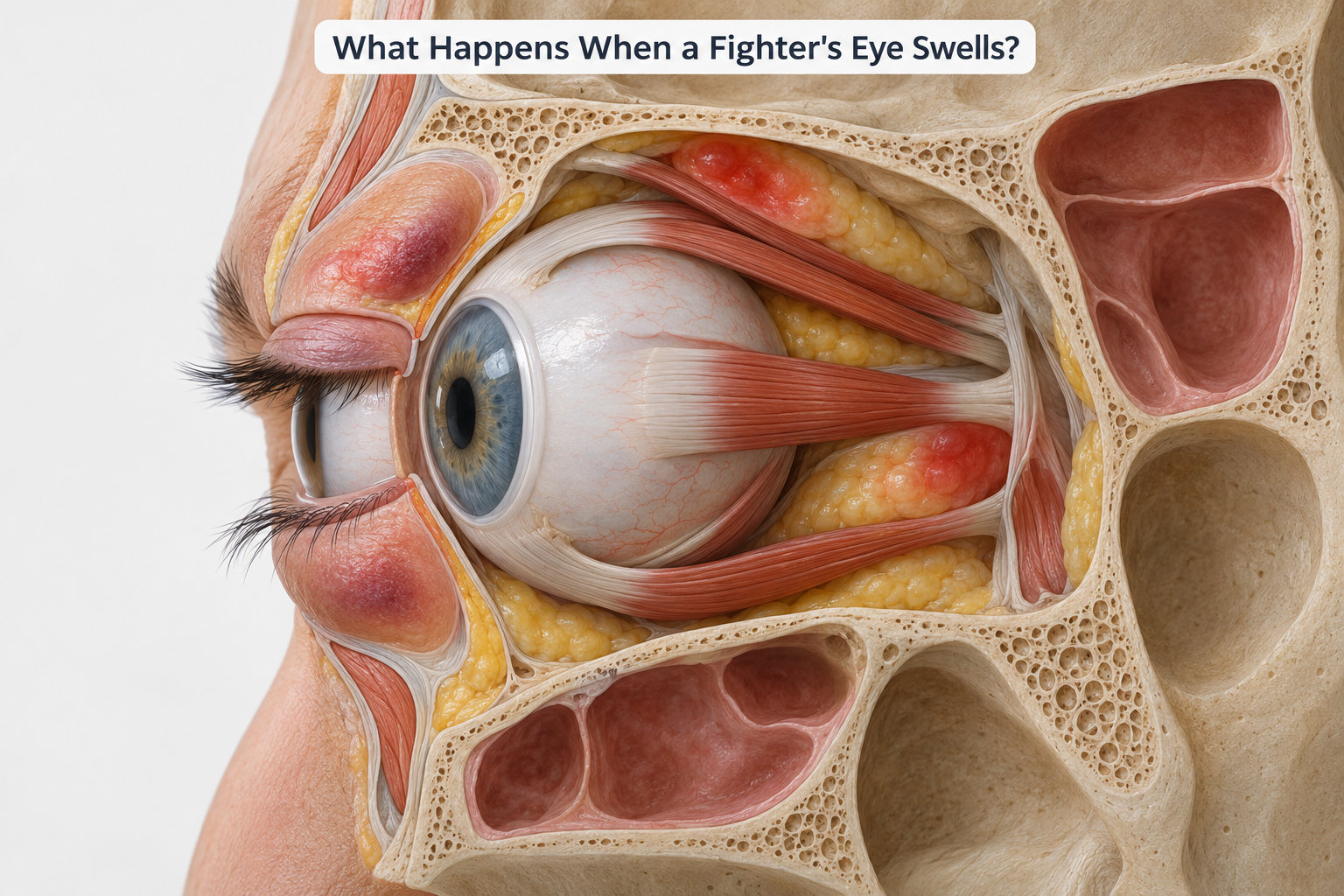
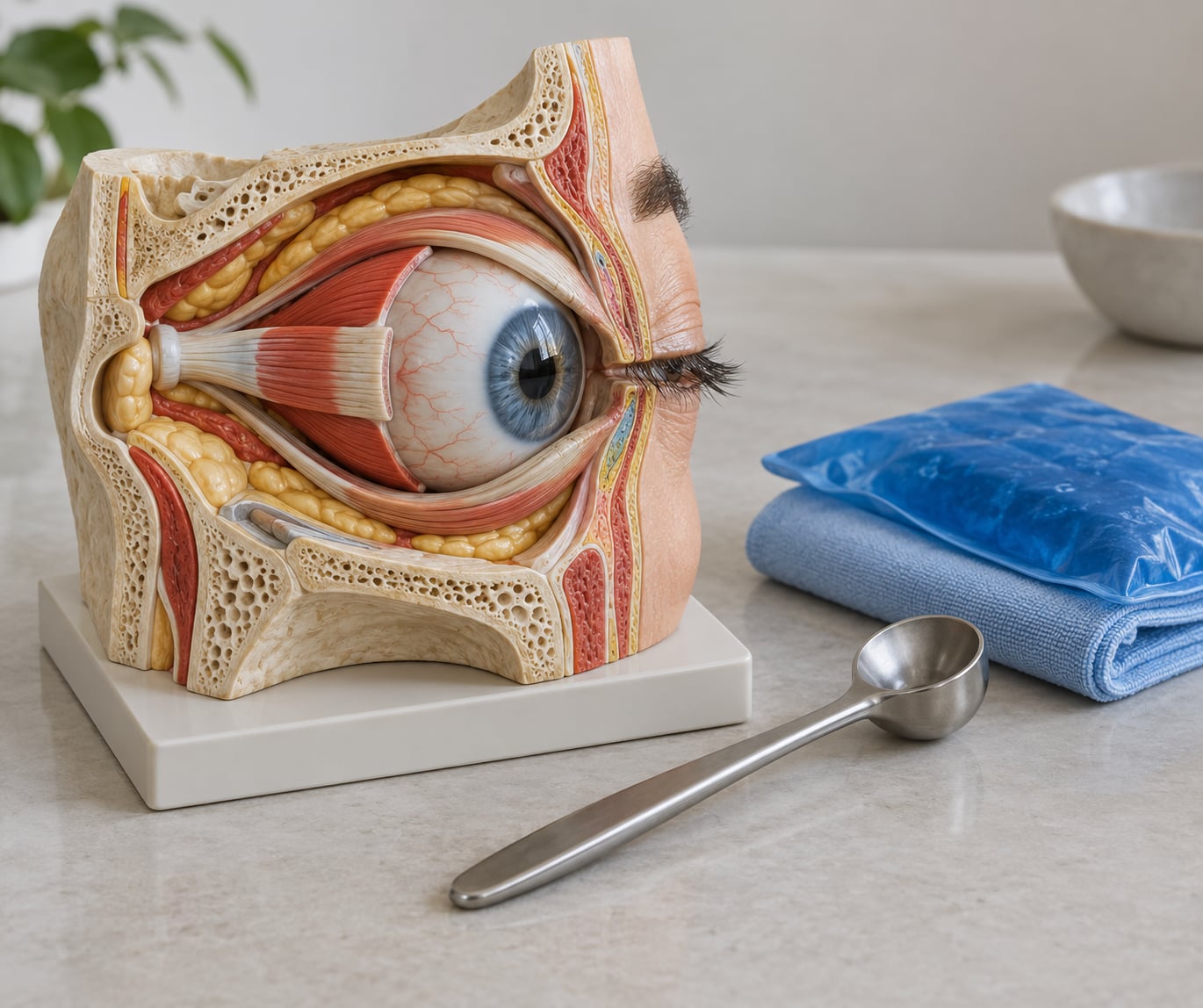
Swelling that closes a fighter’s eye is called periorbital edema. It is the result of blunt force trauma rupturing capillaries in the loose tissue around the eye socket, so blood and fluid collect where there is very little structure to soak them up, and the lids swell forward into the line of sight.
The swelling sits in several structures at once, and each behaves differently. Knowing which one is involved is how a clinician tells a cosmetic bruise from a real problem.
| Structure | What a blow does to it | What it looks like from the outside |
|---|---|---|
| Skin and eyelids | Thinnest skin on the body, stretched over the socket rim | Puffy lids, pitting when pressed, purple discoloration |
| Loose tissue under the skin | Capillaries rupture and fluid pools where nothing supports it | Generalized puffiness that hides the eye within hours |
| Orbital fat behind the lids | Swells and pushes the eyeball forward | Protruding appearance, eyelids that will not settle |
| Extraocular muscles | Bruise and swell inside the orbit | Pain when the eye tries to move, double vision |
| Bone of the socket rim and floor | May crack under a hard, off-center strike | Numb cheek, eye shifted in position, restricted movement |
| The eye itself | Scratched, bruised internally or detached at the back | Clear signs in the eye, blurred or lost vision |
Why the eye swells more than any other part of the face
Three features make the orbit the worst place on the face to take a shot. The skin is the thinnest in the body, so it barely resists, and the tissue directly beneath it is loose areolar tissue with almost nothing to hold fluid in place.
Then there is the geometry. The eye socket is a bony cup opening forward, and swelling inside a rigid cup has nowhere to expand. It accumulates forward instead, straight into the eyelids.
Compare that with a blow to the cheek, where the tissue has room and the swelling spreads out and looks less dramatic. The eye area concentrates the same amount of fluid into a much smaller space, which is why one clean shot can shut an eye completely.
Why Swelling Closes a Fighter’s Eye After a Punch
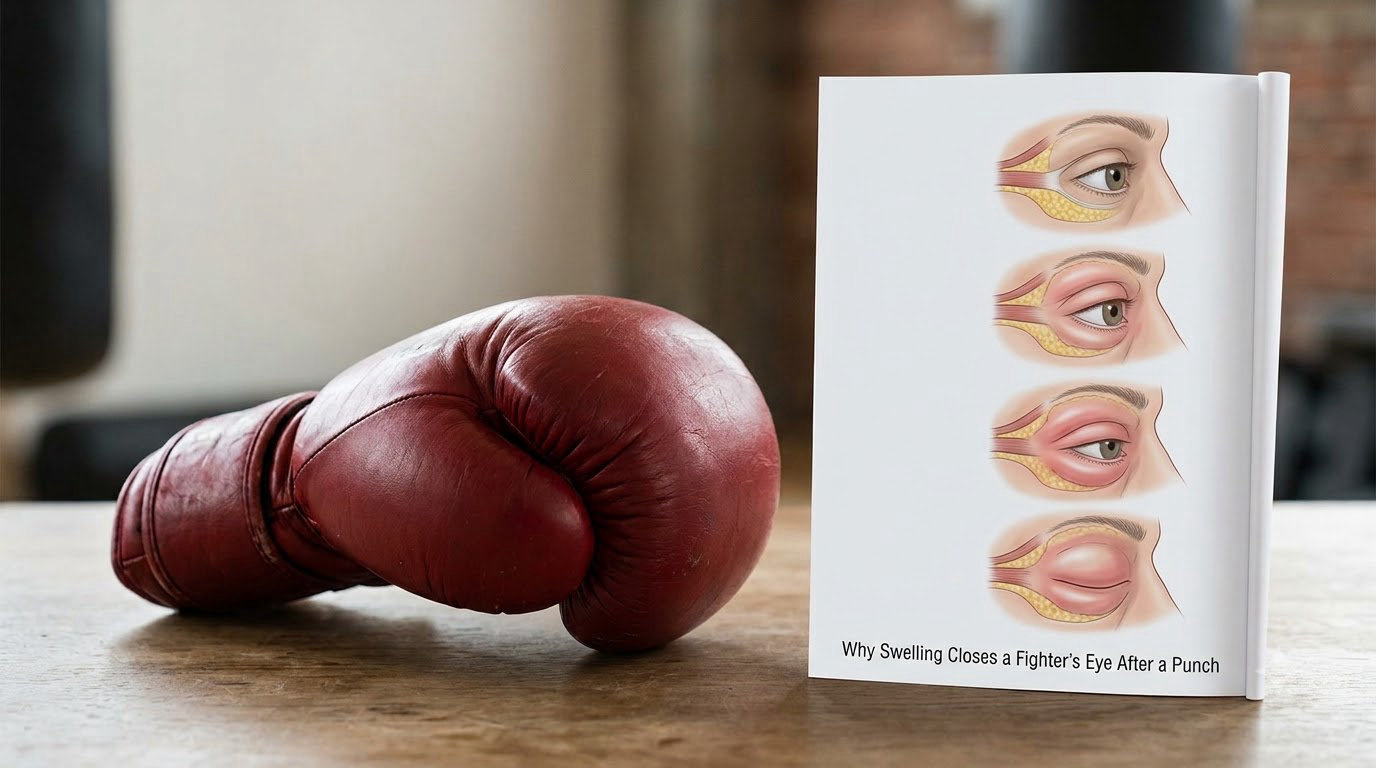
The sequence runs from impact to restricted vision in a predictable order. Understanding each step explains what you see ringside and what the corner is actually trying to do during the one minute they have.
- The blow lands on the brow or cheekbone. Force transfers straight through thin bone into soft tissue. A glove landing on the brow does far more damage than one landing on the forehead, because there is no soft padding there.
- Capillaries rupture. Vessels the width of a hair break, and blood leaks into the loose tissue. You cannot see this under the skin, but it is the start of the whole process.
- Inflammatory fluid follows the blood. Damaged tissue releases signals that make surrounding vessels leaky. Fluid arrives to fight the damage and ends up adding to the swelling.
- The lid fills and thickens. Fluid gathers in the eyelid, which is thin and distends easily. A lid that was a few millimetres thick is now several times that.
- Opening the eye becomes hard work. To look, the fighter has to lift the swollen lid against its own weight. It opens partway, then closes again.
- Rubbing and reopening make it worse. Every time the fighter pushes the lid open or drags a knuckle across it, fresh capillaries break and new swelling starts. This is why a closed eye in round six often looks worse than one in round one.
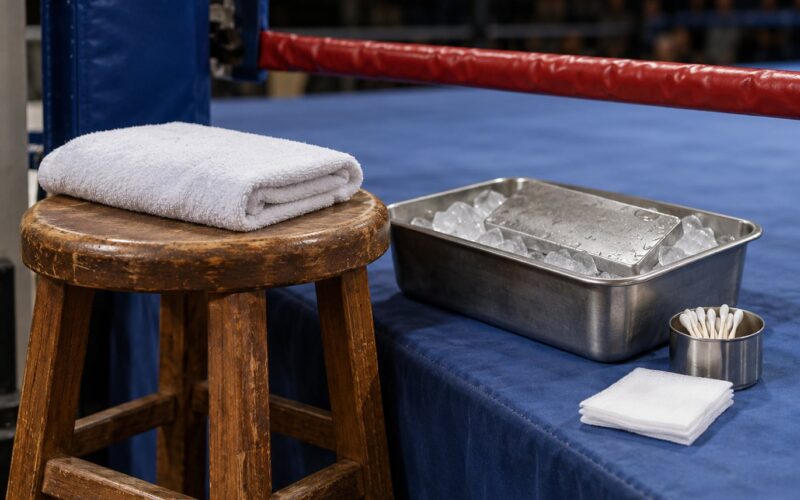
Picture a southpaw landing a straight cross on a fighter’s brow in the second round. The glove compresses skin against bone, blood pools, and within ten seconds the lid has swollen shut. The corner applies a cold metal enswell to the closed lid, which constricts the blood vessels and slows further bleeding. The fighter blinks it open for a second, tears clear some of the smear, and tells the referee he is fine.
By the fourth round the swelling has not just settled, it has spread across the bridge of the nose and dropped into the upper cheek. The colour changes from red to purple. What the crowd reads as toughness, the corner reads as a countdown.
Why the corner reaches for cold
Cold works by narrowing blood vessels, and narrowed vessels leak less and pass less fluid into tissue. That is the whole reason for the enswell, a small smooth piece of metal, and for the cold water splash that follows it.
Pressure does a second job. Pressing the swollen tissue flat compresses what has already collected and slows new fluid arriving, and it does this without heat, which would do the opposite and encourage bleeding.
Why a cutman sometimes skips the enswell
A thread on Reddit’s r/MMA asks why cutmen deliberately leave a swelling alone, and the practical answer comes up repeatedly: once an eye is fully closed there is no opening left to cool, the swelling has usually already peaked, and working it aggressively can break more capillaries. Cold pressure helps an eye that might still open. It does not rescue one that has already shut.
Common Causes in Boxing and Other Contact Sports
A swollen eye after a fight has several possible sources, and the outside appearance alone cannot tell you which one you are looking at. Two fighters with identical black eyes can have injuries that need completely different responses, one cosmetic and one an emergency.
| Condition | Usual cause | What it looks like | Corner treatment | When to stop |
|---|---|---|---|---|
| Swelling (periorbital edema) | Blunt impact on soft tissue | Puffy lids, purple bruise, eye closes over hours | Cold enswell and water, external pressure | When the fighter cannot see from that eye |
| Laceration | Tear from glove, ring or accidental headbutt | Open bleeding cut near the brow or lid | Adrenaline and coagulant swab, Vaseline, haemostat for the cut | If the cut interferes with vision or bleeds heavily |
| Corneal abrasion | Glove surface or fingernail scratching the eye | Watery, painful, light-sensitive, feels like grit | Do not rub, do not put anything in the eye, needs assessment | Immediately when the fighter reports vision change |
| Orbital fracture | Sharp, off-center blow to the socket rim | Eye looks shifted, restricted movement, numb cheek, double vision | None in the corner, medical assessment needed | Straight away, fight is over |
| Hyphema or deeper injury | Force transmitted through the globe | Red or hazy colour inside the eye, blurred sight, pain | None in the corner | Straight away, fight is over |
Why swelling closes a fighter’s eye after any contact sport
The same mechanism operates in MMA, Muay Thai and kickboxing. Strikes to the brow and the cheekbone are simply more frequent, and in grappling exchanges a fighter’s own elbow or forehead can do the job just as well.
Differences in equipment change severity rather than mechanism. Exposed-face bouts and amateur bouts with thinner gloves produce more orbital injuries. Headgear reduces cuts, but it also adds a surface that can catch a glove and deliver force across the brow rather than diffusing it.
Deeper injuries hide behind the swelling. A retinal tear, a hyphema or a fracture of the socket floor can produce a black eye that looks identical to a harmless one from the outside, which is exactly why nobody should judge by appearance alone.
What to Do Immediately After Eye Swelling
If swelling follows a strike, the first moves are simple and all of them are protective. Anyone can follow them, in a corner or in a car park after sparring.
- Stop the activity. The fight or the round ends. A fighter with a closed eye cannot defend accurately and should not be asked to try.
- Do not press on the eye itself. Gentle cold pressure around the bone is fine, but pushing on the globe risks making a bruise into something worse.
- Do not force the lids open. Pulling the lid apart to look starts new bleeding and adds swelling. Let it open on its own.
- Do not blow the nose. If the socket floor has cracked, blowing hard can force air into the tissue and cause emphysema. This is a well-documented warning in emergency eye care.
- Use cold, not heat. Cold compresses vessels and slows bleeding. Heat encourages it, which is the opposite of what you want in the first day.
- Get a qualified medical assessment. A clinician decides whether imaging is needed and whether the eye needs protection. Only a clinician can tell you whether the eye itself is intact.
The World Boxing Association’s ringside guidance follows the same logic in a shorter form: cold compress plus external pressure, and an expectation of a five to seven day healing window. Any corner practice that goes beyond cold and pressure is not routine, and the fight doctor ringside outranks everyone in the corner.
For an amateur with no cutman, the honest version of this section is that a cold compress and time are the entire safe home treatment. Anything beyond that is a guess about an injury nobody has examined.
How Long Does Swelling Usually Last?
Timelines vary with the force involved and what was struck. General patterns hold well enough to set expectations, but they are not a safe return window.
| Stage | What swelling is doing | Typical appearance |
|---|---|---|
| First few hours | Blood and fluid begin collecting, lids thicken quickly | Puffy, sore, noticeably closing |
| 24 hours | Swelling at or near its peak, colour shifts to purple | Often worse than it looked the night before |
| Days 2 to 3 | Fluid starts clearing, tissues still firm | Yellow and green tones appear as old blood changes |
| Days 5 to 7 | Blood is reabsorbed, lids return toward normal | Residual puffiness around a fading bruise |
The important caveat sits underneath all of that. A deeper injury, a fracture or a retinal tear can sit behind a swelling that is visibly improving, which means the healing curve tells you about the bruise and nothing about the eye.
That is why nobody should use a shrinking swelling as permission to resume. The clearance decision belongs to a clinician who has looked at the eye.
Warning Signs That Need Urgent Medical Care
Some combinations of symptoms after a blow to the eye need a clinician the same day. None of them are things a fighter should assess for themselves.
- Vision that is blurred, doubled, dimmed or lost in any part of the field
- Pain that gets worse rather than settling, especially with movement of the eye
- Sensitivity to light that will not go away
- Nausea or vomiting following the blow
- An eye that does not move normally, or looks shifted in position
- Clear fluid leaking from the eye, or a wound that gapes
- A numb or tingling cheek below the injury
- Heavy bleeding that does not stop with pressure
- Flashes of light, new floaters, or a curtain shadow moving across vision
- A red flag: raised eye pressure can appear days later, sometimes after the bruise looks fine
Taken together, these point to damage beyond a surface bruise. Any one of them after a strike means stop and get assessed rather than waiting to see whether it settles.
The rule for training is simple. No sparring, no competition, no hard rounds until a qualified clinician has assessed the eye and cleared the fighter. That conversation has no timeline attached to it.
How Swelling Can Affect a Fighter’s Eyesight
Most vision loss in a closed eye is obscuring rather than damaging. A swollen lid covering part of the pupil, a film of tears across the cornea and reduced blinking together blur the image and drag it out of focus. Remove the swelling and the sight often returns to what it was.
That is genuinely different from damage, and the two are easy to confuse from ringside. Temporary obscuring clears or improves as the swelling settles. Damage does not follow that pattern, and it often shows up as distortion, a shadow, a new floater or pain the fighter cannot describe.
Reduced blinking matters more than it sounds. A fighter who cannot blink properly stops lubricating the cornea, so the surface dries and gets more irritated the longer the eye stays shut. It is one reason a corner cleans the area rather than letting it sit sealed.
Depth perception takes the hit too. One eye closed removes the stereoscopic input the brain uses for judging distance, which makes incoming punches harder to track and evasions less accurate. It is a fight-safety problem before it becomes a health problem.
The honest gap between fighter and corner is worth naming. The fighter feels pressure, fog and frustration. The corner sees a lid that will not settle. Neither one is looking at the retina, and neither is qualified to. That gap is exactly why the swelling cannot be used as a read on whether the eye is safe.
Frequently Asked Questions
Is every swollen eye after boxing dangerous?
No. Most eye swelling after boxing is periorbital edema, a surface bruise that settles over five to seven days with no lasting effect on sight. But some blows that cause identical looking swelling also cause a socket fracture, a hyphema or a retinal tear, and appearance alone cannot distinguish them. The rule is that swelling needs assessment when any warning sign is present, such as vision change, worsening pain, double vision or a numb cheek.
Can a fighter continue training when the swelling starts to go down?
Not on the strength of the swelling alone. A shrinking bruise tells you the surface tissue is healing and nothing about the eye behind it. A fracture, a tear or raised pressure can persist while the lid looks normal again, and some complications show up days later. Fighters should be assessed and cleared by a qualified clinician before returning to sparring or competition, with no timeline attached to that decision.
Why can a swollen eye look worse the next morning?
Several things happen overnight. Lying flat reduces drainage from the face, so fluid settles where gravity puts it. Blinking less while the eye is shut means tears and debris stay on the surface. Rubbing the lid during sleep, or reopening it repeatedly during the fight, breaks fresh capillaries. And some swelling simply peaks after a full day rather than appearing all at once, which is why a closed eye in the final round is often more dramatic than one earlier on.
Does redness around the eye mean the injury is serious?
Redness on its own is a weak signal. Rubbing a swelling keeps the skin irritated and inflamed, so redness can be high around an injury that turns out to be harmless. What matters is the pattern rather than the colour. Redness combined with vision change, severe pain, light sensitivity, restricted eye movement or a hazy appearance inside the eye is a different picture entirely, and that combination needs a clinician.
Can swelling return after a fighter reopens the eye?
Yes, and that is one of the most common reasons a closed eye gets worse late in a bout. Forcing the lids apart, rubbing to clear the vision or repeatedly peeking through the gap breaks new capillaries and restarts the cycle. It is why a cutman who wants to check the eye works gently at the corner rather than prising the lids apart. A corner that has to fight the swelling open has already lost time it did not have.
Conclusion
Swelling closes a fighter’s eye because a blow ruptures capillaries in the loosest, thinnest tissue on the face, and the fluid has nowhere to go but forward into the lids. Usually that is all it is, and it settles within about a week. It can also be hiding a fracture or damage to the eye itself, and no corner can tell the difference by looking.
So the first moves are always the same. Stop the activity, keep cold pressure on the lid without pushing on the eye, leave the lids alone, do not blow the nose, and get a qualified medical assessment. Any warning sign means the same thing: this is a doctor conversation, not another round. Reviewed for 2026.