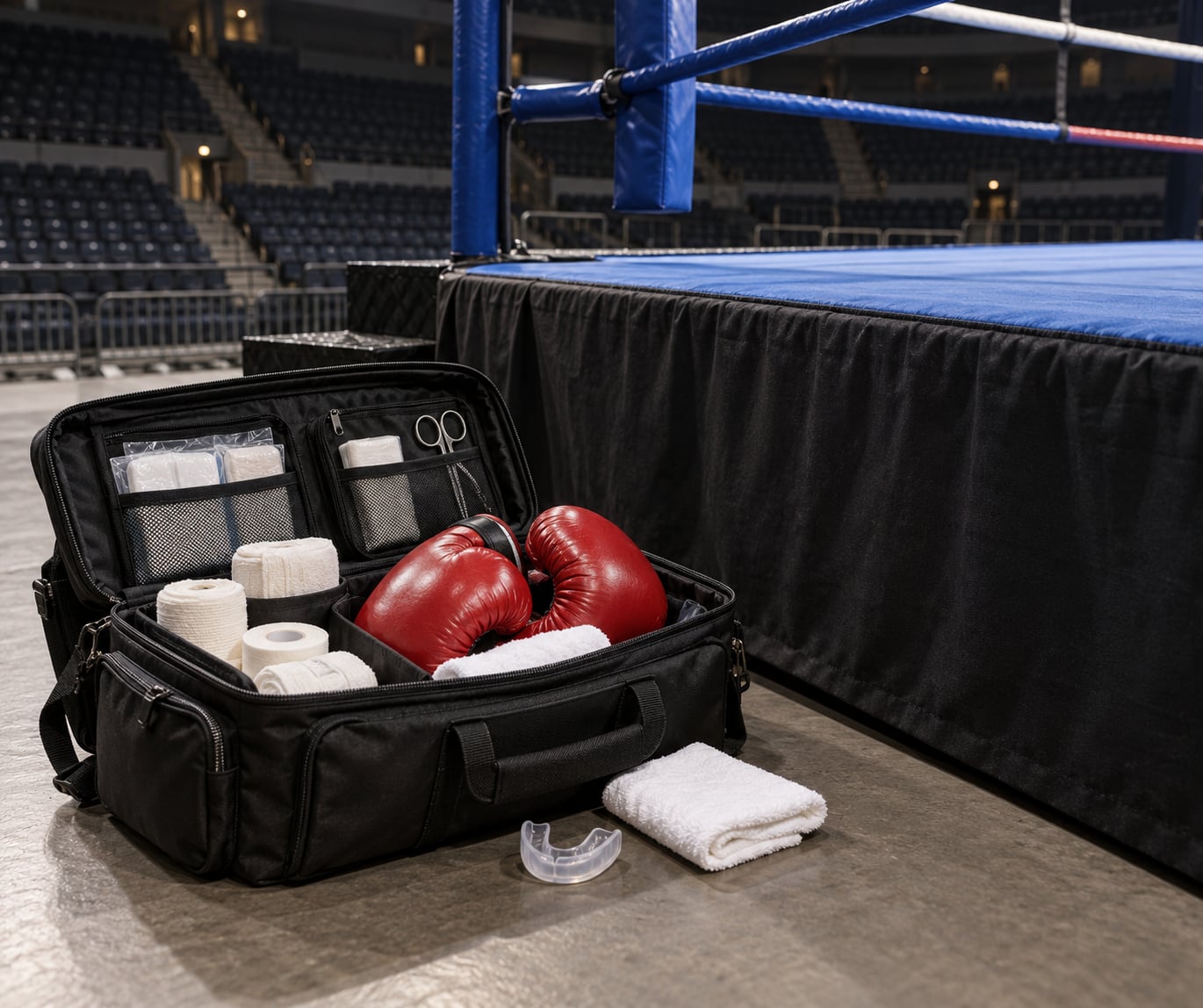
A ringside doctor, also called a ringside physician or fight doctor, is the licensed physician appointed by the governing commission to decide whether each fighter is fit to compete. The doctor examines both fighters before the bell, watches every round from ringside, advises the referee when a fighter is in danger, and issues the medical suspension that follows a stoppage.
If you have watched a lot of boxing and never worked out who the person sitting on the apron is doing, you are not alone. Most people only notice the doctor when something goes wrong. Here is the full job, in the order it happens.
- Examines both fighters before the first bell
- Reviews medical history and paperwork from the fighter’s own doctor
- Checks protective equipment, including the mouthguard
- Assesses signs of weight cutting and dehydration
- Decides whether each fighter is fit to continue
- Watches every round from a fixed ringside seat
- Tracks balance, speech, coordination and behaviour
- Answers the referee’s summons to the apron
- Examines a fighter in the neutral corner
- Recommends that the bout be stopped
- Performs a post-fight neurological check
- Issues any medical suspension with the commission
Everything below is general information about how the role works, not medical advice. If you are a fighter with symptoms after a bout, speak to a doctor directly.
Table of Contents
- What the Ringside Doctor Does During a Fight
- How a Ringside Doctor Is Prepared Before Fight Night
- How the Doctor Monitors a Boxing Bout
- When Does the Ringside Doctor Stop a Fight?
- What Happens If a Fighter Needs Medical Attention?
- How the Ringside Doctor Differs from the Cutman
- Who Is Ringside at a Boxing Event?
- Why Boxing Safety Rules Still Matter
- Frequently Asked Questions
- Can a ringside doctor stop a boxing fight?
- What happens if a boxer is knocked unconscious?
- Why does a referee ask the ringside doctor to examine a fighter?
- Is a ringside doctor present at every professional boxing match?
- What is the difference between a boxing cutman and a ringside doctor?
- Can a fighter continue after being examined for concussion symptoms?
- What to Notice Next Time You Watch Boxing
What the Ringside Doctor Does During a Fight
During a fight the ringside doctor assesses both fighters, monitors physical and neurological warning signs from the apron, advises the referee when a fighter should be examined or the contest should end, and provides urgent treatment when conditions require it.
The job is mostly watching. A doctor who spends a whole twelve-round fight leaning forward is doing it wrong; the work is a slow scan of the two fighters repeated every few seconds, checking for changes rather than searching for a single dramatic moment.
What the doctor cannot do is walk into the ring mid-bout and end it on their own. That distinction confuses more viewers than anything else about fight night, and it is covered properly below.
How a Ringside Doctor Is Prepared Before Fight Night
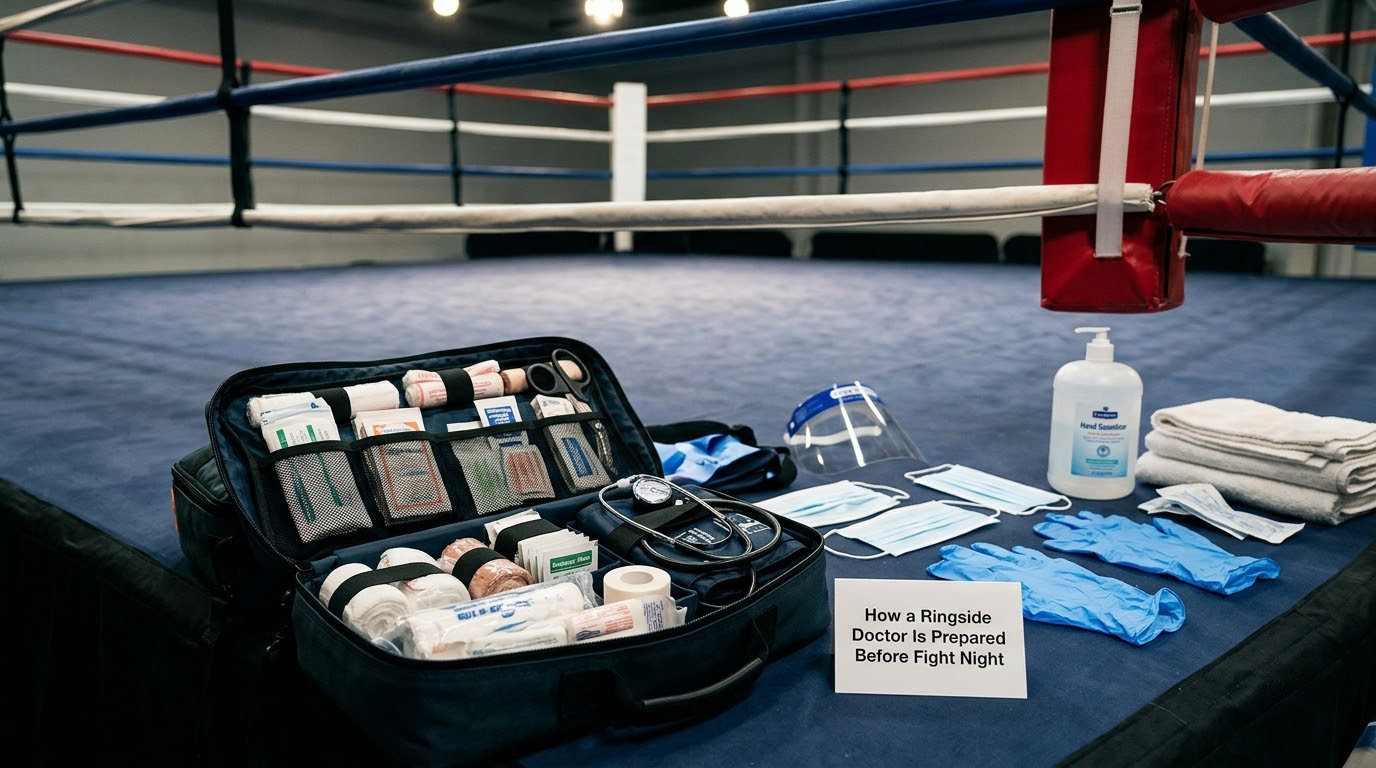
Doctors arrive hours before the first bout of the card. They introduce themselves to the referee and to both corners, confirm which fighter is in which corner and which corner is neutral, and check that they can see both fighters clearly from their seat.
The physical setup matters more than people expect. The doctor needs an unobstructed line of sight to the fighters’ faces, which is why the apron position is chosen carefully in a venue where the camera platforms and the ring apron are close together.
The medical kit itself is checked before the doors open: gloves, a tongue guard, gauze and coagulant for bleeding, an oximeter, a blood pressure cuff, a stethoscope, a penlight for the eye exam, and materials for basic wound care. Access to an automated external defibrillator and a stretcher is confirmed, and the doctor knows exactly where the ambulance is parked and who is driving it.
Finally the doctor talks to officials. Which commission is sanctioning the event, what the medical rules of that jurisdiction require, and who to call at the state commission if a suspension needs to be issued after the arena empties out.
What the Ringside Doctor Does: Pre-Fight Checks
The pre-fight exam is the single most consequential part of the job, because once the bell rings, stopping a fight costs money, momentum and sometimes a title. Everything the doctor does before the first bell is aimed at not needing to do it during the bout.
In practice the checks cover a lot of ground:
- Existing injuries. Torn ligaments, a shoulder already taped, a broken nose that has not set properly, a previous eye injury. The doctor asks what the fighter trained around and what the corner plans to protect.
- Medical history. Usually the fighter’s own doctor completes a pre-fight form. The ringside physician reviews that paperwork independently, and an ambiguous clearance means a phone call, not a signature.
- Weight cutting signs. Fighters routinely shed weight quickly to make a limit. A fighter who looks grey, dizzy, unfocused or unable to hold a conversation is showing signs of severe dehydration, and the doctor can call the bout off before it starts.
- Prior concussion history. A history of knockouts changes the risk calculation. The Association of Ringside Physicians has published consensus statements on concussion management in combat sports, and the British Journal of Sports Medicine carries the underlying consensus work.
- Protective equipment. The mouthguard has to fit and be in place. It can become a hazard if it is damaged or if the fighter starts swallowing it, and the doctor is the person who decides it comes out.
- Blood-borne infection screening. Commission requirements cover screening for hepatitis and HIV, and the doctor reviews those results with an eye to whether the paperwork actually matches the person standing in front of them.
One thing worth naming plainly: the doctor can refuse to certify a fighter as fit. That decision does not need the referee’s agreement, and it does not need a committee. It is the one power that belongs to the ringside doctor alone.
How the Doctor Monitors a Boxing Bout
Ringside, the doctor sits at the apron with a clear line to both corners and keeps a low profile between rounds. Most of the bout the doctor is still, tracking four things above all: balance, speech, coordination and behaviour.
Changes in any of those four matter more than the amount of damage visible on the face. A fighter who takes a hard shot and immediately snaps back into guard is a very different situation from one whose feet stop tracking and who starts answering questions a half-beat late.
Between rounds the doctor is available to the corners if a fighter’s condition changes, and ready to enter the ring if summoned. A corner that sees something the doctor missed can raise it with the referee, and from there the doctor examines the fighter in the neutral corner, away from the corner team and the crowd.
The communication is deliberately low-key. A doctor who runs onto the apron mid-round changes the mood of the building whether or not it turns out to be nothing, so the professional habit is to lean to the referee, speak quietly, and keep the examination out of view where possible.
When Does the Ringside Doctor Stop a Fight?
The doctor recommends a stoppage when a fighter shows neurological signs, loses consciousness, is dropped repeatedly, is bleeding uncontrollably, has lost vision in an eye, or cannot safely continue. Under the ABC Unified Rules, however, the referee is the sole arbiter of a bout.
So the honest answer to who ends the fight is: the doctor decides, the referee rules. The sequence is that the referee summons the physician, the physician examines the fighter, and if the fighter cannot safely continue the referee ends the contest. The doctor has the medical authority; the referee has the rulebook authority.
That gap is real, and practitioners argue about it openly. One ringside physician, writing about his career in boxing and MMA, said he had been overruled only once in 23 years: he stopped the first fight between Arturo Gatti and Micky Ward at the end of round nine and the referee allowed the contest to continue. Ward went on to win by knockout in the tenth, and it became one of the most debated endings in the sport’s history.
That same physician makes the point that the ringside seat often gives a better view of accumulating damage than the referee’s, particularly at amateur level where officials are less experienced. Most observers do not know that intervention happened at all.
The Warning Signs That Prompt an Examination
- Loss of balance, staggering, or feet that stop tracking the body
- Slurred or delayed speech, and answers that miss the question
- Confusion, blank staring, or uncharacteristic behaviour
- Repeated uncharacteristic actions, such as pawing at the gloves or failing to guard
- Loss of consciousness at any point, followed by a slow or incomplete recovery
- Multiple knockdowns within a single round
- A cut that keeps bleeding despite treatment from the cutman
- Complaint of blurred vision, double vision or pain behind an eye
- Sudden loss of movement or an inability to stand or leave the corner
- Retching, or a collapse that does not fit the pattern of a clean knockout
The Association of Ringside Physicians publishes consensus statements covering concussion, ocular management, weight management and blood-borne infectious disease screening, and those statements are the reference points a well-run event works from.
What Happens If a Fighter Needs Medical Attention?
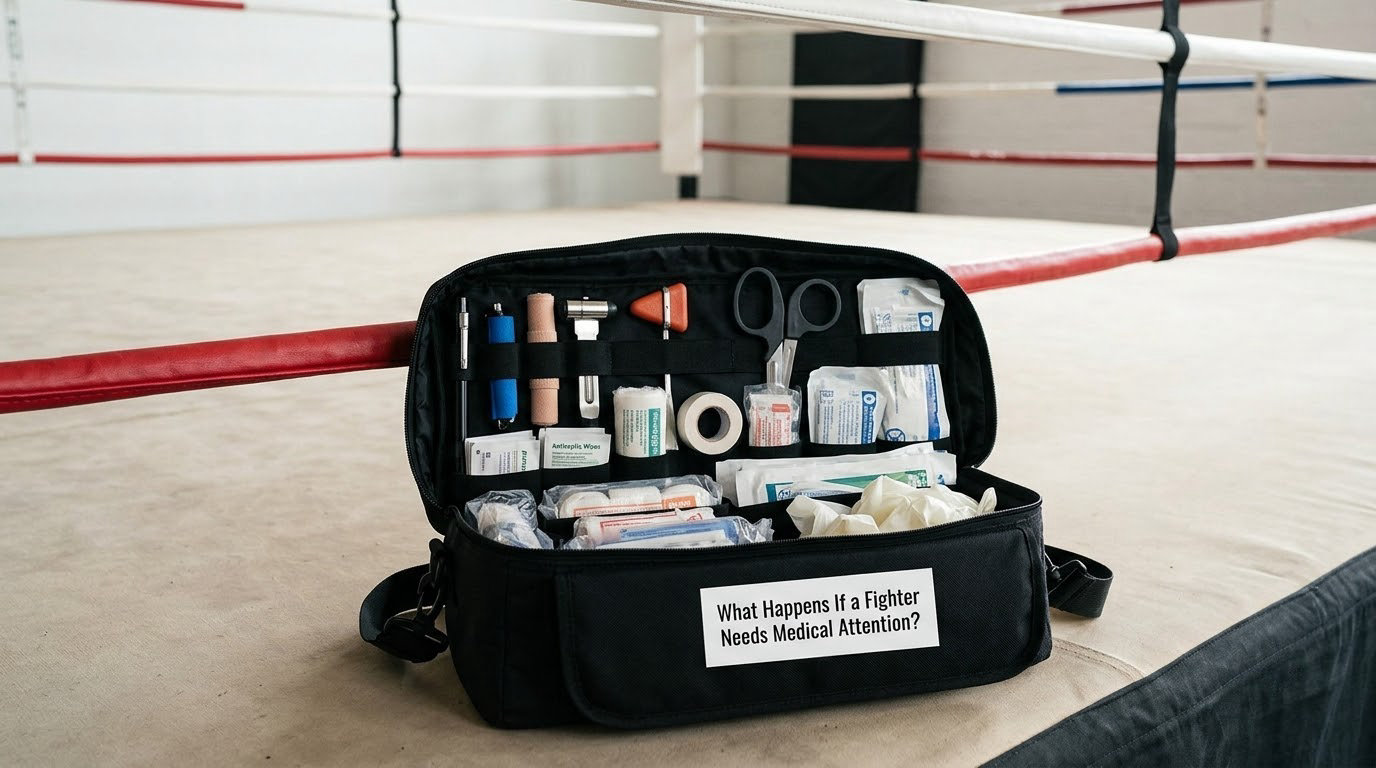
A routine cut is not an emergency, and the doctor is careful not to treat every nick as one. The cutman handles bleeding inside the ring while the fight continues; the doctor’s involvement starts when bleeding will not stop, when vision is affected, or when the cutman asks for help.
For a real medical event, the sequence usually runs like this:
- The referee stops the bout and motions the doctor in.
- The fighter is taken to the neutral corner, or out of the ring entirely if the situation is serious.
- The doctor assesses responsiveness, airway, breathing, circulation, pupil response and neurological status.
- Stabilisation happens ringside where possible, with oxygen, airway support and treatment for shock.
- Transfer to hospital happens when the doctor wants imaging or observation that cannot be done at ringside. A concussed fighter is not cleared to leave alone or to go home.
- The post-fight exam happens once the fighter is stable, usually in the medical room rather than the dressing room.
- A medical suspension is issued to the commission before anyone leaves.
Suspension length is set by consensus guidance and the commission’s rules. A first knockout or technical knockout without loss of consciousness is commonly associated with a suspension of at least 30 days. Loss of consciousness, or a repeat within the suspension period, pushes it considerably longer, and the licensing body may require neurological consultation and imaging before it will lift.
Fighters frequently describe the suspension as the most confusing part of a stoppage, because it arrives as paperwork rather than as an explanation. Nobody tells a dazed fighter in the dressing room how long they are out. The doctor is the one who writes the note, and the commission is the one that serves it.
How the Ringside Doctor Differs from the Cutman
The cutman manages bleeding and superficial injuries inside the ring during the bout. The ringside doctor assesses whether a fighter is safe, advises the referee, manages significant medical concerns and arranges further care after the bell.
Confusing the two is easy from the seats, because both work around a fighter’s face during a break. The difference is one of scope. The cutman’s job is to stop the bleeding so the fight can resume. The doctor’s job is to decide whether resuming is a good idea at all.
Who Does What Ringside: Roles Compared
- Ringside doctor. Physician. Sits on the apron, examines fighters before, during and after the bout, can withhold medical clearance, recommends stoppage, issues suspensions.
- Referee. Ringside official. Enforces the rules in the ring and is the sole arbiter under the ABC Unified Rules, which means only the referee can end a bout.
- Cutman. Ringside assistant. Works between rounds with swabs, coagulant and water, manages cuts and swelling, and can call for a doctor.
- Cornerman. Coach. Voices concerns to the referee or doctor, applies the swab and ice, and decides whether to throw the towel.
- Second. Assists the cutman and keeps the corner’s equipment organised during a round break.
That structure explains why a towel rarely gets thrown in modern professional boxing. Cornermen can flag a problem, but the call belongs to the referee, and the medical opinion behind it belongs to the doctor.
Who Is Ringside at a Boxing Event?
A professional card usually has a physician assigned to each bout, sometimes with a second physician covering a block of the card and a first-aid or paramedic team standing by outside the ring. How many fighters one doctor covers depends on the jurisdiction, and some commissions specify a ratio of one physician per eight bouts, with two physicians required once a card reaches nine or more.
Requirements also vary sharply by place. USA Boxing requires a registered M.D. or D.O. who is background screened, while some state commissions set their own staffing and clearance rules. Outside the United States it can look different again: in Victoria, Australia, medical practitioners must be authorised by the state board before they can fulfil the ringside doctor role, and licensed promoters appoint them.
None of that is universal. The package rules change by commission, by country, and between professional and amateur boxing, which is the main reason answers on this topic age badly.
Why Boxing Safety Rules Still Matter
A ringside doctor cannot make boxing safe. The damage in the sport is the point of the sport, and no amount of pre-fight screening removes it. What the doctor can do is catch the cases where continuing is measurably worse than stopping, and do so early.
That only works when the rest of the machinery works too. Gloves, ring design, concussion protocols, the referee’s authority to stop a contest, corner rules and commission regulations are all load-bearing parts of the same system. Remove the rules and the doctor’s job becomes impossible; remove the doctor and the rules do very little on their own.
The fair criticism of fight-night medical coverage is not that doctors are absent, it is that they are stretched. One physician watching a long card in a hot arena is being asked to run neurological exams on exhausted fighters in poor lighting. Coverage ratios are worth pressing promoters on.
Updated for 2026. Standards cited here are general information about how ringside medicine works; commission rules change, so check the rules of the body sanctioning any given event.
Frequently Asked Questions
Can a ringside doctor stop a boxing fight?
Not on their own. Under the ABC Unified Rules the referee is the sole arbiter of a bout. The doctor decides whether a fighter can safely continue, and the referee acts on that recommendation. The exception is before the bell, where the physician can refuse to certify a fighter as fit and the bout does not start at all.
What happens if a boxer is knocked unconscious?
The referee stops the bout and calls the doctor, who checks responsiveness, airway, breathing, circulation and pupils at ringside. If the fighter does not recover quickly enough, the doctor arranges ambulance transfer for observation and imaging rather than letting them leave on their own. A medical suspension usually follows before the fighter leaves the venue.
Why does a referee ask the ringside doctor to examine a fighter?
Usually because something changed between rounds. A fighter may be unsteady, slow to answer, bleeding heavily, complaining about vision, or simply not moving the way a competent boxer should. The referee waves the physician in so a trained medical opinion goes into the decision, and the examination happens out of public view where possible.
Is a ringside doctor present at every professional boxing match?
In sanctioned professional boxing, a physician is normally required, though staffing levels vary. Some commissions specify one physician per eight bouts and require two from nine bouts upward, and amateur shows may be covered differently. Some jurisdictions authorise and appoint practitioners through a state board, so the exact requirement depends on where the fight takes place.
What is the difference between a boxing cutman and a ringside doctor?
A cutman manages bleeding and superficial injuries inside the ring between rounds, using swabs, coagulant and water, so the fight can continue. The ringside doctor is a licensed physician who decides whether a fighter is safe to continue at all, advises the referee, handles significant medical problems and issues any post-fight suspension.
Can a fighter continue after being examined for concussion symptoms?
Sometimes, yes. A doctor who finds nothing on a full neurological assessment may clear a fighter to continue, and the decision belongs to the doctor with the referee acting on it. If concussion signs are present, the doctor will recommend stopping, and continuing after such an examination is where the serious secondary-injury risk sits.
What to Notice Next Time You Watch Boxing
Watch the apron, not just the ring. You will see the doctor seated there hours before the first bell, usually alone with paperwork, and then following the same four things every round: balance, speech, coordination, behaviour.
When the referee waves someone in, that is the moment the role becomes visible. Listen for whether an examination follows a stoppage or the action resumes, and remember that many medical events are never announced at all. The most useful thing you can learn from a fight night is that somebody qualified is making that call, and that the paperwork following the bell may matter more to a fighter’s career than the fight itself.