How much space you need for boxing at home comes down to one number for most people: at least 6 x 6 feet of clear floor space and an 8 foot ceiling for a bag-only setup. A full setup with mats, footwork room and a speed bag platform wants about 10 x 10 feet. Usable dimensions matter more than total square footage, because furniture, door swings and low joists quietly eat the room you thought you had.
The table below breaks those numbers down by setup type, then by equipment, so you can match a real room in your house against what you actually want to do in it. The constraint rarely ends up being the floor. It ends up being the ceiling, or the wall the bag wants to swing toward.
Table of Contents
- How Much Space You Need for Boxing at Home?
- Home Boxing Space at a Glance
- Bag-Only Training: The Smallest Practical Setup
- What Floor Area Should You Leave Around the Bag?
- How Much Ceiling Height Do You Need?
- Garage, Basement, and Spare-Room Setups
- Do You Need Space for a Boxing Ring or Other Equipment?
- Safety and Installation Considerations
- Frequently Asked Questions
- Conclusion
How Much Space You Need for Boxing at Home?
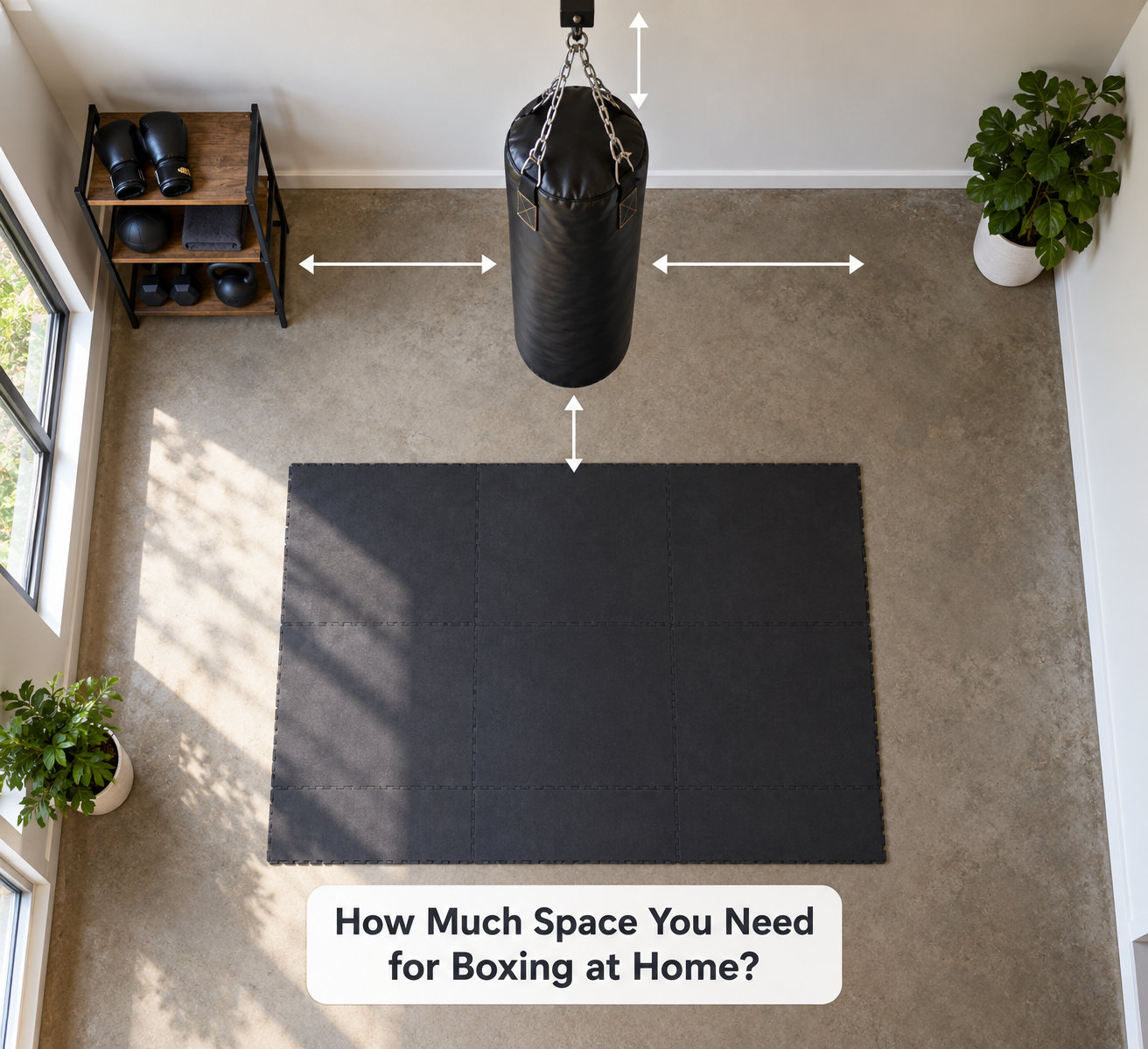
Six by six feet of open floor with 8 feet of headroom gets you bag work, jump rope and shadow boxing. Ten by ten feet is the point where footwork drills, floor work and a mounted platform all fit in the same room without you constantly repositioning things.
Those are floor figures, not room figures. A spare bedroom advertised as 8 x 10 might give you 5 x 7 once the bed, the wardrobe door and the radiator are accounted for. Measure what is clear, not what is on the deed.
Two things separate a workable corner from a frustrating one: clearance you can move in, and structure that can carry the load. A 100-pound heavy bag swinging on a full-power straight puts a peak force of roughly 300 to 500 pounds on whatever holds it. Drywall and a hollow wall anchor will not carry that. Neither will a soffit, a dropped ceiling tile, or a lightweight joist that is not part of the load path to the structure.
Ceiling height decides the rest. Under about 8 feet and you are looking at a freestanding bag or a wall bracket rather than a hung bag. Over 9 feet and the longer bag styles fit properly, which changes how much floor they need, because a longer bag swings further.
Home Boxing Space at a Glance
Here is how the four common setups compare. Square feet are for the clear working area only, so take the number you can actually keep empty.
| Setup | Clear floor area | Ceiling height | Typical kit | Best for | Main limitation |
|---|---|---|---|---|---|
| Bag-only corner | 6 x 6 ft (about 36 sq ft) | 8 ft minimum | Heavy bag, wraps, gloves, jump rope | Straight work, combos, cardio | No room for lateral footwork drills |
| Compact setup | 8 x 8 ft (about 64 sq ft) | 8 to 9 ft | Heavy bag, double-end bag, mats, freestanding bag option | Bag work plus footwork and core work | Speed bag platform crowds the room |
| Full home gym | 10 x 10 ft (about 100 sq ft) and up | 9 ft or more | Heavy bag, wall-mounted platform, mats, speed bag, medicine ball | Structured sessions with two zones | Takes a room out of use permanently |
| Training ring area | 20 x 20 ft for a full ring, 8 x 8 ft compact | 10 ft recommended | Ring, pads, corner bags | Footwork, pad work, moving with a partner | Needs a whole room and a high ceiling |
Now break it down piece by piece, because most rooms get sized by the bag and then the rest of the kit arrives and the room stops working.
| Equipment | Floor space needed | Ceiling or mounting height | Notes |
|---|---|---|---|
| Heavy bag, hung from ceiling | 6 x 6 ft minimum, 10 x 10 ft for footwork | 8 ft minimum ceiling | Largest single demand on both floor and structure |
| Freestanding heavy bag | 5 x 5 ft minimum plus swing room | None, but check it clears your ceiling | No structural work, heavier and wider footprint |
| Wall-mounted punch bag | 4 x 4 ft minimum | Stud or solid masonry required | Cheapest option for rentals, less punch feedback |
| Double-end bag | 6 x 6 ft clear on all sides | About 8 ft to hang | Full platform motion, so the clearance is real |
| Speed bag platform | 4 x 4 ft plus standing room | 60 to 70 in platform height | Mounts to wall studs or a ceiling joist |
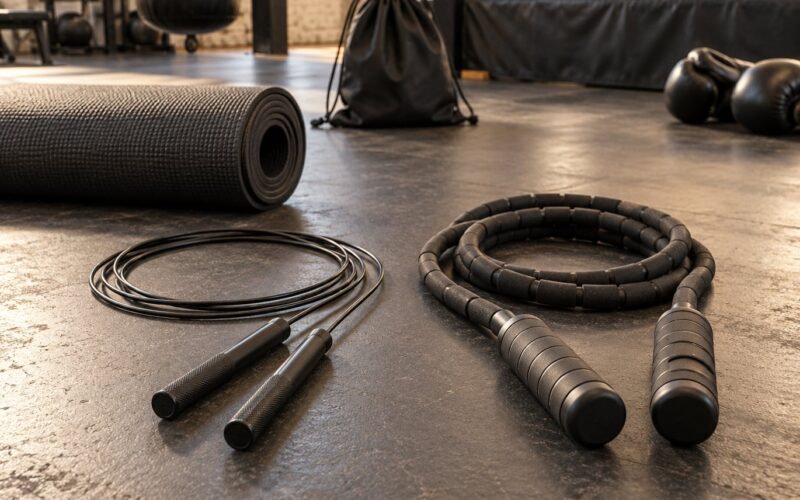
| Jump rope area | 6 x 6 ft | None | Needs flat floor and headroom for two-foot jumps |
| Shadow boxing only | About 2 m x 1.5 m (roughly 6.5 x 5 ft) | None | Workable floor footprint when no bag is possible |
| Mat coverage under a bag | Extend 2 ft beyond the swing radius | None | 1-inch foam tiles are the usual starting point |
Add those rows up the way a real room forces you to. A 10 x 10 foot area with a bag in one corner, mats under and around it, and a jump rope zone takes about 100 square feet. Add a wall platform and you are at roughly 140. That is a small spare bedroom, not a walk-in closet.
Bag-Only Training: The Smallest Practical Setup
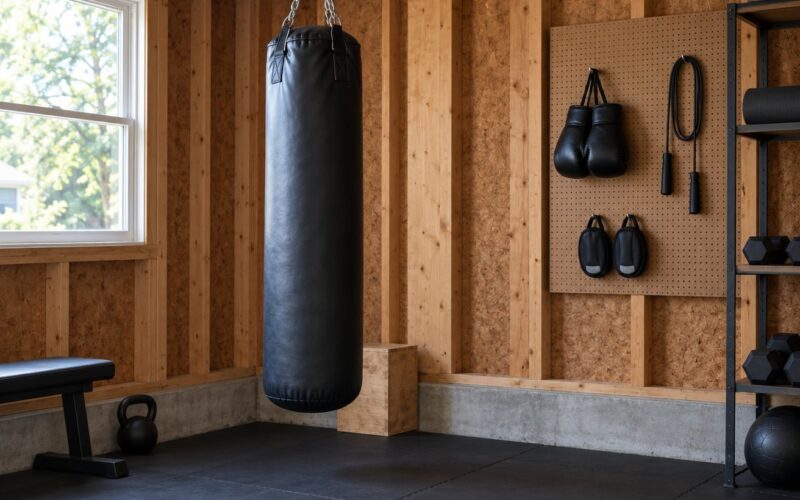
The smallest setup that still feels like boxing is a single hung heavy bag in a 6 x 6 foot clear area. In practice that means the bag occupies the middle of one wall, and you keep three to four feet open in front of it plus roughly three feet on each side.
The bag itself is smaller than that. What makes the setup need six feet is the swing. A 100-pound bag on a proper mount moves in a long arc, and it moves fast. Without side clearance you spend every session ducking and apologising to the wall.
Community layouts follow the same pattern. On r/martialarts people describe training in a footprint plus a half wide by three feet deep of mat area, with a punch bag, a rice bag and a door-frame pull-up bar. One home gym group member documented a working setup in a room of 5 m by 2.4 m, which is roughly 16 x 8 feet. That is a narrow room used lengthwise, and it worked because the bag was at one end and nothing else competed for the middle.
Where very small rooms fail is corners. Bags pushed tight into a corner with a sand-filled base cannot be moved, so footwork drills and any kickboxing movement are off the table. That limitation comes up repeatedly in home boxing threads, and it is worth deciding up front whether you would rather train on combinations in a tight corner or train on footwork in a longer room.
Give the bag its own end. If the room is 5 x 7 feet, put the bag on the short wall and work along the length. You will thank yourself the first time you try to circle.
What Floor Area Should You Leave Around the Bag?
Three to four feet of clearance on every side is the working rule for a heavy bag, and three feet in front is where most people stand. In front means measured from the bag at rest, not from the wall behind it.
For casual sessions, shadow boxing with occasional bag touches, six by six feet holds up. For full-power straight work, combos with movement, slips and counters, you want ten feet in front. Hitting a bag at full extension while standing at three feet means your fist and elbow travel well past that distance.
Two activities quietly need more room than people expect:
- Lateral movement. Slipping, bobbing and circling spread you out sideways. Each direction costs about two feet of reach beyond your stance, and you need both at once for combination work.
- Floor work and burpees. Sled work, push-ups and stretching all want a clear rectangle you can move through, not a patch between the bag and the sofa.
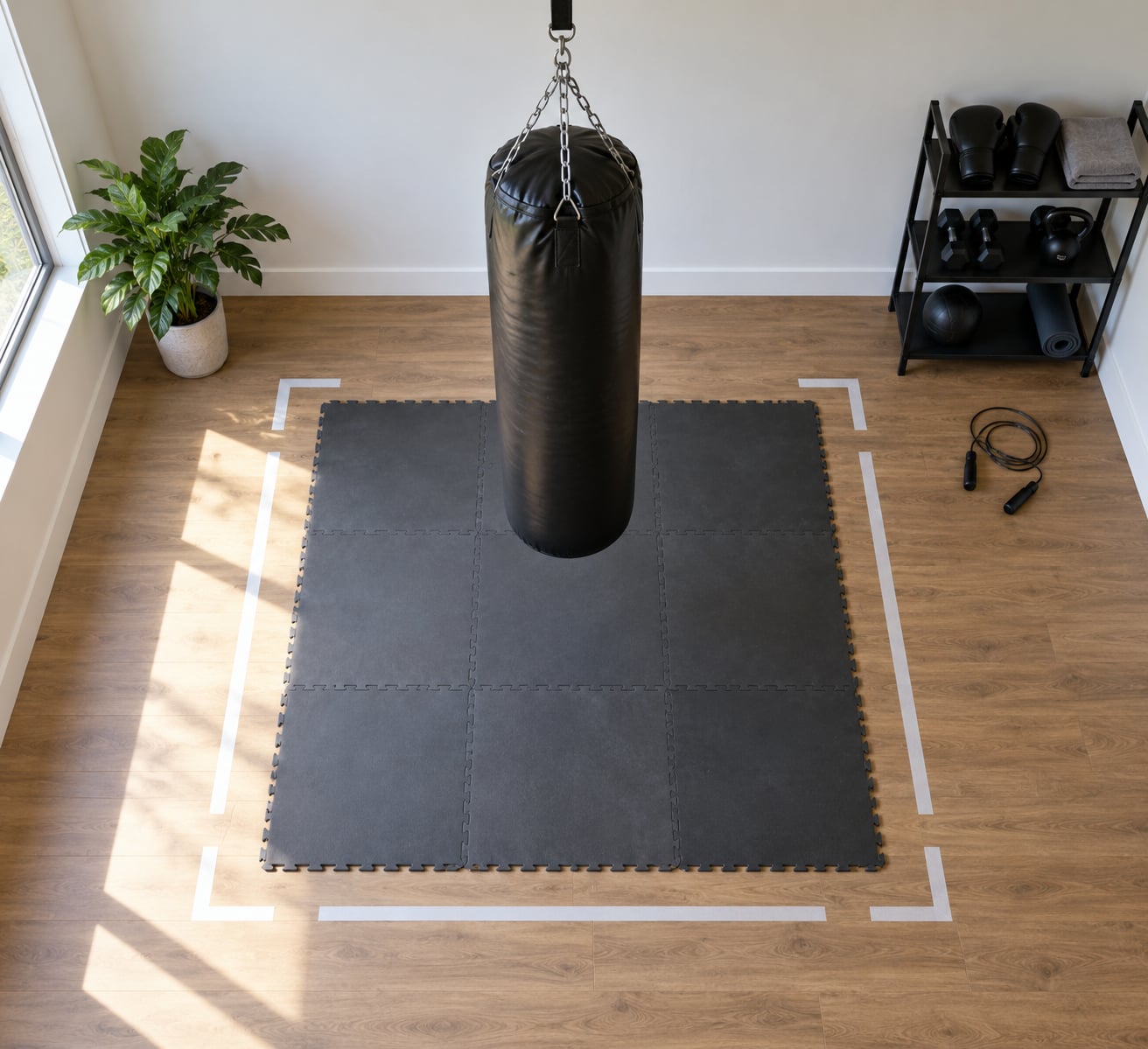
Mat sizing follows from the swing, not from the room. Measure how far the bag reaches at full extension, then extend the mat another two feet past that in every direction. A 4-foot-wide mat under a bag that swings 18 inches each way looks generous until the first hard combination sends you sideways onto bare floor.
The two-zone layout solves most tight-room problems. Zone one is the bag, with its full clearance. Zone two is an open rectangle for jump rope and shadow boxing, ideally out of the bag’s arc. Where you cannot separate them, keep the bag at one end of the room rather than the centre, so the free space stays one continuous shape.
How Much Ceiling Height Do You Need?
Eight feet is the practical floor for a hung bag, and nine feet gives you room to pick a longer bag. Bag lengths are commonly sold at 120 cm, 150 cm and 180 cm, roughly 4, 5 and 6 feet. The 6-foot bags suit taller ceilings. Cramming one into a 7.5-foot room leaves almost no drop length and nothing left to strike near the top.
Ceiling height also changes the footprint. Longer bags swing wider and faster because they have more mass above your fist level. A 6-foot bag in a 10 x 10 foot area behaves very differently from a 4-foot bag in the same square, and the difference is usually a lot of unanswered voicemails from the downstairs neighbour.
Mounting is where the real constraint sits. The load from a swinging 100-pound bag peaks in the hundreds of pounds and reverses direction constantly, which is why the term is dynamic load. Follow the manufacturer’s mounting spec, and if it says a joist, use the joist.
Under about 8 feet, you have three honest options:
- Freestanding bag. A weighted base sits on the floor, so the ceiling does not matter. It does need a 24-inch diameter base clearance plus swing room, and the base cannot be dragged easily once filled.
- Wall bracket. Mounts into wall studs on two vertical points. Uses no ceiling height and throws no structure-borne noise through the ceiling, but the feedback is duller and the bag hangs lower.
- Bodyweight only. A 2 m by 1.5 m footprint is enough for shadow boxing and jump rope. It is not nothing. It is also not a substitute for hitting something.
Reddit advice on wall-mounted hardware is consistent: attach into 2×4 studs, and spread the load across enough surface area that the fasteners have bite. Standard drywall anchors are for pictures, not for bags.
How Much Space You Need for Boxing at Home
Turn the numbers into a decision by working room to room rather than product to product. Measure the room’s length and width at floor level, then subtract everything that stays there: bed, desk, shelving, radiator, the swing arc of the door.
Next measure ceiling height in two or three spots, not one. Old houses slope, and basements step. Confirm the floor is level where the base will sit, because a freestanding bag on a slope walks.
Identify anchor points before you buy anything. A stud finder and a tape measure tell you in ten minutes whether the ceiling has joists running the direction you need and whether they are spaced at 16 or 24 inches on centre. If you cannot find solid structure, that single fact decides between a hung bag and a freestanding one, and it costs nothing to check.
Garage, Basement, and Spare-Room Setups
The same 10 x 10 feet of clear floor feels different in every room, mostly because of what surrounds it.
| Room | Working dimensions to aim for | Ceiling | Watch for |
|---|---|---|---|
| Apartment corner | 6 x 6 ft minimum, 8 x 8 ft better | 8 ft, confirm it is not a drop ceiling | Noise rules in the lease, downstairs neighbours, wall construction |
| Spare bedroom | 8 x 8 ft workable, 10 x 10 ft comfortable | 8 to 9 ft typical | Wardrobe doors, radiators, losing a usable bedroom |
| Single-car garage | 10 x 10 ft to 12 x 12 ft | 8 ft often, 9 ft better | Overhead door tracks, the car itself, cold concrete |
| Basement | 10 x 10 ft and up | 7 ft is common, often with ducts | Ducts and joists overhead, moisture, ventilation, noise carried through the frame |
Garages give you the best floor and the worst ceiling. Overhead door rails and the opener track eat vertical space, and an 8-foot slab ceiling limits which bags you can hang. Move the car out and you gain far more usable area than any equipment purchase adds.
Basements are the mirror image. You tend to get floor space and lose headroom to ducts, and the ceiling may be a suspended tile grid that cannot carry a bag at all. Moisture and ventilation matter for both comfort and the floor covering. Concrete also transmits impact straight through your feet, which is a good argument for a proper mat rather than a thin rug.
Noise behaves differently in each. In a house with a basement, structure-borne vibration travels through the joists and shows up downstairs as thumping even when the airborne sound is modest. Isolation mounts and mass-loaded vinyl help. In an apartment, timing and a written check of your lease matter more than any acoustic product.
Bedrooms work well until the bag asks you to give up the room permanently. If you are not sure, start with a wall-mounted bag and mats that store flat.
Do You Need Space for a Boxing Ring or Other Equipment?
A full ring is 20 x 20 feet inside the ropes, and it wants a ceiling near 10 feet. That is not a spare room any more, it is a dedicated building. A standard ring is the reference point people use when they compare home setups, and the gap is not small.
Compact training rings come in around 8 x 8 feet and are useful for footwork and solo drills, but they still need clearance outside the ropes, so plan 10 x 10 for the whole footprint. Most people with a basement or garage are better served by a foldable mat area than by a ring, because a mat gives you room for mitt work, stretching and conditioning that a ring cannot.
Other additions each have a cost in floor space:
- Wall-mounted speed bag platform. 4 x 4 ft plus standing room, mounted at 60 to 70 inches. Fold-away models exist specifically so the wall goes back to being a wall.
- Double-end bag. Six feet clear on every side, because it moves fast in two directions. This is the piece that most often breaks a tight room.
- Medicine ball and slam ball. Needs open floor away from walls. Slams into drywall are a good way to meet your landlord.
- Jump rope station. Six by six feet and a hard floor. This is the cheapest 36 square feet in the whole setup.
- Mitt work with a partner. Effectively a ring. Two people boxing at full speed need more room than one person hitting a bag.
Worth being blunt about the limits: no home room develops sparring timing, ring work, or the pressure of competition. What a good setup does build is technique on combinations, conditioning, footwork habits and consistency. Forum members are usually honest that bag work supplements a real gym rather than replacing one, and VR boxing fills some of the gap only if you have around 6 x 6 feet to move in freely.
How to Measure and Plan Your Training Area
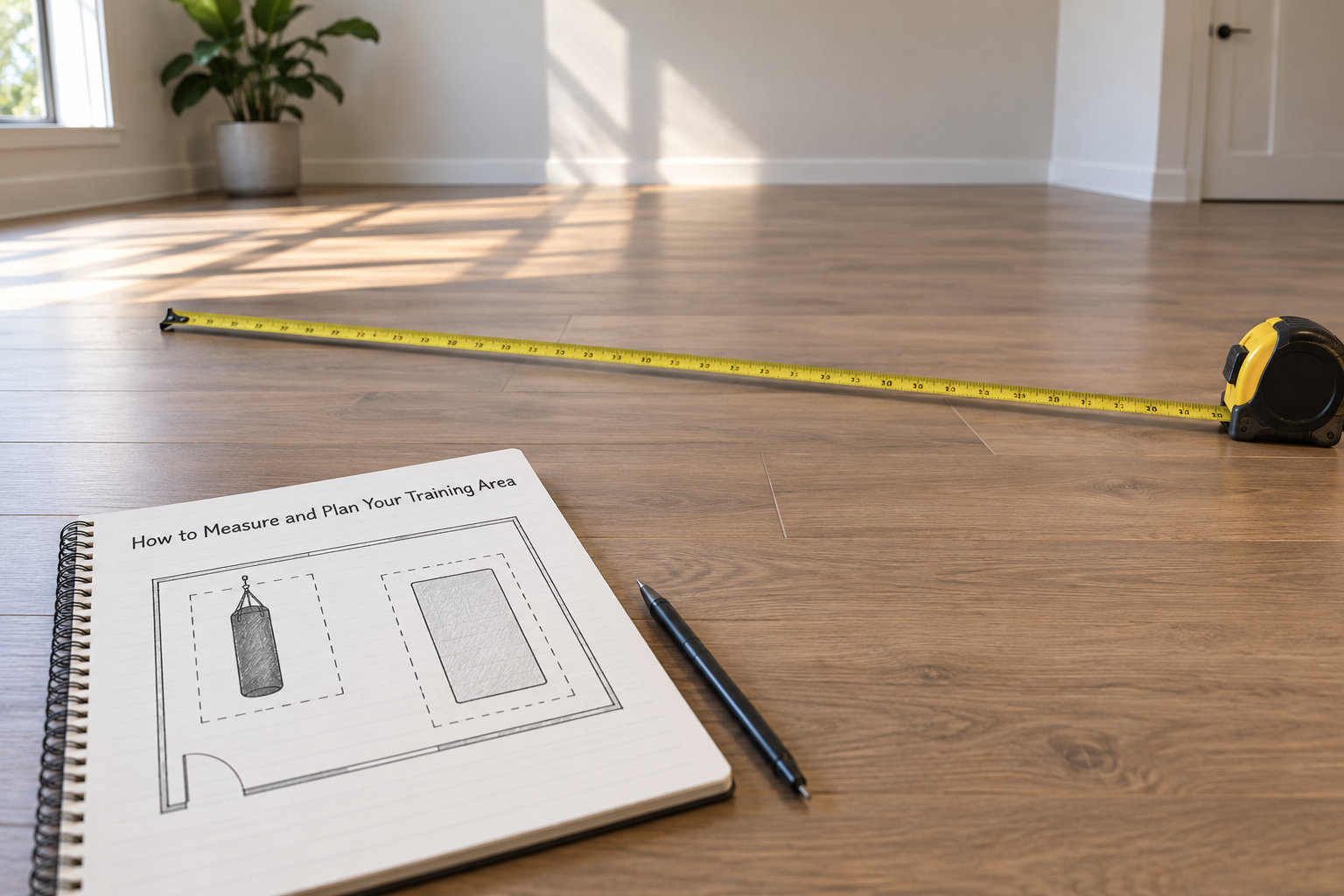
Do this before you buy anything. It takes about ten minutes and saves the return trip.
- Measure length and width at floor level. Two points on each wall, not one, in case the room is out of square. Write down the smaller figure.
- Subtract the fixed furniture. Bed, desk, shelves, radiators, door swing arc. Whatever remains is your real working area.
- Measure ceiling height in three places. Include a spot near any ducts or a bulkhead. Note the lowest one as your working ceiling height.
- Find your anchor points. Run a stud finder across the ceiling or wall and mark joist or stud locations. Note their direction and spacing, 16 or 24 inches on centre.
- Sketch the layout before buying. Draw the bag position, the swing arc, the mat edge and the jump rope zone. If the shapes overlap in the sketch, they will overlap in the room.
Then do a standing test. Stand where you would stand to work and swing your arms fully, turning as you would turn. Anything you hit is something you will hit with a bag moving at speed too.
Safety and Installation Considerations
Space is only half the constraint. A swinging bag is a 100-pound object on a hinge moving faster than you can react to, and the failures are predictable.
Anchor to structure. Joists for a ceiling mount, studs or solid masonry for a wall mount, and the manufacturer’s specified hardware for both. Avoid drywall anchors, and avoid any fastener that relies on the ceiling tile grid of a suspended ceiling. If you are unsure whether the surface carries load, a structural engineer or a qualified installer is a modest cost against a collapsed ceiling.
Clear the working zone. Nothing within the swing radius should be breakable: television, shelving, glass, floor lamps. Keep electrical items, extension leads and furniture that creates a trip hazard out of the area, and keep the route to your exit clear.
Protect the floor and your hands. A mat that extends two feet past the swing radius does more for your ankles than most people expect, and 1-inch foam tiles are the usual starting point for a home corner. Keep the bag filled to its rated weight, because an underfilled bag swings unpredictably and deforms at the fill seam.
Control noise at the source. Isolation mounts and bushings cut structure-borne vibration, which is the sound that travels through the building frame. Mass-loaded vinyl and foam under the platform help with airborne sound. Timing matters in shared walls, and checking your lease or building rules before you drill is cheaper than the alternative.
Then test the setup progressively. Push the bag at half power for a session, then at close to full power, before you trust it with a full session of combinations. Listen for creaks in the mount. If the bag is punching the ceiling on a deep combination, your drop length is wrong and you need a shorter bag or a lower mount point.
Frequently Asked Questions
Can I put a heavy bag in a small room?
Yes, if you are realistic about what you are training. A 6 x 6 foot clear area with an 8 foot ceiling supports bag work, shadow boxing and jump rope. It does not support footwork drills or floor work, because you will run out of room within two combinations. One workable pattern used by home trainers is a room around 16 x 8 feet with the bag at one short end, so the free space stays one continuous shape.
What is the minimum ceiling height for a home boxing bag?
About 8 feet for a standard hung heavy bag, and 9 feet if you want one of the longer bags around 5 to 6 feet. Longer bags suit taller ceilings and swing wider and faster, which means more clearance. Below 8 feet, use a freestanding bag with a weighted base, a wall-mounted bracket into studs, or bodyweight work in a footprint of roughly 2 m by 1.5 m.
Is a standing heavy bag better than a wall-mounted bag for a small space?
For a small space, yes, mostly because it needs no ceiling at all. A freestanding bag with a 24-inch base wants about 5 x 5 feet plus swing room, and the base stays put once it is filled, so it also ends your footwork drills. A wall bracket uses even less room and hits quieter through the building, but the feedback is duller and it still needs two studs. Check what your ceiling allows before choosing.
How far should I stand from a boxing bag?
About three feet from the bag at rest for straight-punch combinations, and further for hooks, uppercuts and full-power shots that need follow-through. Keep three to four feet of clearance on both sides as well, because slipping and circling take you sideways roughly two feet past your stance. Measure the front clearance from the bag itself, not from the wall behind it.
Can I install a heavy bag in an apartment?
Often yes, but the ceiling needs solid structure rather than suspended tile. Anchor into a joist with the hardware the manufacturer specifies, and check your lease or building rules before drilling. The bigger issue is noise. Isolation mounts and mass-loaded vinyl reduce structure-borne vibration that travels through the frame, and keeping sessions to daytime hours protects the neighbours who share your walls.
Conclusion
Start with a tape measure, not a bag. Measure the room at floor level, subtract the furniture and the door swing, check ceiling height in the lowest spot, and find out whether a joist or stud exists where you need it. Those four answers decide everything else.
Then reserve the full movement zone around whatever you hang: three to four feet on every side, and ten feet in front if you want to work at full power. Verify the structure before the first punch, and how much space you need for boxing at home stops being a guess.